


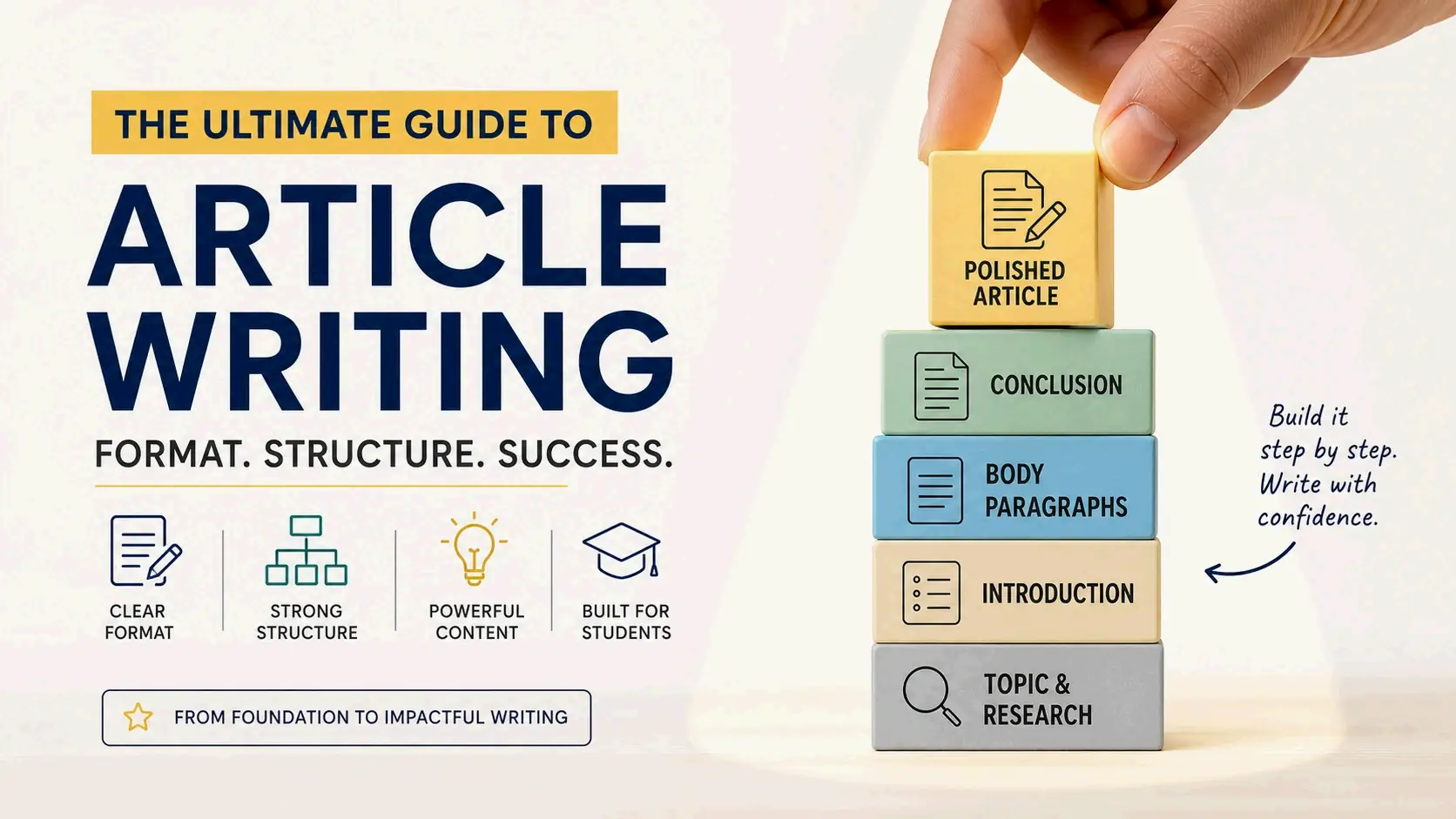
The best way to learn article writing with example is to study a finished piece. At its core, it’s the skill of creating a nonfiction article for a publication, built around a clear structure: headline, byline, lead, body, and conclusion. This guide walks you through each step and ends with an annotated student example so you can see how it all fits together.
Contents
- The Article Writing Format: A 5-Part Structure
- How to Write an Article: A Step-by-Step ‘Writing Flow’ from Idea to Draft
- Annotated Article Writing Example for Students
- 4 Main Types of Article Writing Explained with Examples
- Article Writing for Different Grade Levels: Middle School vs. High School vs. College
- Conclusion
- FAQ
The Article Writing Format: A 5-Part Structure
The standard newspaper article format consists of five distinct components—Headline, Byline, Lead, Body, and Conclusion. Every good student article, whether it covers a school board meeting or a science fair win, relies on this framework to deliver information with clarity and speed. At the heart of that framework sits the Inverted Pyramid Structure, which means that the most newsworthy facts come first, and supporting details follow in descending order of importance. Together, the five-part format and the inverted pyramid give your writing a clear roadmap.
What is the Inverted Pyramid Structure?
The inverted pyramid is the organizing principle behind most news and informational writing. Picture a pyramid turned upside down: the most important facts spread across the top, and details narrow as you move down. That way, a reader can stop after the first paragraph and still get the essentials—the who, what, when, where, and why (the 5 Ws).
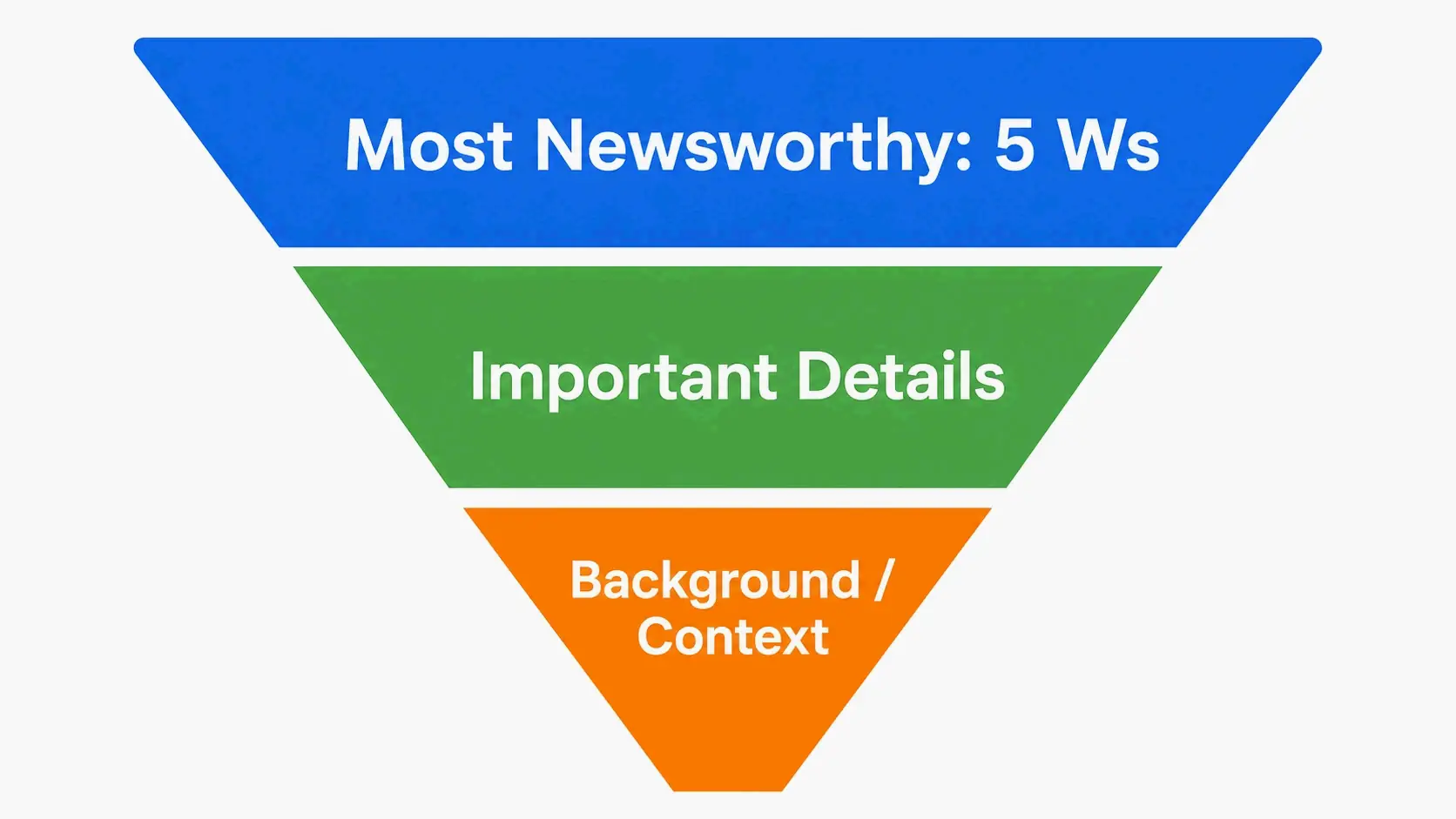
As the University of Hull explains, the first layer delivers the most noteworthy information; the middle layer tells the main story with details in order of importance; and the bottom layer holds supporting content or a closing statement. This hierarchy is what sets an article apart from an essay. In an essay, the conclusion often packs the biggest insight. In an article, you don’t save the best for last—you lead with it.
Breaking Down the Standard Format: Headline, Byline, Lead, Body, Conclusion
Each component of the five-part format serves a specific purpose. The table below gives a one-line definition for quick reference, and the sections that follow explore how to write each one effectively.
| Component | Purpose |
|---|---|
| Headline | A concise, compelling title that summarizes the story and grabs attention. |
| Byline | The writer’s name, usually placed directly under the headline, giving credit. |
| Lead | The opening paragraph that answers the essential 5 Ws (Who, What, When, Where, Why) right away. |
| Body | The main section that develops the story with quotes, background, and supporting details. |
| Conclusion | A forward-looking or impactful closing line—not a summary, but a kicker that leaves an impression. |
The headline should capture the essence in just a few words. Student newspapers tend to use straightforward, informative headlines like “Lincoln High’s Recycling Program Reaches One-Ton Milestone” instead of pun-filled ones. The byline follows right underneath, as “By [Your Name].” The lead boils down the most important 5 Ws into one or two sentences—and it’s often the hardest-working part of any article. The body arranges details from most to least important, and it should include at least one direct quote from someone involved in the story. Finally, the conclusion doesn’t just echo the lead. Instead, it looks ahead, shares a resonant quote, or loops back to the bigger picture.
How to Write an Article: A Step-by-Step ‘Writing Flow’ from Idea to Draft
Many students make the mistake of agonizing over the headline first. A better workflow flips the order: gather your facts, draft the body, write the lead, and save the headline for last. This sequence mirrors how information unravels in a newsroom and how clarity tends to emerge as you write. Here’s a five-step flow that takes you from idea to finished draft.
Step 1: Research and Gather the 5 Ws
Before you type a single sentence, nail down the five Ws—Who is involved, What happened, When and Where it took place, and Why it matters. If you can, add a sixth question: How. For a school event, that means talking to organizers, taking notes, and typing out direct quotes on your phone right during the interview. As EasyGrader points out, trying to reconstruct exact wording later rarely works—it’s best to capture quotes immediately while the speaker’s words are still fresh.
Step 2: Draft the Body Paragraphs First
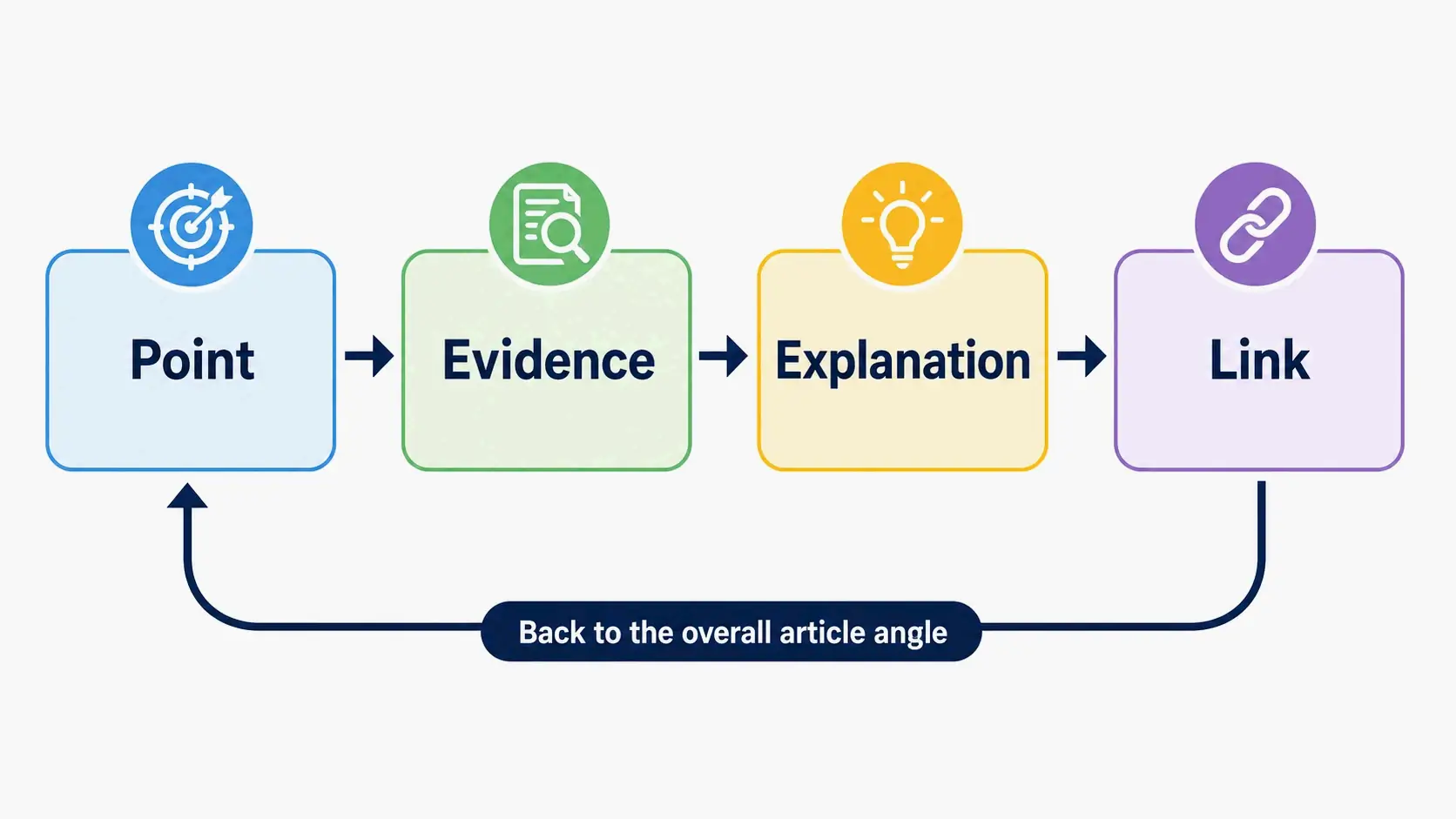
Writing the body first forces you to organize your evidence before you try to summarize it. The PEEL Paragraph Structure—Point, Evidence, Explanation, Link—is a reliable way to build each paragraph. Start with your main point, back it with a fact or quote, explain why that evidence matters, and then link the paragraph back to the article’s overall angle.
An example drawn from research on mobile phones illustrates the PEEL approach:
- Point: Unrestricted mobile phone use hurts students’ ability to concentrate.
- Evidence: According to Orchids International School, a 2019 study from the London School of Economics found that banning mobile phones in schools led to a 6.4% improvement in test scores, with the largest gains among the lowest-achieving students.
- Explanation: This finding suggests that phones don’t just cause occasional distraction—they chip away at the kind of sustained focus real learning needs.
- Link: If attention is the foundation of all learning, then any policy that allows unchecked phone use deserves a hard look.
Step 3: Write the Lead (Introduction)
Once you have a draft of the body, the story should be clear in your mind. Boil down the most important Ws into one or two sentences that hook the reader. Avoid lazy summaries like “This article is about…” Instead, deliver the newsworthy core right away.
For a school recycling story, a strong lead could be: “Lincoln High School’s student-run Green Earth Club has collected and recycled one metric ton of paper and plastic since August, hitting the milestone just before Earth Week.” This answers who, what, where, and when in a single sentence. The why—the environmental impact—can come later in the body.
Step 4: Draft a Working Headline
Write the headline last, after the article is finished. A good headline is concise, uses active voice, and captures the central action of the story. It should be informative, not cute. For the recycling example, “Lincoln High’s Student-Run Recycling Program Hits One-Ton Milestone” does the job without any gimmicks. When you’re unsure, follow Associated Press style and capitalize the main words. EasyGrader notes that many students spend twenty minutes on the article and two minutes on the headline—even though the headline is often the first thing a teacher reads.
Step 5: Write the Conclusion
Newspaper articles rarely end with a summary. Instead, the conclusion—often called a “kicker”—looks ahead, shares a final quote, or reflects on the bigger picture. For our recycling story, a forward-looking kicker might be: “The club now plans to expand the program to include electronic waste and old textbooks, aiming to double its collection rate by the end of the academic year.” That kind of ending builds momentum instead of simply repeating what you’ve already said.
Annotated Article Writing Example for Students
Seeing a complete article marked up with annotations makes the format easier to understand. The following example, drawn from a student newspaper piece published on EasyGrader, shows a real school story—a recycling program milestone at Lincoln High. Each annotation connects the writing choice back to the structural principles covered above.
Headline: Lincoln High’s Student-Run Recycling Program Hits One-Ton Milestone
Byline: By Sarah Ahmed, Staff Writer
[ANNOTATION: Headline & Byline]
The headline uses active voice and a specific detail (one-ton milestone). The byline sits right underneath, following the standard “By [Name]” format. Together, they immediately tell the reader what the story is and who wrote it.
HYDERABAD — Lincoln High School’s student-led Green Earth Club has collected and recycled one full metric ton of paper and plastic since launching the sustainability initiative in August, marking a major milestone just ahead of the school’s Earth Week celebration.
[ANNOTATION: Lead]
The dateline sets the location. The lead quickly answers who, what, when, where, and why. All five Ws appear within two sentences, staying true to the inverted pyramid—the most essential information comes first.
The program, organized entirely by students to cut down on campus waste, involved daily recyclable pickups from every classroom and weekly sorting sessions run by club members.
“We started this as a small project to clean up our lunchroom, but seeing the whole student body get involved has been incredible,” said Ali Raza, a junior and president of the Green Earth Club.
[ANNOTATION: Direct Quote in Body]
The body brings in a quote from Ali Raza, the club president. This one quote does three things at once: it adds a human voice, it backs up the story’s importance with an authority (the club leader), and it follows the standard practice of placing quotes in the body, not the lead. The quote is precise, and it includes the speaker’s name and title—a detail that builds credibility.
The initiative has the backing of the school’s science department, and Principal Ayesha Khan praised the students’ commitment. “They’ve proven that small, consistent actions can lead to massive environmental benefits for our community,” Khan said.
The Green Earth Club now plans to expand the program to include electronic waste and old textbooks, with a goal of doubling its current collection rate by the end of the academic year.
[ANNOTATION: Conclusion (Kicker)]
The article wraps up with a forward-looking detail, not a summary. This kicker matches the structure we described in the step-by-step flow: it points to what happens next and leaves the reader feeling like the story is still moving. It doesn’t repeat the lead or introduce fresh arguments.
When you compare this example to the format table, it’s easy to see how each element fits: the headline and byline on top, the lead delivering the 5 Ws, the body adding context and quotes, and the conclusion closing with possibility, not repetition. With this template, you can plug in your own facts and quotes while keeping the same structural bones.
4 Main Types of Article Writing Explained with Examples
The type of article you need for an assignment shapes your tone, structure, and purpose. While there are many article types, four cover most student writing: informative, persuasive, descriptive, and narrative.
Informative Article
An informative article presents facts and data without taking a strong personal position. Its goal is to educate.
- School Context: A report on how the human immune system works, written for the school science page.
- Mini Lead Example: “The human immune system uses white blood cells, antibodies, and the lymphatic network to identify and neutralize harmful pathogens before they can cause illness.”
Persuasive Article
A persuasive article argues for a specific position and aims to change the reader’s opinion or move them to action. It uses evidence, rhetorical techniques, and a confident tone.
- School Context: An op-ed arguing for a school uniform policy, intended for the student newspaper’s opinion section.
- Mini Lead Example: “Requiring all students to wear uniforms would reduce peer pressure, lessen morning stress, and shift the focus from fashion to learning—three benefits that too many schools continue to ignore.”
Descriptive Article
A descriptive article paints a vivid picture of a person, place, or event using sensory language and strong imagery. It places the reader in the scene.
- School Context: A piece describing the experience of a school festival, from the smell of food stalls to the noise of the student band.
- Mini Lead Example: “The air in the courtyard was thick with the scent of roasted corn and the beat of a dhol drum, as hundreds of students filled the space for the annual Diwali Mela.”
Narrative Article
A narrative article tells a story in chronological order, often used in feature writing. It may follow one person’s journey or reconstruct a sequence of events.
- School Context: A profile of a student athlete tracing their training from middle school injury to a state championship comeback.
- Mini Lead Example: “Maya Chen never imagined she would compete again after fracturing her ankle in eighth grade, but three years later she stood on the podium at the state science fair—not as an athlete, but as the student whose invention could bring clean water to thousands.”
Article Writing for Different Grade Levels: Middle School vs. High School vs. College
Article expectations change as students progress. A piece that earns an A in middle school would likely need more depth and attribution at the college level. The following breakdown offers tailored guidance for each stage.
Middle School
At this stage, keep things simple and clear. Use straightforward language, shorter paragraphs, and a lead that answers the 5 Ws directly. A club event report works well, like: “The Springdale Middle School Chess Club won its first district trophy on Saturday after defeating five other schools.” A single quote from a club member plus a brief description of the event is usually enough. The conclusion can just say what’s next—for example, “The team now prepares for the regional tournament in April.” The goal is to practice the basic structure without making it more complicated than it needs to be.
High School
High school articles step up the complexity. Students should learn to include a Nut Graph—a short paragraph right after the lead that explains why the story matters in a bigger context. For example, after leading with a statistic about mental health and phone use, a nut graph could say: “The link between constant connectivity and rising student anxiety is now too significant for schools to ignore.” High school articles also expect multiple quotes, a more developed analysis, and the ability to handle persuasive or opinion pieces. One strong topic could be the mental health effects of mobile phone use, citing research like the 2019 LSE study that found a 6.4% test score improvement after mobile phone bans (Orchids).
College
At the college level, article writing needs a formal academic tone, deeper analysis, and proper citations. For research-based pieces, you’ll need to understand narrative vs. parenthetical in-text citations. As Monroe University explains, a narrative citation weaves the author into the sentence (e.g., “Edwards (2017) argues…”), while a parenthetical citation puts the source info in parentheses at the end (“…were later vindicated by society at large (Edwards, 2017)”). College articles often run 800 words or more, pull from multiple primary sources, and require you to clearly tell the difference between summary, paraphrase, and direct quotation. The goal isn’t just to report a story, but to analyze what it means within a larger academic or social picture.
Conclusion
The article-writing structure—the Inverted Pyramid, the 5 Ws, a well-placed quote, and the headline-byline-lead-body-conclusion format—isn’t a creative cage. It’s a launchpad for clear, powerful storytelling. Once this framework feels natural, you can focus on what really counts: finding a real event, interviewing one person, getting a strong quote, and letting the facts do the talking. Try this: Write a 300-word piece using the five-part format and the annotated example we covered. Then compare your draft to the sample. Check whether your lead answers the 5 Ws, your body includes a quote, and your conclusion looks forward. Practice with one small story, and the pattern will stick for every assignment that comes your way.
FAQ
What is the difference between an article and an essay?
An article is written for a public audience in a publication like a newspaper or magazine. It focuses on objective information or a specific community angle. An essay, on the other hand, is usually an academic response to a prompt—it argues a thesis for a teacher or examiner.
How long should a student newspaper article be?
For middle school, aim for 300–500 words. For high school, 500–800 words is typical. The exact length depends on how complex the story is, but shorter is almost always better. Make sure every sentence earns its spot.
What are the 5 Ws in article writing?
The 5 Ws stand for Who, What, When, Where, and Why. They’re the building blocks of a strong lead. A well-crafted introduction should answer as many of these as it can in the opening sentences.
Can I use first-person in a newspaper article?
In standard news or informational articles, no. Stick to third-person and an objective point of view. The exception is an opinion piece or op-ed, where using “I” is fine for sharing a personal viewpoint.
How do you write a good headline for an article?
A good headline is concise, uses active voice and strong verbs, and captures the heart of the story. Write it last, after the article is done, so you know exactly what the piece is about before you boil it down to a few words.
