


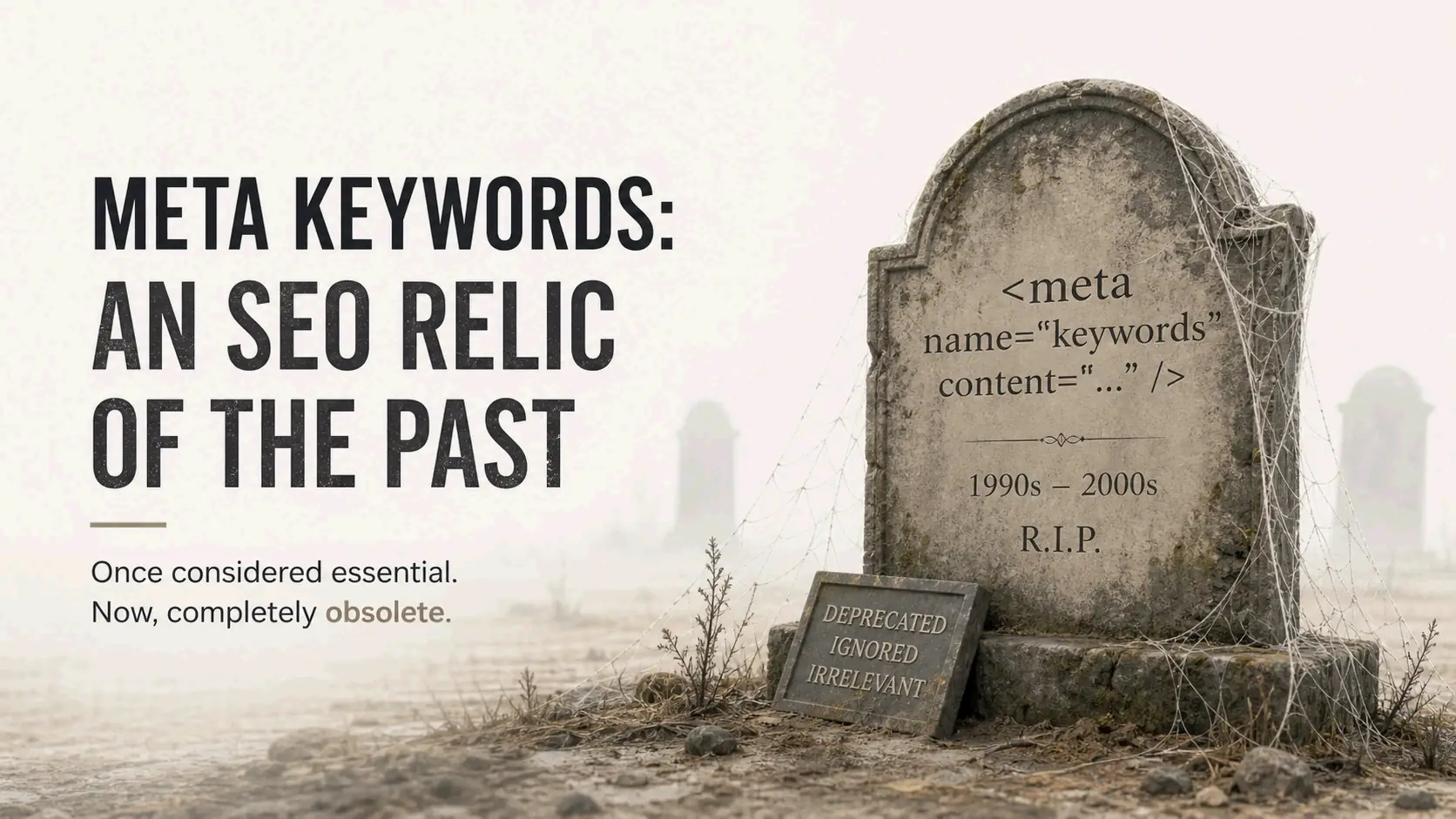
No, meta keywords are not important for SEO. Google officially ignores the meta keywords tag for ranking, and Bing treats it as a potential spam signal. Instead, focus on your title tags, meta descriptions, high-quality content, and structured data.
Contents
- The Definitive Answer: Meta Keywords Are Not Important for SEO
- Why Did Meta Keywords Lose All SEO Power? A Brief History
- The Bing Spam Signal: A Hidden Danger of Using Meta Keywords
- Meta Keywords Are Dead: A Step-by-Step Guide to Safely Removing Them
- The 5 Meta Tags That Are Actually Important for SEO
- How AI Search Engines Like ChatGPT Read Your Content (It’s Not Meta Keywords)
- Conclusion
- FAQ
The Definitive Answer: Meta Keywords Are Not Important for SEO
The meta keywords tag won’t help you rank on any major search engine today. Google has been explicit about this since September 2009, saying it “doesn’t use the keywords meta tag in our web search ranking.” That position hasn’t budged. Bing goes even further — instead of just ignoring an overstuffed tag, it may treat it as a spam signal. Current guidance from Orange MonkE confirms that Google, Bing, Yahoo, Yandex, and DuckDuckGo all either ignore the tag or see it as a spam risk. So the takeaway is clear: keeping meta keywords on your pages has no upside for rankings and brings avoidable risk.
The tag itself is a simple HTML element that sits in the <head> section and is only visible in the page source code. It holds a comma-separated list of words meant to describe a page’s topic, but modern search engines have moved far beyond such easy-to-game signals. Today, the meta keywords tag survives mainly as a historical artifact — a leftover from 1990s SEO that hangs around on old websites and legacy content management systems. Knowing what it is helps you spot it as a piece of SEO archaeology, not a tool you’d use today.
What Is the Meta Keywords Tag? A Technical Definition
The meta keywords tag is an HTML meta element placed inside the <head> of a webpage. Its structure is straightforward: a <meta> tag with name="keywords" and a content attribute containing a comma-separated list of terms. For example:
<meta name="keywords" content="meta keywords, SEO, meta tags, on-page SEO, keyword optimization">
This tag is hidden from normal visitors and only appears when someone inspects the page source. In the 1990s and early 2000s, engines like AltaVista used it as a direct relevance signal. Today, no major engine uses it for ranking, and the tag has no practical SEO function. It’s completely separate from the visible keywords in your content, which still matter a lot for search rankings.
Why Did Meta Keywords Lose All SEO Power? A Brief History
The meta keywords tag collapsed because it was so easy to abuse. In the early days of search, when the algorithms were relatively crude, webmasters stuffed the tag with popular but completely unrelated keywords — phrases like “free movies,” “cheap flights,” “celebrity gossip” — just to drag traffic to their pages. This practice, keyword stuffing, polluted the signal so badly that search engines had to drop the tag as a reliable relevance indicator.
Orange MonkE lays out the timeline clearly: a short period of usefulness in the 1990s, then rampant abuse by black-hat SEOs, and the final nail in the coffin when Google publicly dropped support in 2009. The over-stuffing habit was everywhere; a site selling kitchenware might have crammed in dozens of high-traffic but irrelevant terms, making search results worse for everyone. Once the tag became a spam vector, it was only a matter of time before it was devalued completely.
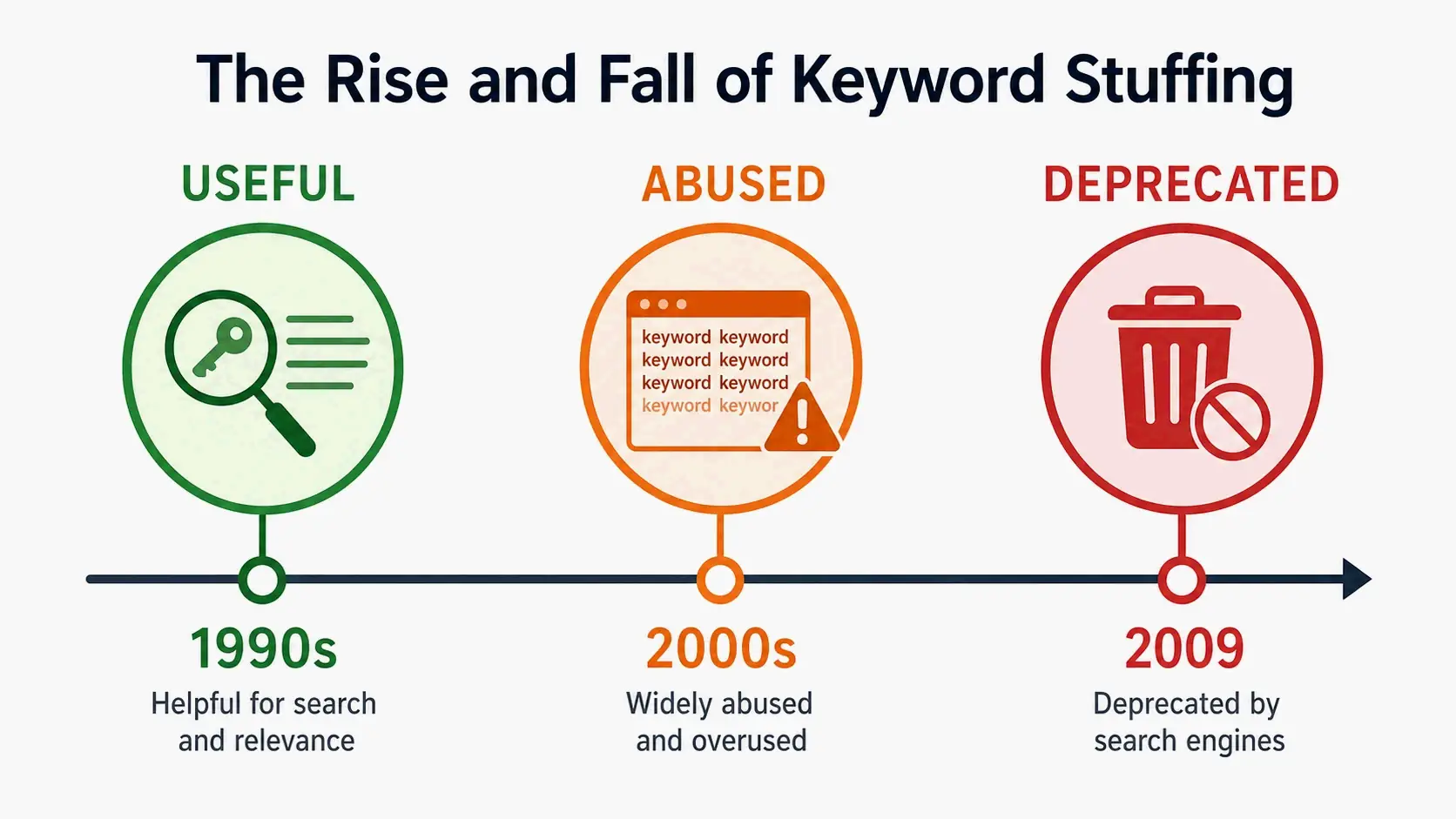
The broader shift in search moved away from simple keyword matching and toward analyzing actual page content, link authority, user behavior, and semantic understanding. Modern engines figure out what a page is about from the real text on the page, structured data, and natural language processing — not from a hidden, self-declared list that takes zero effort to manipulate. The meta keywords tag fell victim to its own low barrier to entry: when a signal is effortless to fake, it stops being useful. Google still follows this principle when evaluating ranking factors today.
The Matt Cutts Announcement That Changed SEO Forever
In September 2009, Google’s Matt Cutts published a short, clear statement: “Google doesn’t use the keywords meta tag in our web search ranking.” The accompanying video made it obvious that years of keyword stuffing had ruined the tag’s utility. That announcement marked a turning point. SEOs who had relied on the tag had to pivot toward on-page content quality, and the industry gradually accepted that meta keywords were dead. Multiple sources, including Fonzy.ai and HigherVisibility, confirm the statement remains definitive 15+ years later, with no reversal since.
The Bing Spam Signal: A Hidden Danger of Using Meta Keywords
Bing’s position creates a risk that many site owners overlook. While Google simply ignores the tag, Bing’s team has indicated that heavy use of meta keywords can be taken as a spam signal. As Orange MonkE points out, Bing views the tag as something “used mainly by spammers on its platform.” This isn’t a neutral stance — it’s an active, negative hint that can contribute to a site’s overall spam assessment.
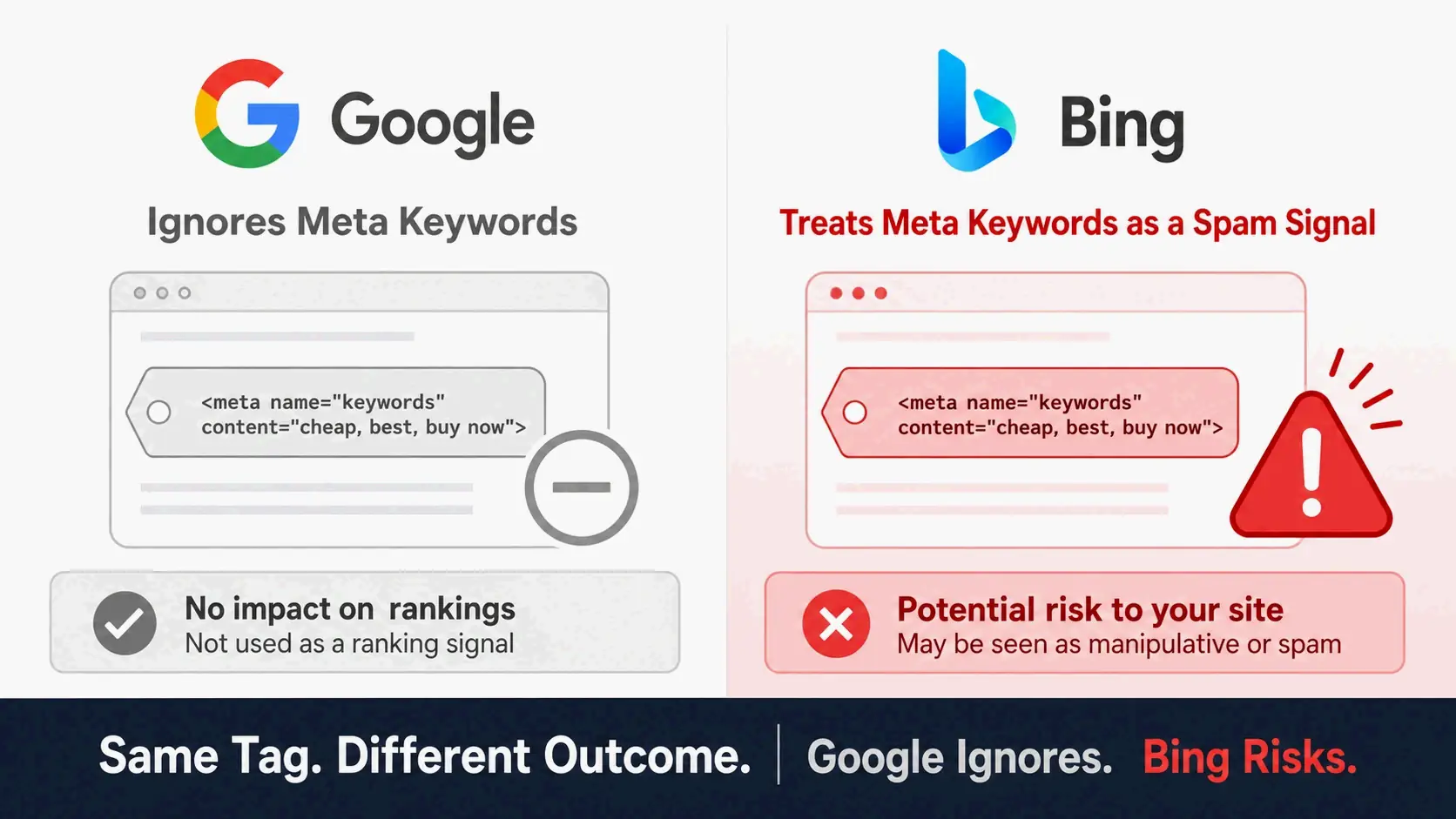
In practice, that means a website with keyword-stuffed meta tags may trigger a manual review or automated suppression, especially for new or low-authority domains that haven’t built up trust signals yet. A site already in a competitive or spam-heavy niche — finance, gambling, pharmaceuticals — faces even more scrutiny. If the tag is filled with irrelevant terms, the risk compounds. For established, high-authority sites, the immediate danger is lower, but a stuffed tag still adds unnecessary noise and can slow down a clean audit.
The key takeaway: keeping legacy meta keywords tags, especially overstuffed ones, goes against modern SEO hygiene. Removing them is a simple defensive move with no ranking downside on Google and a real potential upside on Bing.
How a ‘Spam Signal’ Differs from Being Simply Ignored
A neutral “ignored” signal doesn’t help, but it doesn’t hurt either. A spam signal is actively negative: it feeds into a quality assessment that can push a site closer to algorithmic filtering or a manual review. When Bing engineers say that meta keywords are mostly used by spammers, they’re basically advising legitimate sites to distance themselves from the practice. Google, by contrast, treats the tag as weighing nothing — neither positive nor negative — so the risk sits entirely within Bing’s ecosystem. This distinction means the tag isn’t harmless on all engines; it can act as an unnecessary red flag that competent SEO work can eliminate in minutes.
Should You Panic? Assessing Your Actual Risk from Bing
Most sites won’t face an immediate penalty for a modest, relevant set of meta keywords they inherited from an old CMS. But if your site has thousands of pages with heavily stuffed tags, especially containing terms that have nothing to do with the visible content, the risk goes up. For new sites still building domain trust, the tag adds a needless credibility drag. The practical advice is simple: audit your meta keywords presence, check whether the tag contains spammy patterns, and prioritize removal during your next technical cleanup. Since there’s no reward for keeping the tag on Bing, the possibility of a spam association is a solid reason to delete it.
Meta Keywords Are Dead: A Step-by-Step Guide to Safely Removing Them
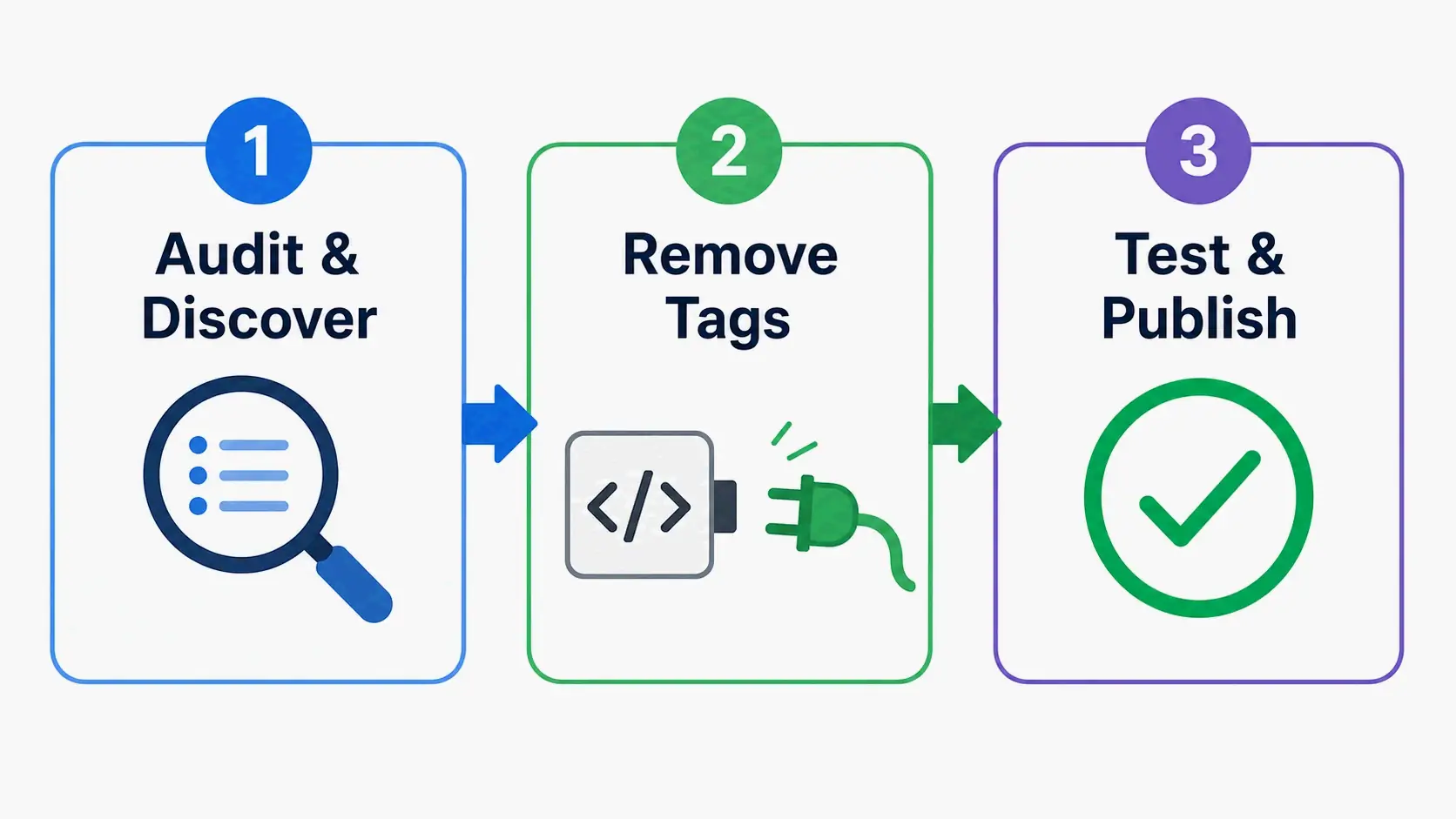
If your site still carries the meta keywords tag — a common legacy issue — here’s how to clean it up without any effect on your live rankings. The process will vary depending on your CMS, but the core principle is the same everywhere: remove the tag in a controlled way, test on a staging environment, and deploy only after verification. Since Google ignores the tag and Bing doesn’t use it positively, removing it can’t hurt your organic traffic; it can only eliminate a potential spam signal.
Option 1: Removal via Your CMS (WordPress, Shopify, Magento)
- WordPress: Most modern SEO plugins (Yoast SEO, Rank Math, SEOPress) already removed the meta keywords field from their interfaces. If an older plugin still shows it, just leave the field blank. For bulk cleanup, Orange MonkE recommends using a plugin’s bulk-editing tools or running a safe database find-and-replace to strip out stored keyword values.
- Shopify: The platform doesn’t expose a meta keywords field in the admin UI for products or pages. If a legacy theme or app adds one, you can remove that custom code or disable the app.
- Magento: The meta keywords field still appears in product and category settings, but you can safely leave it blank. Audit your catalog and clear the field where you can. For large stores, Magento’s bulk attribute update function can handle this efficiently.
Option 2: Manual Removal from a Custom HTML Template
If you have direct access to the template files, look for the line that generates the meta keywords tag — it’s usually in header.php, functions.php, or a theme’s head partial. The code will look something like:
<meta name="keywords" content="...">
Remove or comment out this line. If the tag is generated dynamically from a custom field or database value, disable the logic that populates it. Test on a staging server first, verify by inspecting the page source, then push to production.
Option 3: The ‘Inherited a Mess’ Audit & Cleanup Plan
When you inherit a site with thousands of legacy meta keywords, cleaning up page by page isn’t practical. A structured audit-based plan makes the job manageable:
- Crawl the site with a tool like Screaming Frog or Sitebulb to find every page that has a meta keywords tag and catalog the keyword values.
- Prioritize pages based on traffic and how spammy the keywords are. Tags stuffed with unrelated terms should be addressed first.
- Delete the tag at the template level — edit the single theme file or plugin setting that generates the tag. This removes it from every page at once.
- Consider a database clean for the stored keyword values. With WordPress, you can use WP-CLI or a safe search-replace plugin to strip the legacy field data from post meta. On other platforms, use equivalent bulk-update tools. Always run this operation on a staging copy first.
- Test and monitor. Spot-check a representative sample of pages to confirm the tag is gone. Then push live. In the following weeks, check Bing Webmaster Tools for any positive shift in spam assessment, if that data is available.
The 5 Meta Tags That Are Actually Important for SEO
Since meta keywords are useless, where should you put your optimization effort? These five tags directly impact crawling, indexing, visibility, and click-through rates. They form the backbone of strong on-page SEO.
1. Title Tag: The Most Important Ranking Factor on Your Page
The title tag is a confirmed ranking factor and the clickable headline in search results. Keep it under 60 characters, lead with your primary keyword, and make it compelling. HigherVisibility points to a case where a Reddit blogger saw a 25% traffic drop after removing title tags and meta descriptions — traffic came back once those tags were reinstated. Unique, intent-driven title tags give you the highest leverage of any on-page optimization you can do.
2. Meta Description: Your 160-Character Sales Pitch for Clicks
The meta description doesn’t directly affect rankings, according to Google’s own guidance. But it has a big influence on click-through rate. HigherVisibility reports that 62.9% of users click on a page based on the meta description. A well-written description acts like organic ad copy, summarizing the page and giving searchers a reason to click. Keep it around 135–160 characters, include the target keyword naturally, and write a unique description for every page. Just keep in mind that Google rewrites meta descriptions roughly 63% of the time, as reported by Strategyc, but a strong custom description still gives the algorithm a clear signal about the page topic and often ends up as the snippet.
3. Robots Meta Tag: The Key to Controlling Indexation
The robots meta tag tells search engines how to crawl and index a page. Common directives include noindex (keep the page out of search results), nofollow (don’t pass link equity), and max-snippet (control snippet length). This tag is essential for managing index bloat, hiding thin content, and directing your crawl budget. An incorrect noindex can accidentally remove entire sections of a site from search, so you need to audit it regularly.
4. Canonical Tag: Solving Duplicate Content Once and For All
The canonical link element (rel="canonical") consolidates ranking signals when the same content is accessible through multiple URLs. It prevents duplicate content problems and protects you from ranking dilution. Every page should have a self-referencing canonical tag, even if no duplicates exist. For e-commerce sites with parameter-heavy filters, proper canonicalization is critical. HigherVisibility shares an example where a client’s product color variations created duplicate URLs; canonical tags pushed the primary product page from position 18 to 6 within two months.
5. Open Graph Tags and Social Media Meta Tags
Open Graph (og:title, og:description, og:image) and Twitter Card tags control how your content appears when shared on social platforms. They aren’t ranking factors, but they influence click-through rates from social networks and drive referral traffic. Properly implemented OG tags make shared links look professional and improve engagement. This is part of a comprehensive metadata strategy that goes beyond pure search ranking.
How AI Search Engines Like ChatGPT Read Your Content (It’s Not Meta Keywords)
AI-powered search engines and language models — ChatGPT, Perplexity, Google AI Overviews — ignore the meta keywords tag entirely. They don’t read hidden, self-declared keyword lists. Instead, they parse the visible content, heading hierarchy, natural language, and structured data to understand page topics and extract answers.
Pages that succeed in AI search are the ones built with clear semantic structure. BrightEdge’s 2025 analysis found that pages with structured data are cited 3 times more often in AI-generated answers than pages without it. The recipe for AI visibility is well-defined:
- Schema markup: Implement appropriate structured data types (Article, FAQ, Product, HowTo) to give AI models explicit context about what your content contains.
- Clear heading hierarchy: H1–H3 tags that show topic progression help both traditional crawlers and AI parsers understand the page’s scope.
- Well-formatted lists and definitions: AI models pull answers from bullet points, numbered lists, and definition-style paragraphs more easily than from dense, unstructured prose.
- Natural-language question framing: Write headings and content that directly answer common user questions, matching the prompt style that AI users tend to use.
Meta keywords do none of this. If you invest time in the tags that actually matter — title tags, meta descriptions, structured data, and content quality — you’re on the right path for showing up in both traditional search and AI-generated responses.
Conclusion
The meta keywords tag is an obsolete and potentially harmful relic of early SEO. It gives you zero ranking benefit on any modern search engine, poses a spam-signal risk on Bing, and exposes your keyword strategy to competitors. If your site still has meta keywords, especially from a legacy system, make it a priority to audit and safely remove them using the steps above. Then redirect that energy toward crafting compelling title tags and meta descriptions, along with implementing structured data — the elements that actually drive visibility in both traditional search and AI-powered discovery.
FAQ
What is the difference between meta keywords and meta description?
Meta keywords are a hidden HTML tag for injecting target keywords that Google ignores entirely. Meta descriptions are a visible summary of page content displayed in search results, crucial for click-through rate but not a direct ranking factor.
Will removing meta keywords from my website hurt my Google rankings?
No, removing them is safe and won’t hurt rankings. Google doesn’t use the tag for positive ranking signals, so removing it changes nothing. If the tags contained spammy text, removing them could even be a net positive.
Should I still use meta keywords for Bing or other search engines?
No. Bing explicitly treats excessive meta keywords as a spam signal. Using the tag could harm your Bing rankings. No major search engine uses it for positive ranking.
Can competitors learn my SEO strategy by looking at my meta keywords?
Yes, this is a real risk. The tag is visible in your page’s source code, giving any competitor a clear list of your target keywords. Removing it hides that roadmap.
Do meta keywords help with AI search engines like ChatGPT?
No, they don’t. AI models prioritize semantic meaning, structured data, and natural-language text. They ignore hidden, keyword-stuffed tags and focus instead on elements like Schema markup and clear headings.
