


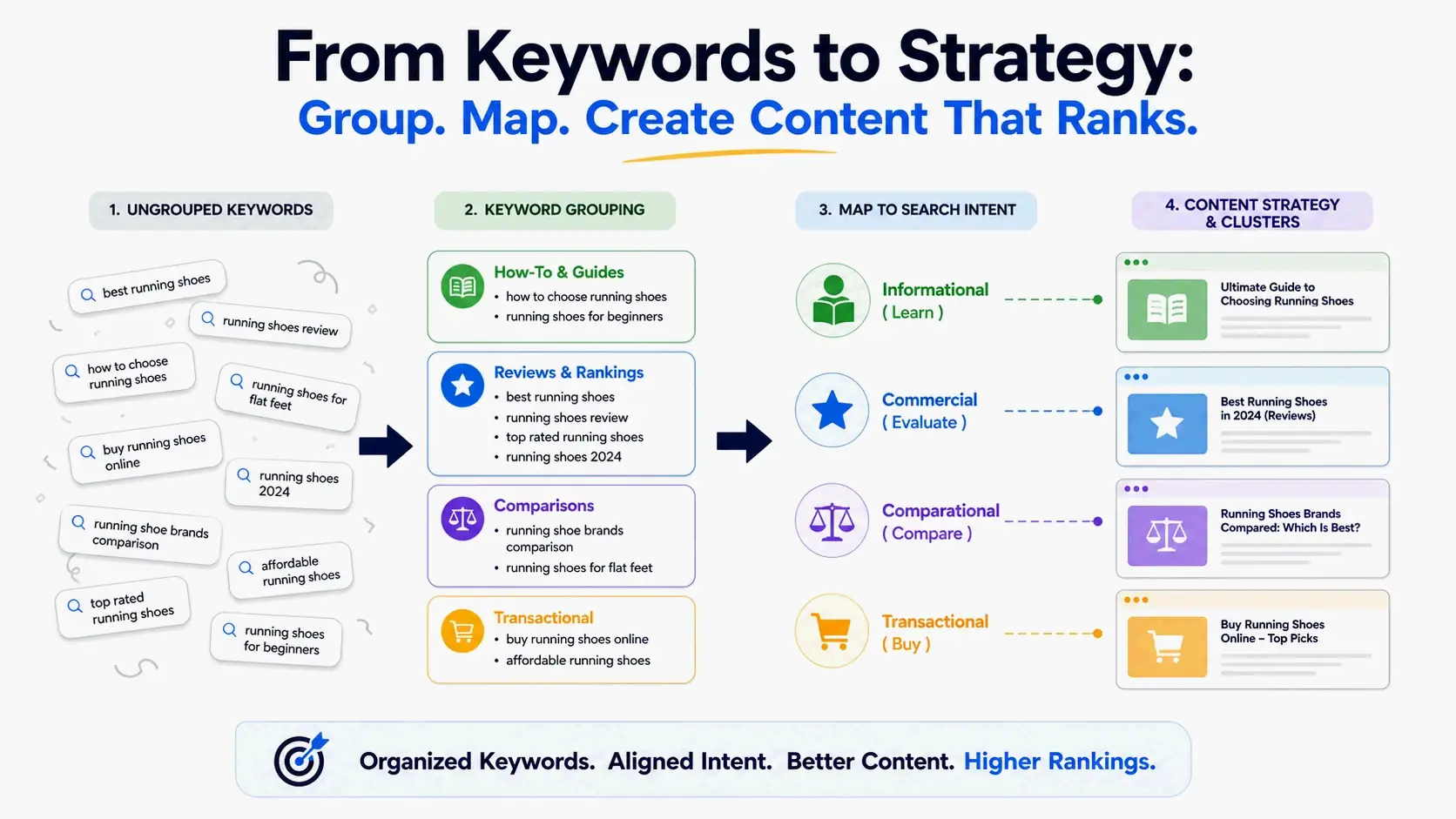
Keyword grouping (often called keyword clustering) means sorting related search terms into clusters that share the same intent, verified by checking if those keywords bring up the same URLs in Google’s top results. In 2026, with AI overviews drawing from a smaller set of trusted sources, building tight, intent-driven clusters has gone from a nice-to-have to a must.
Contents
- What Is Keyword Grouping (and Why AI Overviews Make It Essential in 2026)
- The Foundation: How Search Intent Dictates Keyword Groups
- SERP-Based Clustering vs. Semantic Clustering: Which Logic Should You Trust?
- How to Group Keywords: A Manual, No-Tool Workflow for 100% Accuracy
- Solving a Silent Killer: Using Keyword Groups to Diagnose and Fix Cannibalization
- From Clusters to Content Architecture: Building Topic Clusters and the Hub-and-Spoke Model
- Best Keyword Grouping Tools to Automate the Process
- Conclusion
- FAQ
What Is Keyword Grouping (and Why AI Overviews Make It Essential in 2026)
Keyword grouping organizes related keywords into clusters around shared themes, search intent, or user goals. As Elementor explains, it transforms a messy keyword list into a structured map where each cluster targets one specific intent, helping search engines and users understand your focus.
Generative AI search engines—Google’s AI Overviews, ChatGPT, Perplexity—have changed the game. They don’t scan everything; they pull from a smaller pool of trusted, well-structured sources that show topical authority. According to ClusterView, a scattered keyword strategy is now “a liability, not just an inefficiency,” because AI overviews prioritize comprehensive, cluster-based coverage over single-keyword targeting.
Topical authority—the impression that your site truly understands a subject—comes directly from how well you group keywords. Properly clustered keywords let you build focused pillar pages that answer entire sets of related queries. That sends a strong signal to both traditional search engines and AI answer engines that your content is the go-to resource. This is nothing like basic keyword list management, which just sorts terms without considering search intent or what actually shows up on a SERP.
The Foundation: How Search Intent Dictates Keyword Groups
Whenever someone types a query, there’s an intent behind it—a reason for the search. Understanding that intent is the first sorting step when grouping keywords. You’ve likely seen the four classic types:
- Informational: The user wants to learn something (e.g., “how to clean running shoes”).
- Commercial: The user is comparing options before a purchase (e.g., “best running shoes for flat feet”).
- Transactional: The user intends to complete an action, like buying or signing up (e.g., “buy running shoes online”).
- Navigational: The user wants to reach a specific website or page (e.g., “Nike running shoes page”).
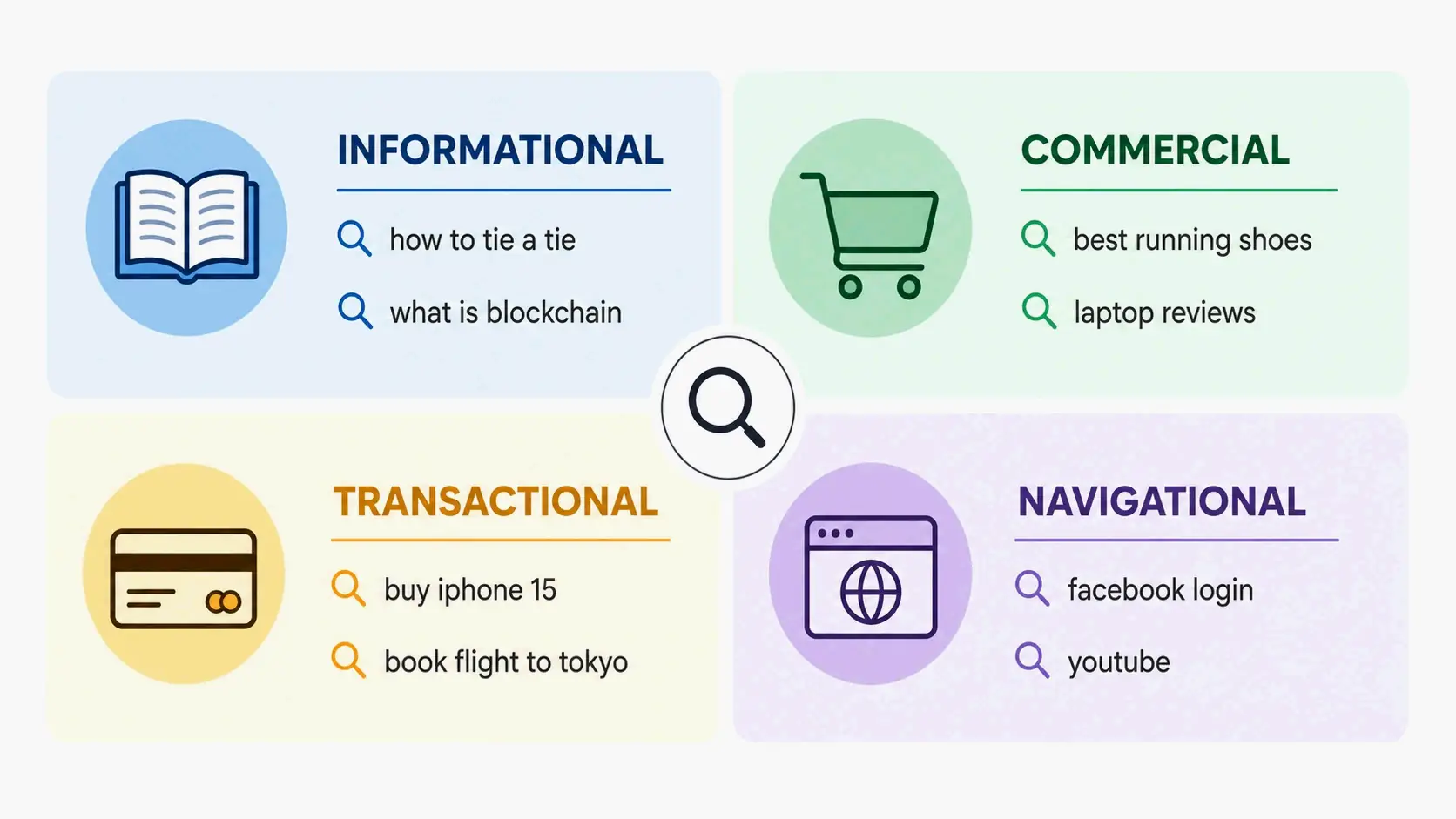
A single page can only serve one main intent well. If you try to cover “best running shoes for flat feet” (commercial) and “how to clean running shoes” (informational) on the same page, you’ll likely confuse users and search engines—and end up with weak rankings for both.
Intent is your first high-level filter for a raw keyword list. Before you even look at SERP overlap or plan pillar pages, tag each keyword with its primary intent. Jennah Patel, Senior Manager of Marketing Operations at LocaliQ and WordStream, puts it this way: “The strongest keyword lists aren’t the largest; they’re filtered by intent, ensuring every click has a clear purpose.” Sorting your terms into intent buckets early helps you dodge the biggest grouping pitfall: mixing buyers and researchers on the same page.
Intent Boundaries: Why ‘Best Running Shoes’ and ‘Running Shoes Review’ Should (Usually) Live Apart
At first glance, “best running shoes” and “running shoes review” might look almost interchangeable. But the intent behind them isn’t the same. “Best running shoes” is a commercial investigation—someone wants a curated list or side-by-side comparison to guide a purchase. “Running shoes review” leans more informational: the searcher expects a deep dive into a specific model or a small set, often after they’ve already narrowed their choices.
Grouping by intent puts these keywords into separate clusters. Trying to cover both on one page means serving two different masters: a quick comparison for shoppers and an in-depth analysis for researchers. The page typically flops for both. Spotting these intent boundaries early keeps your clusters tight and your pages focused.
SERP-Based Clustering vs. Semantic Clustering: Which Logic Should You Trust?
After filtering by intent, you still need to figure out which keywords really belong together on a single page. Two main approaches vie for your trust, and knowing the difference can keep you from building content on bad assumptions.
Semantic clustering relies on natural language processing (NLP) to group keywords by meaning. It looks at word relationships and context, quickly sorting huge lists into broad topic buckets—no live search results needed. Its strengths are speed and uncovering hidden connections; its weakness is intent blindness. For example, a semantic model might lump “how to roast coffee” with “buy roasted coffee” simply because they share a lot of similar words, even though one is an informational guide and the other a transactional purchase.
SERP-based clustering works differently. It grabs the actual top 10 (or 20) Google results for each keyword and groups keywords when their result sets overlap significantly. If a handful of queries share many of the same ranking URLs, Google is practically telling you they share the same intent and can be answered by one page. This method mirrors search engine reality.
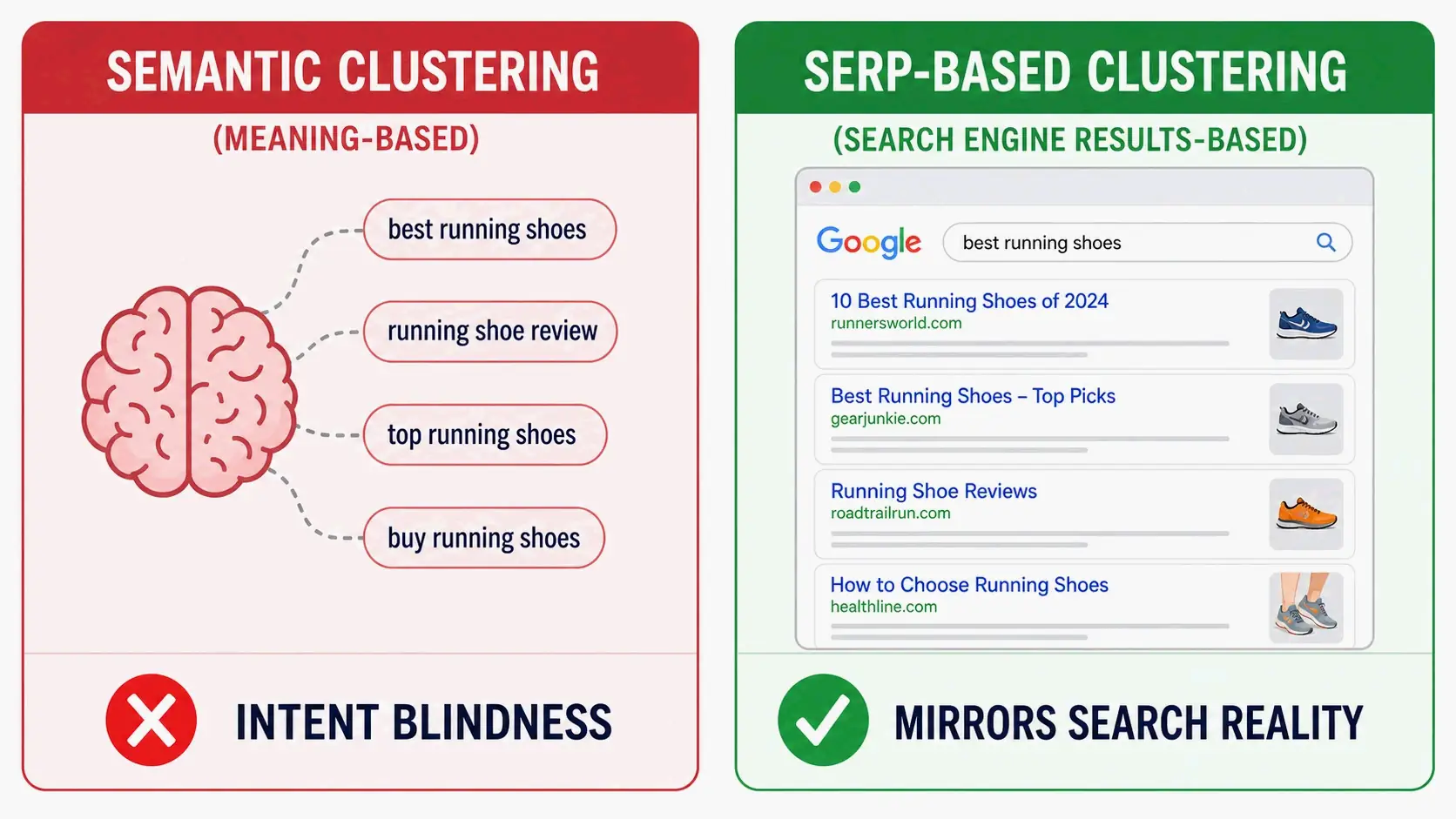
David Kaufmann, SEO expert and founder of SEOcrawl, draws a definitive line: “Semantic clustering groups keywords by meaning… Its weakness is intent blindness. SERP-based clustering groups keywords by what Google actually returns… It catches cases meaning alone would miss.” For on-page content decisions—deciding what goes on one page versus another—SERP-based clustering is the gold standard.
A good rule of thumb for SERP similarity: if keywords share three or four URLs among their top 10 results, they likely belong together. As SEOcrawl puts it, when roughly 40% of the top results overlap, you can treat those keywords as one cluster. If the overlap is lower, do a bit more digging before merging. Tools like Keyword Insights, KeyClusters, and WriteIntent automate this principle, but you can also validate manually—we’ll cover that next.
How to Group Keywords: A Manual, No-Tool Workflow for 100% Accuracy
Plenty of tools can automate grouping, but a manual spreadsheet workflow gives you total control and a much deeper feel for your topic landscape. This five-step method, adapted from SEOcrawl’s approach, uses a running-shoes example to walk through each stage.
Step 1: Brainstorm and pull together a raw keyword list in a spreadsheet. Start by grabbing keywords from your research tools (Ahrefs, Semrush, Google Keyword Planner), competitor gaps, and any queries you already rank for in Google Search Console. Don’t over-filter now; the grouping process will sort out relevance later. Example: “how to clean running shoes,” “washing running shoes,” “can you put running shoes in the washing machine,” “how to dry running shoes,” “best running shoes for flat feet,” “running shoes for overpronation,” “how often to replace running shoes,” “when to replace running shoes.”
Step 2: Tag each keyword with a primary intent (I for informational, C for commercial, T for transactional, N for navigational). Add a column in your spreadsheet and label each one. “Best running shoes for flat feet” is commercial; “how to clean running shoes” is informational. This step alone separates keywords that should never share a page.
Step 3: Manually validate SERP overlap between keywords with the same intent tag. Take two keywords—say, “how to clean running shoes” and “washing running shoes”—and Google each one. Capture the top 10 organic URLs (ignore ads and SERP features), then compare the lists and count the shared URLs.
Step 4: Group keywords that share 3 or more URLs in their top 10 results. If “how to clean running shoes” and “washing running shoes” have at least four overlapping pages, they belong in the same cluster. Watch for edge cases too: a query like “how to dry running shoes” often shares many results with the cleaning terms, so it typically joins that cluster rather than getting its own page. Repeat this process for all keywords within each intent category.
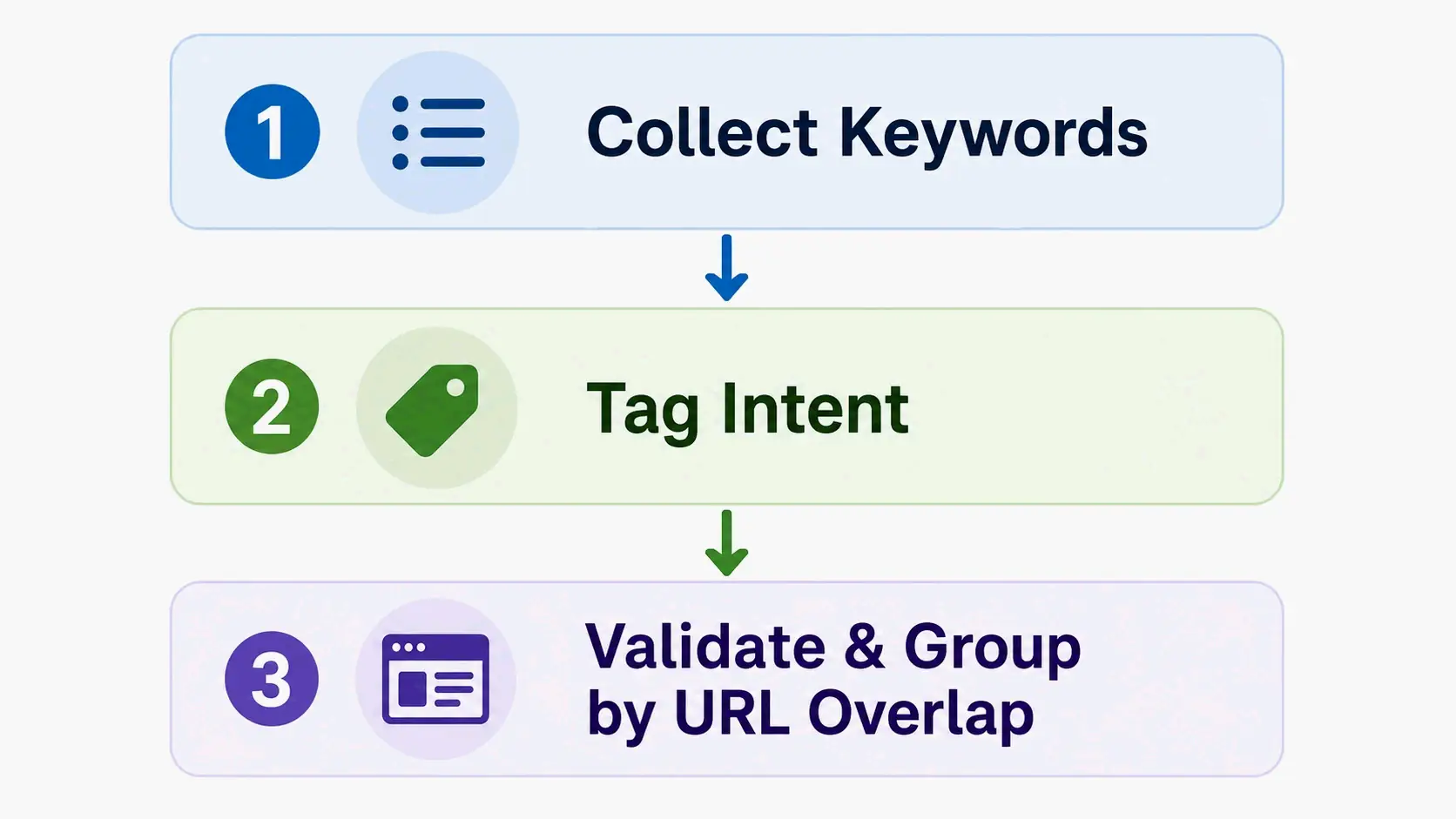
Step 5: Handle edge cases where overlap is only 2 URLs by analyzing the dominant ranking type in the extra slots. When two keywords share only 2 URLs, dig into what type of pages fill the remaining top slots. Open the top results for both queries and look at the dominant content format. If both SERPs are packed with in-depth how-to guides (like long-form blog posts), the keywords probably still share the same intent and can be grouped. If one SERP shows product pages and the other shows blog posts, the intents diverge—keep them separate.
After completing these steps, you end up with something like:
– Cluster A (informational): how to clean running shoes · washing running shoes · can you put running shoes in the washing machine · how to dry running shoes → one comprehensive how-to guide
– Cluster B (informational): how often to replace running shoes · when to replace running shoes → one guide
– Cluster C (commercial): best running shoes for flat feet · running shoes for overpronation → validate SERP overlap, then one or two comparison pages
Eight keywords collapse into three or four well-defined pages, each with a clear primary keyword and supporting terms.
A Spreadsheet Template for Manual Keyword Grouping
To stay organized, set up a spreadsheet with these columns: Keyword, Search Volume, Primary Intent, Top 10 URLs (paste them in from Google), SERP Overlap Count (you calculate this), Cluster ID, and Final Page/URL. This template, based on Elementor’s approach, lets you document each call and revisit clusters as your strategy evolves.
Handling Edge Cases: What to Do When Overlap Isn’t Clear
Keyword grouping isn’t always cut and dried. When two keywords share only 2 URLs, check what type of content dominates the rest. If both SERPs are full of step-by-step tutorials, they probably belong together. If one pulls up authoritative research reports and the other shows light listicles, it’s better to keep them apart. Another gray area: keywords that seem grouped semantically but Google returns very different results—always trust the SERP. As SEOcrawl mentions concerning the running-shoes example, “best running shoes for flat feet” and “running shoes for overpronation” feel related, but if their results are product roundups with little overlap, either keep them separate or use a pillar page with supporting subpages. The SERP is the final word.
Solving a Silent Killer: Using Keyword Groups to Diagnose and Fix Cannibalization
Keyword cannibalization happens when several pages on your site go after the same keywords and end up competing with each other. This splinters your authority and keeps any single page from ranking as high as it could. Your keyword clusters act as a perfect diagnosis map.
Export all your queries and their landing pages from Google Search Console. Then map those queries to your clusters. For each cluster, list all the URLs on your site that rank for any keyword in that group. If more than one page is getting impressions for the same cluster, you’ve got a cannibalization problem. For instance, if three blog posts all show up for variations of “how to clean running shoes,” Google can’t tell which one is the real authority and will spread rankings across them, pushing all three lower than one well-optimized page could reach.
The Consolidation Decision Tree: Merge, Redirect, or Re-optimize?
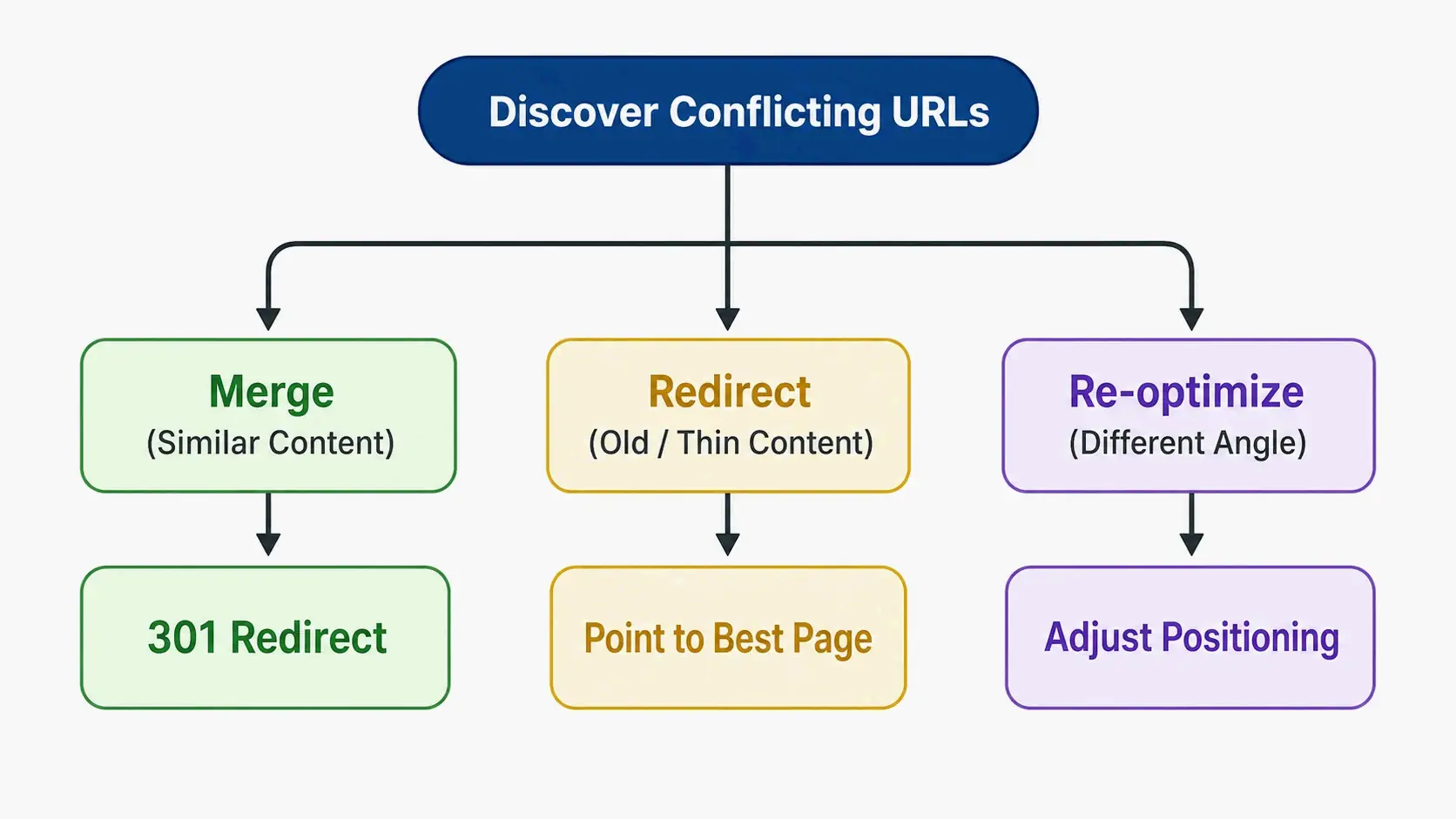
Once you spot conflicting URLs within a cluster, use this simple decision tree:
- Merge when two pages cover essentially the same topic and one is clearly stronger (better content, more backlinks, higher rankings). Combine the content onto the stronger page and 301-redirect the weaker URL.
- Redirect when an old or thin page targets the same intent but brings nothing unique. Point it straight to the best-performing page for that cluster.
- Re-optimize when each page serves a distinct sub-angle of the cluster but they’re accidentally competing for the main head terms. Refine their titles, headings, and internal links so each page targets its specific sub-cluster, while linking to a main pillar page for the broader topic.
Elementor points out that strategic keyword mapping prevents cannibalization “by ensuring that each page has a distinct focus.” With clusters as your guide, you turn a site audit into a clear action plan that repairs internal competition and consolidates ranking signals around fewer, stronger pages.
From Clusters to Content Architecture: Building Topic Clusters and the Hub-and-Spoke Model
Think of a keyword cluster map as a ready-made content plan. Each validated cluster becomes one primary page. Use the highest-volume keyword as the focal point and weave the rest in as subheadings, supporting topics, and natural variations.
For broad subjects, a pillar page (or “hub”) strategy works best. The pillar targets the broad head term with a comprehensive overview and links out to more specific supporting pages (the “spokes”), each handling a sub-cluster. Back to our example: a “running shoe care” pillar could link to the cleaning guide, the replacement guide, and maybe a material-specific care guide. Each spoke then links back to the pillar, strengthening the site’s overall authority on running shoe care.
This interlinked structure tells search engines your content is deeply connected and covers a topic thoroughly—a solid signal of topical authority. SEOcrawl’s visual representation of this model shows the pillar at the center, with spokes feeding in and out, creating a clear hierarchy.
A modern note: rigid keyword density rules are a thing of the past. SEOs once obsessed over hitting exact percentage thresholds for primary keywords. But search engines now understand synonyms, related terms, and context. Instead of counting mentions, just make sure your content naturally covers all the relevant sub-topics your cluster points to. Write for people first, then confirm your primary and supporting terms appear in strategic spots—title tag, H1, first 100 words, subheadings—without jamming them in.
Best Keyword Grouping Tools to Automate the Process
Manual grouping teaches you a lot and works great for small lists, but as your keyword count grows, tools save time and keep things consistent. Here are three tools that each take a different approach, based on an evaluation by ClusterView.
Keyword Insights blends live SERP analysis with NLP to group keywords and then carries the workflow into AI-generated content briefs. It lets you adjust URL overlap thresholds and tags every keyword and group with search intent, making it a comprehensive pick for agencies that want grouping, intent labeling, and brief creation in one subscription. A 7-day trial is available.
KeyClusters uses a straightforward SERP-overlap method: it checks real-time Google results and groups keywords when three or more ranking pages overlap. Its pay-as-you-go approach with credits that never expire makes it flexible for project-based work—no monthly commitment required. That’s ideal for consultants and freelancers who already handle keyword research elsewhere and just need a fast, accurate clustering tool.
ClusterView is built specifically around keyword clustering. It features an interactive cluster map to visualize your topic structure and includes built-in rank tracking. It can turn finished clusters into content ideas via an AI Topic Generator, bridging the gap between research and editorial planning. A free trial is available, and it fits teams that want clustering, rank tracking, and content ideation in one focused platform.
Conclusion
Effective keyword grouping is more than a tidy organizational trick. It’s the blueprint for a site structure that both search engines and generative AI models trust as topically authoritative. When you align your content with intent and validate your groups against live SERPs, you build a site that dodges cannibalization, covers topics fully, and ranks for entire clusters of related queries—not just isolated keywords. Start with a simple move: export your top 50 ranked queries from Google Search Console, manually group them using the SERP overlap method, and audit your existing pages for one cluster to spot your biggest cannibalization risk or content gap. That single exercise can uncover structural weaknesses and quick wins that reshape your content strategy.
FAQ
What is the difference between keyword grouping and keyword clustering?
In day-to-day use, the terms are largely interchangeable. Some people draw a line: “grouping” refers to a manual, spreadsheet-based process, while “clustering” describes the automated, algorithmic version that tools perform. For content strategy, both serve the same purpose: organizing keywords around shared intent.
How many keywords should be in a single group or cluster?
There’s no fixed number. A cluster should include all keywords that clearly share the same intent and SERP reality, whether that’s five or fifty. Getting the intent alignment right matters far more than reaching a certain count. If a group gets so big that it starts to cover different intents, break it up.
Can I use ChatGPT or other AI to group my keywords?
Yes, but tread carefully. AI can quickly group keywords semantically, spotting thematic similarities in seconds. But it doesn’t see live SERPs, so what you get is a draft topic map, not a final call. Always validate the fuzzy clusters against real Google search result overlap before locking them into a page strategy.
