



Topic modeling is a natural language processing (NLP) technique that automatically discovers hidden themes across large collections of text documents. With AI-driven attacks up 56% according to a 2026 IBM report, the need for automated ways to organize and summarize unstructured data has never been clearer.
Contents
- What Is Topic Modeling? The Core Definition and Why It Matters
- How Does Topic Modeling Work? The Fundamental Principle Explained
- Latent Dirichlet Allocation (LDA): The Classic Algorithm That Still Powers Topic Modeling
- Modern Topic Modeling with Neural Networks: BERTopic, Top2Vec, and LLMs
- Evaluating Topic Model Quality: Topic Coherence and Beyond
- Real-World Applications: How Topic Modeling Is Used Across Industries (with 2026 Examples)
- A Beginner’s Guide to Getting Started with Topic Modeling in Python
- Conclusion
- FAQ
What Is Topic Modeling? The Core Definition and Why It Matters
Topic modeling is an unsupervised NLP technique that scans through unlabeled documents and finds clusters of words that frequently appear together. These clusters, called “topics,” represent the hidden semantic structure within the text. Unlike a search query—where you already know what you’re looking for—topic modeling surfaces themes on its own, without labels or human annotation. It’s a core part of Natural Language Processing (NLP) and Text Mining, fields focused on pulling meaning from unstructured text.
Think of it like an assistant sorting a massive stack of research papers. Without reading every page, the algorithm notices that one batch keeps mentioning “market volatility,” “equity,” and “bonds,” while another batch tends to talk about “symptoms,” “treatment,” and “clinical trials.” The model gives you two things: a topic-word distribution (the words most tied to each topic) and a document-topic distribution (how much of each topic appears in a given document).
Why the Wikipedia Definition No Longer Tells the Full Story in 2026
As of July 2026, Wikipedia’s article on “Topic model” carries a banner asking for an update. While that article correctly calls topic modeling a type of probabilistic, neural, or algebraic model for discovering abstract topics, it mostly reflects where the field was in the mid-2010s. A lot has happened since then.
Today’s topic modeling treats the task as a modular process, using transformer-based semantic embeddings, sentence-level clustering, and large language models (LLMs) to create richer, more interpretable topic descriptions. It’s not just about matrix factorization anymore—neural networks and LLMs have expanded what’s possible. The old definition isn’t wrong, but it no longer tells the whole story.
Topic Modeling vs. Text Classification: What’s the Critical Difference?
Topic modeling and text classification are often mixed up, but they solve different problems. The key difference is how they learn. Topic modeling is unsupervised—it works with raw, unlabeled text to find hidden patterns without knowing ahead of time what those patterns might be. Text classification, on the other hand, is supervised and needs a pre-labeled training set to sort documents into known categories.
That difference shapes how they’re used. A company with thousands of support tickets might run topic modeling and discover that recurring issues naturally fall into groups like “delivery delays,” “login failures,” and “refund requests”—categories no one had spelled out beforehand. Once those categories are clear, a text classification model can be trained to route future tickets automatically. In short: topic modeling is an exploratory tool for discovery; text classification is a predictive tool for day-to-day operations.
How Does Topic Modeling Work? The Fundamental Principle Explained
The whole idea rests on a simple assumption: each document is a mixture of topics, and each topic is a distribution of words. Take an article about a basketball game. It might be 40% about “sports rules,” 30% about “team performance,” and 30% about “post-game analysis.” A topic like “sports rules” would then be defined by words such as “foul,” “offside,” “referee,” and “penalty.” The model doesn’t understand these words—it only detects that they show up together unusually often across the collection.
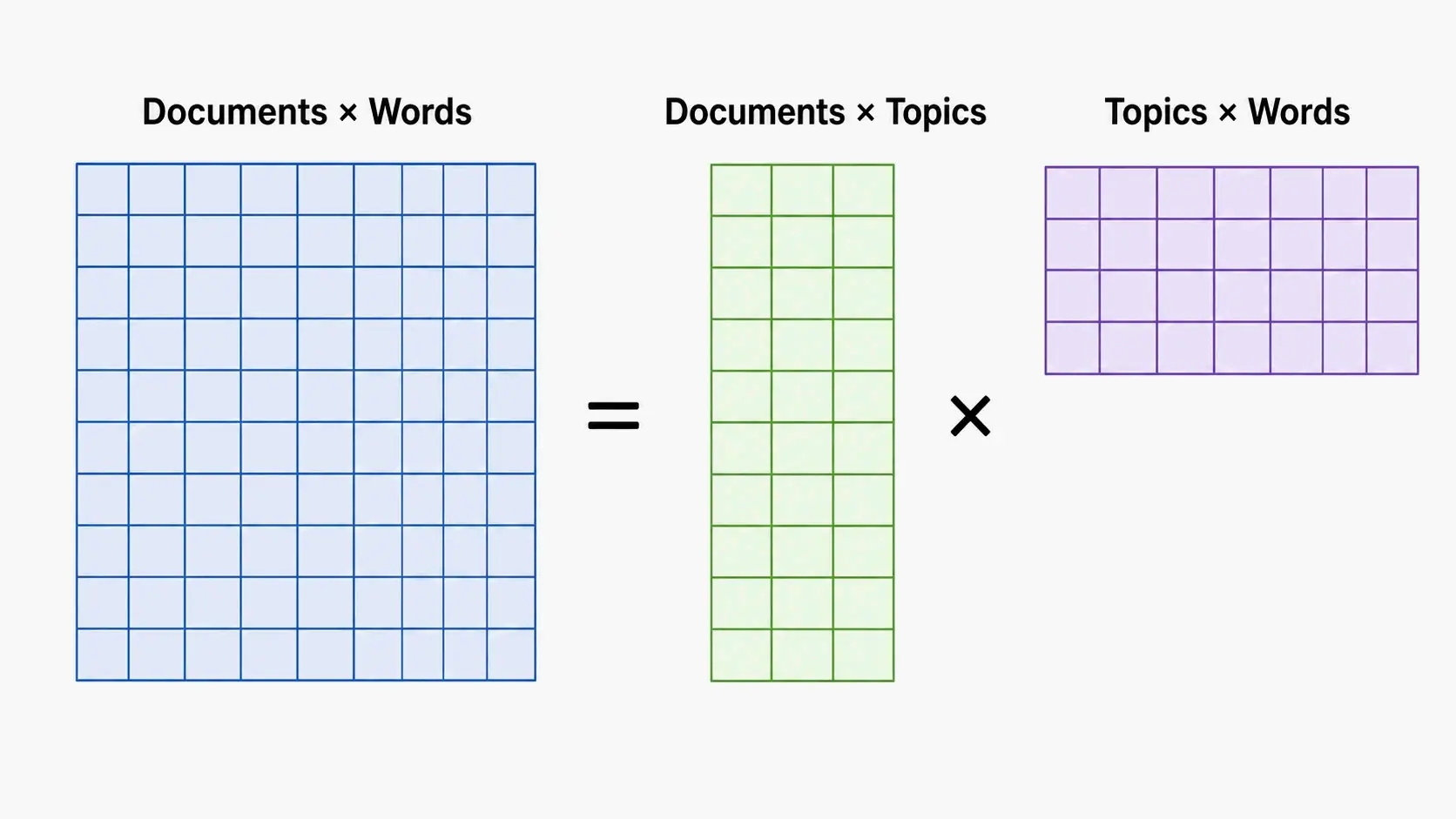
To turn text into math, the process starts with a Bag-of-Words (BoW) representation: each document becomes a vector that just counts how many times each word appears. Grammar and word order are completely ignored. From that numerical table of documents and words, the algorithm does a statistical decomposition. It takes the high-dimensional space of thousands of unique words and compresses it into a low-dimensional space of maybe a few dozen topics. Conceptually, you can think of it as factorizing a big “Documents × Words” matrix into the product of a “Documents × Topics” matrix and a “Topics × Words” matrix. The topics that come out are the ones that best explain the word co-occurrence patterns in the corpus.
Researchers Daniel Cirkovic and Tiandong Wang highlighted an interesting angle in 2026. They noted that the natural power-law frequencies of words—something rarely used in topic model inference—can actually lead to more efficient estimation algorithms. It’s a reminder that the statistical side of text data is still an active frontier.
Latent Dirichlet Allocation (LDA): The Classic Algorithm That Still Powers Topic Modeling
Latent Dirichlet Allocation (LDA) is the best-known topic model, and much of the field was built on it. Introduced by David Blei, Andrew Ng, and Michael I. Jordan in 2003, LDA is a probabilistic generative model that uses Bayesian statistics to describe the document-topic-word relationship. It imagines that every document was created like this: first, pick a blend of topics (using what’s called a Dirichlet prior); then, for each word slot in the document, choose a topic from that blend; finally, draw a word from that topic’s distribution over words.
LDA gives you two main outputs. For each topic, you get a ranked list of the most probable words, which lets you interpret and label the theme. For each document, you get a percentage breakdown showing how much of it belongs to each discovered topic—mapping out its thematic structure. While LDA assumes topics are independent, later variants like Pachinko Allocation were designed to model correlations between topics, since real-world themes often overlap.
A Practical Checklist for Choosing the Optimal Number of Topics
Choosing the right number of topics (often called T) can make or break a model. The brute-force approach—training dozens of LDA models in a grid search and picking the T with the best perplexity—gets expensive fast. A 2025 study by Akramov et al. (arXiv) introduced the Sharpness-Aware Black-Box Optimization (SABBO) algorithm, which treats finding T as a discrete black-box problem. SABBO can land on a near-optimal number after essentially a single evaluation, while older genetic or evolution-based methods needed a full budget of runs to get to a similar spot.
A practical checklist mixes numbers with human judgment. Here are three steps to follow:
- Evaluate Topic Coherence: Measure coherence scores across a range of topic counts (say, 10 to 200). Coherence checks how similar the top words in a topic are, and it tracks better with human interpretability than raw statistical fit (perplexity). Look for an elbow point where adding more topics only gives you tiny improvements.
- Incorporate Domain Knowledge: Metrics alone aren’t enough. A topic count that maximizes a score might still yield topics that are too granular or too vague for a subject expert. Bring in what you know about the field.
- Employ Visualization Checks: Use tools like pyLDAvis to inspect the candidate topics. A good model will show big, non-overlapping topic bubbles on the intertopic distance map, meaning the themes are distinct and well-separated.
LDA’s Limitations and Why Modern Alternatives Emerged
LDA’s strength comes with built-in weaknesses. The Bag-of-Words approach throws out word order, syntax, and all semantic context, treating a document as nothing more than a pile of word counts. That’s why LDA struggles on short texts like social media posts or customer reviews—word co-occurrence signals are just too thin to pick up reliable patterns. A tweet about “Apple’s stock price” and one about “apple pie recipes” can look nearly identical to an LDA model. That loss of context is what pushed the field toward neural methods like BERTopic and Top2Vec, which use embeddings to capture the rich meaning of words and sentences.
Modern Topic Modeling with Neural Networks: BERTopic, Top2Vec, and LLMs
Deep learning has shifted topic modeling from counting words to understanding meaning. The big innovation is using transformer-based neural networks to turn documents into dense numerical vectors called sentence embeddings. These embeddings capture what a text means, not just which words it contains. That semantic awareness powers three major modern approaches: BERTopic, Top2Vec, and LLM-based methods.
BERTopic has become widely adopted because it’s flexible and produces coherent topics. Its pipeline is modular: first, a Sentence-BERT model converts documents into contextual embeddings. Next, UMAP (Uniform Manifold Approximation and Projection) squashes those high-dimensional embeddings into a denser, lower-dimensional space. Finally, HDBSCAN, a density-based clustering algorithm, finds groups of semantically similar documents. Each cluster becomes a topic, and the label is built from the most representative class-based TF-IDF words. Top2Vec follows a similar idea but learns embeddings for both documents and words together in one shared space. It finds topics by clustering those unified vectors without an iterative optimization loop, making it computationally pretty efficient.
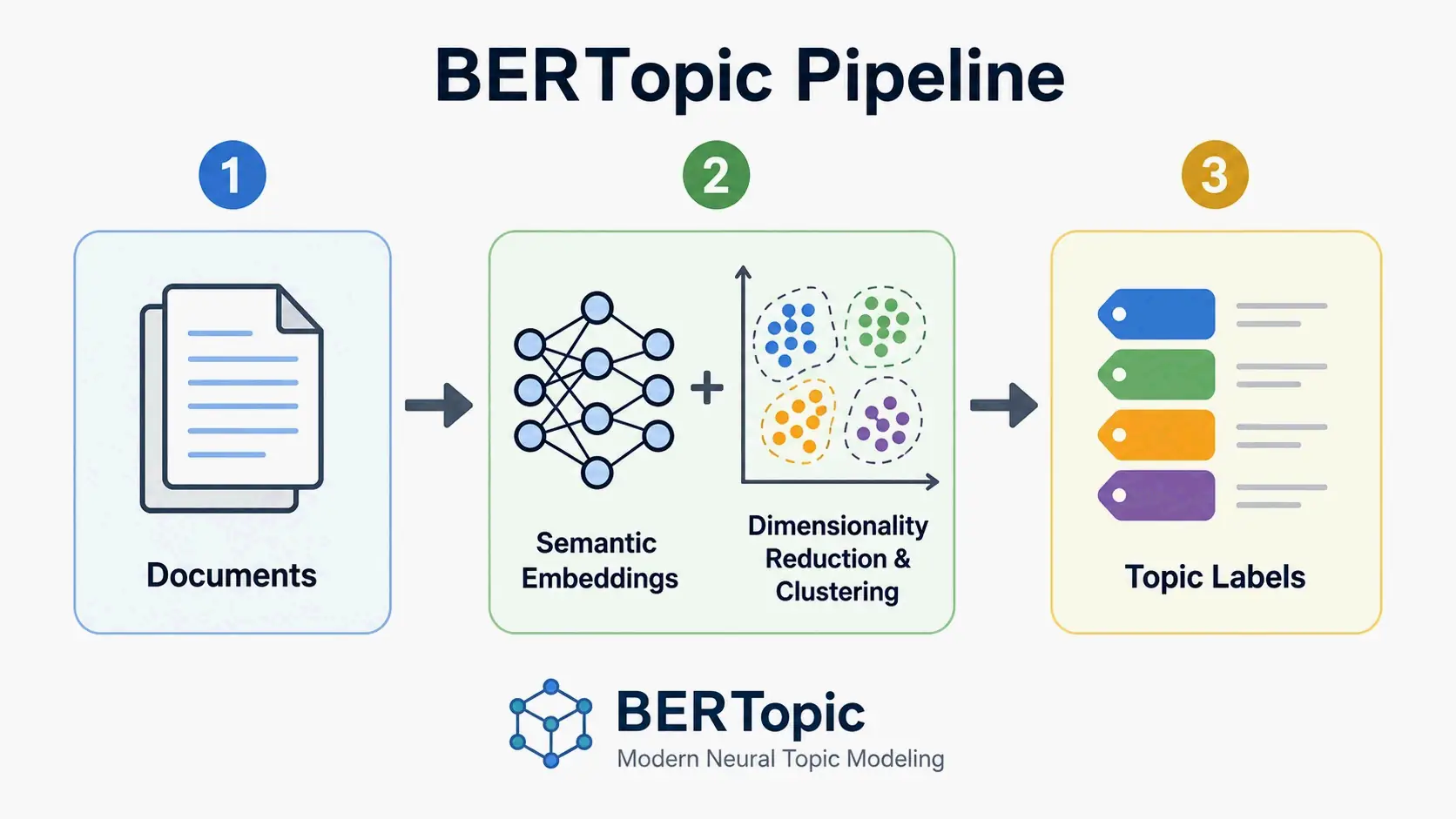
Large Language Models (LLMs) are entering the picture in two practical ways. First, they can improve the interpretation stage: models like Llama2 take BERTopic’s raw clusters and turn keyword lists into descriptive, human-readable labels. Second, there’s a direct prompt-based approach where an LLM like Mixtral reads each document and assigns topics interactively, skipping dataset-wide clustering entirely. The second method is heavier on resources, but it’s also extremely flexible.
A 2026 case study by Tiwari et al. (arXiv) applied these techniques to 69,909 software vulnerability descriptions in cybersecurity. Using BERTopic with advanced embeddings and UMAP, they identified clear, coherent topic clusters like “Red Hat Enterprise Linux vulnerabilities,” “VMware ESXi vulnerabilities,” and “SSL certificate weaknesses.” That gave security analysts an automated way to spot trends and prioritize threats from messy, unstructured vulnerability data.
How to Choose Between LDA, BERTopic, and LLM-Based Methods: A Decision Framework
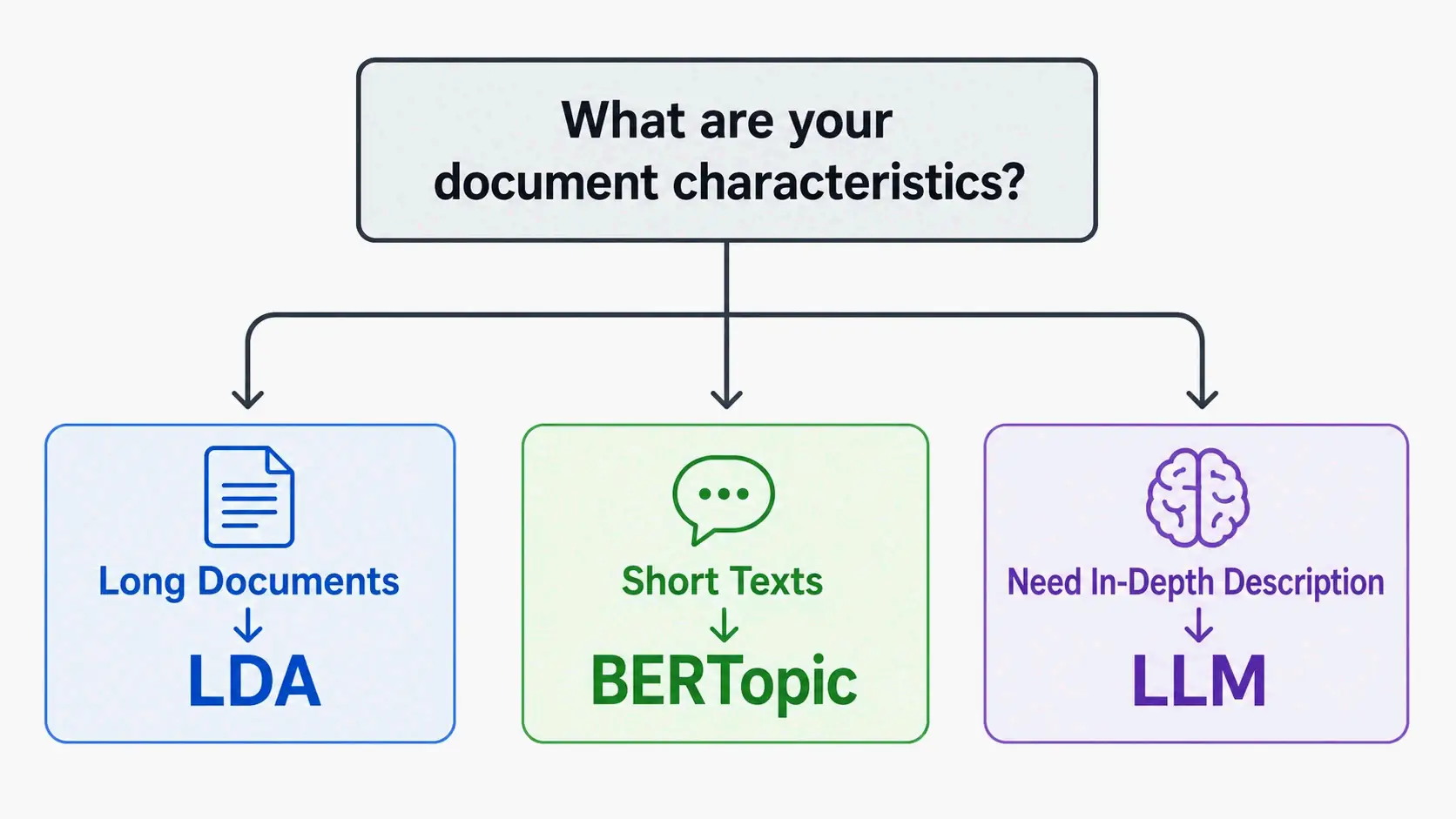
The right approach depends on your data, your compute budget, and what you want out of the analysis. Here’s a simple framework based on corpus characteristics:
- Large Corpora with Long Documents (e.g., academic papers, legal documents): Start with LDA. Despite its limits, LDA is still robust and computationally light for long-form text, where the Bag-of-Words assumption does the least damage. It gives you a fast baseline overview of themes.
- Short Texts and Exploratory Analysis (e.g., tweets, news headlines, customer reviews): Use BERTopic. Its sentence embeddings handle sparse, context-heavy short texts exceptionally well. The built-in tools for visualizing inter-topic distance and hierarchical clustering also make it the top pick when you need to understand how themes relate.
- Need for Deep Semantic Interpretation (e.g., generating a readable report for stakeholders): Bring in LLM-based methods. If the goal is to produce richly descriptive topic labels that non-technical audiences will read, integrating an LLM into a BERTopic pipeline (or doing direct LLM topic assignment) is the strongest option. It costs more on large datasets, but the interpretability is unmatched.
Evaluating Topic Model Quality: Topic Coherence and Beyond
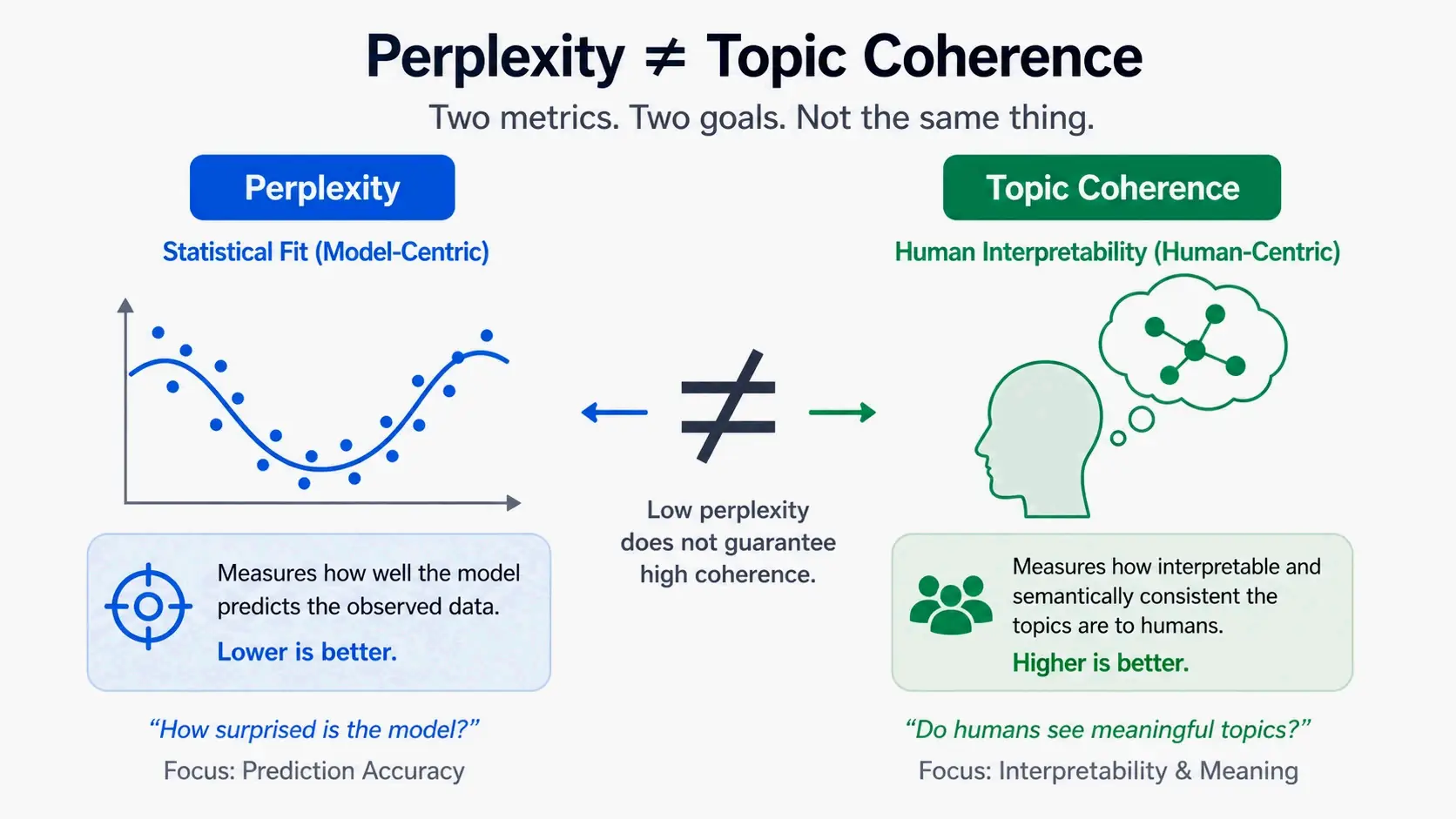
Once you’ve built a topic model, figuring out if it’s any good isn’t straightforward. Evaluation splits into quantitative metrics and qualitative human checks. The two most common numbers are Perplexity and Topic Coherence.
Perplexity comes from the statistical modeling world and measures how well a model predicts a held-out sample. A lower perplexity means a better statistical fit—the model is less “surprised” by new documents. The upside is that perplexity is objective and doesn’t need a human in the loop. The catch is that it often moves in the opposite direction from human interpretability. A model with great perplexity can still produce topics that overlap and look like nonsense to a person.
Topic Coherence was created to close that gap. It evaluates a topic by measuring how semantically similar its high-scoring words are, using word co-occurrence stats from an external reference corpus. High coherence means the top words tend to appear together in real documents, which is a strong signal that people will find the topic understandable. Over the last decade, coherence scores have become the go-to automated standard because they align much better with the real goal: getting useful, clear themes.
Beyond Coherence Scores: Practical Ways to Validate Your Topics
Automated metrics are only a guide. They can’t tell you whether the topics are meaningful or actionable for your specific problem. That’s where two extra layers come in. First, task-based evaluation: test your topic features on a downstream task. If adding topic representations improves a document classifier or information retrieval system over a raw word baseline, then your topics are clearly capturing something useful. Second, and most critical, get a domain expert to review things. A subject matter expert should look at the top words, the most representative documents, and the relationships between topics to judge whether the patterns are real, insightful, and align with their knowledge. Topic visualization tools like pyLDAvis’s intertopic distance map can speed up that review, helping experts quickly spot coherent themes versus the ones that are too fuzzy or overlapping.
Real-World Applications: How Topic Modeling Is Used Across Industries (with 2026 Examples)
Topic modeling has grown from an academic tool into a practical analytics engine across many fields. It’s put to work wherever there’s too much unstructured text to handle manually—corporate threat intelligence, digital humanities, bioinformatics, and beyond.
In cybersecurity, the pressure to automate is enormous. The 2026 IBM report we cited earlier pointed to a 56% jump in AI-driven attacks. Security teams are drowning in threat reports, CVE descriptions, and dark web chatter. Topic modeling, as shown in the Tiwari et al. (2026) study, acts as a triage tool: it categorizes that flood of text and finds latent themes like recurring zero-day exploit types, frequently targeted software stacks (e.g., VMware, Atlassian), and emerging attack vectors. That helps teams decide what to patch first and where to focus resources.
In education, researchers are exploring alternatives within the topic modeling family. Boissier et al. published a 2026 study in SN Computer Science detailing their CREA text processing pipeline, which uses Formal Concept Analysis (FCA) as a text mining method. Their case study showed how FCA could analyze course materials to build a new university curriculum, while also flagging and removing irrelevant documents—a practical way to organize educational resources.
Other fields have mature use cases. In bioinformatics, topic models extract patterns from genomic data and cancer transcriptomic datasets, treating biological functions as latent variables. In finance, they power sentiment analysis by grouping financial news into thematic streams that model market impact. In the social sciences, Dynamic Topic Models track how themes in historical newspapers or scientific journals rise and fall over decades, revealing how cultural and political conversations evolve.
From Digital Humanities to Social Media: Uncovering Hidden Stories with Topic Models
Away from boardrooms and labs, topic modeling enables what scholars call “distant reading.” Instead of a historian reading a century of newspapers by hand, a model can extract themes and track how they change over time. For example, topic modeling has been applied to the Pennsylvania Gazette from 1728–1800 to watch how subjects like “government,” “commerce,” and “religion” shifted during the early American republic. Musicologists have also used it to quantify stylistic changes over time and trace the influence of certain artists on later work. On social media, the same technique uncovers emergent memes, maps the spread of political narratives, and monitors public health discourse—turning millions of short, noisy posts into a coherent thematic landscape.
A Beginner’s Guide to Getting Started with Topic Modeling in Python
It’s one thing to read about topic modeling; it’s another to run it on your own data. The Python ecosystem has great libraries that make the whole workflow accessible with surprisingly little code. The two essential ones are gensim for working with LDA and bertopic for modern neural approaches, along with sentence-transformers for generating document embeddings.
The basic workflow covers four steps: text preprocessing, model initialization, training, and topic inspection. Below is a starter setup that runs both an LDA model and a BERTopic model.
Step 1: Preprocess and train an LDA model with gensim
import gensim
from gensim import corpora
from nltk.corpus import stopwords
import nltk

# Sample documents
documents = ["Machine learning is fascinating.",
             "Deep learning drives modern AI.",
             "Stock market sees major volatility today.",
             "Wall Street reacts to new economic data."]

# Preprocess: tokenize and remove stopwords
stop_words = set(stopwords.words('english'))
texts = [[word for word in doc.lower().split() if word not in stop_words]
         for doc in documents]

# Create dictionary and corpus
dictionary = corpora.Dictionary(texts)
corpus = [dictionary.doc2bow(text) for text in texts]

# Train LDA model
lda_model = gensim.models.LdaModel(corpus=corpus, id2word=dictionary, num_topics=2, passes=10)

# Inspect topics
for topic_id, words in lda_model.print_topics():
    print(f"Topic {topic_id}: {words}")
Step 2: Train a BERTopic model
from bertopic import BERTopic

# BERTopic handles its own embedding and preprocessing
topic_model = BERTopic()

# Fit the model on the raw list of documents
topics, probs = topic_model.fit_transform(documents)

# Get topic information after fitting
topic_info = topic_model.get_topic_info()
print(topic_info)
This code is a minimal starting point. The natural next step is to load a real dataset—like the 20 Newsgroups set from scikit-learn, your own CSV of customer reviews, or a collection of news articles—and then use the decision framework from this guide to pick and tune the right approach for your text length, corpus size, and interpretability goals.
Conclusion
Topic modeling—from classic LDA to neural frameworks like BERTopic and LLM-based methods—remains an essential NLP technique for organizing the ever-growing mountain of unstructured text. Its evolution toward modular, neural, and LLM-integrated approaches in 2026 has made it more powerful and interpretable than ever. To get started, install Python libraries like gensim and bertopic, test them on a small dataset you care about (customer reviews, news articles, research papers—whatever fits), and use the decision framework in this guide to pick the right approach for your data’s length, size, and interpretability needs.
FAQ
What is the difference between topic modeling and text classification?
Topic modeling discovers hidden themes without any predefined labels—it’s all about exploration. Text classification requires a set of pre-labeled examples and then sorts new text into those already-known classes. Think of topic modeling as a discovery tool and text classification as a sorting tool.
How do I choose the optimal number of topics for my corpus?
Evaluate topic coherence scores across a range of topic counts to find a sweet spot. You can also use a modern black-box optimizer like SABBO, which can land on a near-optimal number in just one evaluation. Always confirm the final choice with a domain expert and a visualization tool like pyLDAvis to make sure the topics actually make sense.
What are the latest trends in topic modeling, like BERTopic or using LLMs?
The biggest shift is moving away from Bag-of-Words and toward contextual embeddings from Transformer models, as seen in BERTopic and Top2Vec—this gives you much better semantic understanding. LLMs are now being used to refine and generate human-readable topic labels or to assign topics directly through prompt engineering, making the output far more readable.
Is LDA still the most common topic model, and what are its limitations?
Yes, LDA remains common because it’s straightforward and statistically grounded, especially for large corpora of long documents. Its main limitations come from the Bag-of-Words assumption: it ignores word order, which causes problems with short texts like tweets. For those, modern alternatives like BERTopic produce much more coherent results.
