


AI doesn’t build links for you. What it does is handle the tedious stuff—finding prospects, sorting the good from the bad, and drafting first passes at outreach emails. The AI-powered link building strategies that work in 2026 pair that speed with human judgment. The focus is on data-driven digital PR and content assets that actually earn citations, the kind that move the needle in both traditional search and AI-generated answers. The content behind those citations matters just as much: pipelines that bake in E-E-A-T from the structure level and strip out mechanical AI tone produce assets journalists are far more willing to reference.
Contents
- In 2026, We’re Not Building Links. We’re Earning Citations.
- What Are AI-Powered Link Building Strategies That Actually Work?
- The Ultimate AI Link Building Workflow: A Step-by-Step Automation Guide
- Why Digital PR is Your Highest-ROI AI Link Building Strategy
- Building Content Assets AI Bots and Readers Can’t Ignore
- Scaling for SMBs: Zero-Cost AI Link Building Strategies
- Measuring What Matters: AI Link Building KPIs for 2026
- Conclusion
- FAQ
In 2026, We’re Not Building Links. We’re Earning Citations.
Link building has changed completely. Not long ago, SEO teams chased volume—grabbing backlinks from anywhere that would give them one. The post-March 2026 spam update landscape doesn’t work that way anymore. Google’s latest changes have made one thing clear: quality over quantity. Links from sketchy, irrelevant, or low-authority domains don’t just fail to help now. They actively put you at risk of algorithmic suppression or manual penalties.
This shift lines up with the growth of AI-powered search. ChatGPT, Perplexity, and Google’s own AI Overviews now shape how people find content, and these systems lean heavily on cited, authoritative sources when generating answers. SearchX Pro found that digital PR links show a 3x higher correlation with AI search visibility compared to traditional link building tactics. The takeaway is straightforward: earning citations from trusted publications pulls double duty. It strengthens rankings in conventional search and increases your odds of showing up in AI-generated responses.
This guide is a practical playbook for this new reality. The strategies here use AI not to spam publishers or crank out low-value links, but to scale the research, qualification, and drafting steps that support human-led outreach. The goal isn’t more links. It’s more authoritative citations from sources that search engines and AI models both consider credible.
What Are AI-Powered Link Building Strategies That Actually Work?
AI-powered link building means using artificial intelligence to automate the repetitive, time-eating parts of acquiring links: finding relevant websites, scoring them by authority and traffic metrics, drafting personalized outreach emails, and tracking how campaigns perform. The technology is an efficiency layer. It doesn’t replace editorial judgment or relationship building. For a broader look at where AI fits across the SEO workflow—from keyword research to content refinement—see How to Use AI in SEO.
A big chunk of the industry gets this wrong. Charles Floate, who runs a link building agency, says 95% of people use AI incorrectly in link building. The common mistake is treating AI as a content engine that writes entire campaigns. Its real value is cutting operational costs. Floate points out that AI should automate the parts that eat up hours of manual labor—researching competitor backlinks, categorizing prospects, generating outreach angles—so human team members can focus on higher-value work like building relationships and shaping strategy. Agencies looking to productize this kind of workflow can find a detailed breakdown in the GEO for agencies playbook.
The limits of what machines can do matter just as much. Vikash Bharia, Head of Digital Marketing at W3era, notes that AI can’t fully replace judgment because editorial outreach depends on nuance. An AI model might see two websites covering the same topic and miss that one publishes original expert work while the other exists only for paid placements. That distinction affects risk, trust, and long-term SEO authority. Algorithms also struggle with semantic topical fit when the match requires business context that goes deeper than shared keywords.
The winning formula in 2026 pairs AI-driven data processing with human creativity and relationship building. AI does the quantitative heavy lifting—scraping backlink profiles, scoring domain authority, enriching contact data—while humans make the qualitative calls on which publishers to approach, what angle to pitch, and how to personalize each message. This lines up with Google’s emphasis on E-E-A-T (Experience, Expertise, Authoritativeness, Trustworthiness), since the final output reflects genuine editorial standards rather than automated mass production.
The Ultimate AI Link Building Workflow: A Step-by-Step Automation Guide
Most guides on AI link building talk about principles without offering a concrete technical workflow. The gap between knowing AI can help and actually setting up automated systems leaves too many teams stuck with manual processes. The four-stage framework below—Discover, Qualify, Create, Outreach—gives you a copy-paste workflow that connects AI tools with established SEO platforms.
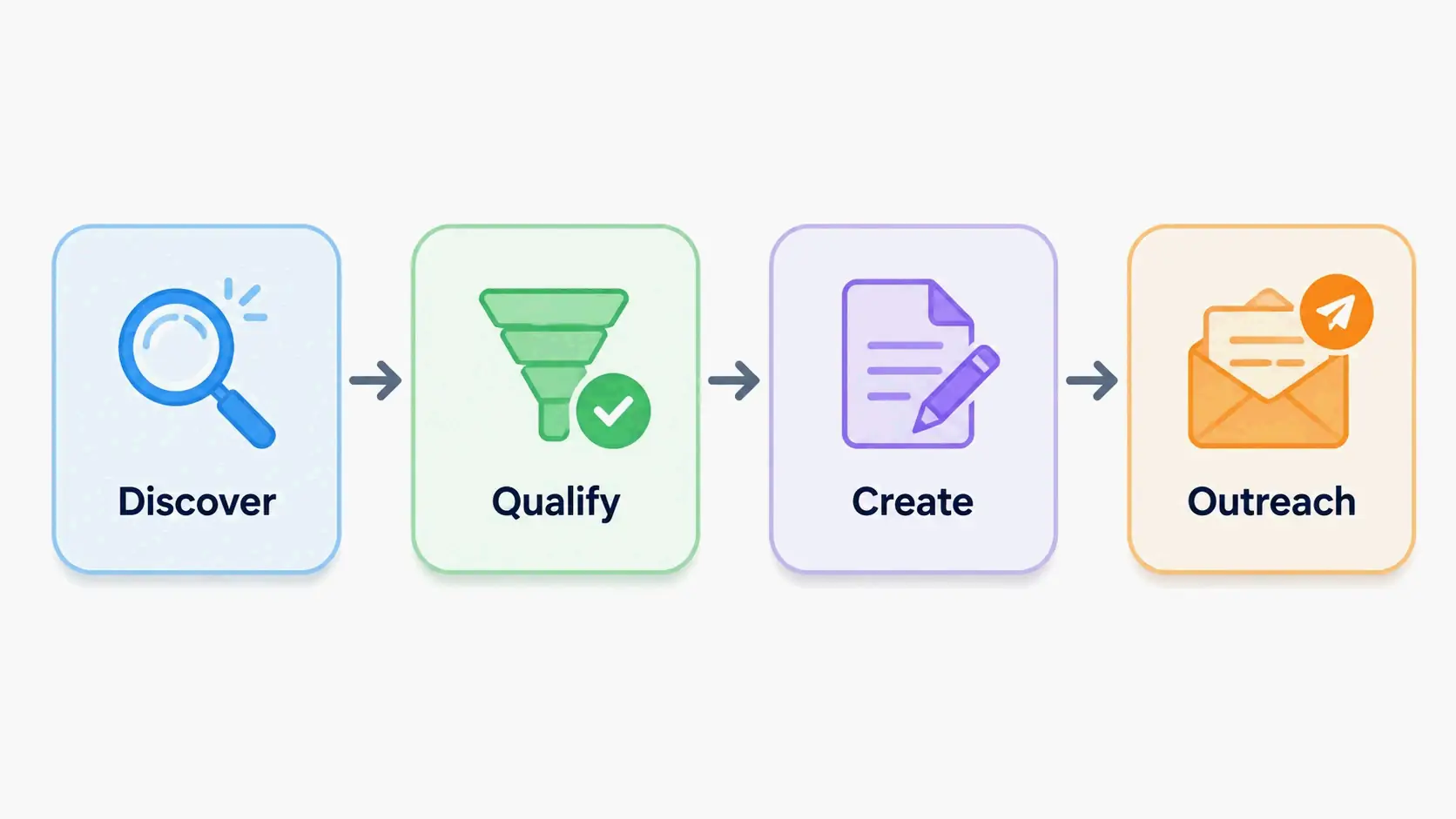
Step 1: Prospecting with AI (Prompt Templates Included)
The prospecting stage sets the quality bar for your whole campaign before any outreach happens. A weak target list leads to low reply rates, poor placements, and unnecessary spam risk. AI speeds this up by processing large datasets that would take human researchers days to get through.
Start by exporting competitor backlinks from Ahrefs or Semrush. Feed that data into ChatGPT or Claude with a structured prompt that classifies each referring URL by page type, placement context, and topical relevance. Charles Floate’s typical workflow covers: scraping competitor backlinks, enriching domains with SEO data, classifying topical relevance, identifying link intent, removing spam sites, generating outreach angles, and prioritizing by ROI and difficulty.
Here’s a prompt template for guest post discovery:
“Act as an SEO strategist. I have a linkable asset about [topic]. My target audience is [audience]. Generate 12 prospect categories for editorial outreach. For each category, list search operators, ideal page types, likely decision-makers, risk signs, and a pitch angle that gives the publisher’s readers clear value.”
This gives you a categorized map rather than a random list of websites. For example, a campaign about AI in dental clinic marketing should target dental consultants, healthcare marketing publications, practice management blogs, and SaaS platforms serving dentists—not every marketing blog you can find.
Real-time verification is still essential. Vikash Bharia recommends answering six questions for each prospect: Does the site still publish fresh content? Does the page serve the same audience? Does the author accept expert input? Does the site show real editorial standards? Does the domain receive organic traffic? Does the content gap match your asset? AI can surface this information, but a human reviewer should inspect source pages directly. Snippets get outdated, and AI sometimes hallucinates publishing policies.
Step 2: Qualification Funnels in N8N/Make.com
Once you’ve identified prospects, the qualification stage filters them based on measurable criteria. N8N and Make.com act as orchestration layers that connect AI analysis with spreadsheet management and outreach platforms.
Build a workflow that pulls prospect data from Ahrefs or Semrush exports, then applies AI scoring across multiple dimensions. Charles Floate’s enrichment process includes DR and authority metrics, estimated organic traffic, top ranking keywords, country and language data, niche categorization, outbound link patterns, indexed pages, traffic trends, contact information, and social profiles.
A practical scoring model, as outlined by W3era’s Vikash Bharia, weights topical relevance at 30%, page-level context at 20%, organic traffic at 15%, editorial credibility at 15%, contact accessibility at 10%, and risk profile at 10%. Only prospects scoring in the top two tiers should move to outreach. This qualification funnel connects directly to Google Sheets, creating a structured database that feeds into the next stage.
Step 3: The AI-Assisted Outreach Drafting Room
The outreach stage is where AI assistance meets mandatory human editing. Connect your qualified prospect spreadsheet to Pitchbox, BuzzStream, or Lemlist, then use AI to draft personalized first emails based on each prospect’s recent article.
The key to effective AI-assisted drafting is prompt structure. Vikash Bharia recommends this framework:
“Write a cold email for an editor at [site]. Target page: [URL]. Their article discusses [summary]. Our asset provides [unique value]. Write under 110 words. Use a specific opening line for the page. Do not use generic praise. Do not mention SEO. Ask if they would consider adding the resource only if it helps their readers.”
This produces a draft that references actual page content rather than generic flattery. But every message must pass through human review before sending. Editors recognize AI-written patterns—inflated praise, overused adjectives, phrases like “I hope this finds you well.” Charles Floate emphasizes that successful outreach is direct and honest. Publishers have heard the same templated pitches thousands of times.
Your workflow should include banned-phrase libraries, validation rules that stop emails with empty variable fields, and A/B testing between human-edited and AI-first drafts. You’re not trying to replace the human touch. You’re cutting the time spent on initial drafting so that relationship building gets more attention.
Why Digital PR is Your Highest-ROI AI Link Building Strategy
Digital PR has clearly pulled ahead of other link building strategies in 2026. It outperforms guest posting, directory submissions, and cold outreach on every meaningful metric. According to SearchX Pro, digital PR delivers an average ROI of about 312% and earns placements on domains rated DR 70 to 79 or higher. These numbers reflect a fundamental shift in how search engines evaluate backlinks. Editorial citations from trusted publications now carry substantially more weight than manufactured links from low-barrier sources.
The performance gap between digital PR and traditional tactics has widened considerably since Google’s March 2026 spam update. Traditional methods like bulk guest posting and link exchanges typically produce links from DR 30 to 60 domains, carry medium to high penalty risk, and show low correlation with AI search visibility. Digital PR, by contrast, operates through earned media placements. Journalists and editors choose to cite your content because it genuinely helps their readers.
AI-Assisted Journalist Pitching: High-Volume, High-Relevance
AI transforms digital PR execution by automating research and monitoring that used to require dedicated outreach teams. Charles Floate describes using AI to monitor journalist queries on platforms like Qwoted and HARO alternatives, perform sentiment analysis on industry news, and draft initial pitches that sound like a real expert rather than a bot.
The workflow involves pulling competitor backlinks and recent media mentions from Ahrefs or Google News, using ChatGPT or Claude to categorize opportunities by authority and topical relevance, and triggering N8N workflows to enrich contact details automatically. AI then generates personalized HARO responses and journalist pitches at scale. Humans review and refine them. Acquired links feed into reporting dashboards, and successful placements inform future targeting.
This turns what used to be a full-time job for multiple staff members into a streamlined system where one person can manage significant volume. Floate notes that digital PR has evolved beyond simply getting mentioned in Forbes. The current focus is on knowing which media links move rankings, reinforcing entities and brand trust, and strengthening authority around high-priority keyword clusters.
The ‘GEO-Synced’ Link Building Playbook
Digital PR links serve a dual purpose that traditional tactics can’t match. A link from a top-tier publication functions as a direct signal to both Google’s ranking algorithms and AI models like ChatGPT and Perplexity. SearchX Pro’s data showing 3x higher correlation with AI search visibility makes the stakes clear: as users increasingly discover brands through AI-generated answers, citations from editorially respected sources become a prerequisite for appearing in those responses.
The Thrive Agency offers a compelling case study of this GEO synchronization in practice. According to Thrive Agency, their data-driven approach combining link acquisition with AI SEO strategies delivered a 4,302% increase in total traffic from AI platforms between January and October of 2025. That included a 322% boost in traffic from Gemini and an 862% surge from ChatGPT. SaaS companies pursuing this kind of AI-search synergy can find a step-by-step breakdown in the GEO for SaaS playbook. These results show that earning citations from authoritative publications directly influences visibility across AI-powered search experiences.
Tracking this impact means monitoring brand mentions in AI search results. Teams should follow not just traditional metrics like domain authority and keyword rankings, but also whether their brand appears in ChatGPT, Perplexity, and Google AI Overviews when users ask relevant questions. This broader view of visibility connects link building outcomes to the actual channels where audiences now discover information.
Building Content Assets AI Bots and Readers Can’t Ignore
A linkable asset is content specifically designed to be cited. It differs from a standard blog post because its primary goal is reference value for journalists, researchers, and niche writers who need authoritative sources to link to. General content marketing targets reader engagement and search traffic. Linkable assets target editorial citation.
This distinction matters because outreach efficiency depends on asset quality. Sending personalized pitches to 50 precisely targeted journalists with a genuinely useful data study will generate more high-DR links than blasting 5,000 contacts with requests to link to a generic blog post. AI speeds up the creation of these assets by handling initial data analysis and visualization generation, but human experts must provide methodology, unique insights, and editorial oversight. End-to-end content pipelines like GeoWriter—which cover research, writing, editorial refinement, AI tone removal, and auto image generation at roughly $0.6 per article—make it practical to produce linkable assets at volume without the $20+ per-piece cost of fragmented tool stacks.
Linkable Asset ROI Matrix: A Comparison Guide
Different types of linkable assets require different levels of investment and produce different returns. The matrix below compares four common formats across key criteria, based on industry patterns observed in successful campaigns:
| Asset Type | Creation Difficulty | Median Cost | Avg. DR of Linking Domains | Typical Link Velocity |
|---|---|---|---|---|
| Original Data Studies | High | High | DR 60 to 80+ | High, sustained |
| Interactive Tools | Very High | Very High | DR 50 to 75 | Moderate to High |
| Definitive Guides | Medium | Medium | DR 50 to 70 | Moderate |
| Industry Benchmark Reports | Medium-High | Medium-High | DR 55 to 75 | High, periodic |
Original data studies consistently produce the strongest results because journalists and researchers actively seek unique statistics to support their own content. Charles Floate’s agency used AI to help build one of their most successful link magnets, a statistics page that earned substantial backlinks by aggregating industry data. The key was using AI for research and data processing while human experts ensured accuracy and provided context.
The TripleDart case study for Storylane shows how feature-driven content assets perform in practice. TripleDart curated high-quality backlinks from Storylane’s client base and paired them with a feature-focused content funnel. This strategic approach led to a 223% increase in total impressions within five months. The case demonstrates that linkable assets work best when they connect directly to product capabilities and user needs, creating content that serves both SEO goals and customer education.
AI’s role in creating these assets follows a clear boundary: use AI for data processing, pattern identification, and draft generation; rely on human experts for methodology design, unique insight development, and final editorial review. Content that merely repackages publicly available information won’t earn citations from authoritative sources. The assets that attract links offer something AI alone cannot replicate—original research findings, expert analysis, and genuine industry perspective.
Scaling for SMBs: Zero-Cost AI Link Building Strategies
Small and medium-sized businesses often face a resource gap in link building. Without agency budgets or dedicated SEO teams, the prospect of competing for backlinks against well-funded competitors can feel impossible. But AI tools have lowered the barrier to entry considerably. It’s now feasible for a one-person team to run effective link building campaigns with minimal financial investment.
The zero-cost tech stack starts with free tiers of established platforms. ChatGPT’s free version handles prospecting analysis, email drafting, and content ideation. Google Sheets serves as a lightweight CRM and qualification database. Hunter.io’s free tier provides up to 25 email lookups per month for contact discovery. Manual monitoring of Qwoted journalist queries replaces paid PR platforms. For keyword planning and topic clustering, open-source tools like kwmaster (which generates P0/P1/P2 keyword priorities) and kwplanner (which builds Hub & Spoke topic clusters) help SMBs identify which linkable assets to create first. Together, these tools cover the essential functions of a link building operation without requiring a credit card.
The first strategy SMBs should implement is reverse-engineering competitor links. Use a free backlink checker to export a competitor’s referring domains, then manually score each prospect for topical relevance and site quality. This takes time but requires no financial investment and builds a targeted prospect list that larger competitors may overlook because they’re focused on volume. The key is prioritizing relevance over raw domain authority. A link from a small but genuinely respected niche blog often outperforms a link from a generic high-DR site with no topical connection.
Broken link building offers another accessible entry point. The process involves finding dead outbound links on authoritative websites and proposing your live, relevant content as a replacement. SearchX Pro notes that this method carries very low penalty risk because the link is editorially placed to solve a real problem for the webmaster. Use a simple site:example.com + keyword search query to find resource pages in your niche, then check for broken links using free browser extensions. ChatGPT can draft a friendly, concise replacement suggestion email that explains which link is broken and why your content fits as a replacement.
The emphasis for SMB campaigns must stay on ultra-personalized, low-volume, high-relevance outreach. A team of one can’t match an agency’s output of 50 pitches per day. What one person can do is send 10 meticulously researched, genuinely helpful emails per day to precisely targeted prospects. Vikash Bharia’s research confirms that this approach produces higher conversion rates than mass outreach. Editors recognize and respond to genuine engagement with their content. The goal isn’t to scale volume. It’s to maximize the quality of every single interaction.

Measuring What Matters: AI Link Building KPIs for 2026
Traditional link building measurement focused almost entirely on Domain Rating and the raw number of referring domains. Those metrics still provide useful baseline data, but they don’t capture the full picture of link building performance in an AI-influenced search landscape. The KPIs that matter in 2026 need to reflect both traditional search impact and emerging AI visibility signals.
AI search visibility should now function as a north-star metric alongside conventional impressions and clicks. Track whether your brand appears in ChatGPT, Perplexity, and Google AI Overviews when users ask questions relevant to your industry. According to SearchX Pro, the 3x higher correlation between digital PR links and AI search visibility makes this metric particularly important for campaigns focused on earned media placements. A link that improves traditional rankings but generates no AI visibility may represent incomplete value in today’s environment. Platforms that combine SEO diagnostics with AI-readiness checks—like GeoWriter’s SEO Audit Skill, which runs a 92-item diagnosis covering both classic on-page factors and GEO signals—help teams compare tooling approaches and close that gap faster.
Synthetic fingerprint risk requires active monitoring. Outreach emails that sound canned or AI-generated damage sender reputation and reduce response rates. Use AI detection tools on your drafts to identify patterns that trigger spam recognition before human editors finalize messages. Vikash Bharia recommends building a banned-phrase library that includes overused expressions like “I stumbled upon your article” and “I hope this email finds you well,” then programming these phrases into your prompt templates as exclusions. The goal isn’t to hide AI assistance. It’s to ensure that the final, human-edited output sounds like a real person who actually read the prospect’s content.
Anchor text optimization is another area where AI provides analytical depth. Use NLP tools to analyze your backlink profile’s anchor text distribution against top-ranking competitors. Charles Floate’s process involves feeding backlink data into ChatGPT with a prompt that categorizes each anchor as branded, exact match, partial match, generic, naked URL, or topical/natural. The AI then identifies overused anchor patterns, potential over-optimization, spam signals, unnatural repetition, and missing anchor diversity. This analysis helps teams avoid the exact-match anchor overuse that Google’s algorithms detect as manipulative, while spotting opportunities to diversify anchor text in ways that look editorially natural.
Campaign reporting should pull all these metrics into a unified view. AI can process exports from Ahrefs, Google Search Console, and internal spreadsheets to produce reports that connect link acquisition to ranking movement, traffic changes, and AI visibility trends. This holistic measurement approach ensures that link building efforts are evaluated against their actual contribution to business outcomes, not vanity metrics that may not reflect genuine authority growth.
Conclusion
The only AI-powered link building strategies that work in 2026 use artificial intelligence for intelligence augmentation, not artificial authority. AI excels at processing data, identifying patterns, and drafting initial outreach—tasks that used to eat up days of manual labor. Human judgment remains essential for editorial decisions, relationship building, and the creative work of developing content worth citing. Start small by picking one stage of the workflow, like AI-powered prospecting, and automating it with the guidance above. A/B test your human-edited drafts against AI-first versions to measure the difference. The goal is to earn fewer, but world-class, citations from sources that strengthen authority in both traditional search and AI-generated answers.
FAQ
Is buying backlinks with AI safe in 2026?
No. Google’s March 2026 spam update specifically targets scaled, paid link schemes, and AI makes detection easier, not harder. The risk of total de-indexation far outweighs any potential short-term ranking gain from purchased links.
How much does an AI-powered link building campaign cost?
Costs range from near-zero for a DIY SMB using free tools and time investment, to $5,000–$20,000 or more per month for a full-service agency like Thrive or TripleDart. The primary expense isn’t AI tools. It’s the human expertise required to guide strategy and create content that genuinely earns citations.
Can Google detect and penalize AI-written outreach emails?
Google doesn’t directly penalize emails, but webmasters and journalists can mark you as spam if outreach sounds generic or robotic. The danger lies in synthetic fingerprinting—recognizable AI patterns that reduce trust. Always have a human editor inject personalization and remove AI hallmarks before sending to protect your domain’s sender reputation.
What are the best AI tools for link building outreach?
For prospecting, Ahrefs and Semrush provide backlink data. For workflow automation, N8N and Make.com connect AI analysis with outreach platforms. For outreach management, Pitchbox, BuzzStream, and Lemlist handle sequencing and tracking. Emerging solutions like BacklinkGPT offer all-in-one functionality but still require human oversight. The most effective stack integrates your data with AI rather than relying on a single black-box tool.
