


To effectively use AI for keyword research, combine generative AI for intent mapping with dedicated SEO platforms for data validation. This hybrid workflow uncovers high-intent, long-tail keywords and structures content that AI search engines can cite — essential for visibility in 2026. Tools that use AI in SEO by reading live SERP data before generating content make this pipeline faster by connecting research directly to production.
Disclosure: This article is published on the GeoWriter blog.
Contents
Why Keyword Research Has Fundamentally Changed in 2026
Keyword research today must serve two masters: traditional blue links and AI-generated answers. The search landscape has shifted so dramatically that methods built around head-term volume alone now miss the majority of opportunities. A SparkToro and Datos study (2024) found that 58.5% of US Google searches ended without a click. That figure reflects a reality where AI Overviews, featured snippets, and knowledge panels often satisfy the query right on the results page.
Gartner predicted that traditional search engine volume will drop by 25% by 2026 as AI chatbots and virtual agents absorb more queries. Semrush data shows Google is becoming more selective about when to display AI Overviews — their appearance rate shifted from 24.61% of tracked keywords in July 2025 to 15.69% by November 2025. That decline does not signal retreat; it means the AI Overviews that remain are more targeted and competitive, making deliberate optimization essential for any brand that wants visibility in those slots. When an AI Overview does appear, Ahrefs’ analysis of 300,000 keywords found it correlates with a 58% lower click-through rate for the number-one blue link.
The shift means keywords must be chosen not just for ranking potential, but for their likelihood of being cited inside AI-generated answers. A purely data‑driven, volume‑first approach fails because it ignores the intent patterns that AI engines reward. This is one reason many teams now face fragmented workflows — one tool for AI writing, another for SEO data, yet another for publishing — with no single platform connecting keyword research to finished content. AI is well suited to accelerate this new, intent‑first keyword research, but only when paired with real validation data and an end-to-end production system.
The Death of the 10 Blue Links and the Rise of AI Citations
The traditional SERP of ten organic links is being replaced by hybrid results pages where AI Overviews, People Also Ask boxes, and rich snippets dominate. Buyers now start with conversation‑shaped queries inside ChatGPT, Perplexity, or Google AI Mode rather than typing a few keywords into a search bar. For brands, the question has shifted from “am I ranking?” to “am I being mentioned and cited?” Winning in 2026 requires keyword strategies built around the questions and entities that AI models pull from when assembling answers. This change demands a workflow that treats ideation and validation as equal partners.
The Hybrid AI Keyword Research Workflow: A Step-by-Step Guide
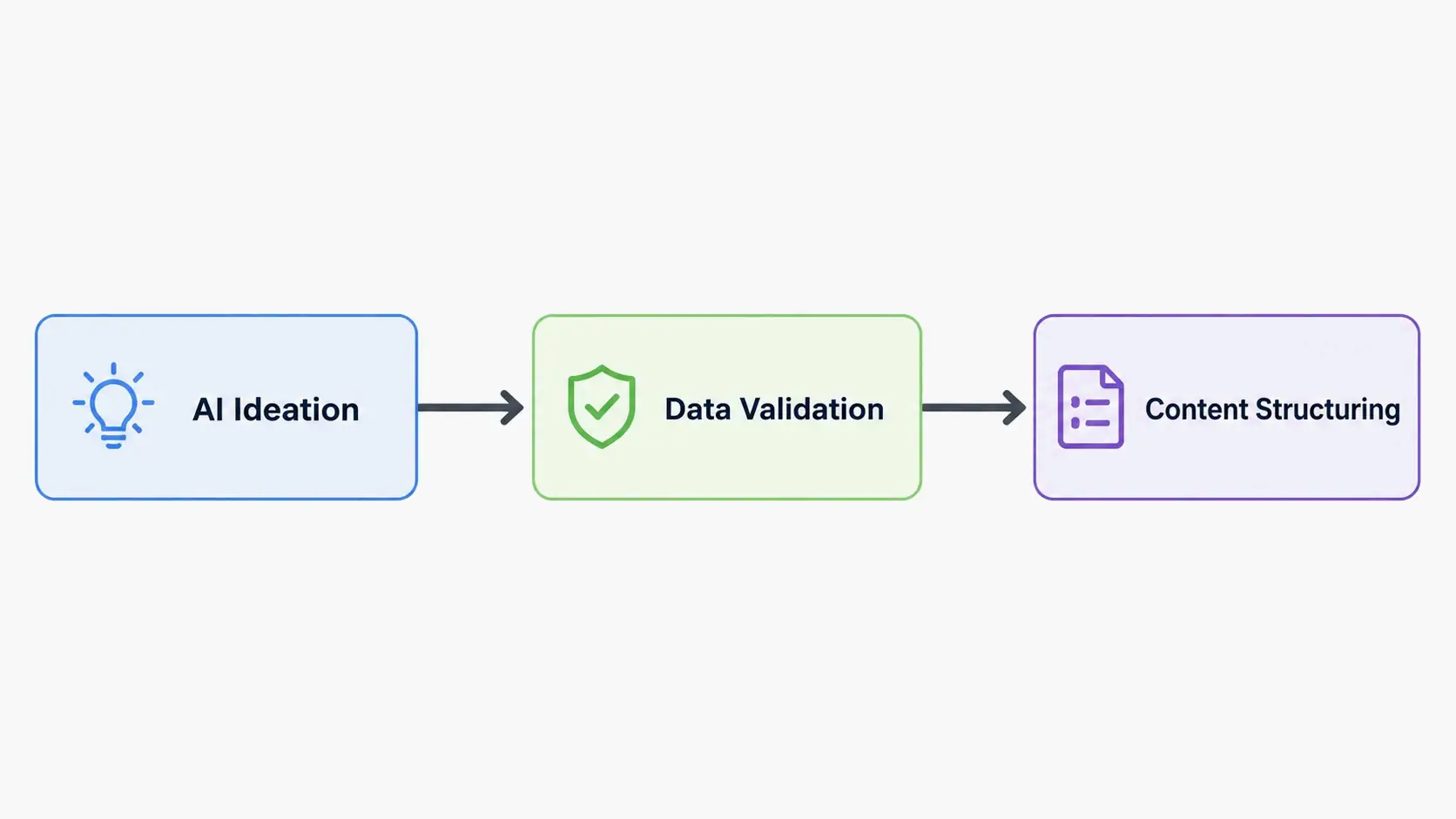
When you blend generative AI’s ability to map intent with the accuracy of traditional SEO tools, the research process becomes faster and more precise than either method alone. The workflow moves from AI‑driven ideation to data‑backed validation, and finally to a content structure optimized for both rankings and citations. As Will Soprano, Director of Digital Products at Atomic Boxes, notes, “Think of AI SEO as an extension of traditional SEO … in order to do AI SEO well, you’ll need all the traditional fundamentals as a first priority.” The goal isn’t to replace tools like Semrush or Ahrefs, but to create a symbiotic relationship where AI handles strategic thinking and those platforms confirm demand.
The broader industry has already embraced this blended approach. HubSpot reports that 66% of marketers now use AI in their roles. One SaaS client, as described by LogicBalls, shifted from chasing head terms to answering user questions and saw a 300% traffic increase in six months (LogicBalls). Teams running a GEO for SaaS strategy see similar gains when they pair intent-based keyword clusters with content built for AI citation. That result came not from throwing AI at a spreadsheet, but from applying a structured, three‑step workflow.
Step 1: Use AI for Deep Intent Mapping and Topical Ideation
Begin with a single seed topic that genuinely matters to your business — for example, “email marketing” or “content strategy.” Prompt a generative AI tool like ChatGPT to act as a search intent analyst. A strong starting prompt is: “Analyze the following niche [your topic] and provide 20 long‑tail keyword clusters based on specific user pain points, excluding broad head terms.” The model will respond with groups of queries that map the different stages of a buyer’s journey, from informational questions to commercial comparisons.
This step goes far beyond volume estimates. AI uncovers the “jobs to be done” behind each search — the real problems users want to solve. It also reveals the adjacent concerns and follow‑up questions that a topic must cover to demonstrate topical authority. The output is not a flat list, but the skeleton of a topic cluster with a pillar page and supporting articles. A test by Ryze AI found that manual prompting of this sort typically takes 20 to 60 minutes per topic, so using structured prompts is essential for efficiency. Still, the time is well spent because it replaces hours of manual brainstorming.
Step 2: Validate AI-Generated Keywords with Real Data
The critical weak spot of any generative AI tool is its inability to provide accurate search volumes or keyword difficulty scores. A raw model will confidently invent numbers that look plausible but are pure fiction. As the Ahrefs study of AI assistant link hallucination showed, AI‑cited links returned 404 errors nearly three times as often as Google results; the same unreliability applies to volume guesses. Therefore, every keyword idea from Step 1 must be validated against a live dataset.
A practical validation sequence uses three free or low‑cost sources. First, copy the 50 most promising AI‑generated keywords into Google Keyword Planner (accessible with a free Google Ads account) to get search volume ranges. Second, cross‑check those terms in Google Search Console to see whether your site already attracts impressions for them — a signal that you are close to winning that query. Third, install a browser extension like Keyword Surfer to see estimated monthly searches directly on the SERP while you manually examine the results page.
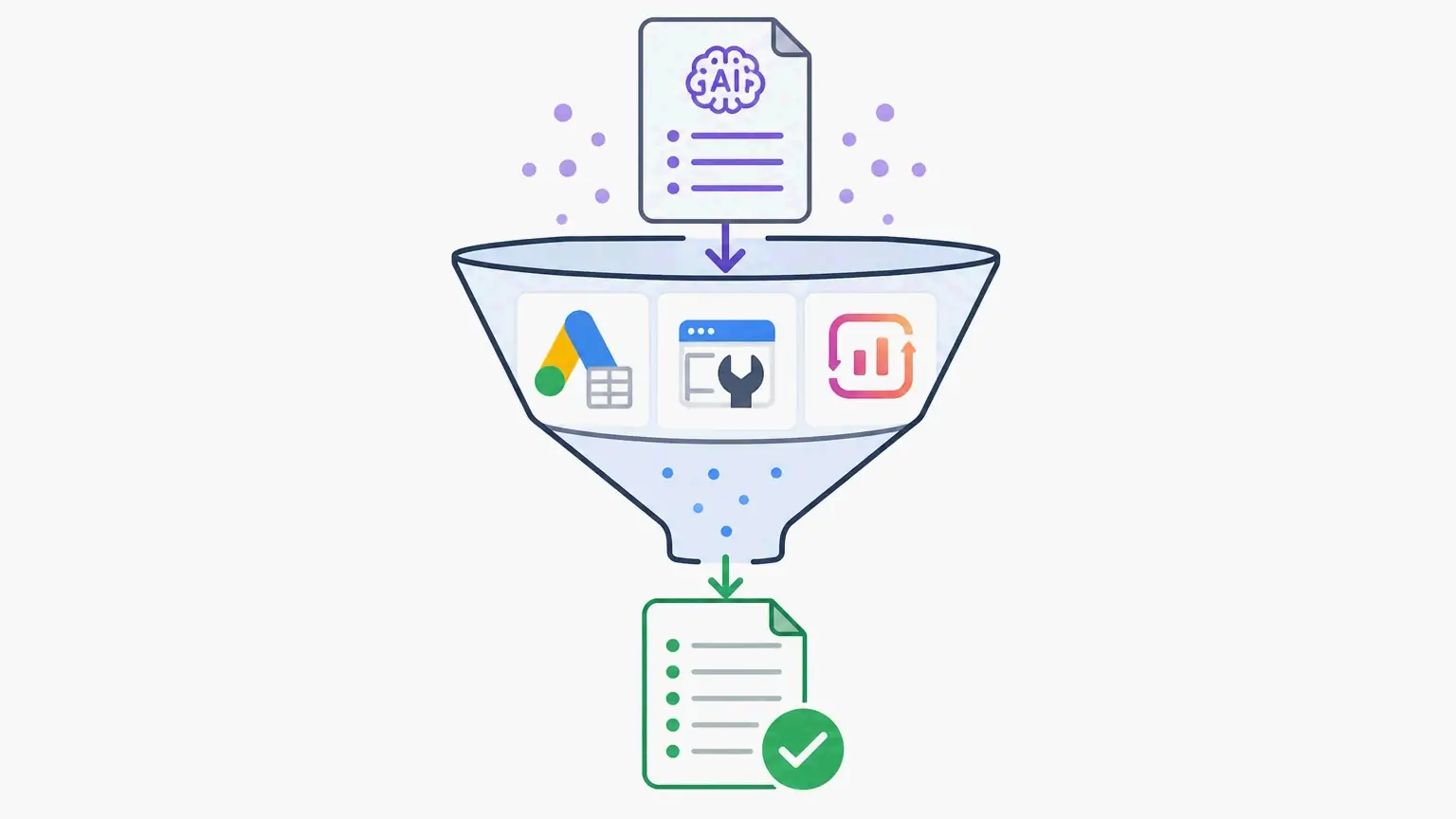
Once validated, filter the list using three prioritization criteria. First, traditional feasibility: the keyword difficulty percentage should be at or below your domain’s current authority level. Second, AI trigger potential: prioritize question‑shaped queries (“how to…,” “what is…”) and entity‑rich terms, since these are most likely to generate AI Overviews. Third, citation gap: check whether page‑one results already contain a clear, quotable answer — if they don’t, you have a strong opportunity to become the source AI engines cite. Keywords that score well on all three criteria earn both blue‑link rankings and AI citations.
Step 3: Structure Your Content Hub for Both Rankings and Citations
With a validated keyword cluster in hand, you can now design a content hub that serves two targets: Google’s classic ranking algorithm and the retrieval engines behind AI Overviews, ChatGPT, and Perplexity. Map each intent‑grouped cluster to a pillar‑and‑cluster architecture. The pillar page targets the broad primary keyword and its most important entities, while cluster pages go deep on each long‑tail variant. Dedicated keyword-planning tools can automate this prioritization step, scoring keywords into priority tiers and mapping them to a Hub & Spoke page layout.
The next layer is Generative Engine Optimization (GEO): structuring content so that AI models can lift clean, self‑contained passages into their answers. For every H2 heading, provide a direct, 40‑word answer to the query immediately after it — a “golden answer” that the AI can cite verbatim. Use definition blocks, comparison tables, and numbered lists, because these formats are easier for retrieval‑augmented generation (RAG) systems to parse. Include FAQPage schema markup to reinforce those question‑and‑answer pairs.
To streamline the journey from keyword cluster to published page, an end-to-end content system can collapse the typical multi-tool chain into a single pipeline. Our platform, GeoWriter, runs Research → Writing → Refinement → Image → Publish in one workflow, reading the live SERP before generating each article so the output matches current search intent rather than stale training data. You can also prompt ChatGPT or Perplexity to generate a content brief manually — ask the model to “create a content brief for [primary keyword] that includes H2s phrased as sub‑questions, a key takeaways box, and a table comparing [entities] — all optimized to be cited by AI search engines.” Either approach produces a guide that ensures every piece is built for both human readers and machine citation.
The 5 Best AI SEO Tools for Keyword Research Compared
The hybrid workflow depends on marrying AI ideation with accurate data, and the tools below each play a specific role in that partnership. The focus here is on their unique AI‑powered keyword research features, not general SEO overviews.
Semrush: The All-in-One Suite for AI-Powered Visibility
Semrush One now bundles traditional keyword research with a dedicated AI Visibility toolkit. The Keyword Magic Tool offers AI‑driven personalized metrics that assess your domain’s real ranking potential, not just raw difficulty scores. On the AI side, an AI Visibility Score tracks how often your brand appears in AI‑generated answers, while Prompt Research maps the actual prompts users ask of models. Fritz.ai gives it a 4.8/5 rating, calling it the best all‑in‑one AI SEO toolkit. Plans start at $199/month with a 14‑day free trial.
Ahrefs: Multi-Platform Keyword Insights
Ahrefs distinguishes itself with AI‑powered keyword suggestions for YouTube, Amazon, and Bing alongside Google (Fritz.ai). Its AI search intent insights help you immediately understand whether a keyword is informational, commercial, or transactional. This cross‑channel capability is particularly useful for brands that want to expand their reach beyond a single search engine. Pricing begins at $99/month, though free tools are limited.
Surfer SEO vs. ChatGPT: The Human Oversight Shield
Surfer SEO operates inside your writing flow, providing real‑time SEO scoring and automatically generating a list of semantic keywords you should include. It acts as a crucial checkpoint for content produced with ChatGPT’s help, anchoring it to proven on‑page metrics and preventing the E‑E‑A‑T erosion that can occur when AI writes without guardrails (Fritz.ai). ChatGPT remains the ultimate ideation engine, but it lacks real data. Pairing Surfer’s on‑page intelligence with ChatGPT’s creative power delivers content that is both original and grounded. Surfer plans start at $89/month.
Moz Pro & Perplexity: Intent Modeling and Citation Research
Moz Pro employs a two‑layer AI model — a machine‑learning classifier and a rules‑based engine — to categorize search intent with high precision (Fritz.ai). This helps you prioritize keywords by what users actually want. Meanwhile, Perplexity serves as a citation research tool. By running your target prompts through Perplexity, you can see which sources the AI engine currently cites — often Wikipedia, Reddit, and news sites — and identify content gaps you can fill. This combination moves keyword research from pure data collection to strategic citation mapping.
Will Soprano offers a critical warning about handing off strategy to any AI tool: “It’s fine to let AI do the work, but if it’s building the concept or creating the strategy, then you’re in serious trouble” (HubSpot). Use AI tools for acceleration and analysis, but keep strategic judgment in human hands.
Tailoring Your Keyword Strategy: Google AI Overviews vs. ChatGPT Citations
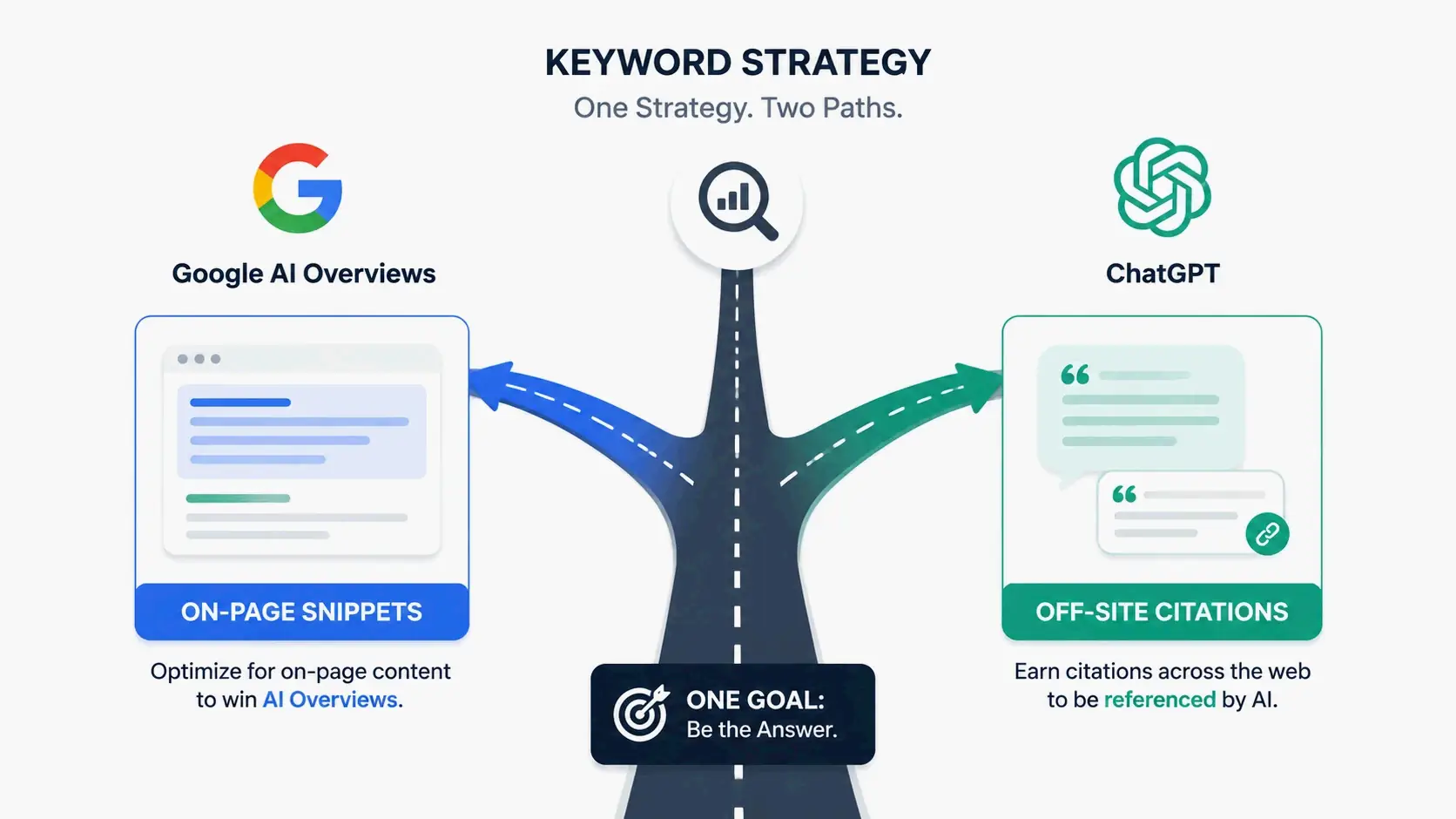
Where you want to appear changes exactly which keywords you should research and how you should structure your content. Google AI Overviews predominantly cite on‑page definitions and content hosted on brand websites, while ChatGPT pulls heavily from third‑party sources like Reddit, Wikipedia, and news outlets. Ignoring these differences leads to a keyword list that targets one engine but misses the other entirely. B2B service providers face this challenge acutely, since their buyers frequently consult both Google and AI assistants during a single research cycle.
Winning Google AI Overviews: Keywords that Trigger On-Page Snippets
For Google AI Overviews, prioritize keyword types that trigger definitions, steps, and lists. A Semrush study of 200,000 AI Overviews found that 82% appeared for keywords with under 1,000 monthly searches, and 35% were question keywords — especially those beginning with “how,” “what,” and “is.” Use Semrush’s AI Overview report to find queries where your domain already ranks but is not yet cited — a direct list of near‑win opportunities. Then optimize those pages by placing a clear, citable definition or answer in the first 100 words.
Winning ChatGPT Citations: Researching Off-Site Conversations
ChatGPT’s citation pattern is different. Otterly.ai research shows that while brand sites still account for 44.7% of ChatGPT’s citations, news and media make up 25.1% and community forums another 8.1%, with only 6.3% coming from encyclopedias. This means your keyword research must extend beyond your own site to the discussions happening on Reddit, Quora, and in news articles. Identify zero‑search‑volume keywords — the precise questions people ask in these communities — and create citable assets on your site that answer them authoritatively. Then actively participate in those external threads, ensuring your content becomes the source that ChatGPT’s retrieval system finds and quotes.
How to Add E-E-A-T to AI-Assisted Content
AI-assisted content becomes authoritative when you layer in genuine Experience, Expertise, Authoritativeness, and Trustworthiness during the keyword research and production stages. Start by identifying “E‑E‑A‑T keywords” in your clusters — terms that demand real-world proof, such as queries containing “case study,” “review,” “results,” “our process,” or “expert opinion.” These are your highest-value targets because no competitor can answer them with generic content alone.
For each E‑E‑A‑T keyword, assign a specific evidence source before writing begins. Interview a subject-matter expert and weave in direct quotes. Pull original data from your analytics, surveys, or customer records. Document a real process with screenshots or measurable results. Add author bylines with verifiable credentials and link to professional profiles. These signals are exactly what both Google’s quality raters and AI retrieval systems use to decide which sources deserve citation.
Build a human oversight checkpoint into the workflow at the keyword-selection stage. For every cluster, ask: “Can we back this with first-party evidence?” If not, either reprioritize or commit to gathering the material — run a survey, conduct an interview, or publish a detailed case study. This discipline ensures your AI-assisted content carries the authenticity signals that earn both rankings and citations, rather than blending into the sea of undifferentiated output.
Conclusion
The core of using AI for keyword research in 2026 is not full automation, but a hybrid loop: AI handles ideation, intent mapping, and cluster creation, while you validate every claim against real search data to build a citable, authoritative content hub. Start small with your next piece. Use a structured ChatGPT prompt to produce an intent‑based keyword cluster, validate the top 10 terms with Google Search Console, and write the final draft with clear, extractable answer blocks. If you want to collapse that multi-step chain into a single run, our platform GeoWriter can take you from keyword to published article at roughly $0.6 per piece — with images, E‑E‑A‑T structure, and GEO-optimized formatting included. This combined SEO and GEO workflow is the new standard for visibility as search continues to fragment.
FAQ
Can I do AI keyword research for free without expensive tools?
Yes. Use ChatGPT’s free tier for ideation and Google Search Console for validation. Install the Keyword Surfer browser extension to see estimated search volumes directly on the results page. This free workflow is effective for low‑competition, long‑tail keywords but may miss broader competitive insights (FutureFactors). When you are ready to scale, API-first content platforms can handle production without requiring expensive monthly subscriptions.
Is ChatGPT a good replacement for Semrush or Ahrefs for keyword research?
No. ChatGPT excels at ideation and intent mapping but invents or hallucinates search volume and difficulty data. Semrush and Ahrefs provide the accurate, real‑time competitive data layer essential for validation. The strongest strategy combines ChatGPT’s generative power with those platforms’ reliable metrics (HubSpot).
How do I find keywords for Google AI Overviews and ChatGPT citations?
For Google AI Overviews, search for informational queries and analyze the AI result to see what code (definitions, lists) is cited, then build that code. For ChatGPT, use Perplexity to identify the sources it pulls from — often Reddit and Wikipedia — and research those external conversations. Semrush’s AI Visibility report helps spot quick‑win opportunities (Otterly.ai).
