


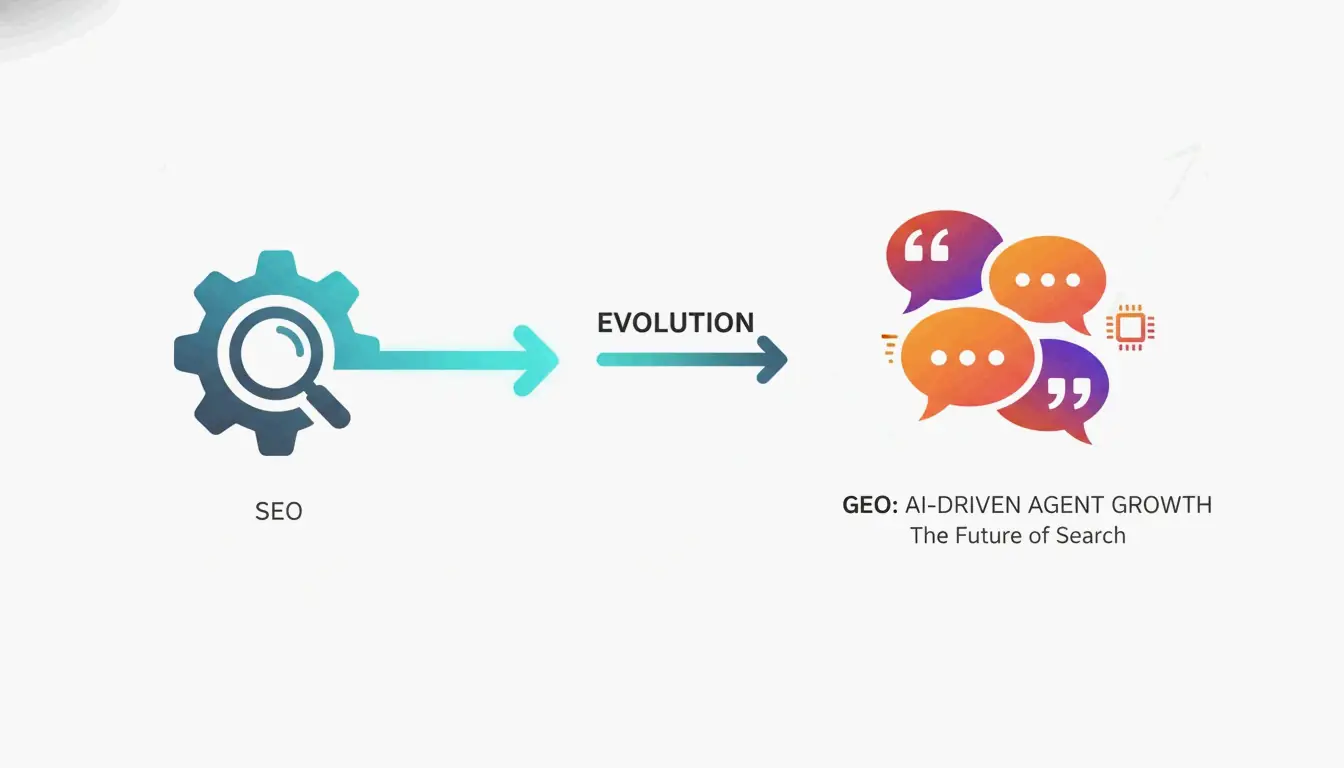
Selling GEO isn’t about inventing a new market. It’s about positioning it as a natural extension of the SEO work you already do—using a quick audit to show clients exactly where they’re invisible to AI, then packaging that into clear service tiers: audit, monitoring, or full optimization. Here’s how to do it now in 2026. For the technical GEO implementation framework, see our GEO for SaaS: Complete Playbook.
Contents
- Why Selling GEO Is a $33B Opportunity Your Agency Can’t Ignore
- The GEO Sales Process: A Step-by-Step Framework for Agencies
- Pricing Your GEO Services: Tiered Retainer Models That Work
- What Goes Into a GEO Campaign? A Tactical Breakdown
- Differentiation: How to Sell GEO When Your Client Isn’t an SEO Buyer
- Overcoming Client Objections: The GEO FAQ Engine
- Building Your Internal GEO Team: Skills, Tools, and Workflows
- Conclusion
- FAQ
Why Selling GEO Is a $33B Opportunity Your Agency Can’t Ignore
Most agencies don’t need a new market to grow AI-search revenue. They need a better conversation with the clients they already have.
The market signals are pretty clear at this point. Conductor’s 2026 State of AEO/GEO Report found that 94% of CMOs plan to increase their AEO/GEO investment this year, and 98% are already investing in some form. The GEO services market is projected to grow from $848 million in 2025 to $33.7 billion by 2034—that’s a 50.5% CAGR, according to Superlines AI Search Statistics 2026.
This is a land-grab moment. The agencies that frame the problem first—and show up with a credible way to solve it—will lock in client trust before competitors even get in the door. As ALM Corp puts it, “If you wait until those clients ask for help, you are already late.”
The real opportunity is in the adoption gap. Based on GenOptima’s 2026 research, only a small minority of marketing teams have a documented GEO strategy. Even fewer have a fully resourced program with citation tracking, schema work, a content roadmap, and a dedicated budget. Meanwhile, according to BrightEdge research cited in Writesonic’s GEO Playbook for Agencies, 54% of businesses expect their SEO or marketing partner to lead AI search efforts. That’s a textbook agency-shaped opening.
The GEO Sales Process: A Step-by-Step Framework for Agencies
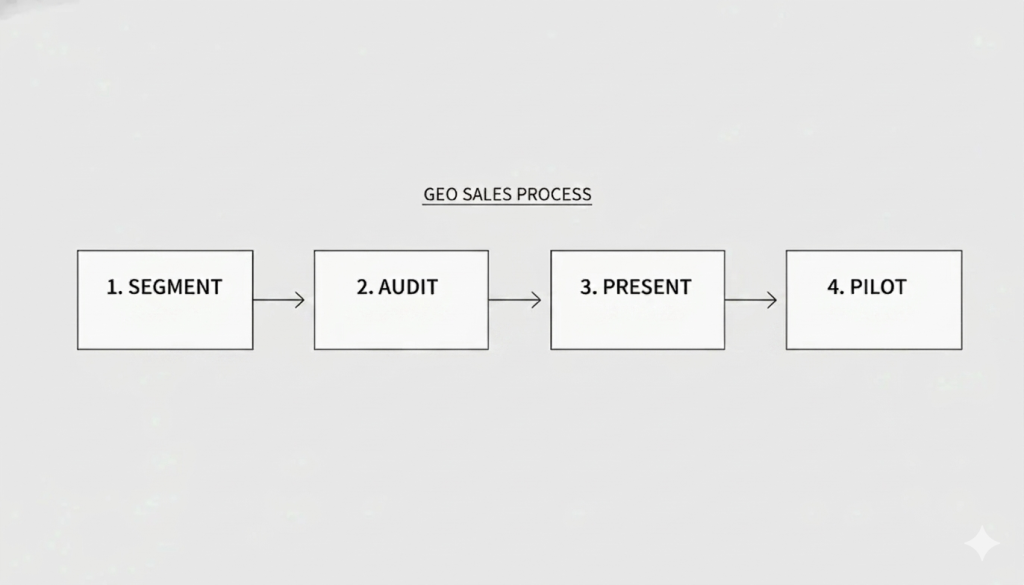
This framework works because it connects something your client already pays for to a channel they’re not yet buying. Each step can run in a single client meeting, ideally ending with a signed 90-day pilot.
Step 1: Segmenting Your Existing Client Base for GEO Upsells
Not every client deserves the same pitch first. Prioritize accounts where the business case is easiest to see.
The strongest prospects share a few common traits, per ALM Corp and GrackerAI:
– Existing SEO or content clients: They already understand search as a growth channel. GEO feels like a natural scope expansion, not an upsell from nowhere.
– High-consideration businesses: B2B services, legal, healthcare, SaaS, finance, and specialist local businesses all benefit when buyers ask broad or comparative questions before visiting a site.
– Clients with strong expertise but weak structure: These businesses have solid knowledge trapped inside thin service pages, scattered blog posts, or poor internal linking.
– Clients facing direct comparison pressure: If buyers ask “best,” “top,” or “how does X compare to Y,” they’re already in AI-answer territory.
– Multi-location or reputation-sensitive brands: These businesses need stronger entity consistency, local authority, and citation readiness across multiple surfaces.
If you’ve got a large client roster, build a simple prioritization matrix using four factors: current SEO spend, category competitiveness, content maturity, and likelihood of AI-assisted buying behavior.
Step 2: The 30-Minute GEO Audit That Closes Deals
The best GEO pitch isn’t usually a deck. It’s a short audit that makes the invisible visible.
According to ALM Corp, a practical pre-sales audit can include:
1. A list of 10 to 20 high-value commercial and informational queries.
2. Manual testing across ChatGPT, Perplexity, Gemini, and Google AI Overviews.
3. Screenshots of answers where competitors are cited and the client is not.
4. A review of the client’s existing content structure.
5. A quick schema and technical-access check (lots of sites unknowingly block AI bots via robots.txt).
6. A content gap map around definitions, comparisons, service explainers, and FAQs.
7. An authority-signal review including author clarity, review signals, trust pages, and brand consistency.
Passionfruit recommends screen-recording the results and documenting which competitors appear, which products get recommended, and whether your client’s brand shows up at all. The full audit takes less than an hour to prepare and becomes the centerpiece of your pitch.
Keep the audit short enough to sell, not so complex that you’re giving away full strategy. The goal is just to make the gap visible.
Step 3: How to Present the Competitive Gap Analysis in a Discovery Call
The most effective GEO sales approach is a live demo. Here’s how GrackerAI recommends running it:
Open with a simple question: “When your ideal customer asks ChatGPT ‘What is the best [category] tool?’, does your brand appear in the answer?” Most clients have never checked. Then do this, right on the call:
- Open ChatGPT or Perplexity and ask a question their customers would ask.
- Show them the results. Either they appear—now show where competitors appear more prominently—or they don’t, which is even better for your pitch.
- Pull up your audit data showing competitive share of voice: “Here’s how often [competitor name] gets mentioned by AI models compared to your brand across 20 different high-value queries.”
A strong audit presentation follows this sequence, per ALM Corp: First, show the query. Then show the answer environment. Then show whether the client was cited, summarized, or ignored. Then explain the likely reason in simple language. Then show what the first 60 to 90 days of remediation would involve.
The data points that close deals include real case results:
– Decentriq achieved a 221% increase in AI citations after working with a GEO agency, per Position Digital.
– Global Industrial delivered a 24% organic growth boost tied to AI search visibility, per Intero Digital case study.
– A commercial plant supplier gained a 1,400% increase in AI traffic, per The Search Initiative.
Step 4: Proposing a 90-Day Pilot – The Lowest-Risk Entry Point
Don’t ask for a full GEO retainer on day one. Propose a 90-day pilot that restructures 10 to 15 of the client’s top-ranking pages for AI extraction, implements structured data, and tracks citation changes month over month.
Passionfruit recommends setting specific success metrics that include citation frequency, citation accuracy, AI referral traffic in GA4, and share-of-voice movement against named competitors. A pilot reduces the client’s perceived risk to nearly zero and gives you a clean dataset to justify a full engagement at the next renewal conversation.
According to GrackerAI data, initial AI visibility improvements typically appear within 4 to 6 weeks, with significant citation increases in 2 to 3 months. That timeline aligns perfectly with a 90-day pilot structure.
Pricing Your GEO Services: Tiered Retainer Models That Work
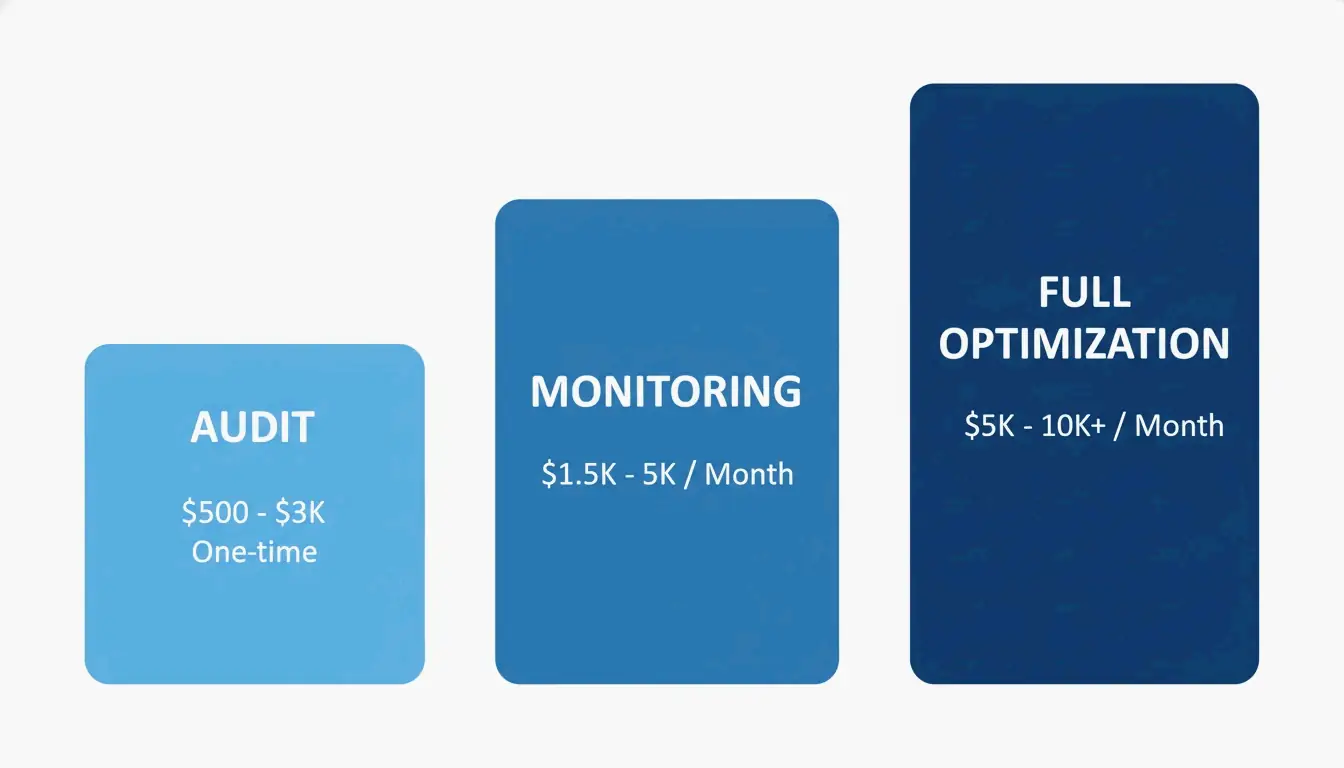
Pricing is where agencies either create momentum or create hesitation. A three-tier model, synthesized from ALM Corp, GrackerAI, and LLM Pulse guidance, works across most client profiles.
The Audit Tier: Your Lead Magnet and Sales Tool
This is the entry offer—a lower-commitment diagnostic for current clients or warm leads.
What it includes: Baseline AI visibility assessment across ChatGPT, Perplexity, Gemini, and Google AI Overviews. Competitor comparison. Content structure review. Schema and technical-readiness review. Priority gaps and first-step recommendations.
Pricing: $500 to $2,000 as a one-time project.
As LLM Pulse notes, the audit sells itself. Once clients see their AI visibility gaps and their competitors’ advantage, upgrading to ongoing monitoring or full optimization becomes an obvious next step.
The Monitoring Retainer: Ongoing Visibility Tracking
This is the core add-on for clients already investing in SEO or content.
What it includes: Monthly AI visibility monitoring across all major engines. Competitive citation tracking. Content optimization recommendations. Monthly reporting with AI visibility scores and citation trends.
Pricing: $1,500 to $5,000 per month, with GrackerAI citing a common range of $3,000 to $8,000 for more comprehensive monitoring.
The Full Optimization Retainer: End-to-End GEO Delivery
This is the broader program for brands that want a complete AI search footprint.
What it includes: Everything in the monitoring tier plus ongoing content creation optimized for AI citation (authoritative articles, listicles, comparison pages, FAQ content), schema implementation and maintenance, technical AI-readiness, digital PR support, and quarterly strategy reviews.
Pricing: $5,000 to $10,000+ per month. Enterprise programs can reach $10,000 to $25,000+ per month.
When to Use a White Label Partner to Scale Delivery
As ALM Corp notes: “For most existing clients, add-ons or scope extensions are easier to get approved.” This is where white label delivery becomes strategically important.
Many agencies can sell the work before they can fully operationalize it. A strong white label partner lets agencies add services under their own brand while keeping delivery quality, reporting cadence, and margin intact. That gives you speed without forcing immediate hiring.
What Goes Into a GEO Campaign? A Tactical Breakdown
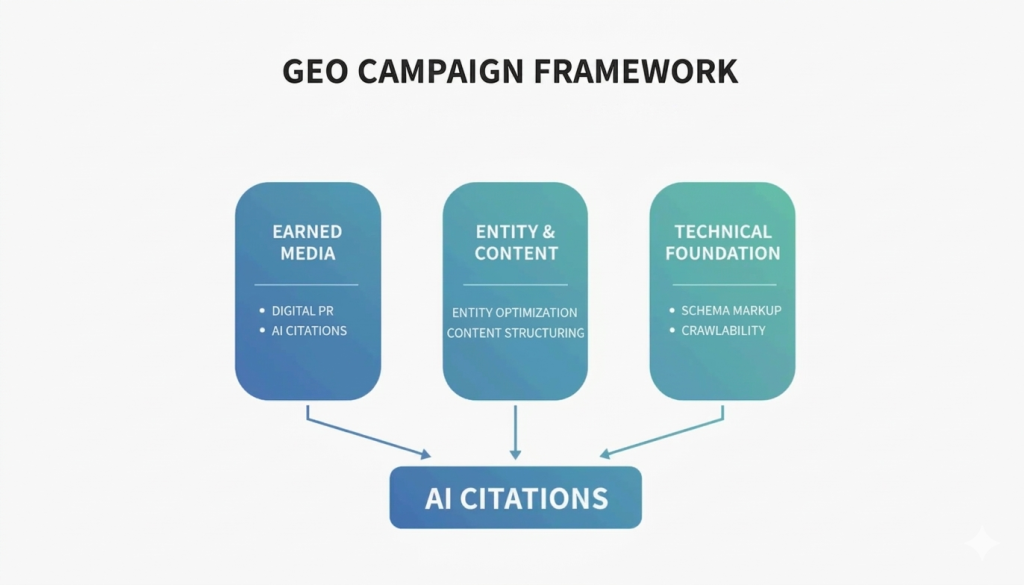
GEO isn’t a single tactic. It’s a discipline that spans content, technical optimization, authority building, and measurement.
Digital PR for GEO: How to Earn AI-Mentioning Backlinks
This is the single highest-leverage input in most GEO campaigns. According to Muck Rack’s analysis of more than one million AI citations, 95% of AI citations come from non-paid sources. A separate Stacker and Scrunch study released in March 2026 found that distributing the same article across third-party news sites delivered a median 239% lift in brand citations across AI engines.
The practical implication: digital PR for GEO campaigns treats earned media as the foundation, then layers schema, content, and on-site optimization on top. Six tactics do most of the work, per Demand Local’s agency playbook:
– Original research and proprietary data releases
– Expert-sourced commentary via platforms like Connectively, Qwoted, and Featured
– Wire distribution and multi-outlet syndication
– Executive thought leadership paired with Author schema
– Reactive newsjacking around breaking topics
– Contributed bylines in trade and vertical publications
For agency GEO programs, the spend ratio shifts. Inside traditional SEO, link building is one tactic among many. Inside GEO, third-party mentions sit upstream of nearly every other input.
Entity Optimization: Making AI Understand Your Brand
Entity optimization ensures AI systems can consistently identify a company, its products, its experts, and its relationships. This includes strengthening Wikipedia and Wikidata entries, knowledge panels, structured business data, and key third-party listings that LLMs train on.
As ALM Corp notes, “We need to structure your expertise so AI-driven search systems can retrieve it accurately and use it in answers.” Entity optimization turns fragmented brand information into a coherent, machine-readable identity that AI models can reference with confidence.
Technical Foundations: Schema Markup and LLMs.txt
Schema helps make content more machine-readable and easier to interpret. It doesn’t guarantee visibility by itself, but it can improve clarity around entities, page types, products, organizations, authors, and FAQs.
Key technical components include:
– FAQ and HowTo schema for answer-format content
– Product, Organization, and Article schema for entity clarity
– Author schema paired with expert bios for E-E-A-T signals
– AI-friendly robots.txt configuration (many sites unknowingly block AI crawlers)
– LLMs.txt files to guide AI models on how to interpret and represent brand content
Content with statistics, citations, and quotations earns 30% to 40% higher visibility in AI responses, per Superlines AI Search Statistics 2026.
Tracking GEO Success: Beyond Traditional Rankings
Traditional SEO tracks keyword rankings and click-through rates. GEO tracks different metrics entirely.
An AI Visibility Score measures how often AI search engines like ChatGPT, Perplexity, Gemini, and Claude cite a brand when answering user queries. Share of Voice compares citation frequency against named competitors. Other key metrics include brand mention volume, sentiment of AI mentions, citation count by platform, and AI referral traffic in GA4.
According to Superlines, pages updated within the last 60 days earn 28% more AI citations than older content, making content freshness its own measurable deliverable. AI search converts at 14.2% versus Google’s 2.8%, per Superlines data—which means even small volumes of AI referral traffic carry outsized revenue impact.
Differentiation: How to Sell GEO When Your Client Isn’t an SEO Buyer
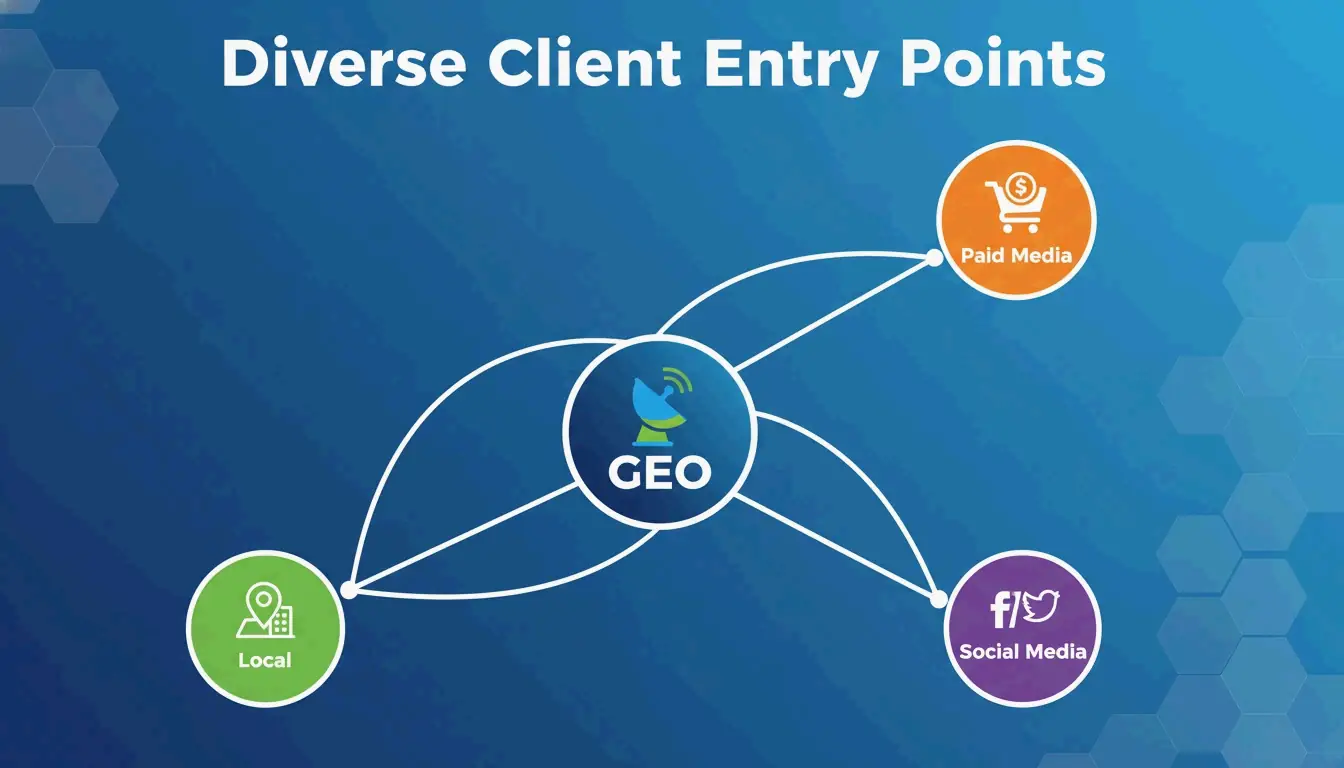
Most GEO guidance assumes the buyer is an SEO client. But some of the fastest-growing GEO opportunities sit with agencies that sell paid media, social, or local services, not search engine optimization.
The Paid Media Angle: Why GEO Improves Ad Performance
Paid ads and GEO function as an integrated visibility system rather than competing channels, according to Castle Agency research cited by Demand Local. GEO creates the authority signals that AI systems reference, while paid search captures the qualified traffic that emerges after AI-influenced research.
Transmission Agency’s client data demonstrates a 16% lift in branded search traffic when effective GEO strategies are implemented. This drives branded search volume that paid search can then capture at lower cost per acquisition. Agencies report 20% decreases in paid search CPA as GEO-driven branded search increases, per Demand Local research.
A useful script for pitching to paid media managers: “Your paid search campaigns capture demand that exists today. GEO builds the upstream authority that creates more branded demand tomorrow—and every branded search you capture after that converts at a higher rate and lower CPA.”
How to Pitch GEO to a Social Media Agency Client
Social media agencies manage brand perception, but they rarely control how AI systems describe their clients. That creates a natural entry point.
As Demand Local notes, user reviews, community engagement, industry influencers, strong social followings, and earned media coverage become critical signals that tell AI systems whether brands are credible and trusted. For social media clients already investing in brand building, GEO extends that work into AI-driven discovery surfaces where the same brand assets now serve as citation signals.
The pitch: “Your social strategy builds brand awareness with humans. GEO ensures that same brand authority is machine-readable—so when prospects ask AI tools about your category, your brand appears in the answer, not just the feed.”
Local GEO Strategy: Getting Multi-Location Clients into ChatGPT Recommendations
Local visibility is the most striking gap in GEO data. According to the SOCi 2026 Local Visibility Index, only 1.2% of local business locations are recommended in ChatGPT, meaning 98.8% are invisible. 83% of restaurants don’t appear at all in AI-generated local recommendations.
For local and multi-location clients, the pitch should emphasize stronger location entity clarity, consistent business information across directories, review and reputation signals, local service-page depth, FAQ and comparison content, and citation consistency across the ecosystem.
Agencies can pitch this directly to clients who already invest in Google Business Profile management or local listings services. The budget often already exists in adjacent form; GEO simply redirects a portion of it toward AI visibility monitoring and optimization.
Overcoming Client Objections: The GEO FAQ Engine
Every agency selling GEO will hear variations of the same objections, as documented across ALM Corp, Passionfruit, and LLM Pulse guidance. Prepare your team with direct, data-backed responses.
Objection 1: “Is GEO a Real Strategy or Just a Hype?”
This objection is the most common and the easiest to answer with data.
Response: “Multiple case studies prove GEO works. Decentriq saw a 221% increase in AI citations. A commercial plant supplier gained 1,400% more AI traffic. The market is projected to grow from $848 million to $33.7 billion, with 94% of CMOs planning to invest in 2026. This isn’t hype—it’s the next evolution of search visibility.”
Objection 2: “This Seems Too Expensive for the ROI – Does It Work for SMBs?”
Yes, especially for local businesses.
Response: “SOCi data shows only 1.2% of local businesses are recommended by ChatGPT—early adopters capture a disproportionate share of voice. Start with a low-cost audit ($500 to $2,000) to identify quick wins and prove ROI before committing to a retainer.”
Objection 3: “How Long Until We See Results? We Need Quick Wins.”
Set realistic expectations anchored in published data.
Response: “GrackerAI data shows initial AI visibility improvements typically appear within 4 to 6 weeks, with significant citation increases in 2 to 3 months. A 90-day pilot is the recommended timeframe to demonstrate measurable value. Pages updated in the last 60 days earn 28% more citations, so quick wins come from refreshing existing high-value content.”
Building Your Internal GEO Team: Skills, Tools, and Workflows
Agencies don’t need a large team to start selling GEO. They need the right combination of strategy, content, and technical capability.
Essential Tools for GEO Agencies
The core tool stack, synthesized from ALM Corp, GrackerAI, LLM Pulse, and GEO Scout guidance, includes:
- AI Visibility Monitoring: GEO Scout, LLM Pulse, or GrackerAI for tracking brand mentions, citations, and share of voice across ChatGPT, Perplexity, Gemini, and Google AI Overviews.
- Traditional SEO Overlap: SEMrush or Ahrefs for backlink monitoring, keyword research, and competitive analysis that feeds into GEO strategy.
- AI Crawlability Check: Tools like LLM Pulse’s AI Crawlability Checker to test whether client sites are accessible to AI bots.
- Schema and Technical Auditing: Screaming Frog or similar tools for structured data analysis.
- Reporting: Looker Studio for building unified dashboards that combine AI visibility data with Google Search Console and GA4.
GrackerAI notes that research shows referring domains carry roughly twice the importance for ChatGPT citations as they do for traditional Google rankings, making backlink monitoring tools essential for GEO campaigns.
When to Use a White Label Partner vs. Building In-House
Many agency owners know they should sell GEO but hesitate because of fulfillment concerns. As ALM Corp notes: “A great sales script without an operational system creates churn. A smart service page without reporting creates skepticism.”
White label delivery is especially useful when an agency has strong client relationships and sales capability but limited capacity in technical SEO, AI-era content structuring, advanced reporting, or scalable fulfillment. A white label partner handles execution under the agency’s brand, with the agency keeping margin and client relationships.
The key decision factor: If you can sell the service consistently but can’t deliver it without hiring a new team, white label is the faster path to revenue. If you have in-house capacity and want to build a differentiated capability, build in-house.
Training Your Team on E-E-A-T and Entity Optimization
E-E-A-T (Experience, Expertise, Authoritativeness, Trustworthiness) is a core signal for both traditional search and AI citation. As GrackerAI notes, AI engines evaluate content differently than Google’s ranking algorithm—they assess source credibility through E-E-A-T signals, the breadth of third-party mentions across the web, and structural clarity.
Training priorities for agency teams:
– Understanding how LLMs select and cite sources
– Entity optimization: making brands, products, experts, and locations machine-recognizable
– Content structuring for AI extraction: clear headings, direct answers, FAQ blocks, comparison tables
– Schema implementation: FAQ, HowTo, Article, Product, Organization, and Author markup
– Digital PR tactics for earning third-party citations
– GEO reporting: AI visibility scores, citation frequency, share of voice
Most agencies train current strategists on GEO measurement frameworks rather than hiring net-new roles, particularly in the first six months.
Conclusion
Selling GEO isn’t optional for agencies anymore. It’s a massive, proven revenue opportunity that starts with a single audit and grows into a recurring retainer. Start today by running a free GEO audit on your top 5 clients. Use the sales script from Step 3 to schedule discovery calls. Package the results into a 90-day pilot. The market is moving fast; the agencies that act now will own the category.
Related reading: For industry-specific GEO strategies, see GEO for B2B Services: Complete Playbook.
FAQ
Is GEO really effective, or is it just hype?
Multiple case studies prove GEO works: Decentriq saw a 221% increase in AI citations, and a commercial plant supplier gained 1,400% more AI traffic. The market is projected to grow from $848M to $33.7B, with 94% of CMOs planning to invest in 2026. It isn’t hype—it’s the next evolution of search visibility.
Is GEO worth the investment for small businesses?
Yes, especially for local SMBs. SOCi data shows only 1.2% of local businesses are recommended by ChatGPT—early adopters capture a disproportionate share of voice. Start with a low-cost audit ($500–$2,000) to identify quick wins and prove ROI before committing to a retainer.
What tools do agencies need to start offering GEO?
Core tools: GEO Scout, LLM Pulse, or GrackerAI for monitoring AI visibility. Complement with SEMrush/Ahrefs for traditional SEO overlap. White label platforms can deliver audits and reporting without building everything from scratch.
How long does it take to see GEO results?
Initial AI visibility improvements typically appear within 4–6 weeks (GrackerAI data). Significant citation increases take 2–3 months, depending on the aggressiveness of content distribution and Digital PR. A 90-day pilot is the recommended timeframe to demonstrate value.
