


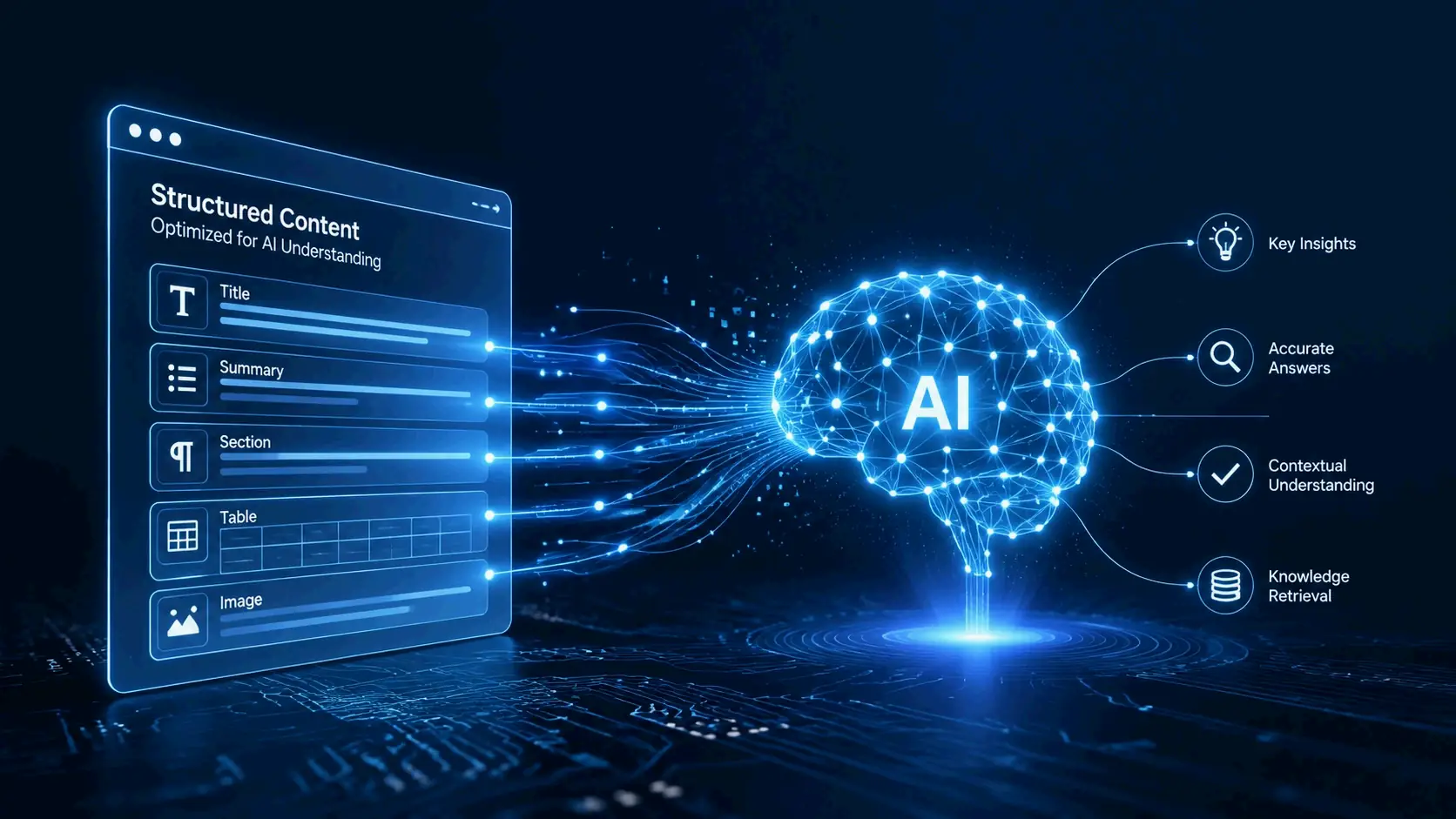
The best techniques for answer engine optimization in AI lead with direct, concise answers; structure pages with question-based headings; implement FAQ and HowTo schema; build topical authority; and earn mentions on trusted third-party sources.
Contents
- The AEO-Optimized Content Framework: What’s Changed in 2026
- Technique 1: The Direct Answer Block — Your Content’s Front Door to AI
- Technique 2: Question-Based Heading Architecture for AI Parsing
- Technique 3: Schema Markup as a Trust Signal for AI Engines
- Technique 4: Building Topical Authority with Content Depth and Freshness
- Technique 5: Earning Third-Party Mentions to Build Off-Site AI Authority
- Technique 6: The Ultimate AEO Pre-Publish Checklist
- How to Measure Answer Engine Optimization Performance (and Which Tools to Use)
- AEO Strategy by Content Type: B2B Guides vs. Ecommerce vs. News
- Conclusion
- FAQ
The AEO-Optimized Content Framework: What’s Changed in 2026
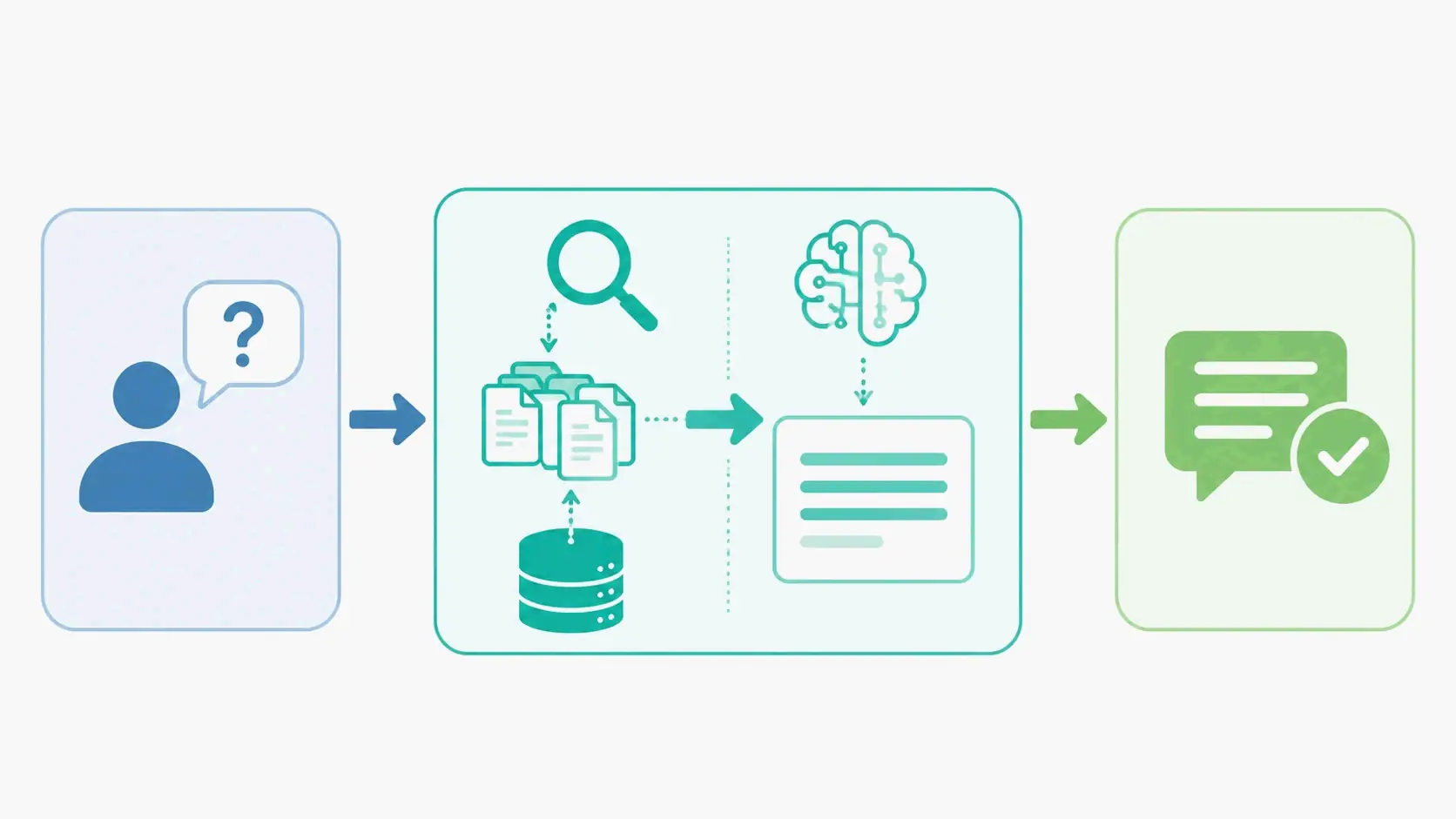
Search no longer revolves around ranking web pages. Answer engines—like ChatGPT, Perplexity, and Google AI Overviews—now use Retrieval-Augmented Generation (RAG) to pull information from the web, synthesize it, and deliver a single, direct response in real time.
This is rewriting how people encounter information. Back in 2024, Gartner predicted that search engine volume would drop 25% by 2026 because of AI chatbots and virtual agents. By mid-2026, that prediction has played out. SparkToro research indicates roughly 60% of Google searches now end without a click to the open web. At the same time, ChatGPT has hit 883 million monthly users, and Google AI Overviews appear in nearly 55% of all Google searches, per Frase data cited by Pierview.
The business impact is substantial. According to Semrush, visitors coming from AI search engines convert at a rate about 4.4 times higher than visitors from traditional organic search. When traffic does arrive from an AI citation, it’s often higher-intent and closer to a purchase decision.
The AEO framework has grown from a loose set of tactics into one integrated system. This guide moves outward—starting with on-page structure where extraction happens, then working toward off-site authority where trust is built. At every level, the goal stays the same: make your content easy for AI to find, trust, and extract.
What Makes This Framework Different
Traditional SEO focused almost entirely on ranking pages in search results. AEO adds another layer: your content has to work even when the user never clicks. As AirOps research shows, answer engines consistently favor pages that lead with clear responses and back them with evidence. The E-E-A-T framework (Experience, Expertise, Authoritativeness, Trustworthiness) now applies not only to human readers but to the AI systems evaluating content for citation.
Technique 1: The Direct Answer Block — Your Content’s Front Door to AI
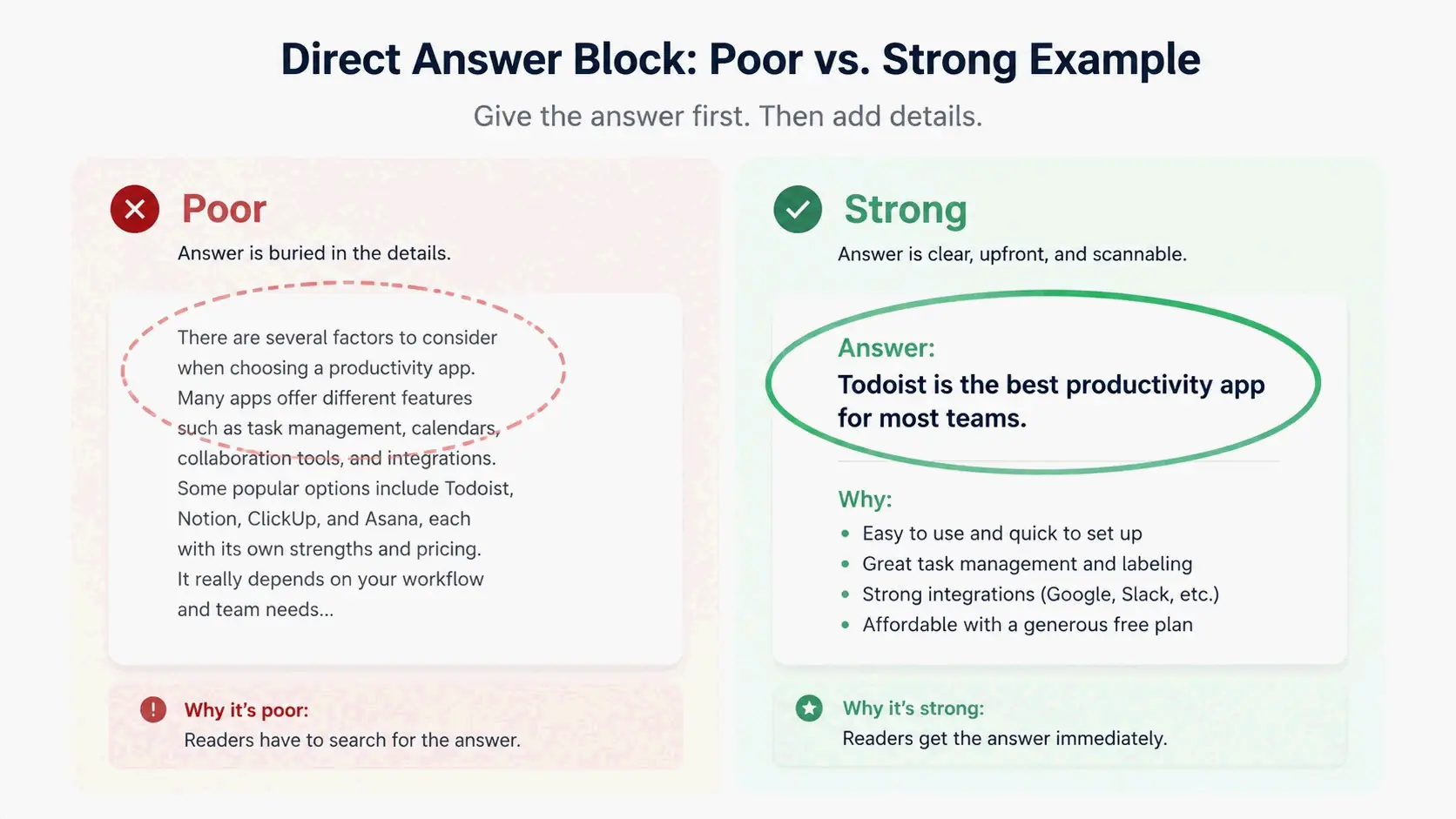
A Direct Answer Block is a 40–60 word, standalone summary placed right after an H2 heading. It answers the section’s core question immediately, which gives AI a clean passage to extract without having to parse context, guess intent, or hunt for the sentence that contains the real answer.
Why this matters: AI models process content in layers. They look for clear signals that a passage addresses a specific question. When the answer sits directly under a heading phrased as a question, extraction becomes faster and more accurate. AirOps found that sequential heading structures increase citation odds by 2.8x. The Direct Answer Block is the content that gets lifted when those headings match user queries.
What Good vs. Poor Direct Answer Blocks Look Like
Take a query like “how does schema markup affect AI visibility.” A weak block might start like this:
“Schema markup has become increasingly important in the modern search landscape. Many SEO professionals have wondered about its role, and research has begun to shed light on the question.”
That’s 40 words without an answer—no definition, no data, no specificity.
A strong version reads:
“Schema markup increases AI citation likelihood by providing machine-readable structure that removes ambiguity about page content. When FAQPage, HowTo, or Article schema matches visible content, answer engines extract information with higher confidence.”
This version delivers a clear statement, a supporting detail, and a concrete mechanism—all in about 40 words.
How to Write an AI-Extractable Direct Answer in 3 Steps
Step 1: State the answer in the first sentence. Open with a declarative definition or response. If the heading asks “What is X,” begin with “X is…” Skip introductory phrases, scene-setting, or narrative buildup.
Step 2: Add one piece of supporting evidence. Right after the definition, include a specific data point, an expert citation, or a concrete example. This signals that the answer is grounded in evidence, not just assertion.
Step 3: Keep the block self-contained. Write it so the passage makes complete sense if extracted and read on its own. Avoid phrases like “as mentioned above” or “in the following section.”
As AirOps Research notes, pages that lead with a clear answer and back it up with evidence consistently outperform pages that bury the response. The Direct Answer Block is what makes that performance possible.
Technique 2: Question-Based Heading Architecture for AI Parsing
Answer engines match user intent to content structure, not just keywords. When your headings mirror the exact questions people ask, AI systems can identify which section answers which query without guesswork.
This matters because RAG systems perform something called query fan-out—one user question triggers multiple related search queries to gather comprehensive source material. A prompt like “how do I optimize for AI search” might spawn fan-out queries such as “what is answer engine optimization,” “how does schema affect AI citations,” and “which tools track AI visibility.” Content structured as a logical question sequence (what, why, how, what next) naturally covers more of those fan-out queries.
AirOps Research shows that sequential heading structures (H2 > H3 > H4 following a logical question flow) increase citation odds by 2.8x compared to unstructured pages. The practical reason: when answer engines land on a page with clear question-based headings matched to direct answer blocks, extraction demands less computational work and produces more reliable results.
Structuring an Article with Question-Based Headings
A well-structured AEO article follows a predictable pattern:
- What: Define the concept. Use H2s phrased as “What is X” or “What does X mean.”
- Why: Explain the importance. Use H2s like “Why X matters” or “Why X is important for Y.”
- How: Provide implementation steps. Use H3s like “How to implement X” or “Step 1: Do Y.”
- What Next: Cover related questions, comparisons, or advanced applications.
This works because it mirrors how AI engines break down complex queries. Google’s documentation on AI features explains that query fan-out generates several concurrent queries from one user input. Content that answers the full question tree—not just the trunk—covers far more of those fan-out possibilities.
Conducting a Query Fan-Out for Comprehensive Topic Coverage
To find the sub-questions your content should address:
Test primary questions in AI engines. Enter your target query into ChatGPT, Perplexity, or Google AI Overviews and note the follow-up questions the system suggests or the subtopics it includes in its response.
Mine “People Also Ask” data. Search your primary keyword and document the related questions Google already surfaces. Those represent the fan-out queries answer engines are likely to generate.
Review sales and support conversations. Questions from sales calls, onboarding sessions, and support tickets reveal the real questions buyers ask—often in their exact words.
Use the FLIP framework. According to Seer Interactive, AI systems are most likely to pull live web data when queries involve Freshness, Local intent, In-depth context, or Personalization. Focus fan-out research on questions that meet at least one of those conditions.
The output should be a question map: a primary question plus 5–10 related sub-questions in logical sequence. Each question becomes a heading. Each heading gets a direct answer block. The result is a page that answers the whole question tree instead of one isolated query.
Technique 3: Schema Markup as a Trust Signal for AI Engines
Schema markup provides machine-readable signals that clarify page meaning, entity relationships, and authorship. For answer engines, structured data removes the ambiguity built into natural language, which makes extraction more reliable and citation more likely.
AirOps notes in its 2026 report that rich schema increases citation likelihood. The reason is straightforward: when FAQPage schema explicitly labels a question-answer pair, the AI doesn’t have to guess whether a passage counts as Q&A. When HowTo schema marks up sequential steps, the system can extract and present those steps in order without parsing the entire page.
Schema works best when it reflects content users can see. Marking up hidden or implied content sends mixed signals and often gets ignored. Google’s official documentation confirms there’s no special schema requirement for AI features—the same structured data that supports rich results also supports AI extraction. Google has also explicitly said that LLMs.txt files and other custom markup are unnecessary for visibility in Google’s generative AI features.
FAQ, HowTo, and Article Schema: When to Use Each
FAQPage Schema: Use when your page contains a visible FAQ section with clear questions and answers. Both the question and the full answer text must appear on the page. Per Google’s documentation, FAQPage markup shouldn’t be used for advertising or duplicated across multiple pages.
HowTo Schema: Use for step-by-step instructional content. Each step must be visible on the page. The markup helps answer engines pull out and present procedural content in chronological order—especially useful for voice search responses where a system reads steps aloud.
Article Schema: Use for blog posts, guides, and news content. This schema clarifies authorship, publication date, and content type. For AEO, Article schema supports E-E-A-T signals by connecting content to a verified author or organization.
Organization and Person Schema: Use to establish entity identity. When answer engines understand who created the content and what organization they represent, brand-related queries return more accurate results.
Implementation step-by-step:
- Audit existing pages for content that fits FAQ, HowTo, or Article formats.
- Generate JSON-LD markup for each applicable page. Validate it with Google’s Rich Results Test.
- Make sure markup matches visible content exactly—no hidden text, no implied answers.
- Deploy markup and verify in Search Console that rich results are eligible.
- Re-validate after every content update to catch syntax errors or mismatches before they block extraction.
Technique 4: Building Topical Authority with Content Depth and Freshness
Topical authority means covering a subject cluster completely—the core question, related sub-questions, comparisons, edge cases, and follow-up queries someone might ask next. Answer engines evaluate not just whether a single page answers one question, but whether a domain shows thorough expertise across a whole topic area.
This depth matters because AI systems run query fan-out, generating multiple related searches from one prompt. A site with surface-level coverage might answer the initial query but miss the follow-ups. A site that covers a question tree comprehensively has a higher chance of being cited across several related prompts.
Freshness is the second piece of authority. According to the AirOps 2026 State of AI Search Report, 83% of AI citations for commercial and evaluation-stage queries come from pages updated within the past 12 months. For high-intent queries, more than 60% of cited pages were refreshed within the last six months. Pages that aren’t refreshed quarterly are three times more likely to lose citations than recently updated pages.
What this means in practice: publishing content once and leaving it alone is not an AEO strategy. Content decays without regular upkeep, even when structure and authority are solid. A case study from Webflow illustrates the impact: after implementing a systematic content refresh program, Webflow achieved a 5x increase in refresh velocity and a 40% traffic uplift.
A 5-Step Content Refresh Workflow for AI Visibility
Step 1: Identify high-value pages at risk. Use analytics data to find pages that generate meaningful traffic or conversions but haven’t been updated in 6–12 months. Prioritize pages tied to evaluation-stage queries where freshness signals matter most.
Step 2: Audit for outdated claims. Review statistics, examples, product references, and year-specific statements. Replace any data older than 12 months with current figures. Update case studies and examples to reflect the current market.
Step 3: Expand question coverage. Review query fan-out data for the page’s primary topic. Add sections that address related questions the existing page doesn’t cover. Each new question-based heading with a direct answer block widens the page’s citation potential.
Step 4: Strengthen evidence signals. Add expert quotes, specific statistics, or citations to primary sources that weren’t in the original version. These signals raise AI trust.
Step 5: Update schema and republish. Verify that schema markup reflects any structural changes, update the publication date, and republish. Submit the updated URL through Search Console for re-indexing.
Technique 5: Earning Third-Party Mentions to Build Off-Site AI Authority
Answer engines don’t form opinions about brands based solely on brand-owned websites. They synthesize information from the broader web—news articles, review platforms, forums, industry publications, and social media. When a brand consistently appears alongside certain topics across multiple trusted sources, AI systems treat that association as a confidence signal.
AirOps research found that brands are 6.5 times more likely to be cited through third-party sources than through their own domains. In other words, what other sites publish about your brand matters far more for AI visibility than what you publish about yourself.
The mechanism is probabilistic. Lily Ray, Vice President of SEO Strategy & Research at Amsive, puts it like this: “Large language models are highly reliant on up-to-date information from search engines to provide accurate answers. Therefore, one of the best ways to drive visibility from AI search is to be among the chosen results when LLMs use web search—and that boils down to having solid SEO, strong brand awareness and a positive reputation.”
How to Identify AI’s Most-Cited Sources for Your Topic
The first step in building off-site authority is understanding which third-party sources AI engines already trust for your queries.
Test your priority queries in AI engines. Enter a question into ChatGPT, Perplexity, or Google AI Overviews and document which domains appear as citations. Repeat this across multiple related queries to spot patterns.
Categorize the source types. Cited sources usually fall into a few buckets: industry publications, listicles and comparison articles, review platforms (G2, Trustpilot), forums (Reddit, Quora), YouTube videos, and research or data publications.
Prioritize sources you can realistically influence. A New York Times article may be harder to secure than a niche industry blog, but both carry weight with AI engines. Focus on sources where you have a credible path to inclusion—digital PR outreach, guest contributions, expert commentary, or product review programs.
An Outreach Framework for Earning Mentions on AI-Trusted Sites
Step 1: Build a target list. Document the specific pages that appear as AI citations for your target queries. For each page, find the author or editor contact information.
Step 2: Prepare your value proposition. Before reaching out, figure out what you can offer. Options include original data or research findings, expert commentary from credible team members, a unique perspective or case study, and product access for review purposes.
Step 3: Execute outreach with pre-written copy. Make inclusion easy for authors and editors. Provide a pre-written paragraph they can adapt, along with supporting data or credentials. Respect their editorial independence—the goal is to be included because your brand adds value to their content.
Step 4: Expand to YouTube visibility. Ahrefs research shows YouTube mentions have the strongest correlation with AI visibility across ChatGPT, AI Overviews, and AI Mode. For B2B brands, the opportunity is significant because many high-value topics have limited video coverage. Create videos that answer buyer questions directly, or partner with YouTube creators for product reviews and expert interviews.
Technique 6: The Ultimate AEO Pre-Publish Checklist
Most AEO guides tell you what to do but stop short of giving you a practical tool to run before you hit publish. The checklist below pulls every major technique from this guide into one pre-publish verification workflow. Run through it before publishing any new or refreshed piece of content you want cited by answer engines.
Direct Answer Blocks
– Does each H2 section open with a 40–60 word, self-contained answer?
– Can each direct answer block be extracted and read independently?
Heading Hierarchy
– Are H2, H3, and H4 headings phrased as questions where possible?
– Do headings follow a logical sequence (what, why, how, what next)?
– Does the structure avoid vague or marketing-driven heading language?
Schema Markup
– Is FAQPage schema applied where visible Q&A content exists?
– Is HowTo schema applied for step-by-step instructional content?
– Is Article schema applied with correct author and publication date?
– Does all schema markup match content visible on the page?
Internal Linking and Topic Clusters
– Does the page link to related content using descriptive anchor text?
– Is the page connected to a broader topic cluster on your site?
Freshness and Dating
– Has the page been updated within the last 12 months?
– Are statistics, examples, and references current and accurate?
– Is the publication or last-updated date clearly visible?
Author E-E-A-T Signals
– Is the author identified with a visible bio?
– Does the bio include relevant credentials or experience?
– Are claims backed by data, citations, or expert input?
Readability and Extraction
– Are paragraphs short enough to scan (2–4 sentences)?
– Are lists, tables, or visual elements used where they improve clarity?
– Does content avoid marketing language that signals promotional intent?
Third-Party Mention Status
– Does your brand appear on trusted third-party sources for this topic?
– Is there an active outreach plan for sources you haven’t secured?
This checklist is built for real use. Walk through each item before publishing, and treat any gaps as tasks—not failures. Pages that pass every check earn citations more consistently and hold them longer as AI platforms re-index content.
How to Measure Answer Engine Optimization Performance (and Which Tools to Use)
Traditional rank tracking measures position in search results. AEO measurement calls for different metrics because visibility in answer engines doesn’t always produce clicks or conventional rankings.
Citation Frequency: Track how often your content appears as a cited source in ChatGPT, Perplexity, Google AI Overviews, and Gemini responses for your priority queries. Perplexity surfaces citations inline, making it one of the clearest platforms for monitoring whether your content is being selected.
Share of Voice: Measure how often your brand appears in AI responses relative to named competitors. This metric captures category positioning more than raw traffic.
Prompt Coverage: Calculate the percentage of priority questions in your topic map that your content can answer clearly. Higher coverage means more opportunities for citation across related queries.
AI Referral Traffic: Monitor direct traffic from AI platforms in your analytics. While this metric undercounts total AEO impact, it provides a concrete signal of which pages drive clicks from AI responses.
Assisted Conversions: Track conversions where an AI touchpoint appeared in the user journey. This captures influence that doesn’t register as direct referral traffic.
Tools that support these measurements include Semrush, which added AI visibility tracking to its existing SEO toolkit, and AirOps, which connects citation monitoring to content optimization workflows. Google Search Console’s Generative AI performance report gives visibility into how content performs in Google’s AI features.
Timeline expectations: citation patterns usually shift within 4–8 weeks of structural improvements on pages with existing authority. Freshness-driven changes on recently updated content often move faster. Building lasting off-site authority and topical dominance typically requires 3–6 months of steady effort.
Key AEO Metrics to Track in 2026
Immediate signals (track weekly): Citation frequency for priority queries, AI referral traffic volume, featured snippet ownership changes.
Mid-term signals (track monthly): Share of voice relative to competitors, prompt coverage percentage, content refresh compliance rate.
Long-term signals (track quarterly): Assisted conversion trends from AI touchpoints, branded search volume changes, overall topic authority in AI responses.
AEO Strategy by Content Type: B2B Guides vs. Ecommerce vs. News
Not all content serves the same purpose, and AEO tactics shift depending on what the page is designed to accomplish.
B2B Guides: Decision-makers search with increasingly specific, multi-layered questions about implementation, integration, and ROI. B2B AEO leans heavily on comprehensive topical authority through deep query fan-out coverage. Content should cover not just the primary question but the full evaluation path—comparisons, pricing context, technical requirements, and post-purchase considerations. YouTube visibility is especially valuable for B2B because many high-intent topics lack video coverage, which creates gaps your content can fill. Expert quotes, original research, and case study data strengthen the evidence signals AI engines weigh heavily for commercial queries.
Ecommerce Product Pages: Answer engines are getting better at completing transactions. For product pages, direct answer blocks should immediately address core specs—dimensions, materials, compatibility, and key differentiators. FAQ schema should cover buyer evaluation questions: shipping policies, return terms, warranty details, and comparisons to alternatives. Third-party reviews on trusted platforms like Trustpilot, G2, and Yelp carry outsized weight because AI engines treat aggregated review signals as validation. Structured product feeds and clear policy pages enable the agentic commerce shift, where AI systems select and recommend products based on machine-readable data rather than marketing copy.
News Articles: Freshness is the dominant signal for news content. Article schema with accurate publication timestamps is essential. Direct answer blocks should summarize key facts—who, what, when, where, why—in the first paragraph, aligning with the inverted pyramid structure AI engines favor for time-sensitive information. News content that demonstrates FLIP criteria (Freshness, Local intent, In-depth context, or Personalization) has a higher probability of being retrieved through RAG systems when users ask about current events.
Conclusion
The best techniques for answer engine optimization all come back to one central idea: make it easy for AI to find, trust, and extract your content. Clear structure, proven authority signals, and consistent freshness are the three variables within your control that most reliably predict citation performance. Take one top-priority article today and run it through the AEO Pre-Publish Checklist from this guide. Prioritize adding a direct answer block and refreshing any facts older than 12 months. Then measure citation changes over the next 4–8 weeks. The teams that build systems for AI visibility now will compound their advantage as answer engines handle an increasing share of research and evaluation.
FAQ
Is Answer Engine Optimization (AEO) just a trend, or is it here to stay?
AEO is a structural shift, not a trend. It’s driven by the permanent integration of large language models into search behavior. With AI search visitors converting at 4.4 times higher rates and platform user bases continuing to grow, optimizing for answer engines is now a core digital strategy rather than an experimental tactic.
What are common mistakes to avoid in Answer Engine Optimization?
Treating AEO as a separate channel from SEO is a common mistake. The two are complementary—SEO gets content discovered, AEO determines whether it gets cited. Ignoring content freshness is another critical error, as 83% of AI citations come from pages updated within 12 months.
How long does it take to see results from AEO efforts?
Initial visibility improvements can appear within 4–8 weeks for freshly updated, well-structured content targeting low-competition queries. Building lasting off-site authority and topical dominance typically requires 3–6 months of consistent effort across content creation, refresh cycles, and third-party mention building.
Can AEO replace traditional SEO completely?
No. AEO doesn’t replace SEO; it’s what SEO is evolving into. Strong technical SEO fundamentals, site authority, and a positive brand reputation remain the foundation on which AI visibility is built. As Lily Ray notes, large language models rely heavily on traditional search indices to provide accurate answers.
