


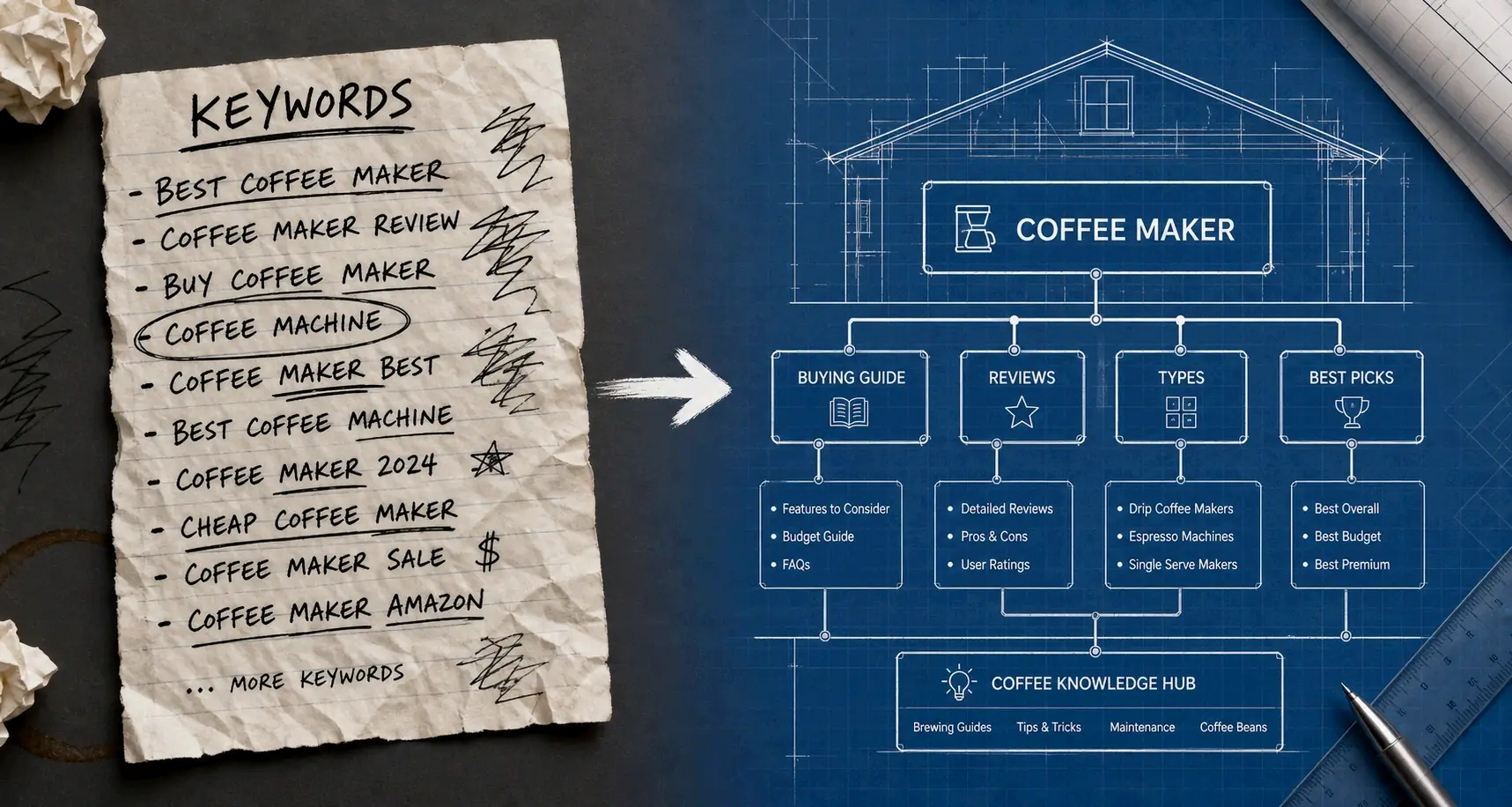
A topical content map is a plan for organizing your content so search engines see you as a real expert on a subject. Instead of chasing individual keywords, you build clusters of connected pages—pillar pages supported by deeper articles—that work together to prove your site thoroughly covers a topic.
Think of it as moving from a grocery list of keywords to an actual architecture. Google and AI search systems have gotten much better at spotting which sites genuinely know their stuff versus which ones just stuffed the right terms into the right places. A solid topical content map is what gets you ranked for queries you never even optimized for.
Contents
- Why a Topical Content Map Matters More Than Keywords in 2026
- The Strategic Framework: Define Your Scope Before You Touch a Tool
- Step-by-Step: How to Build a Topical Content Map That Won’t Cannibalize
- How to Audit a Topical Content Map Before You Publish
- Frameworks for Different Business Models: E‑commerce, SaaS, and Content Sites
- Optimizing Your Topical Content Map for AI Search Engines (GEO)
- Tools for Topical Content Map Creation: What Actually Works
- Conclusion
- FAQ
Why a Topical Content Map Matters More Than Keywords in 2026
Search engines evaluate content differently now. For years, ranking was straightforward: match a page to a keyword, put the right words in the right spots, and you’d climb the SERP. That model’s dead. Google and AI search platforms increasingly reward sites that show connected, comprehensive expertise across an entire subject—not pages optimized for isolated queries. This shift from keyword-level optimization to topic-level authority is the biggest change in SEO since mobile-first indexing.
A topical content map is how you respond to that shift. It’s a structured plan showing how every piece of content you publish connects to a central subject, forming a web that search engines read as genuine expertise. The results are measurable. Sites with strong topical architecture rank for thousands of related queries they never explicitly targeted, show up in AI-generated answers across multiple platforms, and weather algorithm updates far better than sites with scattered, disconnected content.
Topical Authority: The Compound Interest of SEO
Topical authority is the recognition search engines give your site when you cover a subject comprehensively and coherently. It works like compound interest: the more connected content you publish in a defined topic area, the more each new piece benefits from the authority already built by the pages around it.
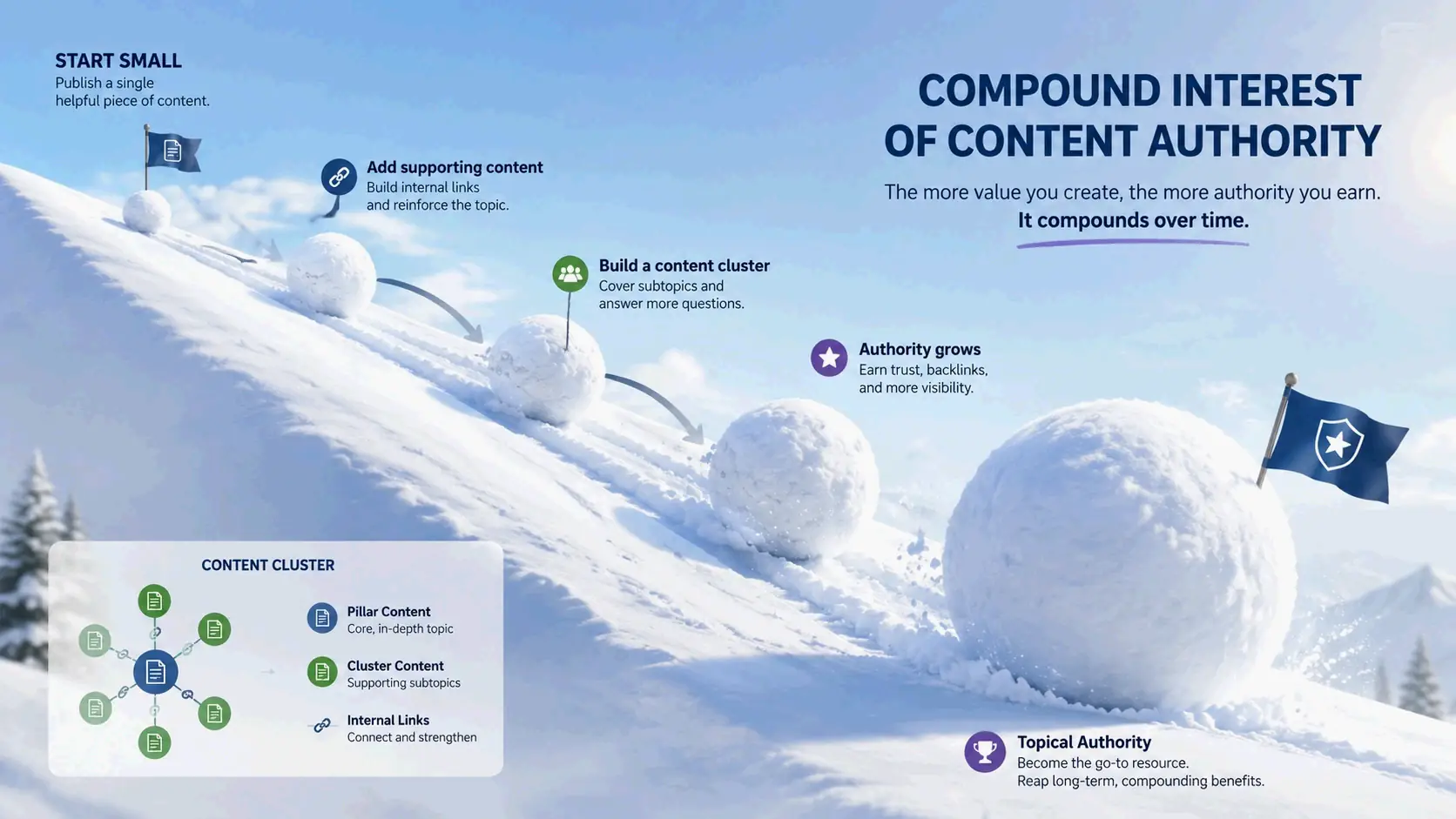
You can see this playing out in competitive SERPs. Bicycle Motor Works, a specialist e-bike retailer, operates with a Domain Rating (DR) of 15—that’s relatively weak backlink strength. Yet it consistently outranks Amazon, with a DR of 96, for competitive e-bike keywords, according to analysis by Ahrefs. The reason is structural: Bicycle Motor Works covers the e-bike topic with depth and focus, while Amazon’s content spans countless categories, diluting its topical signal. The specialist also earns regular AI Overview appearances simply because it owns the e-bike subject better than larger brands with scattered attention.
This compounding visibility stretches across traditional search and AI platforms alike. Healthline shows just how big the advantage can be. A single page on its site about magnesium glycinate ranks for 2,500 keywords on Google, appears in 473 AI Overviews queries, and surfaces across 279 prompts on ChatGPT, 200 prompts on Perplexity, 28 prompts in Gemini, and 86 prompts in Copilot, as reported by Ahrefs. Each piece of content benefits from the topical authority accumulated by the entire health library, not just its own optimization.
What the 2024 Google Leak Revealed About Topic Focus
In 2024, an unprecedented leak of Google’s internal API documentation confirmed what SEO practitioners had long suspected: Google models each site’s topical identity and penalizes content that drifts from that center. Two internal signals stand out, as identified by analysis from Shaun Anderson at Hobo Web.
The siteFocusScore measures how concentrated your content is around a core subject. A high score means your site stays tightly relevant to a defined topic area. The companion signal, siteRadius, measures how far your content strays from that center. Publishing off-topic content doesn’t simply fail to build authority—it actively dilutes the authority signal you’ve already earned.
Here’s what that means in practice: your topical content map has to define not just what you’ll cover, but what you’re intentionally leaving out. Every piece of content outside your semantic boundary weakens the focus signal you’re working to strengthen. Before greenlighting any new piece, ask yourself: would someone landing on this page for the first time immediately understand what my site is about? If the answer’s no, that topic probably doesn’t belong in your map.
The Strategic Framework: Define Your Scope Before You Touch a Tool
There’s a common trap in topical mapping: reaching for software before you’ve answered the foundational strategy questions. Tools can speed up research, clustering, and gap detection, but they can’t determine your semantic boundary, validate your entity model, or make the editorial calls that separate an authoritative cluster from a keyword dump. As Koray Tuğberk GÜBÜR, who originated the framework, has stated, cited by Ayon Chy: “A topical map is not a list of keywords.” It’s a semantic architecture that models how Google understands entities and their relationships.
The strategy-first approach means defining three layers before you open any tool: your semantic boundary, your entity-attribute-value model, and your intent map. These decisions shape everything that follows. Without them, even the most sophisticated clustering algorithm spits out output that looks organized but lacks the editorial logic that produces rankings.
From Keyword List to Semantic Network: The EAV Method
The Entity-Attribute-Value (EAV) model is what elevates a topical map from a keyword cluster into a ranking architecture. An entity is a thing Google recognizes—a noun like “storage ottoman,” “API management,” or “essential tremor.” Attributes are the properties of that entity that people search for—storage volume, hinge mechanism, medication options, surgical treatments. Values are the specific facts, comparisons, and answers that satisfy those attribute queries.
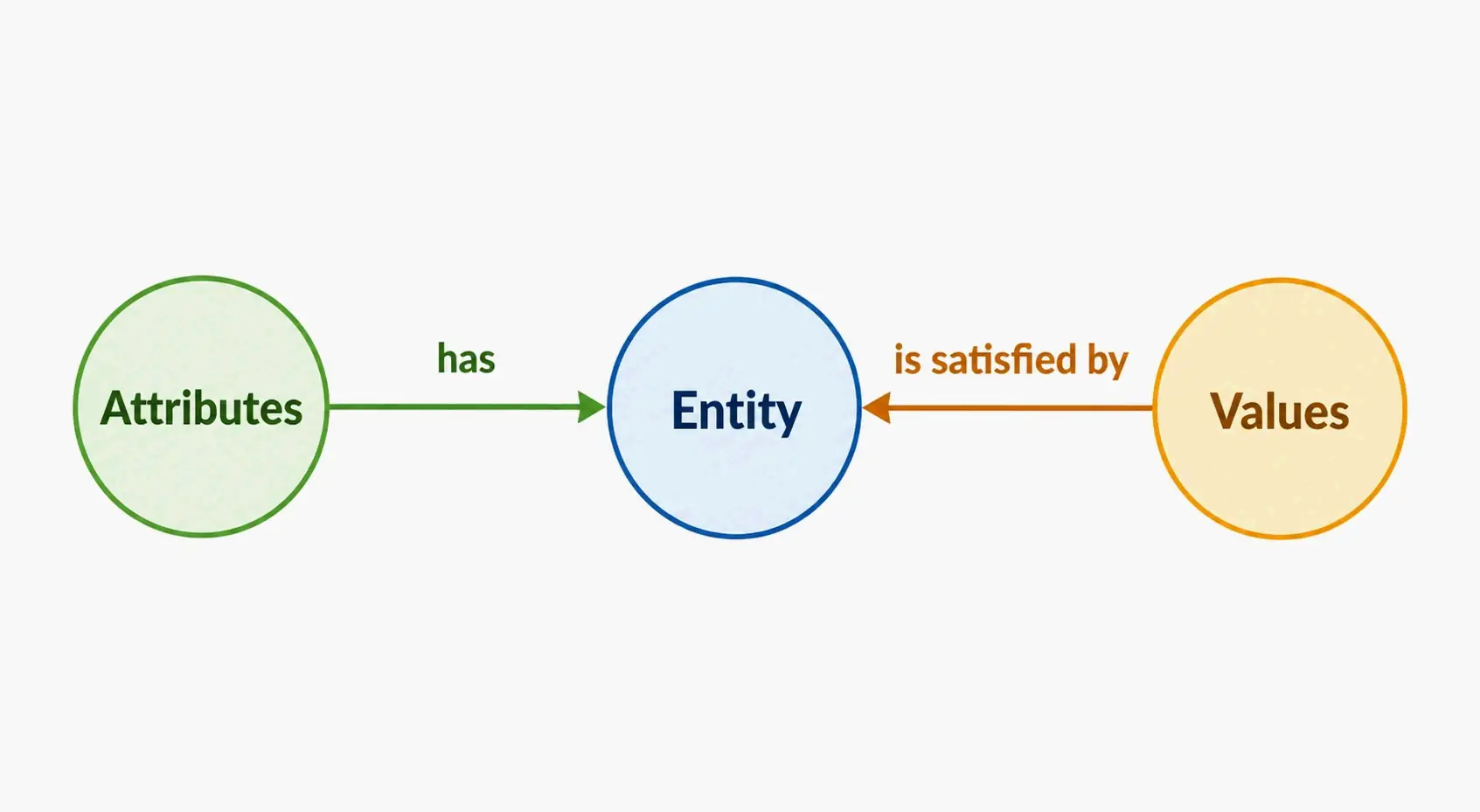
To build an EAV framework, start by identifying your central entity. Define the attributes a user needs to understand to make a decision about that entity. Then, for each attribute, verbalize the specific queries real people search—not just the main term, but the full range of phrasings across informational, commercial, and transactional intent. This verbalization step connects your entity model to actual search demand. A map built on EAV logic naturally avoids the gaps and overlaps that plague keyword-first maps, because every page in the architecture answers a specific user question about a specific entity attribute.
Intent Mapping: Matching Content Type to User Goal Before You Write
Search intent is the goal behind a query. Getting it right determines whether your content satisfies the user or misses completely. The four standard intent categories—informational, navigational, commercial investigation, and transactional—need to be assigned at the page level before content production begins.
Informational queries require educational depth: guides, explainers, how-to articles. Commercial investigation queries need comparison, evaluation criteria, and buying guides. Transactional queries demand product pages, pricing information, and conversion paths. When a map assigns the wrong content type to an intent, you get a page that ranks poorly no matter how good it is—because it doesn’t match what the user came to find.
A solid intent map also prevents the most common architectural failure in topical mapping: multiple pages targeting the same intent with slightly different keywords. This is what causes cannibalization, and you can only catch it at the structural level, before publication. Each macro context—the combination of a primary entity and a single user question—should have exactly one page assigned to it. If your map shows two pages serving the same macro context, one of them needs to be merged, redirected, or re-scoped before it ever reaches your content team.
Step-by-Step: How to Build a Topical Content Map That Won’t Cannibalize
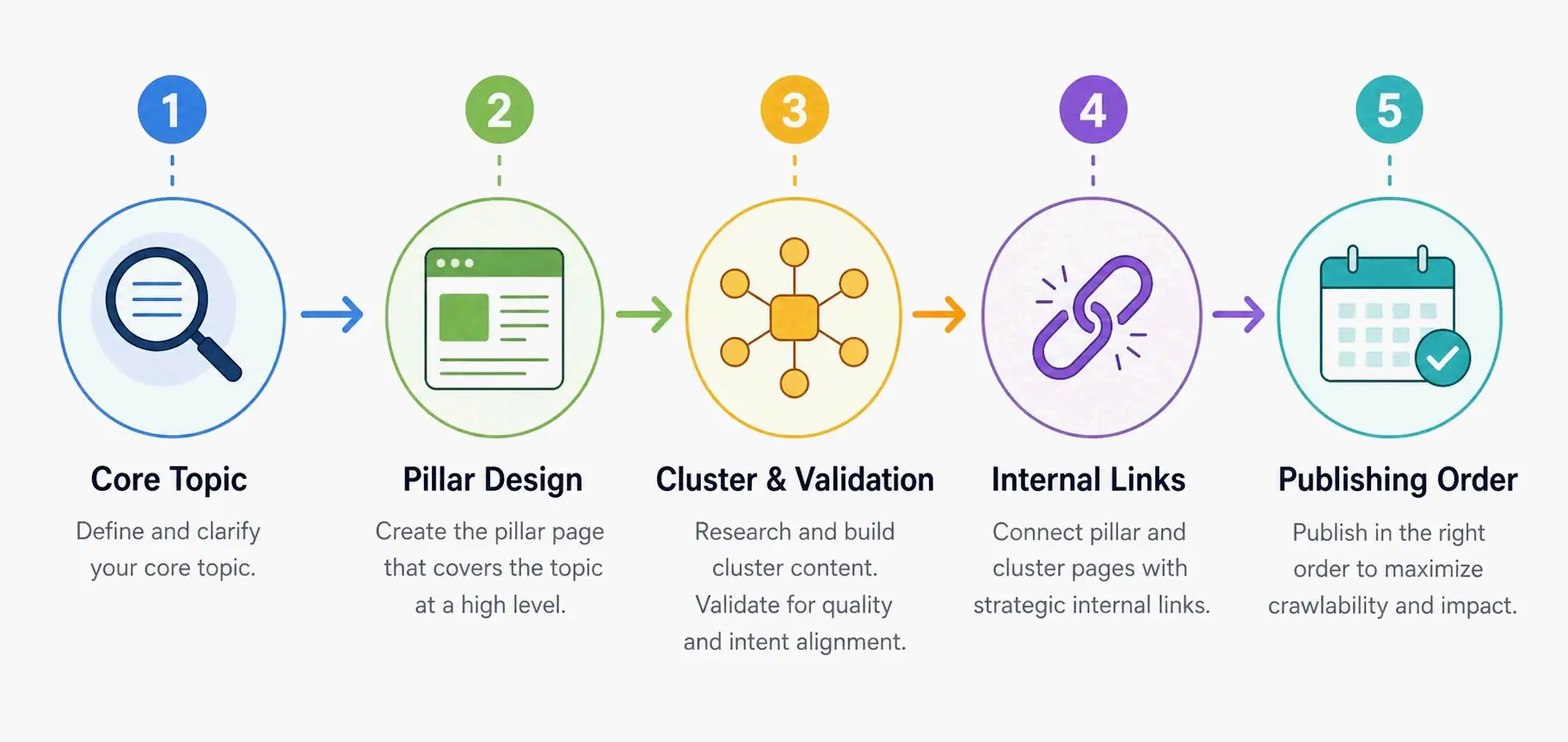
Building a topical content map follows five distinct steps. Each step builds on the one before it. Skip steps, or do them out of order, and you’ll produce the kind of architectural weakness that surfaces months later as flat traffic, cannibalized rankings, or clusters that never gain traction. The framework below is designed to prevent exactly what SWAT SEO observed when a previous agency used a tool to build a map that produced 47 pages where 12 targeted variations of the same query, as reported in their 61-day tool test. The map looked organized. The architecture was broken from the start.
Step 1–2: Pillar Design and Cluster Logic
Step one is core topic selection. The right scope is specific enough to build genuine expertise around but broad enough to support a meaningful cluster of supporting articles. “Enterprise API management for fintech” works. “API management” is too broad. “One specific API endpoint configuration” is too narrow. The topic also needs to align with your Ideal Customer Profile’s research behavior and your product’s core use case, so content authority translates into business outcomes.
Step two defines the pillar page architecture. A true pillar page isn’t a glorified guide or a long blog post with a table of contents. It’s a comprehensive resource that covers the broad topic at a high level and systematically links to every cluster page beneath it. The pillar answers the main question for the core entity. Cluster pages go deep into specific attributes, each targeting a distinct user question with a clear search intent. This distinction matters because search engines evaluate whether your pillar genuinely serves as a hub. A weak pillar—a thin overview with links to shallow supporting pages—fails to signal the authority the architecture is designed to project.
Cluster generation should follow SERP-overlap logic, not lexical similarity. Keywords that Google consistently ranks the same pages for should be grouped together. Keywords that require different content types or serve different intents should be separated, even if the words look related. Parent topic clustering, the method used by tools like Ahrefs’ Clusters by Parent Topic feature and Keyword Insights’ SERP-overlap algorithm, groups keywords by what Google actually treats as related—not by surface-level word matching.
Step 3–5: Validation, Linking, and Launch
Step three is hierarchy validation and cannibalization detection. Every cluster must have a clear pillar page. Every article within a cluster must serve a distinct macro context—one article, one user question, one primary entity. When two URLs in your map answer the same macro context, you’ve created a cannibalization conflict that Google can’t resolve. The result: one page ranks for both queries, often the wrong one, and neither performs at its potential.
Step four builds the internal linking architecture. The pillar page links to every cluster page within its topic. Every cluster page links back to the pillar. Cluster pages covering closely related subtopics cross-link to each other. This network of links is the physical structure that signals to Google how your content relates, and it’s what transfers authority through the cluster. Without it, even well-researched pages remain cut off from the topical signal they should be strengthening.
Step five defines the publishing order. The pillar page goes live first, so every subsequent cluster article has a hub to link back to from day one. Cluster articles targeting evaluation-stage queries, which drive the highest pipeline contribution, should be prioritized next. Foundational concept content follows to capture early-stage awareness. Publishing a pillar page after its supporting articles is a structural error that starves the pillar of authority. The sequence of execution matters as much as the architecture itself.
How to Audit a Topical Content Map Before You Publish
A topical content map that looks fine on paper can still contain structural failures invisible until the content goes live. The only way to prevent this is a systematic audit before your team writes a single page. The process below catches the four categories of failure that most commonly undermine topical maps: intent conflicts, hierarchy violations, orphaned pages, and competitive coverage gaps. GeoWriter’s SEO Audit Skill runs 92 AI-powered checks across these dimensions, catching structural issues that manual review often misses.
The 4-Point Pre-Publish Audit Checklist
The first checkpoint is intent conflict detection. Review every page in the map against its assigned search intent. Does the content type match the user goal? If a page targeting a commercial investigation query is structured as a how-to guide, it won’t rank regardless of quality. If two pages in the same cluster target the same intent with different keywords, merge them now. The cost of fixing this after publication is a content restructuring project. The cost of catching it before publication is a five-minute review.
The second checkpoint is pillar-cluster hierarchy validation. Every cluster must have an identifiable pillar page that covers the broad topic and links to every supporting article. If a cluster exists without a pillar, it’s structurally incomplete. If a pillar page doesn’t link to its cluster articles, the authority pathway is broken.
The third checkpoint is orphan page identification. Every page in the map should have at least one other page linking to it within the cluster architecture. Pages with no inbound internal links are orphaned from the cluster signal. They may still rank, but they’ll underperform because they receive none of the authority flowing through the internal linking network.
The fourth checkpoint is competitive breadth. Use a content gap matrix to compare your planned coverage against the top three competitors ranking for your core topic. Identify subtopics they cover that your map doesn’t address. These are coverage gaps that will limit your topical authority no matter how well your existing pages perform. Prioritize filling the highest-value gaps before you consider the map complete.
Cannibalization Detection: Fixing Cluster Conflicts Early
Cannibalization is the most expensive failure in topical mapping because it’s invisible at launch and compounds over time. Two pages targeting the same macro context will split the ranking signal between them, and neither will perform as well as a single, comprehensive page would have.
Detection requires reviewing every cluster for overlapping macro contexts. The test is simple: if you can describe two pages in the same cluster as answering the same user question about the same entity, they’re competing. Fix the conflict by merging the pages into one comprehensive resource, by redirecting one to the other, or by re-scoping one to serve a genuinely distinct macro context. Do this before publication. Once conflicting pages are live and indexed, remediation requires 301 redirects or content consolidation projects that should never have been necessary.
Frameworks for Different Business Models: E‑commerce, SaaS, and Content Sites
The same EAV framework adapts to different business models, but the mapping logic shifts significantly across e‑commerce, SaaS, and content site contexts. Applying a blog-centric mapping approach to a product catalog produces structurally wrong outputs—keyword optimization where entity modeling is needed.
E‑commerce Topical Maps: From Product Attributes to Entity Clusters
E‑commerce topical mapping is fundamentally about modeling product attributes as entity clusters, not about writing blog posts around product keywords. A product page defines an entity. Its attributes—size, material, use case, compatibility, load capacity, fabric type—are the supporting architecture that tells Google your site is a definitive source on that product category.
Consider a UK manufacturer selling upholstered storage ottomans. The central entity is the storage ottoman. The P1 attributes, the essential properties you need to model, include internal storage volume, lid hinge mechanism, static load capacity, frame construction material, and fabric type. Each of these attributes may justify its own supporting page or section within the pillar architecture. A map that treats a product catalog like a blog cluster will produce category pages with keyword-targeted text and no structured attribute coverage. Search engines can’t model your products as entities if your site doesn’t model their attributes.
The e‑commerce map also needs to account for use-case attributes. Storage ottomans serve different functions in hallways, bedrooms, and living rooms. Dimensions, recommended materials, and style considerations shift by use case. These become cluster pages that bridge product attributes with buyer intent. Tools that can’t model EAV architecture can’t build e‑commerce topical maps. They can score on-page text against keywords, but they can’t determine which attributes need their own URL versus which become sections on the pillar page.
SaaS Topical Maps: The Buyer’s Journey as a Cluster Architecture
SaaS topical mapping organizes content around the stages of the buyer’s journey rather than product attributes. The core entity is the problem your software solves, and the clusters map to problem awareness, solution exploration, vendor comparison, and implementation.
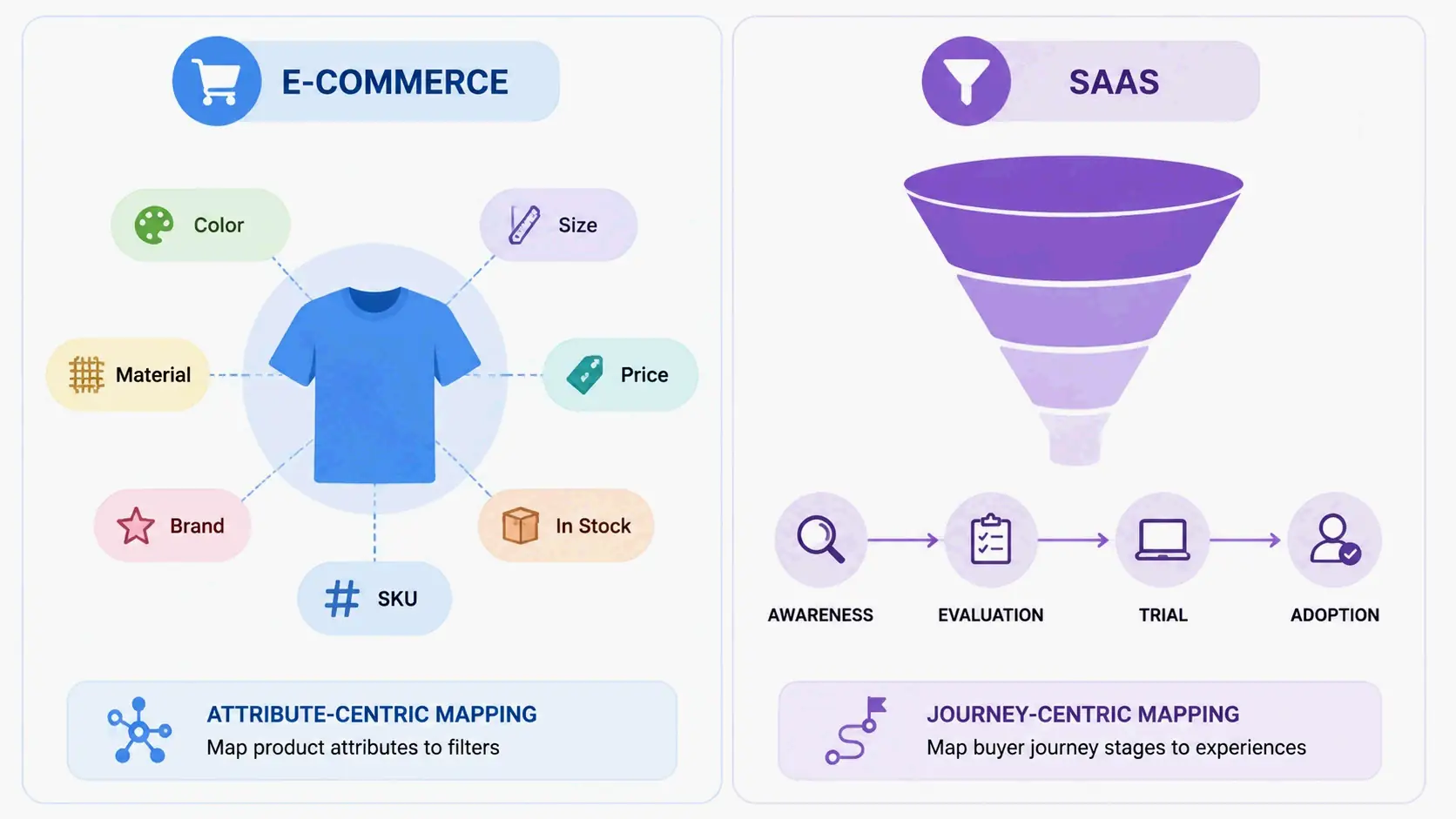
A SaaS company selling API management software would structure its map differently from a product catalog. The pillar page covers enterprise API management comprehensively. Cluster one addresses problem awareness: what API rate limiting is, why API security matters, and what happens when API gateways fail. Cluster two covers solution exploration: how to evaluate API management platforms, the differences between cloud-native and third-party solutions, and build-versus-buy analyses. Cluster three addresses vendor comparison: direct comparisons between competing platforms, pricing model evaluations, and integration capability assessments. Cluster four covers implementation: deployment guides, configuration documentation, and advanced use cases.
The buyer’s journey architecture works because it mirrors how SaaS prospects actually research. They don’t search for product attributes first; they search for problem definitions and solution categories. A map that organizes content by journey stage captures demand from the first exploratory search through the final vendor selection query. The same EAV logic applies: the entity is the problem category, the attributes are the evaluation criteria and implementation concerns, and the values are the specific answers your content provides.
Optimizing Your Topical Content Map for AI Search Engines (GEO)
Building topical authority now serves two audiences: traditional search engine rankings and AI-generated search responses. AI platforms—Google’s AI Overviews, ChatGPT, Perplexity, and others—function differently from classic SERPs. They don’t return ten blue links. They construct answers by querying their training data and real-time retrieval systems for the most contextually relevant, authoritative sources available on a subject. A topical content map optimized for this environment produces more citations, across more queries, than isolated content ever will.
Query Fan-Out: How AI Expands Your Reach Across Platforms
Query fan-out is the process where AI search systems expand a single user prompt into multiple related sub-queries to construct a comprehensive answer. When a user asks Perplexity about treating essential tremor, the system doesn’t search for that exact phrase. It fans the query out into sub-queries about medication options, surgical treatments, lifestyle management, and prognosis, then synthesizes the results. As explained by Ahrefs, the more subtopics your cluster covers, the more of those sub-queries you appear in, compounding your AI visibility advantage.
The Healthline data makes this effect concrete. Their single page on magnesium glycinate surfaces across 279 ChatGPT prompts and 200 Perplexity prompts because the page is part of a comprehensive health content cluster that covers the entity’s attributes from every angle. AI systems recognize the site as a trustworthy source on the broader subject, so they retrieve it for queries that are semantically adjacent, not just exact matches.
The takeaway for topical map construction is straightforward. A cluster that covers a topic comprehensively—including the low-volume, high-specificity questions competitors skip—will be retrieved across a wider range of AI-generated answers than a cluster that only targets high-volume head terms. Comprehensive coverage is the prerequisite for query fan-out visibility. Partial coverage limits your addressable AI query surface regardless of page quality.
Content Structures That Get Extracted by AI
AI systems don’t read pages the way humans do. They extract specific passages in response to structured retrieval queries. Content designed for extraction follows predictable patterns.
Every section should open with a direct, concise answer to the implied question before expanding into detail. A section about API rate limiting should begin with “API rate limiting controls the number of requests a user can make to an API within a specified time window,” not with background context about API infrastructure. AI systems pull the first authoritative statement they find. A buried answer is an unextracted one.
Headers at the H2 and H3 level should mirror how people phrase questions in natural language search. “What is API rate limiting” performs better for extraction than “Rate Limiting Overview” because the AI system matches the header to the user’s query phrasing. FAQ blocks at the end of each article, with specific, self-contained answers, provide another extraction surface. Schema markup, including Article schema on each page and FAQPage schema on FAQ blocks, gives AI systems structured data they can parse directly.
Sites with strong topical authority dominate AI Overviews, ChatGPT, and Perplexity for the same reason they dominate traditional SERPs: search engines trust them to provide accurate, comprehensive answers on their subject. The compounding effect works across platforms. One strong cluster feeds visibility everywhere AI search systems operate. Build the cluster once, and it earns citations across every platform your audience uses.
Tools for Topical Content Map Creation: What Actually Works
Topical map tools divide sharply into those that produce architectural output and those that produce decorated keyword lists. The difference isn’t about feature count or interface polish. It’s about whether the tool models entities and search intent at the structural level, or simply rearranges keyword data into visual groupings. Choosing the right tool for the right stage of your workflow determines whether your map survives contact with a content team and, ultimately, with Google’s ranking systems.
Tool Evaluation Criteria: Beyond Surface Output
The first criterion for evaluating a topical map tool is whether it groups content by SERP-overlap logic or lexical similarity. Lexical similarity groups keywords that contain the same words. SERP-overlap groups keywords that Google ranks the same pages for. The difference is operational: lexical similarity produces clusters that look organized but contain pages that don’t belong together in a search context. SERP-overlap produces clusters aligned with how Google actually interprets topic boundaries.
The second criterion is whether the tool provides an editorial layering mechanism. A raw clustering output is not a map. A map requires pillar identification, cluster hierarchy, internal linking architecture, and a publishing sequence. Tools that stop at clustering output require the operator to make every editorial decision manually. Tools that produce map output with structural logic built in reduce the gap between research and execution.
The third criterion is intent detection. A tool that doesn’t classify search intent at the page level can’t prevent cannibalization. If the tool can’t distinguish between an informational query and a commercial investigation query targeting similar language, the operator has to classify every cluster manually—a process that takes hours on a large map and produces errors that surface months later.
The fourth criterion is cannibalization warnings. The best tools flag overlapping macro contexts during map generation, stopping the conflict before it enters the content calendar. Tools without this capability ship silent cannibalization, and the operator finds out when rankings flatten.
Stage-by-Stage Tool Matching: Research, Build, Validate
The research stage requires tools that surface entities, attributes, and keyword data from real search indexes. Ahrefs provides the highest-quality keyword data and uses parent topic clustering that respects SERP overlap. Its Keywords Explorer and Clusters by Parent Topic feature are effective for pulling structured keyword data into the mapping process. Keyword Insights, tested across 312 clusters in the SWAT SEO 61-day evaluation, produces clustering with genuinely strong SERP-overlap math, though the editorial layer requires manual construction.
The build stage requires tools that translate keyword data into architectural output. SemanticOS operates on an Entity-Attribute-Value model, enforcing an 8-step workflow from source context declaration through EAV architecture modeling to 6-phase topical map generation, as documented by Ayon Chy. It’s the only tool in the 2026 comparison that natively maps product attributes into topical structure, making it the viable choice for e‑commerce mapping. MarketMuse handles topic coverage planning for large content libraries but produces topic models rather than architectural maps. Its strength is gap detection across existing content inventories, not structural map generation.
The validation stage requires tools that audit existing content against the map. Ahrefs’ Site Audit identifies orphaned pages and missing internal link connections. Google Search Console integration surfaces intent conflicts by comparing declared funnel stages against actual ranking intent. SemanticOS includes a Macro Context Drift auditor, an SPO Triple Auditor that parses articles as Google’s NLU would, and a Topical Authority Transfer Simulator that models how authority will flow through the planned link graph and publishing order.
For practitioners who want affordable cluster planning and are comfortable handling the editorial layer themselves, kwplanner automates Hub & Spoke cluster architecture while kwmaster handles P0/P1/P2 keyword priority and page layout, complementing tools like Floyi and Topical Map AI that provide fast first-pass mapping at low price points. Frase and Surfer SEO are better suited to page-level optimization after the map exists, not as primary map-building platforms. The critical rule across all tools: no tool replaces editorial judgment. A map that hasn’t been reviewed by a human for intent accuracy, hierarchy validity, and cannibalization risk is a draft, not a deliverable. The difference shows up in rankings six months later.
Conclusion
A topical content map isn’t a keyword spreadsheet. It’s the architectural blueprint that signals to Google, and increasingly to AI search systems, that your site owns a subject area. The distinction between a map built on entity-attribute logic and one built on keyword clustering is the distinction between compounding organic visibility and flat traffic six months after launch.
Start with a strategy-first audit of your site’s current entity coverage. Define your semantic boundary—what you own and what you intentionally exclude. Build an EAV framework for your core topic, identifying the entities, attributes, and user stories that form your content architecture. Validate every cluster against actual search data and SERP behavior. Then use the 4-point audit checklist—intent conflicts, hierarchy validation, orphan pages, competitive breadth—before you publish a single new page. Tools accelerate execution. They can’t replace the editorial judgment that determines whether your map produces rankings or just produces content.
FAQ
What’s the difference between a topical content map and a keyword cluster?
A keyword cluster groups queries by search intent and SERP overlap. A topical content map organizes entities, attributes, and their relationships into a semantic architecture that signals expertise across a subject area. Clusters are an output of research; a topical map is the strategic blueprint that determines which clusters to build and why.
How many articles do I need in a content cluster to build topical authority?
There’s no fixed number. Authority comes from covering a topic’s entity-attribute space comprehensively, not from volume. A cluster of 10 tightly relevant, architecturally sound pages can outperform 50 diluted ones. The 2024 Google leak confirmed that semantic concentration matters more than content volume.
Can I use ChatGPT or AI to build a topical content map for free?
AI can accelerate entity extraction and initial cluster generation, but the strategic layer—defining scope, validating hierarchy, and detecting cannibalization—requires human editorial judgment. Without strategic oversight, AI-generated maps tend to produce overlapping clusters and shallow architectures. For a structured approach to using AI in SEO content production, read How to Write SEO Content with AI. Raw LLMs also hallucinate keywords with no real search demand, as documented in the SWAT SEO evaluation.
How long does it take for a topical content map to improve SEO rankings?
Topical authority builds slowly. Initial ranking improvements often appear within 2–4 months of publishing a complete cluster. The compounding authority effect—ranking for thousands of related queries across both traditional and AI search—typically builds over 6–12 months of consistent execution. The timeline depends on niche competitiveness and content velocity.
