


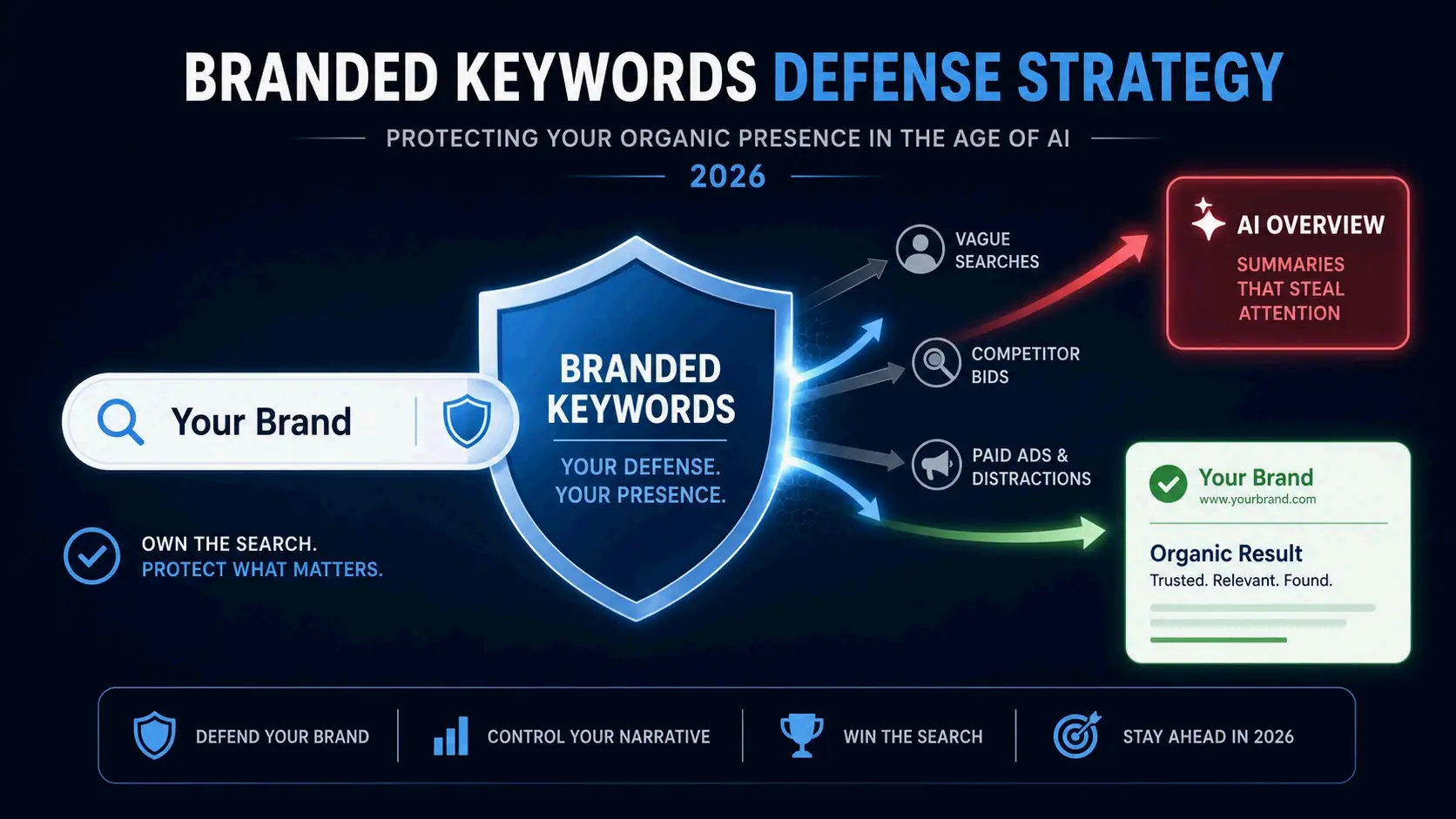
Targeting branded keywords means you actively bid on and optimize for search terms that contain your brand name. In 2026, this approach isn’t just nice to have. It’s how you hold on to high-intent demand that competitors and AI-generated search features are trying to siphon away—while keeping your measurement clean and your growth story grounded in reality.
Contents
- What Are Branded Keywords? A 2026 Definition Beyond the Basics
- The Strategic Imperative: Why Branded Keyword Defense Is Non‑Negotiable in 2026
- High‑Priority Differentiation: Building Brand Entity Authority to Supercharge Your Keyword Defense
- How to Structure a Defensive Brand Bidding Campaign in Google Ads
- Proving Incremental Value: How to Measure True Brand Campaign ROI
- Beyond Google: Adapting Your Branded Keyword Strategy for Amazon
- Advanced: Using Branded Keywords as a Real‑Time Growth Radar
- Conclusion
- FAQ
What Are Branded Keywords? A 2026 Definition Beyond the Basics
A branded keyword is any search query that includes your brand name, product lines, or trademarked terms. When someone types “Nike running shoes” or “Apple MacBook Pro pricing,” they’re using a branded keyword. On the flip side, a non‑branded term is a generic category phrase with no brand attached—think “running shoes” or “best laptop for programming.” Where you draw the line is up to you: you build a list of your own brand and product‑line terms, and anything that contains one of them counts as branded.
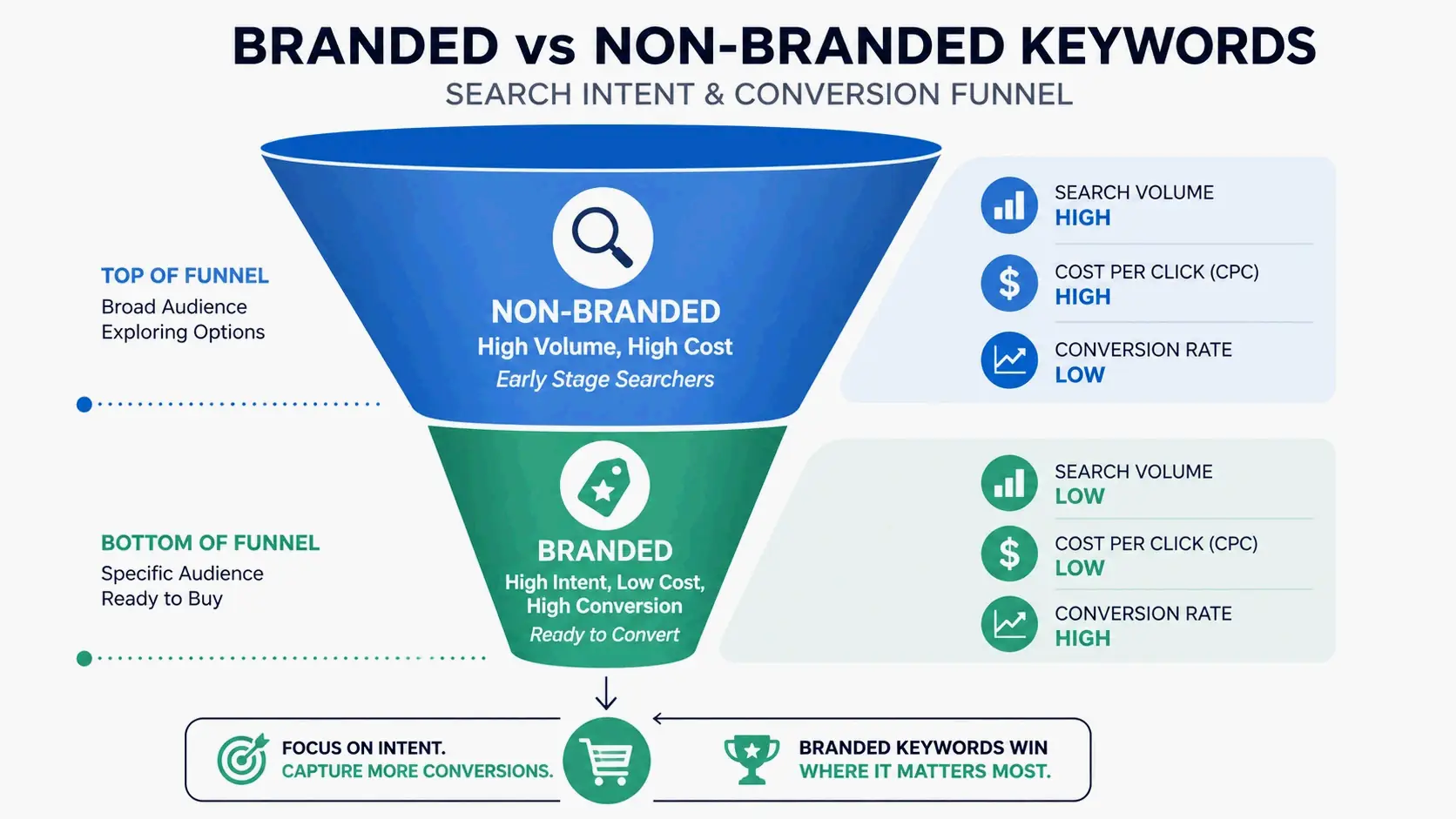
Why does this matter? Branded keywords sit at the very bottom of the marketing funnel. They capture people who already know who you are and are often ready to buy, sign up, or take action. As a result, branded terms almost always bring in more revenue per dollar spent and cost less per click than non‑branded queries. Non‑branded terms are still crucial—they introduce your business to fresh audiences—but they convert at lower rates. Seeing branded keywords as a strategic asset instead of just another set of search terms is the first move in protecting your most valuable demand.
Branded vs. Non‑Branded Search Intent: Two Fundamentally Different Visits
The biggest difference between these keyword types comes down to what the searcher actually wants. A branded search means the person already knows your brand—through a referral, a piece of content you published, or a previous visit. A non‑branded search like “web design company” signals a stranger comparing options. This intent gap shows up directly in performance: branded visitors convert at a much higher rate and cost a lot less to bring in.
The Strategic Imperative: Why Branded Keyword Defense Is Non‑Negotiable in 2026
If you let competitors sit in the top spots for your own brand name today, you’re willingly handing over customers at the moment they’re closest to converting. The search landscape in 2026 has shifted in three ways that make defensive brand bidding a requirement, not a choice.
First, competitors can legally bid on your brand terms. Google doesn’t block trademarks when they’re used only as keywords. A rival who buys your brand name can put their ad above your organic listing and grab people who were actively looking for you. The US Court of Appeals for the Second Circuit made this clear in its 2024 ruling in 1‑800 Contacts v. JAND, holding that simply buying a competitor’s trademark as a search keyword didn’t amount to infringement. The legality only underlines the urgency: if you’re not claiming the paid space for your own name, someone else will.
Second, AI Overviews are pushing organic results further down the page. According to Pew Research Center, 18% of Google searches in March 2025 produced an AI‑generated summary. When that summary appeared, users clicked on traditional links only 8% of the time, compared to 15% when no summary was there. An AI answer sitting above the organic listings sharply reduces the click‑through rate even for the number‑one organic spot. That makes a paid ad on your own brand name increasingly necessary if you want to be seen.
Third, automation in Google Ads can hide what’s really going on. Performance Max campaigns are designed to chase conversions across all of Google’s channels. Without clear boundaries, they naturally drift toward brand‑aware users—people who already know you and convert easily. That inflates Performance Max’s reported numbers but destroys measurement clarity, because you can no longer separate true acquisition from the capture of existing demand.
As Olga Bobchenok, digital marketing specialist at VIDEN Growth, puts it: “Treating brand isolation as ‘optional’ is where many accounts start losing control.” In an automation‑first Google Ads world, the decision to bid on branded keywords isn’t just a budget question—it’s a governance question.
High‑Priority Differentiation: Building Brand Entity Authority to Supercharge Your Keyword Defense
A well‑built Google Ads campaign is only half the story. The other half is making sure Google understands your brand as a coherent entity in its Knowledge Graph—the structured database that powers Knowledge Panels, AI Overviews, and a lot of ranking decisions. A strong brand entity lowers the cost of paid defense and makes your organic results more resilient against AI‑driven SERP features.
When Google is confident in your brand’s attributes—its name, logo, founding date, official website, social profiles, and category—it’s far less likely to confuse your business with a competitor or treat your domain like a generic publisher. That confidence shows up as a higher Quality Score for your own branded campaigns, so you pay less per click to own your name. It also strengthens the authority of your organic listing, making it harder for an AI Overview to overshadow or misrepresent you.
The first steps to build that entity are practical: implement comprehensive Organization schema on your homepage, making sure the markup includes legalName, url, logo, foundingDate, founder, sameAs links to authoritative profiles (Wikipedia, Wikidata, LinkedIn), and contactPoint details. Next, claim and complete your Wikidata entry—a structured data record that feeds straight into the Knowledge Graph—and audit the consistency of your Name, Address, and Phone number (NAP) across every directory where your business appears.
How Google’s Knowledge Graph Reduces Your Reliance on Paid Defense
A brand with a fully populated Knowledge Graph entry earns higher organic click‑through rates because users see a rich, accurate Knowledge Panel right next to the search results. That stronger organic presence means you capture more demand without a paid click, while any paid ad you do run costs less thanks to the better Quality Score that comes from entity clarity. Over time, a strong entity shrinks the total budget you need to defend your branded real estate, freeing up spend to put toward growth.
How to Structure a Defensive Brand Bidding Campaign in Google Ads
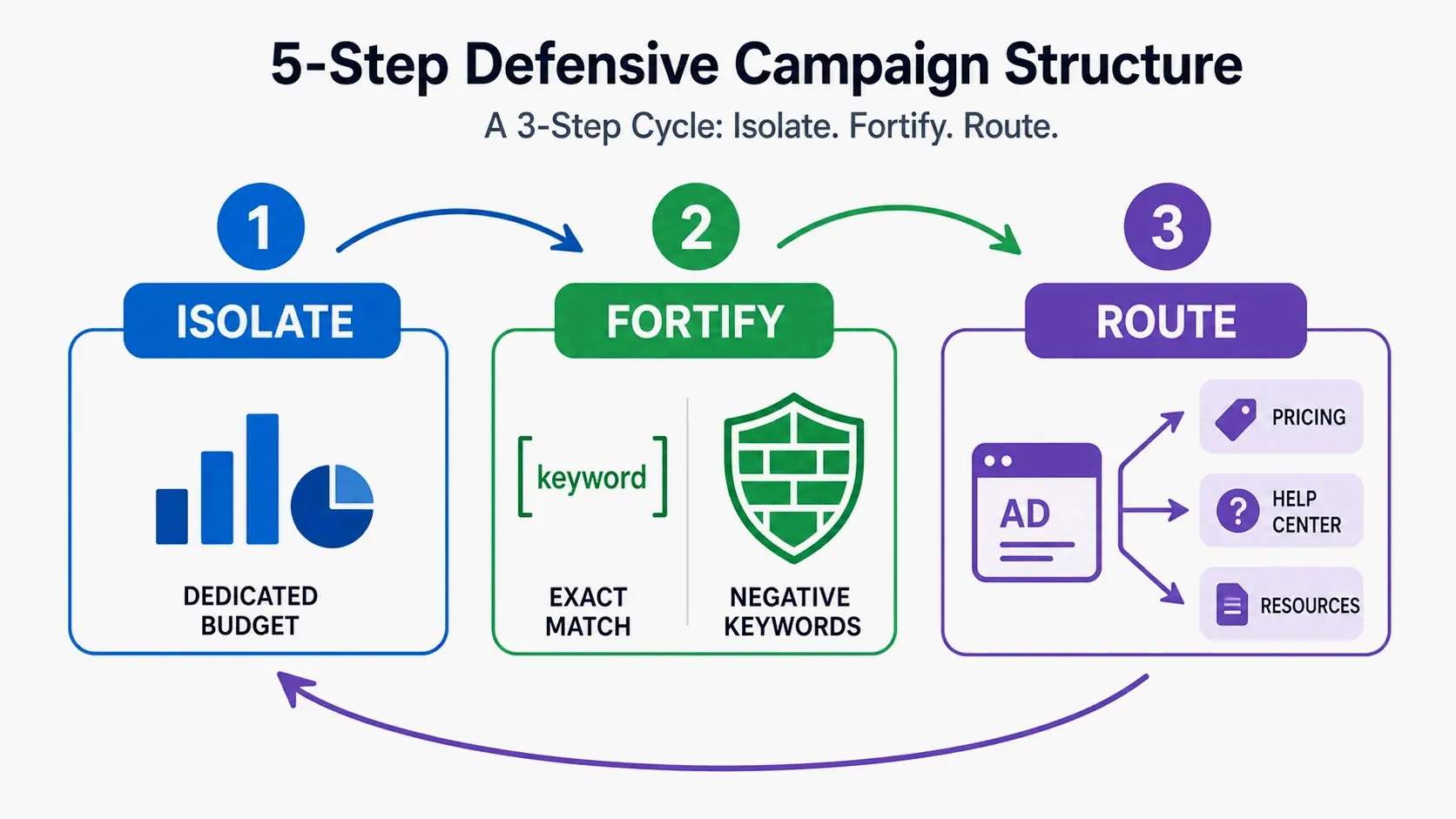
A solid brand search campaign needs intentional isolation, exact‑match control, and ongoing monitoring. The framework below keeps your brand traffic cleanly separated from discovery campaigns.
Step 1: Discovery. Build a thorough list of every branded keyword variation your audience uses. Include exact brand names, product line names, common misspellings, product codes, and partner phrases like “[brand] pricing,” “[brand] reviews,” or “[brand] login.” Use Google Keyword Planner to scrape your own site for branded terms, and check Search Console’s query report to find actual user queries you might have missed.
Step 2: Segmentation. Create a dedicated campaign with its own daily budget, separate from Performance Max and non‑brand search campaigns. Aim for 100% impression share on your brand terms. A dedicated budget keeps brand spend from being cannibalized by discovery campaigns and makes measurement simple.
Step 3: Fortification. Use exact match keywords for core brand terms and build a thorough negative keyword list. Block all category terms, competitor names, and semi‑brand queries that could leak into this campaign. The goal is “intent hygiene”—making sure the campaign fires only on genuine brand‑intent searches.
Step 4: Messaging. Control the narrative with custom ad copy, sitelinks, and assets. Route users based on their likely intent: send pricing queries to a pricing page, support queries to a help center, and review queries to case studies or testimonials. Never dump all brand traffic onto a generic homepage.
Step 5: Competitive Defense. Regularly check Auction Insights to see which competitors are bidding on your brand and how aggressively. When rivals show up, your brand campaign acts as a structural shield, keeping high‑intent users from being diverted right when they’re about to act.
An audit of over 150 Google Ads accounts by VIDEN Growth found that branded traffic was often scattered across multiple campaign types, inflating CPA and confusing the algorithm. Consolidating all brand terms into a dedicated, exact‑match campaign consistently improved both measurement clarity and cost efficiency.
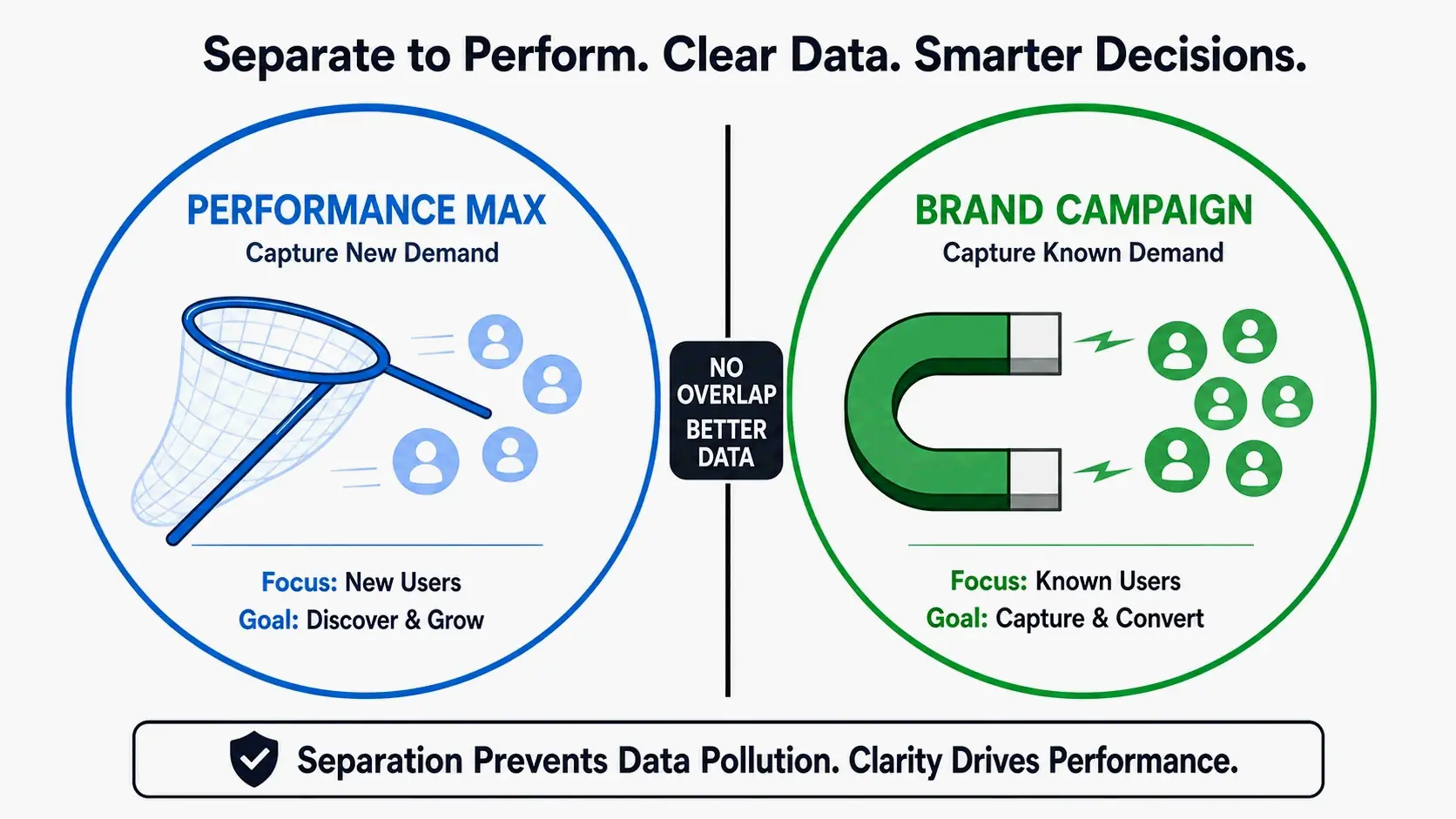
Why Performance Max and Branded Keywords Require a Strict Separation
Performance Max is built to find conversions by expanding audiences across channels. It naturally gravitates toward brand‑aware users because they’re the easiest to convert. Without a dedicated brand campaign, Performance Max reports look deceptively strong, blending true acquisition with warm brand demand. Only a structural separation—a brand campaign that is explicitly excluded from Performance Max’s scope—forces Performance Max to focus on its real job: uncovering net‑new demand.
Proving Incremental Value: How to Measure True Brand Campaign ROI
One persistent worry about brand bidding is that paid ads simply steal clicks that would have gone to organic results anyway, wasting budget on demand you already own. That concern misses how the modern SERP actually works. When a paid ad and an organic listing show up together, their combined presence captures more total clicks than organic alone, because the paid ad pushes down competitors, shopping units, and third‑party results that might otherwise distract the user.
The core metric for evaluating brand campaigns is incremental clicks—the net gain in total (paid + organic) brand traffic when ads are running. Google Search Console’s paid vs. organic report gives you a starting point, but to isolate cause and effect, you need a controlled experiment.
Geo‑Testing SOP for Brand Ad Incrementality: A 4‑Week Plan
Pick two geographically distinct markets that are comparable in size, customer demographics, and seasonality. In one market (the control), pause all branded search ads for four weeks. In the other (the test market), keep them running as usual. Track total brand conversions—the sum of paid and organic—in both markets over the same period. If the test market shows a net increase in total conversions relative to the control, your brand ads are delivering incremental value. If total conversions stay identical, those paid clicks were cannibalizing organic traffic. Most businesses that run this test discover that brand ads protect demand more than they cannibalize it, especially in competitive sectors where rivals bid on their name.
Beyond Google: Adapting Your Branded Keyword Strategy for Amazon
On Amazon, the fight for branded keywords plays out on a different field. You’re not just defending against competitor ads—you’re defending against their actual product listings. A competitor who bids on your brand name can put their product directly in front of a customer who searched for yours. The main goal stays defensive, but the measurement and mechanics shift.
Branded campaigns on Amazon typically achieve a very low Advertising Cost of Sale (ACoS) because they capture demand that’s already there. Non‑branded campaigns cost more but are the primary driver of New‑to‑Brand sales—customers discovering your product for the first time. The SellerStack analysis of Goldbond illustrates this split: a branded campaign on “Goldbond lotion” might run at an 8% ACoS, while a non‑branded campaign targeting “itch lotion” runs at 35% ACoS but generates far more New‑to‑Brand sales. Splitting these two approaches into separate campaigns lets you measure each goal on its own: cheap defense versus paid discovery.
Advanced: Using Branded Keywords as a Real‑Time Growth Radar
Brand search data—volume, Impression Share, and CPC trends—can act as a leading indicator of market dynamics and brand health. A sudden spike in competitor brand bidding or a rise in your own CPC for brand terms signals that a rival has launched a conquesting campaign against you. A drop in total brand search volume may point to fading awareness or a reputational issue that needs attention fast.
For agencies, a white label rank tracker is essential for transparently reporting these branded‑keyword metrics to clients under the agency’s own brand, preserving value attribution and client trust. Even in‑house teams can use daily brand position monitoring to catch SERP feature changes or ranking drops that hurt the digital “front door” of the business.
Conclusion
A branded keyword strategy in 2026 is a unified effort on two fronts: defensive paid bidding to control your message, and proactive entity SEO to reinforce your authority. Start with a full audit. Isolate your brand terms into a dedicated Google Ads campaign with exact‑match keywords and a separate budget. Check your Knowledge Graph entity by searching your brand name plus “Wikipedia” and make sure your Organization schema is correct. Fix the foundation, then turn on your defense.
FAQ
How do I find all the branded keyword variations for my business?
Start with a seed list of your core brand, product names, and common misspellings. Use Google Search Console’s ‘Queries’ report and Google Ads’ search terms report to surface actual user queries. Tools like SEMrush can help, and don’t forget to include variations like “brand + support,” “brand + login,” and “brand + pricing.”
Is a separate brand search campaign really necessary if Performance Max covers all channels?
Yes, it is critical for measurement integrity. Performance Max blends brand, non‑brand, display, and video into one “black box,” making true performance assessment impossible. Isolating brand terms gives you clean data on your most profitable channel.
How does a branded keyword strategy on Amazon differ from Google?
Google’s strategy is primarily defensive, preventing competitors from stealing clicks on your brand name. Amazon’s strategy is both defensive and offensive, aiming to capture brand searchers at the point of purchase while achieving a very low ACoS compared to discovery‑focused, non‑brand campaigns.
How do I know if my paid brand ads are cannibalizing my organic sales?
A geographic lift test is the gold standard. Run your brand ads in one set of comparable markets and pause them in another. Track total combined conversions (organic + paid) in both regions. If the increase in paid conversions in the test region is greater than the total lift, cannibalization is occurring.
Can a white label rank tracker help with my branded keyword strategy?
Absolutely. For agencies, it is essential for transparent reporting on branded keyword rankings and share of voice relative to competitors. Even for in‑house teams, tracking daily brand position is vital for immediately flagging SEO or SERP feature changes that might harm your digital front door.
