



A topic cluster is a strategic SEO framework that organizes content around one comprehensive pillar page and multiple supporting cluster pages, all connected through intentional internal linking. This structure signals deep, organized expertise to both search engines and AI systems—and it’s central to building topical authority.
Contents
- What Is a Topic Cluster and Why Does It Matter for Modern SEO?
- The Strategic Core: Your Pillar Page Explained
- The Connective Tissue: Why Internal Linking Makes the Strategy Work
- Step-by-Step: How to Build a Topic Cluster Strategy From Scratch
- Topic Clusters in the Age of Generative AI: A GEO Optimization Checklist
- Tools and Technology for Scaling Your Topic Cluster Strategy
- Conclusion
- FAQ
What Is a Topic Cluster and Why Does It Matter for Modern SEO?
A topic cluster is a way of organizing content where a central “pillar” page covers the broad topic, and “cluster” pages dive into specific subtopics. Instead of publishing disconnected articles that each chase a single keyword, this approach creates a coherent network of content that search engines can easily interpret. As Wellows puts it, paraphrasing Google’s guidance, “a topic cluster is basically an internal-linking and relevance system applied at scale.” The result: your site becomes a connected knowledge hub, not just a collection of isolated pages.
This approach marks a shift from keyword-centric to topic-centric SEO. The old way was to build a separate page for every keyword variant, which often ended with multiple pages answering the same question and competing with each other. A topic cluster strategy replaces that chaos with a deliberate architecture: one pillar page covers the broad topic, and each cluster page addresses a specific subtopic. Search engines then see a site that understands a whole subject area, not just scattered terms.
The impact is measurable. HubSpot documented a site that grew from 5,000 to over 300,000 monthly organic sessions after switching to a cluster-style content approach over three years. This structural change signals Topical Authority—the recognition by search engines that a domain is an authoritative source on a subject—and provides the architectural foundation for lasting organic visibility.
The Three Building Blocks of a Topic Cluster
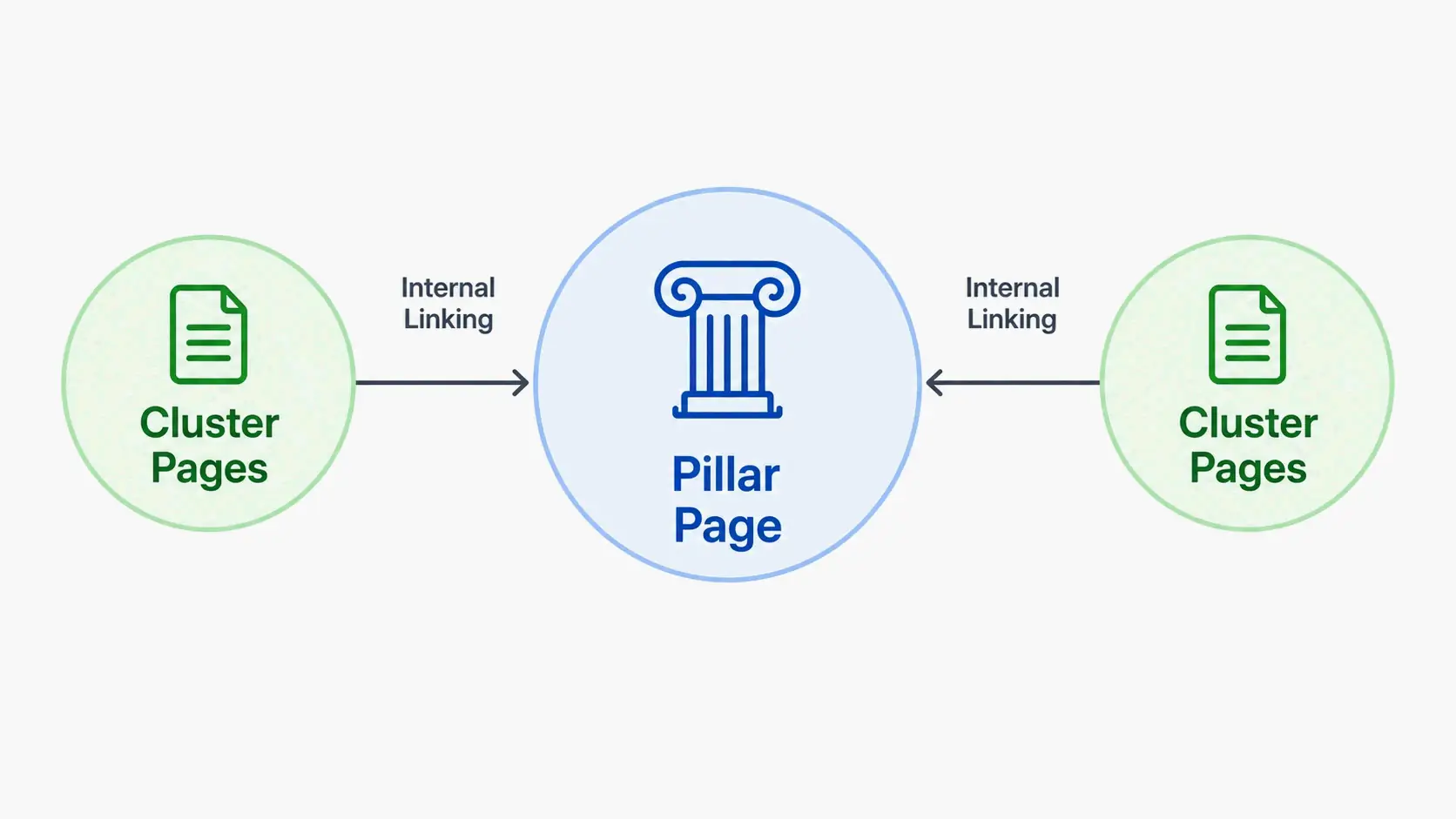
Every topic cluster has three parts. The Pillar Page is your central hub—a comprehensive resource that covers the core topic at a high level. Cluster Pages are the supporting spokes, each diving deep into a specific subtopic or user question. And the Internal Linking structure connects every cluster page back to the pillar (and the pillar out to each cluster), creating a semantic web that both search engines and users can navigate.
From Keywords to Concepts: The Evolution of SEO Strategy
Today’s search algorithms don’t judge pages one by one. They consider how well your site covers a whole topic, rewarding depth and breadth across interconnected content. A topic cluster reflects this reality by organizing content around concepts and user intent, not just isolated keywords. It’s how search engines now process queries as parts of broader topic landscapes—using entity relationships and content completeness to figure out which sites truly know their stuff.
The Strategic Core: Your Pillar Page Explained
Your pillar page is the centerpiece that defines and introduces a broad topic. It’s not just about word count; its job is to provide a complete overview of the subject and direct readers (and search engines) toward the detailed cluster pages. A good pillar page covers all the major angles of its core topic, but it doesn’t go deep on any one subtopic—that’s what the cluster pages are for.
Pillar pages also support Google’s E-E-A-T framework—Experience, Expertise, Authoritativeness, and Trustworthiness. By presenting a cohesive overview and linking to in-depth subtopic articles, a pillar page demonstrates that your site understands the topic comprehensively. It shows first-hand insight and curated depth, which builds credibility with users and aligns with the quality signals search engines care about. When each cluster page reinforces the pillar through contextual backlinks, the whole architecture projects expertise at the domain level, not just on a single page.
Topic Cluster vs. Content Silo: Understanding the Architectural Difference
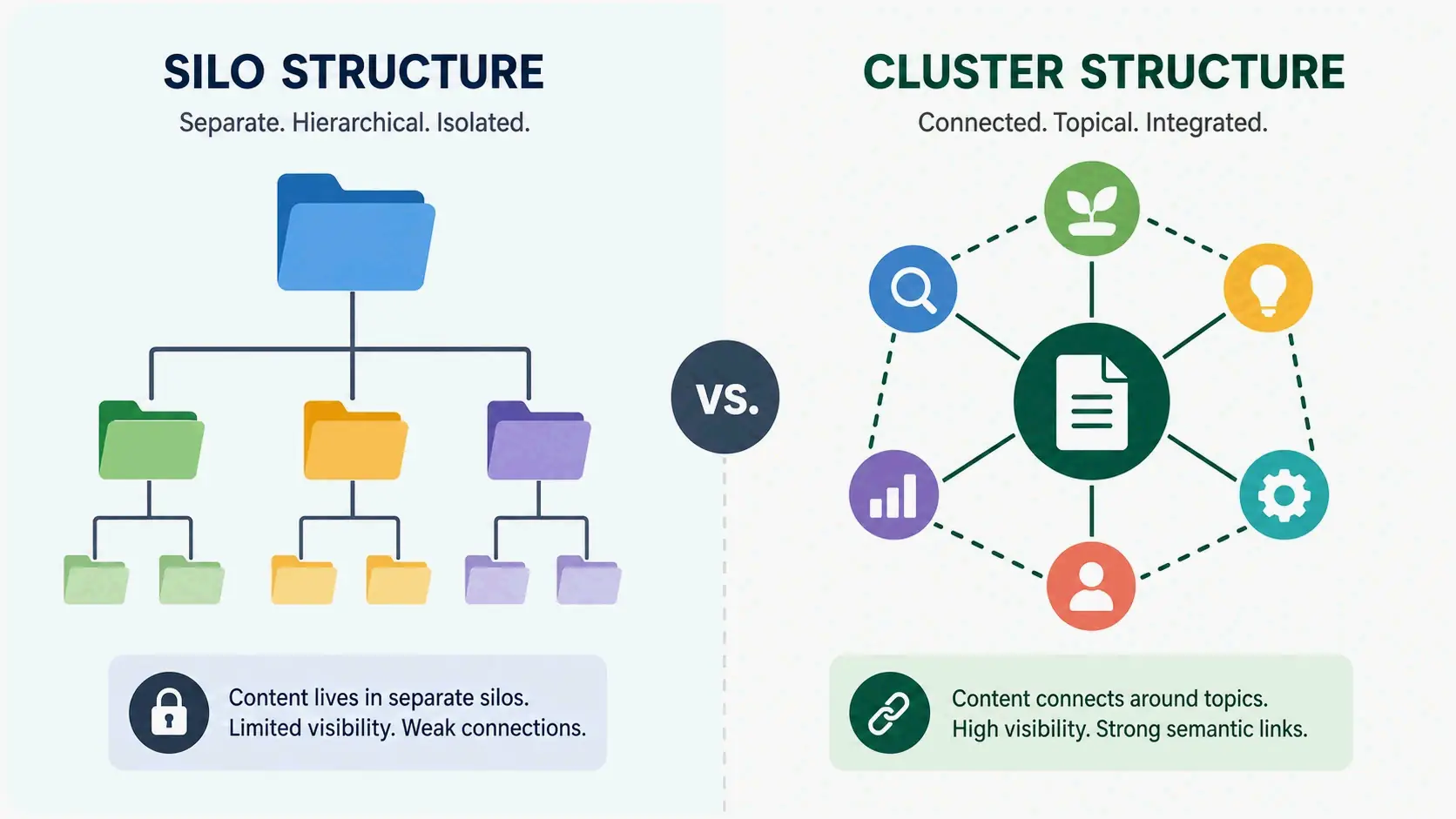
People often confuse topic clusters with content silos, but they serve different purposes. A content silo relies on a strict hierarchical URL structure and folder-based organization to group related content. A topic cluster, on the other hand, is defined by semantic relationships built through internal links, regardless of the URL path. A silo organizes navigation; a cluster organizes topical relevance. Today, many SEO strategies combine both—using clean sitemaps and categories for crawlability while leaning on contextual links to signal subject-matter depth.
The Connective Tissue: Why Internal Linking Makes the Strategy Work
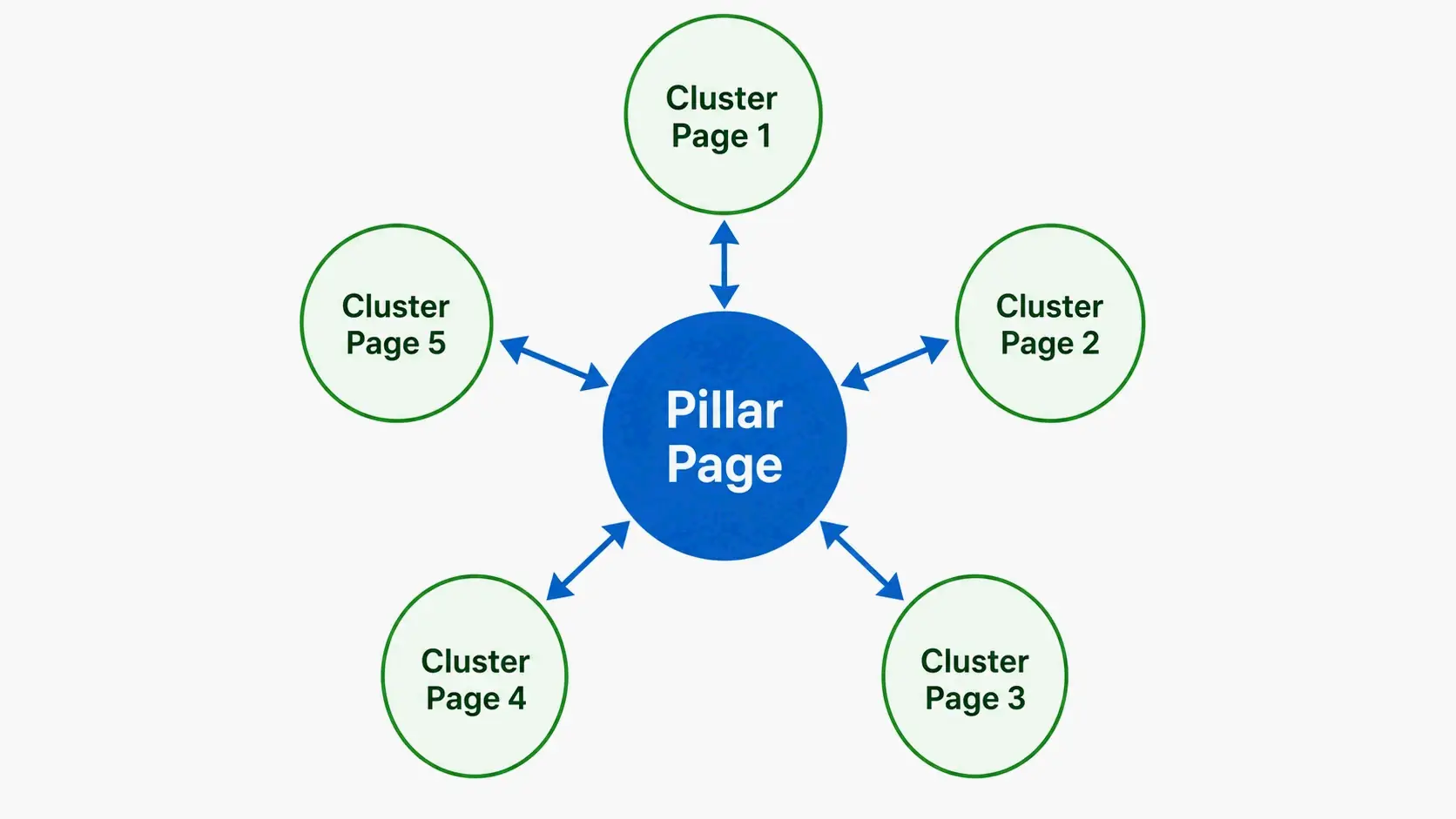
Internal linking is what turns a collection of related articles into a working topic cluster. The links between your pillar page and cluster pages distribute PageRank and signal to search engines how the pages relate. In a proper hub-and-spoke setup, the pillar links out to every cluster page, and each cluster page links back to the pillar with descriptive anchor text. Cluster pages can also link to each other when it makes sense editorially.
Data from Moz (2025) shows that properly implemented topic clusters increase the internal PageRank of cluster pages by an average of 34% within 60 days. This authority flow lifts the entire group in search rankings, strengthening visibility across the topic.
A well-linked cluster also solves the problem of keyword cannibalization. When multiple pages target the same query, search engines get confused about which page to rank. By giving each cluster page a distinct subtopic and reserving the broad primary terms for the pillar, a cluster eliminates that internal competition. Each page goes after a unique search intent, and the internal links reinforce the hierarchy you’ve set.
Step-by-Step: How to Build a Topic Cluster Strategy From Scratch
Building an effective topic cluster takes a systematic, data-driven approach. These five steps move you from initial topic selection to publishing a minimum viable cluster.
Step 1: Define Your Core Topic and Core Keyword
Pick a topic that balances what your audience needs, what matters for your business, and what you can realistically produce content for. The topic needs to be broad enough to generate five to ten supporting articles, but specific enough that your site can realistically own it. Something like “marketing” is too generic; “B2B email marketing strategy” is focused and workable. Use keyword research to confirm the parent term has decent search volume and related long-tail queries that point to a viable cluster.
Step 2: Perform Subtopic and Keyword Research Based on Search Intent
Group subtopics by user intent, not just keyword variations. For a core topic like “email marketing,” organic subtopic groups might include foundational definitions, tool comparisons, setup walkthroughs, and performance improvement guides. Tools like Semrush can help you validate each subtopic’s search volume and competition level. According to a Semrush Content Gap Study (2025), brands that fill competitor content gaps see, on average, 38% higher engagement and 2.4 times more AI citations—so targeting unmet, intent-driven subtopics really pays off.
Step 3: How to Audit Your Existing Content for Cluster Opportunities (The Retrofit Method)
Chances are, your site already has articles that could work as cluster pages. Start with a content audit using Google Search Console and a crawler like Screaming Frog to map your existing URLs to specific topics and intents. Identify articles that cover related subtopics but aren’t linked together. When retrofitting, you’ll often create or designate the pillar page last; first, organize your existing articles into tentative clusters, then build or choose a pillar page to anchor them. This approach saves time and leverages the authority your older content already has.
Step 4: Strategically Write and Plan Your Internal Linking Structure
Before you publish new content, map out the linking structure. Every cluster article must link contextually to the pillar page, and the pillar must link out to each cluster. Related cluster pages should link to each other where it helps the reader. Use descriptive anchor text that reflects the target page’s core topic. Every time you publish a new cluster article, go back and add forward and backward links in your previously published pages. This ongoing maintenance is essential for building cohesive topical authority.
Step 5: Create a Content Calendar and Publish the “Minimum Viable Cluster”
A minimum viable cluster usually includes one pillar page and five to ten cluster pages that together cover the most important subtopics. Publish the pillar page first, so the hub exists before the supporting content. Then roll out the highest-demand cluster pages and expand gradually based on performance data and any gaps you spot. A realistic publishing schedule helps both users and search engines take in your site’s evolving topic structure.
Topic Clusters in the Age of Generative AI: A GEO Optimization Checklist
Generative AI search engines like ChatGPT, Google AI Overviews, and Perplexity process content differently than traditional search. They break queries into multiple sub-questions, pull relevant passages from across the web, and synthesize answers while citing sources that show comprehensive, connected authority. Topic clusters fit this model perfectly because they provide the breadth and depth AI systems are looking for.
According to a Yext AI Citation Study (2025), websites with topic clusters received 3.2 times more citations than single-page competitors. Another case study from Backlinko (2025), covering 50 B2B SaaS sites, found that implementing a pillar-cluster architecture boosted AI citation rates from 12% to 41% for pillar topics. These findings confirm that AI systems lean on cross-referenced, interconnected content to validate expertise.
Essential GEO Checklist for Your Topic Cluster
To optimize your clusters for generative AI visibility, incorporate these practical techniques:
- Format factual claims as discrete, standalone statements that AI models can extract as citations.
- Include FAQ schema on pillar and cluster pages so that question-answer pairs are directly accessible to answer engines.
- Craft “citation-worthy sentences”—concise, information-dense passages that directly answer specific questions.
- Use clear H2 and H3 headings phrased as questions to mirror how queries are processed.
- Maintain content freshness, as AI platforms frequently prioritize recently updated pages.
- Ensure bi-directional internal linking so that the entire topic footprint is discoverable as a coherent corpus.
Tools and Technology for Scaling Your Topic Cluster Strategy
A variety of tools can support the planning, creation, and monitoring of topic clusters. Traditional SEO suites like Semrush and Ahrefs excel at keyword research, competitive gap analysis, and rank tracking. Newer AI-native platforms, including ClickRank and Sight AI, bring automated topic mapping, content generation, and AI visibility tracking into the workflow.
Tool Comparison: Traditional SEO vs. AI-Native Platforms
Traditional tools give you deep competitive intelligence and manual controls that experienced SEO strategists love. Semrush’s Topic Research and Content Gap tools, for instance, help you identify subtopics and prioritize production. AI-native platforms, by contrast, focus on accelerating execution—automated clustering, AI-assisted draft generation, and monitoring brand mentions across generative engines. The right stack depends on your team’s skills and budget: a lean team might prefer an AI-native solution that combines research, writing, and monitoring, while larger organizations may choose to integrate best-of-breed traditional tools with specialized AI components for content generation and internal linking automation.
Conclusion
Building topical authority in 2026 means you need a deliberate, structured content strategy. The topic cluster model is the proven framework for demonstrating expertise systematically to both users and the algorithms that serve them. Start small: audit one core topic, identify the biggest subtopic gaps, and publish a minimum viable cluster this quarter. Consistent expansion and maintenance will lead to lasting organic visibility across traditional search and AI-powered platforms.
FAQ
How many articles should a topic cluster have?
There’s no fixed number. Start with a minimum viable cluster of five to ten pieces covering the most important subtopics. What’s more important is covering the topic’s various intents completely—not the number of articles. Quality and relevance consistently beat quantity.
How long does it take to see SEO results from implementing topic clusters?
You might see initial ranking improvements for long-tail cluster pages within 60 to 90 days. Meaningful organic traffic growth, like the trajectory HubSpot documented, usually takes a commitment of six to twelve months. AI citations can rise faster as AI models update and re-crawl.
Can I retrofit a topic cluster to my existing content?
Yes. Start with a content audit using Google Search Console and a crawling tool to group existing pages by theme. Designate or create a pillar page to anchor the cluster, then update internal links throughout. The pillar page is often the last element to create when retrofitting.
Is a topic cluster the same as a content hub or silo?
No. A content silo is a strict hierarchical URL structure, while a topic cluster is a semantic relationship built through internal links. A “content hub” is a broader, less precise term; a topic cluster is a specific SEO strategy centered on deliberate architecture and linking.
Can topic clusters work for a small business or local website?
Absolutely. A small business can dominate a niche by fully covering a very specific, local topic. Even a minimum viable cluster of five to ten pages around a core service topic is highly effective and manageable, improving visibility and user trust without requiring large content volumes.
