



The trick to finding good quality but low traffic keywords is to stop obsessing over search volume. Instead, look at the high-intent queries already bringing impressions to your site in Google Search Console, then use GA4 to verify traffic quality through engaged sessions and conversion rates. Once you have a solid list, score each keyword against a matrix that weighs business value more than raw search volume.
Contents
- What Actually Makes a Keyword “Good Quality but Low Traffic”?
- Step 1: Mine Your Highest-Intent Opportunities (Before Reaching for Any Tool)
- Step 2: Expand Your List Using AI and Traditional Research Tools
- The Keyword Quality Scoring Matrix: Look Beyond KD
- Step 3: Validate Whether Low Traffic Actually Means High Quality (Using GA4)
- How to Structure Content for Your High-Quality, Low-Traffic Keywords
- A Special Case: Finding High-Value Keywords for Local Services
- Conclusion
- FAQ
What Actually Makes a Keyword “Good Quality but Low Traffic”?
A good quality but low traffic keyword isn’t defined by its tiny search volume alone. What sets it apart is the intent of the person typing it. These are typically long-tail queries — specific phrases with four or more words — that signal someone is further along in the buying or decision-making process. Unlike a zero-volume keyword (a shot in the dark with no recorded demand), a low-traffic keyword has proven traction, even if it’s modest. We’re often talking about 1 to 5 monthly searches.
Its value comes down to clarity. Data from Ahrefs shows that a staggering 94.74% of all tracked keywords get 10 or fewer monthly searches. In other words, the long tail isn’t some obscure corner of SEO — it’s where most of the fight for organic visibility actually happens.
A key distinction here: these terms are not the same as “low-competition” keywords. Competition, usually measured by a Keyword Difficulty (KD) score, estimates ranking difficulty based on the backlink strength of the pages currently sitting on page one. A keyword can have a high KD and still be high-quality for your business. The real filter is an “intent-value” lens. A high-quality, low-traffic keyword is one where the search intent aligns tightly with a commercial or transactional outcome. The low volume just reflects how specific the query is.
Research from Circulate Digital drives this home: long-tail keywords have an average conversion rate of 36%, compared to 11.45% for broader, high-volume terms. Quality shows up in the audience’s willingness to act — and that’s precisely what the low traffic number can hide.
Step 1: Mine Your Highest-Intent Opportunities (Before Reaching for Any Tool)
The best place to start isn’t an external SEO tool. It’s your own data in Google Search Console (GSC). Third-party tools help you predict future opportunities, but GSC surfaces terms where your site already has some topical authority and is just underperforming. Head to the Performance report and filter for queries ranking in positions 8 through 20. These terms generate decent impressions but get far fewer clicks than they should. The gap you’re seeing is between relevance and how well your content is actually packaged.
This is widely seen as one of the fastest paths to quick wins. Edwin Choi, Founder of Jetfuel Agency, puts it plainly: “The keywords sitting at position 8 with real impression volume — those are the first ones you address. The opportunity is already in the data.” These queries have already cleared a relevance bar with Google’s algorithm. A more targeted content rewrite, a sharper meta description, or a dedicated landing page can be enough to turn a trickle of low-volume traffic into something meaningful.
There’s a second layer worth exploring: manually auditing SERPs for conversational and AI-generated queries before they even show up in traditional keyword tools. By 2026, platforms like ChatGPT, Perplexity, and Google’s AI Overviews have reshaped how people search. According to KeywordsEverywhere, roughly 20% of voice searches are triggered by just 25 high-frequency, question-based keywords. By digging through “People Also Ask” (PAA) boxes and AI-generated summaries, you can spot ultra-specific questions your buyers are asking right now — questions that currently have virtually no tracked search volume. These are first-mover opportunities where you can create content that ranks in both traditional search results and AI-driven features before competition even forms.
Step 2: Expand Your List Using AI and Traditional Research Tools
Once you’ve exhausted your owned data, SEO platforms and AI tools can help you discover related long-tail variations. Take the validated low-volume queries from GSC and plug them into tools like Semrush or Ahrefs as seed keywords. The goal is to surface conversational, intent-rich phrases that stay highly specific. Discovery isn’t the hard part — filtering is. Instead of applying a one-size-fits-all KD cap, set your maximum based on your own site’s Domain Authority or Domain Rating (DA/DR). If your site has a DR below 20, target KD 0–15. If you’re between 20 and 40, you can look up to KD 30. This keeps your ambitions realistic relative to your actual link-building muscle.
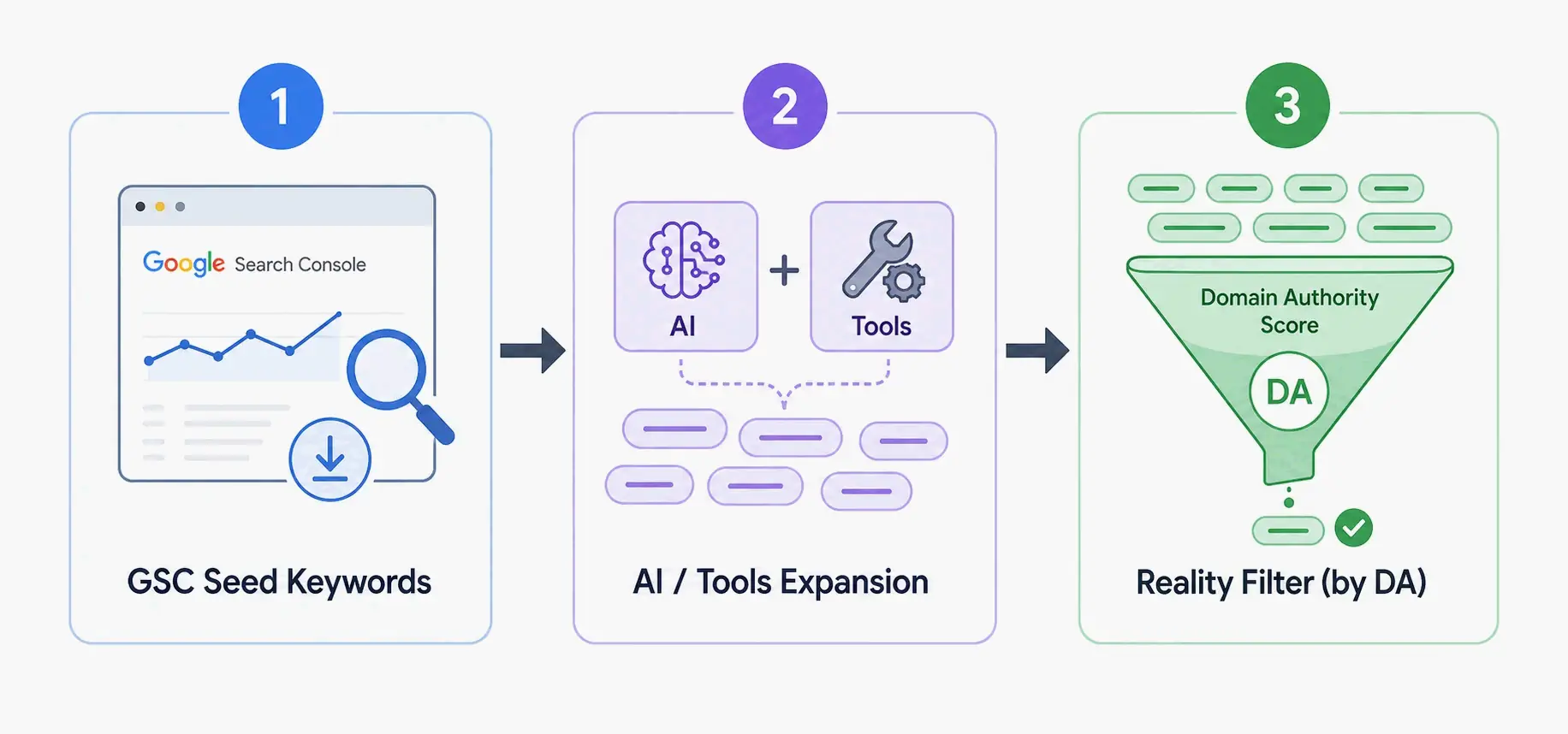
AI language models can generate a different breed of keyword — conversational terms often too new to have a calculated KD. These need validation, not difficulty filtering. The key is to use structured prompts. A prompt chain can walk you from a broad persona to a concrete list of targetable queries.
A Prompt Chain for Finding Underserved Conversational Keywords
Start by defining the searcher’s persona and the problem context: “Act as a business owner in the legal industry who is looking for a more affordable way to generate client leads than paid advertising. What specific questions would this person ask when first learning about SEO?”
Next, ask the AI to transform those questions into long-tail keyword phrases that signal both intent and specificity: “Turn these questions into long-tail keyword phrases, prioritizing phrases with commercial investigation intent, such as comparing services or evaluating costs.”
Finally, add a performance constraint that targets only untracked queries: “From this list, identify any phrases that are likely too specific to register a high search volume in a tool like Ahrefs but for which a detailed, original answer would be highly valuable to a business owner ready to hire a service provider.” This method homes in on queries that fly under the radar of volume-based tools.
To validate these AI-suggested terms, check whether they appear in your GSC impressions or trigger PAA box features. If they do, they have real conversational demand. For any terms you discover through traditional tools, look at the Cost Per Click (CPC). A high CPC tells you advertisers have already recognized the traffic’s commercial worth. That makes a low-volume keyword worth pursuing even when KD is hard to measure precisely.
The Keyword Quality Scoring Matrix: Look Beyond KD
KD alone doesn’t tell you enough. To separate low-traffic noise from genuine opportunities, a keyword quality scoring matrix gives you a clear, repeatable framework. It scores each keyword on five weighted dimensions, producing a combined score that drives your “go/no-go” content decisions.
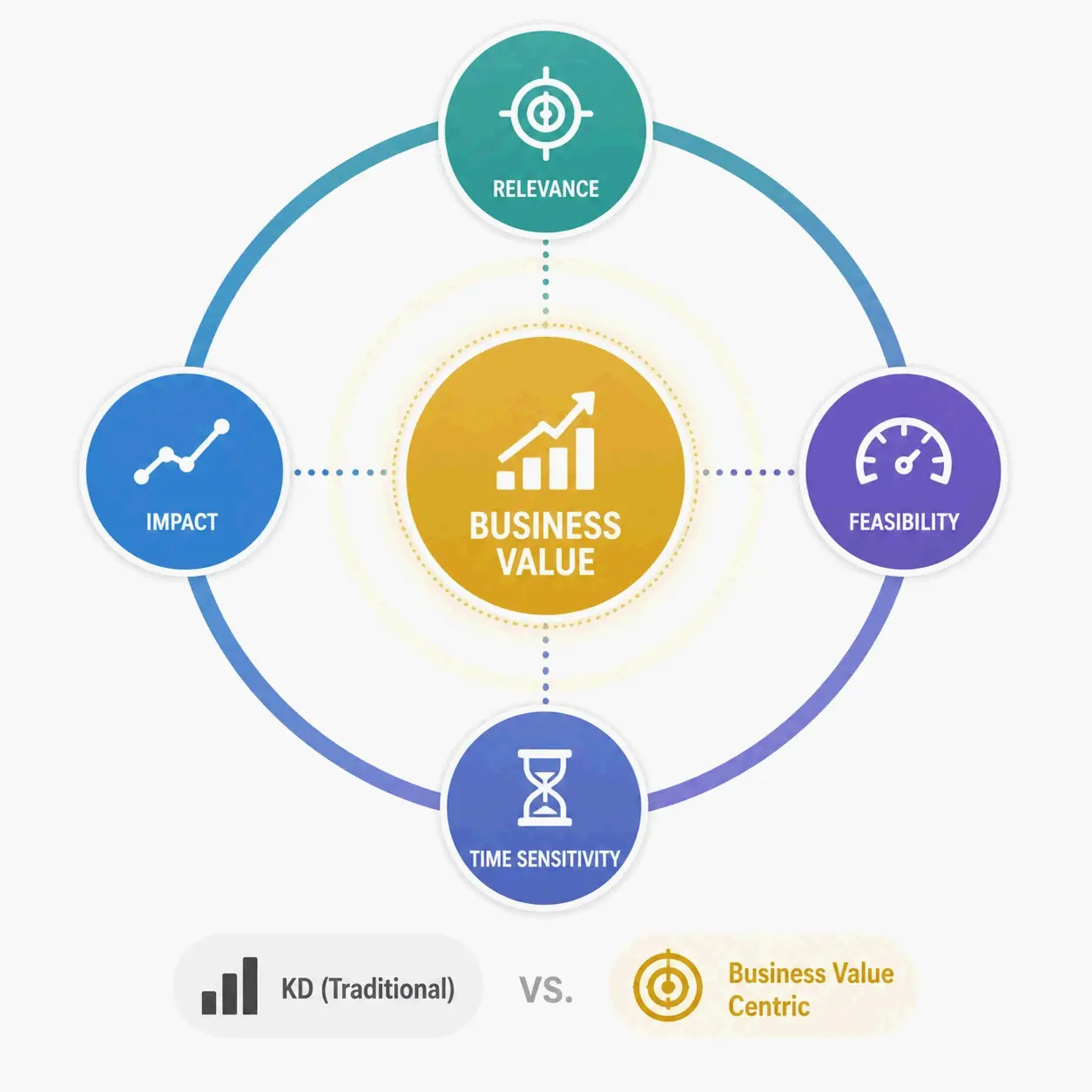
Intent Match is the first dimension, scored from informational to transactional. The keyword needs to line up with a page type you can realistically create — a blog post for an informational query or a product page for a transactional one.
Business Value comes next. Look for commercial modifiers in the query (words like “best,” “pricing,” “for”) and check the CPC. A high CPC or a strong commercial modifier signals a higher potential conversion rate (CVR).
SERP Quality requires manually reviewing the current top-ranking pages. A keyword becomes more attractive when the existing results are forums, thin content, or low-authority sites that your more specific, higher-quality content can realistically beat.
Traffic Potential goes beyond single-keyword volume to estimate the total traffic a page could capture. As reported by SEOProfy, search terms that are 10–15 words long get 1.76 times more clicks than single-word queries. A page targeting one low-volume, long-tail keyword will often rank for dozens of related variations. The total traffic potential can be far larger than what the primary keyword’s volume suggests.
Conversion Signals is the final dimension. Ask whether this specific keyword has already shown positive engagement or high click-through rates (CTR) in your GSC data. A weighted score across these five areas gives you a prioritized list where you chase keywords not for their volume, but for their demonstrated and probable business impact.
Step 3: Validate Whether Low Traffic Actually Means High Quality (Using GA4)
A list of high-scoring keywords is still just a hypothesis until you verify post-click behavior. This final step uses GA4 to prove that traffic from these low-volume terms is actually high quality. You’re moving beyond click-through rates to measure real on-page engagement and conversion performance.
This validation step tackles a common frustration: rankings and traffic improve, but leads don’t. By isolating traffic quality from traffic volume, you get the real story.
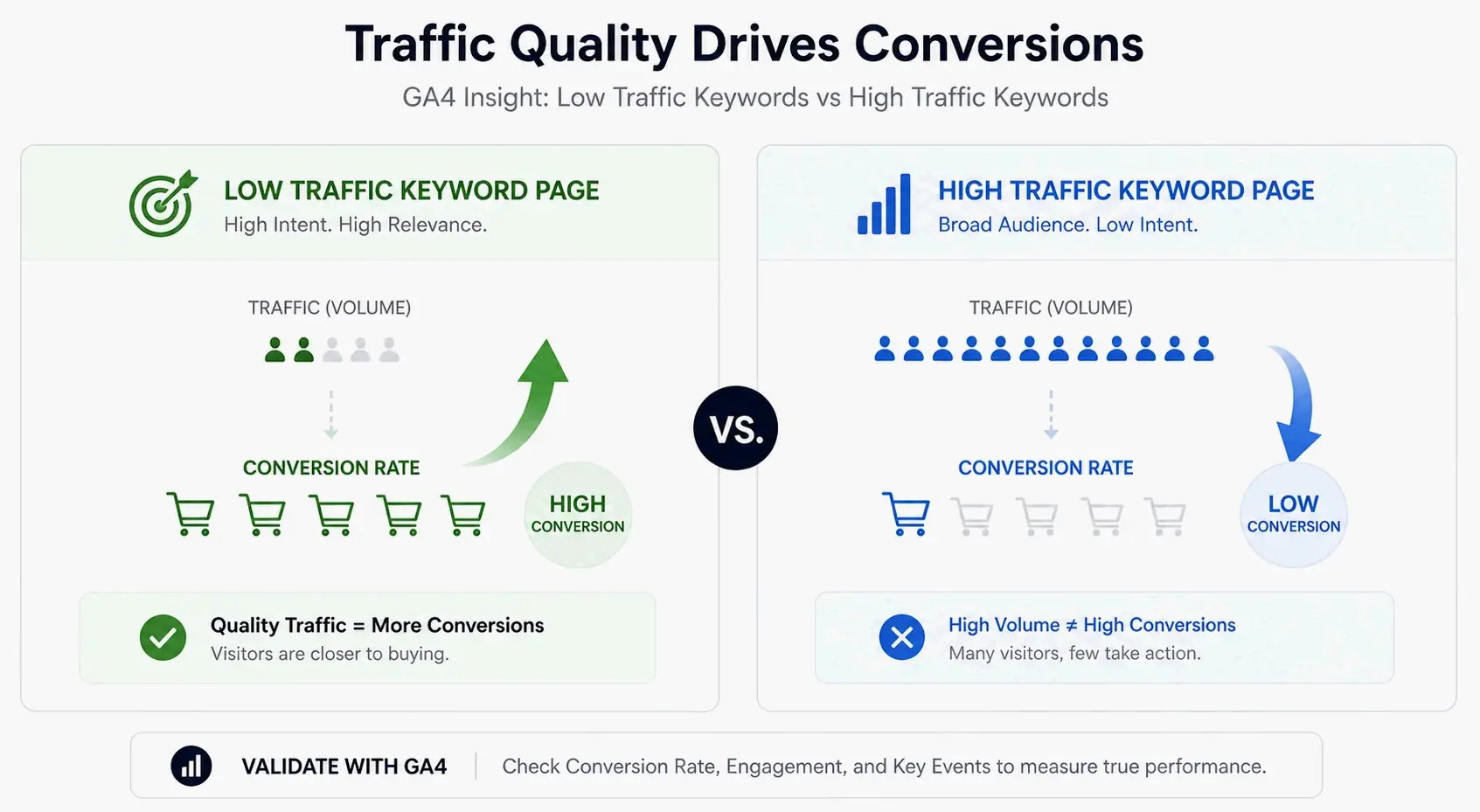
Compare the behavior of visitors arriving through your target keywords against a baseline of general or high-volume traffic. In GA4, pick your low-traffic landing pages and examine two metrics: engaged session rate and session conversion rate. High-quality traffic from a low-volume keyword will show greater scroll depth, longer average engagement time, and a higher likelihood of completing micro-conversions — things like signing up for an email list or downloading a guide. This proves your content is meeting the searcher’s intent, making them more qualified leads than a generic visitor from a broad term.
The ultimate proof? When a landing page targeting a good quality but low traffic keyword outperforms a high-volume page in overall conversion rate. A page built around “how to tell if your SEO company is working” might attract very few visitors. But if its session conversion rate for booking a consultation is significantly higher than a blog post on “SEO basics,” that low-traffic keyword is undeniably more valuable to the business. This analysis connects the early high-CTR signals from GSC directly to valuable on-page actions.
How to Build a ‘Traffic Quality’ Report in GA4
Open the “Explore” section in GA4 and create a free-form report. Set rows to “Landing page + query string” and columns to “Session source/medium.” Import the metrics that reflect quality: “Engaged sessions,” “Average engagement time per session,” and key conversion events like “generate_lead” or “sign_up.” Then apply a filter to show only the landing pages targeting your list of low-traffic keywords.
This report surfaces the quality delta immediately. You might find that visitors from an exact-match, low-volume query have an engaged session rate of 85%, while visitors from a broad organic search category sit around 40%. By pinpointing which low-traffic pages drive the highest conversion and engagement rates, you can scale the strategy that actually works. That means redirecting effort away from high-traffic, low-quality pages and toward these validated, high-intent topics.
How to Structure Content for Your High-Quality, Low-Traffic Keywords
Once your keywords are validated, structure your content to maximize their collective strength. The most effective approach is to group validated keywords into Topic Clusters or Content Silos. Build a central pillar page that broadly covers a core topic, then create supporting spoke pages that each target a specific, low-traffic keyword. This signals comprehensive topical authority to search engines — and that matters in modern SERPs filled with AI Overviews and dynamic features.
The content format should mirror the keyword’s intent. For transactional low-traffic keywords like “best pricing for small business SEO audit,” create tool pages, comparison charts, or dedicated service landing pages. For conversational, question-based keywords unearthed from AI tools, respond with structured FAQ pages and question-led articles built to get cited in PAA boxes. For informational deep dives — say, a comprehensive guide on a niche process — format the content so AI crawlers can easily parse it. Answer the query directly at the top, then expand into deeper detail.
A Special Case: Finding High-Value Keywords for Local Services
For local service businesses — lawyers, dentists, home service providers — the framework needs an additional layer of hyperlocal focus. These businesses face a unique challenge: they want to attract a global audience for informational content, but they need to convert a highly specific local audience. A keyword like “what to do after a dog bite” has informational value. But “best emergency dentist open sunday in pasadena” has extremely low search volume and exceptionally high conversion intent.
To find these hyperlocal keywords, combine GSC data with competitor analysis and a manual review of the local pack SERP features. Look for long-tail phrases that include neighborhood names, specific service modifiers, and signals of immediate need. These keywords will rarely register a KD score in a standard tool, but you can validate them by checking whether they appear as localized PAA queries or autocomplete suggestions in Google. The conversion potential of a single click on such a term can far outweigh hundreds of clicks on a generic, high-volume informational query about a related topic.
Conclusion
Finding good quality but low traffic keywords is a validation system, not a guessing game. The real value lives in measuring post-click quality rather than predicting pre-click volume. The process moves from mining intent signals in GSC, to scoring them against business value, to finally proving their worth through engaged sessions and conversions in GA4. This shifts the goal from chasing vanity metrics to finding clients who are ready to buy.
Stop hunting for new keywords tomorrow. Open Google Search Console today. Identify your three highest-impression queries sitting at positions 8 through 20. Optimize those pages to match intent perfectly, then monitor the engaged session rate in GA4 for 30 days. Scale what works using the keyword quality matrix.
FAQ
What is the difference between a low-traffic keyword and a zero-volume keyword, and which is more valuable?
A low-traffic keyword has a proven, small search volume (1–5 monthly searches), while a zero-volume keyword shows no data in most tools. A low-traffic keyword is immediately more valuable because it represents validated demand. A zero-volume keyword is an untested hypothesis that you may choose to pursue only if its conversational specificity signals a high-intent opportunity, but you should always prioritize terms with proven, albeit small, demand first.
Can AI tools like ChatGPT or Perplexity help me find these high-quality, low-traffic keywords?
Yes, aggressively. In 2026, you can prompt AI to generate ultra-specific, question-based queries your buyers ask. The key is to validate these seemingly “zero-volume” phrases in Google Search Console and SERP features. If they appear in ‘People Also Ask’ or trigger AI Overviews, they are conversationally active and often represent first-mover opportunities before they register any volume in a traditional keyword tool like Ahrefs or Semrush.
How do I know if the traffic from a low-volume keyword is actually “high quality”?
You must track beyond pageviews. In GA4, measure the ‘Engaged session rate’ and ‘Session conversion rate’ for landing pages targeting these keywords. High-quality traffic will show a greater scroll depth, longer average engagement time, and more completed micro-conversions, like email sign-ups. The definitive proof is a higher conversion rate compared to the traffic from your generic, high-volume terms.
Should I avoid all high-competition, high-volume keywords completely?
Not necessarily, but you should deprioritize them when you are still building your website’s authority. A balanced content strategy uses a few high-volume “pillar” topics for broad brand visibility while aggressively pursuing low-traffic, high-quality keywords for initial conversions. The relevance clusters you build from the low-competition terms will eventually signal enough topical authority to your domain, allowing you to compete for harder, high-volume keywords over time.
