


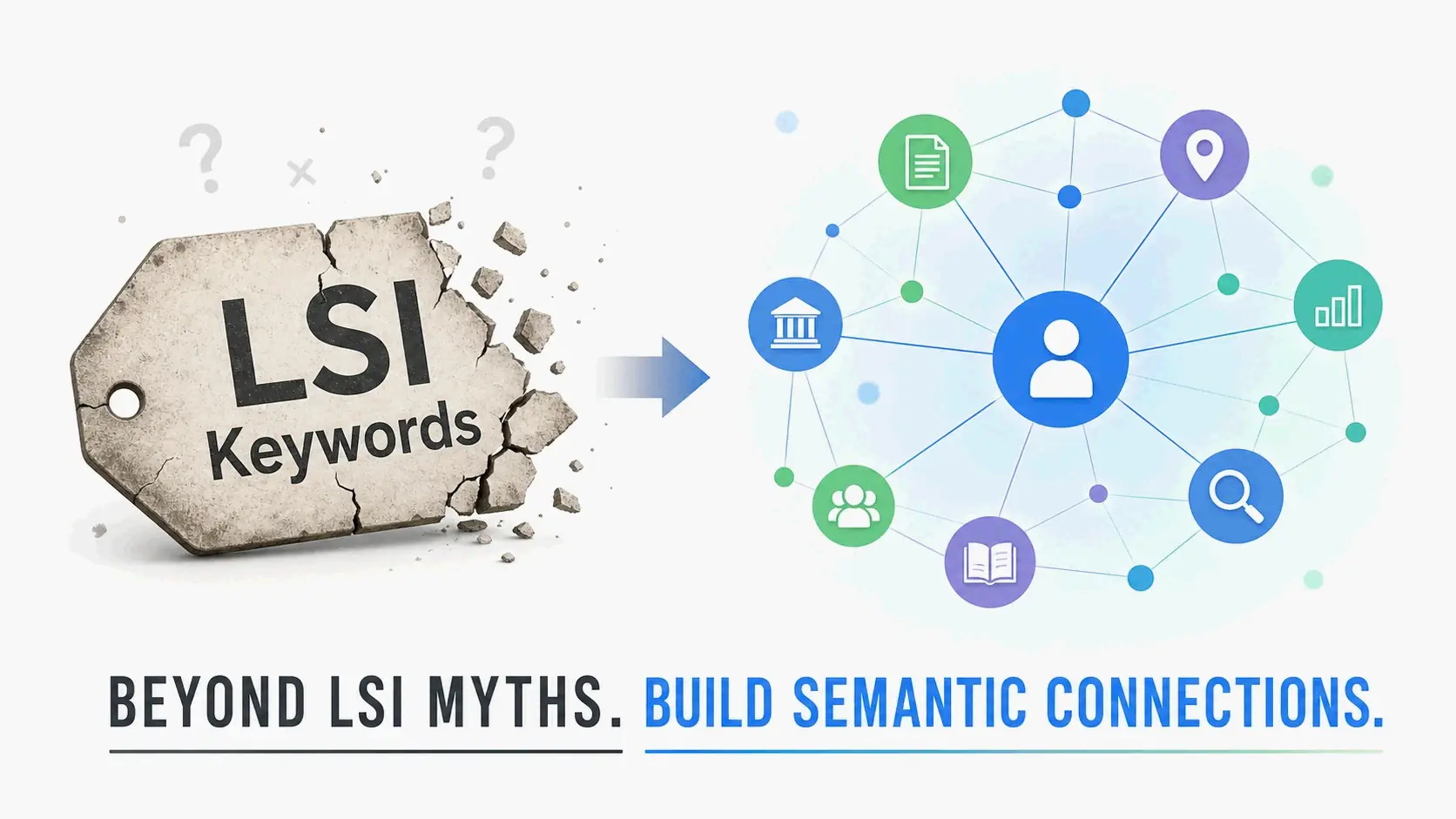
“LSI keywords in SEO” refers to a tactic that doesn’t actually exist. Google doesn’t use Latent Semantic Indexing to rank pages—it never has. What you really need is a semantic content strategy built around entity relationships and search intent, not a mythical list of words tied to a 1988 research paper.
Contents
- The Uncomfortable Truth: There’s No Such Thing as ‘LSI Keywords in SEO’
- What Is Latent Semantic Indexing (LSI)? A 1988 Patent That Doesn’t Power Google
- How the LSI Keyword Myth Started and Why It Persists
- Semantic Keywords: The Genuine Signal That Replaces the LSI Myth
- From Keywords to Concepts: A Modern Workflow for Semantic Content Research
- How Topic-Level Depth Signals E-E-A-T (and Earns AI Citations)
- Conclusion
- FAQ
The Uncomfortable Truth: There’s No Such Thing as ‘LSI Keywords in SEO’
Telling people to “sprinkle LSI keywords into your content” is flat-out wrong. Google’s John Mueller has said so, more than once. Back in 2019, he pointed out that LSI keywords aren’t a thing. He had to say it again in 2023 because the myth refused to die.
The whole idea of an “LSI keyword” is a misnomer. It comes from misunderstanding a decades-old technology built for small, static collections of documents—not the open web. Yet thousands of blog posts, tools, and courses still push the term as if Google relies on it.
Give a tactic a technical-sounding name that hints at algorithmic sophistication, and it spreads fast. SEOs latched onto “latent semantic indexing” to explain why related terms appear in well-ranking content. It sounded plausible. It just wasn’t true.
What Is Latent Semantic Indexing (LSI)? A 1988 Patent That Doesn’t Power Google
Latent Semantic Indexing is a real math technique. A 1988 research paper introduced it as a way to retrieve documents from small, fixed collections by looking at patterns of word co-occurrence. The method could spot which terms tended to show up together in a closed set of documents—like one library catalog with a few thousand entries.
The problem is scale. LSI was never meant to handle the entire internet. Google indexes hundreds of billions of pages that change all the time. The math that works in a controlled library setting becomes computationally impractical at that size and speed. Google’s engineers knew this from day one.
SEO researcher Bill Slawski spent years studying Google’s patents. His summary: “LSI keywords do not use LSI, and are not keywords.”
The technique is academically valid in its original context. It simply has nothing to do with how modern search engines rank web pages.
How the LSI Keyword Myth Started and Why It Persists
The LSI keyword myth started with a common pattern in SEO. Early practitioners noticed that pages covering related terms ranked better. They needed a name for it. “Latent Semantic Indexing” sounded technical, authoritative, and just complex enough that few people would question it.
Once the term started circulating, it spread through sheer repetition. One blog wrote about LSI keywords in 2015. Hundreds of others copied it without checking. The claim turned into accepted wisdom that newcomers inherited, no questions asked.
Two things keep the myth alive beyond mindless copying. First, there’s money in it—a whole category of tools markets itself as “LSI keyword generators,” selling lists of words under a name that suggests algorithmic sophistication. Second, the jargon effect: tossing terms like “latent semantic indexing” and “co-occurrence vectors” at business owners creates enough confusion that they stop questioning the method. As Expert SEO puts it, half the time “that jargon does nothing but make simple work look complicated—so you stop asking questions and open your wallet.”
You’ll even find made-up stats supporting the myth, like claims that LSI keywords boost traffic by a specific percentage. Follow the link back to a source, and there usually isn’t one.
Semantic Keywords: The Genuine Signal That Replaces the LSI Myth
Semantic keywords are what the LSI myth was trying to describe—but got wrong. A semantic keyword is a word or phrase that’s related to your topic by meaning, not just by matching strings or counting co-occurrence. These terms help search engines figure out what your page is really about.
Take the word “spider.” By itself, Google can’t tell which meaning you intend. Put it next to “web,” “eight legs,” and “huntsman,” and the algorithm gets that you mean the creature. Put it next to “ice cream,” “fizzy,” and “tall glass,” and it knows you’re talking about a dessert. Surround it with “City Kickboxing,” “footwork,” and “fight prep,” and it understands you mean the conditioning drill. The surrounding words clear up meaning through context—not some old indexing method.
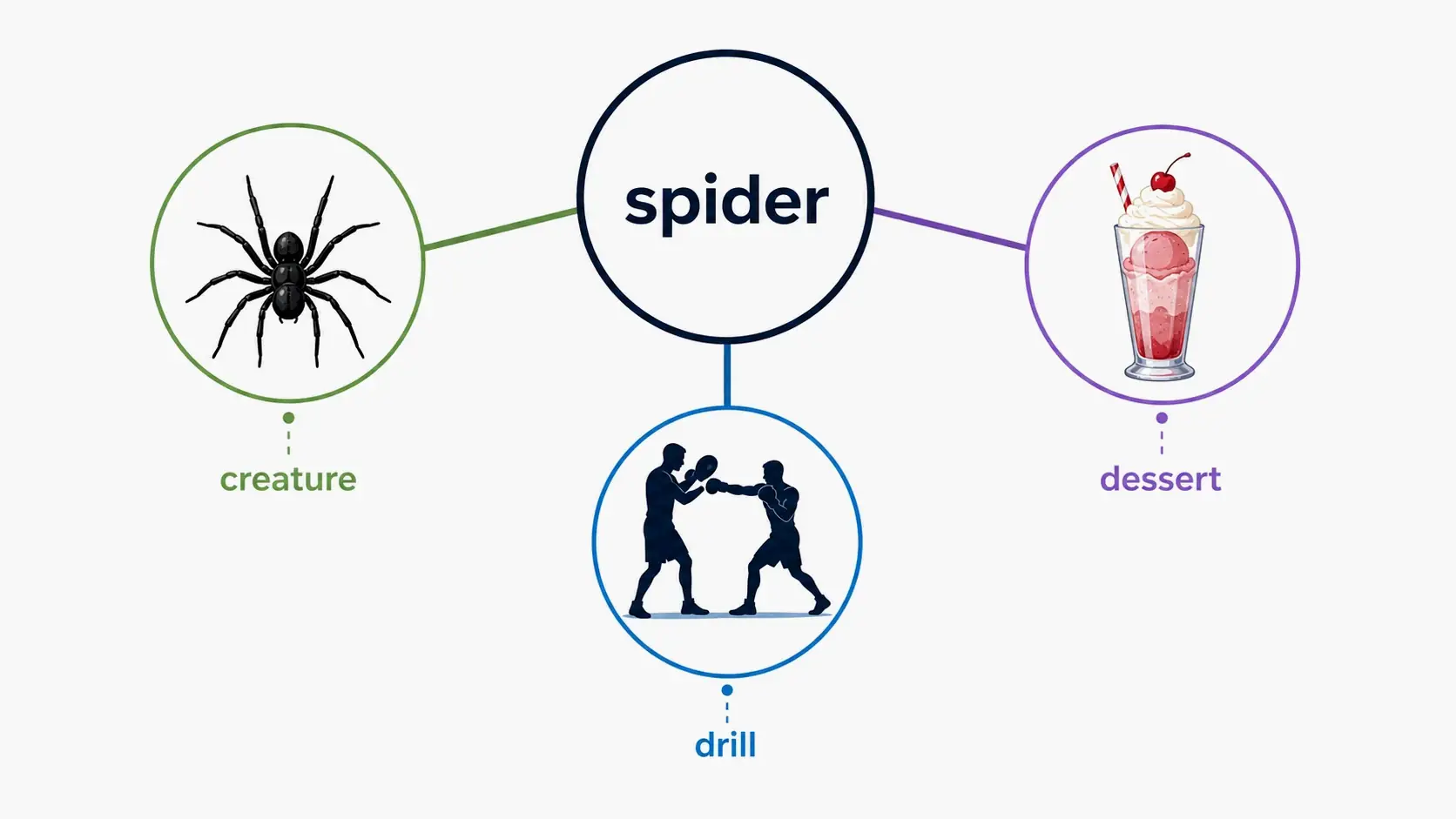
When an SEO says “LSI keywords,” they almost always mean semantic keywords. That distinction matters: only one of these terms describes something Google actually uses.
The era of exact-match keywords is over. Modern search engines don’t judge a page by how many times a phrase appears. They check whether the content shows real understanding. Related terms don’t cause good rankings—they’re a byproduct of content that truly covers the topic.
The Google Technology Stack That Replaced LSI: RankBrain, BERT, and MUM
Google’s modern approach to understanding language leans on a series of increasingly sophisticated NLP technologies—none of them LSI.
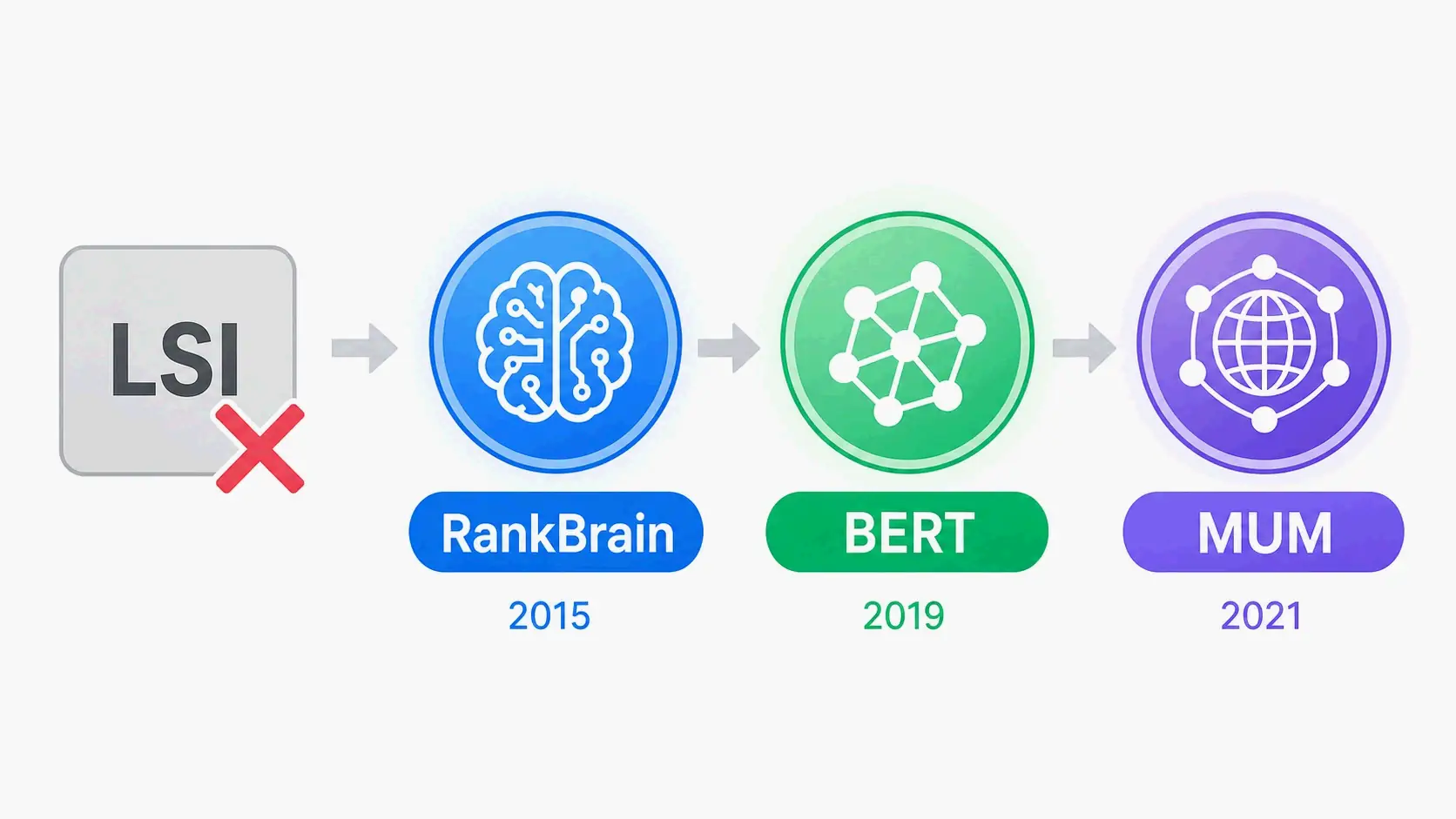
RankBrain, launched in 2015, was Google’s first machine learning system for interpreting queries. It helped the algorithm realize that words and concepts relate in ways beyond simple matching.
BERT, released in 2019, was a big leap. This transformer-based model processes words in relation to every other word in a sentence at the same time, so it understands context from both directions. BERT knows that “bank” means something different in “river bank” versus “bank account” because it looks at the whole linguistic picture.
MUM, announced in 2021, is multimodal and 1,000 times more powerful than BERT. It can understand text, images, and video all at once—and transfer knowledge between languages.
Together, these systems evaluate whether a page shows real topical depth. They’re not ticking off a keyword list. They’re checking whether the content answers the questions a searcher really has.
From Keywords to Concepts: A Modern Workflow for Semantic Content Research
So what do you do instead of chasing LSI keywords? Build a topic-level research process grounded in user intent and entity relationships. This approach works whether you’re optimizing for traditional rankings, Google’s AI Overviews, or answer engines like ChatGPT, Perplexity, and Claude.
Bernard Huang, founder of Clearscope, puts it this way: “Both come down to the same goal: creating content that genuinely covers a topic well. When you do good semantic keyword research and map out the concepts and relationships around a topic, you’re building content that works for traditional search and AI engines at the same time.”
That unified strategy is the backbone of Answer Engine Optimization (AEO)—structuring content so answer engines can extract, synthesize, and cite it. The research process stays the same; the execution changes in how you structure for passage-level extraction.
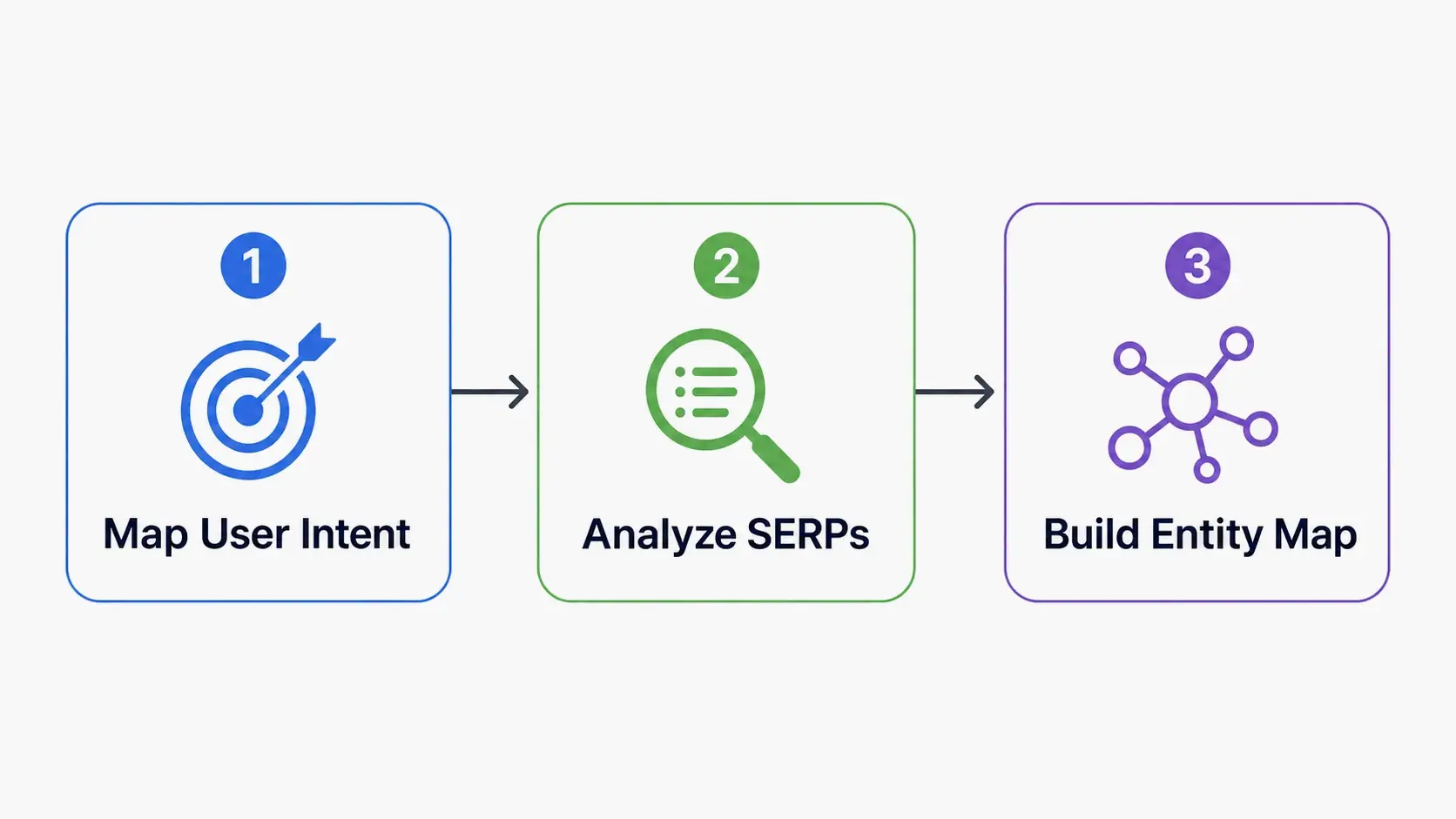
Step 1: Map Topics to User Intent, Not Just Words
Before you open any tool, nail down two things: what you’re writing about and what action you want the reader to take. Keyword research that starts with search volume instead of intent produces content that ranks for queries that don’t convert.
Figure out what the person actually wants when they search your main keyword. Are they looking for information, comparing options, or ready to buy? Get that wrong and nothing else matters. Then map each audience persona to the exact prompts they type into search engines and AI tools when they’re actively weighing a solution.
Pull the exact questions from sales call recordings, demo request forms, G2 reviews, and community discussions. The language real buyers use is almost always more specific—and more valuable—than anything a keyword tool suggests.
Step 2: Analyze SERPs to Identify ‘People Also Ask’ and Entity Patterns
Search your main keyword and study what Google shows. The “People Also Ask” box is one of the easiest ways to find semantically related questions. Click through a few results to expand the list—Google generates related questions on the fly from that starting point.
Note which subtopics and terms keep showing up across the top-ranking pages. Check the related searches at the bottom of the results page. Then cross-reference these with your persona-to-prompt map from Step 1. Do the SERP patterns match what your buyers are really asking, or is there a gap that’s an opportunity?
Daniel Horowitz, Enterprise SEO at Salesforce, explains it well: “I always want to see how the topic is actually being framed across rankings, AI answers, People Also Ask, forums, documentation, and competitor pages. That’s where you start to see which entities recur, which subquestions matter, where you can add value with an FAQ section, and which phrasing keeps showing up.”
Step 3: Build an Entity Map to Structure Your Content Outline
Once you’ve gathered a raw list of terms and questions, group them into clusters: core concepts, related entities, common questions, use-case modifiers, and comparison terms. That gives you an entity map—a structured picture of how all these concepts connect to each other and to your main topic.
The entity map tells strategists and writers which sections to include, which entities to name-drop, and where to go deeper. A page about “project management software” would use semantic terms like “task tracking,” “team collaboration,” and “workflow automation,” while entity references anchor the specifics—naming platforms like “Asana,” “Monday.com,” and “Jira.”
This entity-rich approach naturally demonstrates the E-E-A-T signals—Experience, Expertise, Authoritativeness, Trustworthiness—that Google’s quality raters look for. A page that maps a topic’s conceptual territory shows real expertise in a way a keyword-stuffed page never can.
How Topic-Level Depth Signals E-E-A-T (and Earns AI Citations)
The link between semantic depth and AI visibility is real—and measurable. One HubSpot study found that 44.2% of ChatGPT citations come from the first 30% of a text. When AI models pull answers, they grab from content that clearly defines entity relationships and thoroughly addresses subtopics—exactly what a well-structured, entity-rich article delivers.
This is where SEO and AEO meet. When a page uses specific, clear language and maps out the concepts around a topic, traditional search engines rank it higher and AI answer engines are more likely to cite it. The same semantic research serves both.
Bernard Huang notes that both come down to creating content that genuinely covers a topic well. A page that shows real expertise through semantic completeness gets citations from AI models because it’s exactly the kind of authoritative source those models are designed to reference.

Conclusion
“LSI keywords in SEO” is a tactic built on a technical misunderstanding that’s hung around for over a decade. Google does not use Latent Semantic Indexing on the open web—it never has. What works is creating content that covers a topic thoroughly through semantic relevance and entity relationships, fulfilling search intent completely.
So stop chasing lists of mythical words. Map user intent, analyze what top-ranking pages and “People Also Ask” sections cover, and structure every piece of content as a definitive, entity-rich resource that answers every real user question. Build topical authority. Earn links. The semantic terms will show up on their own—they’re a byproduct of expertise, not the cause of rankings.
FAQ
Are LSI keywords a Google ranking factor?
No, categorically not. John Mueller has said so publicly multiple times—in 2019 and again in 2023—that LSI isn’t part of Google’s ranking algorithm. What matters are semantically related terms that help the algorithm understand context and depth.
What’s the difference between LSI keywords and semantic keywords?
“LSI keyword” is a misnomer tied to an outdated 1988 mathematical model made for small, fixed document sets. “Semantic keyword” is the right term for words and entities that relate to a topic by meaning. Modern semantic understanding comes from NLP models like BERT and MUM, not LSI.
What are the best tools to find semantically related keywords?
Tools like Clearscope, Surfer SEO, Semrush’s Keyword Magic Tool, and Ahrefs’ Keywords Explorer analyze top-ranking pages to surface the topics and subtopics you need. Google’s “People Also Ask” box and related searches at the bottom of SERPs are still powerful, free resources for semantic content mapping.
How many LSI or related keywords should I use in my content?
Don’t aim for a specific number or density—that’s the old keyword-stuffing mindset. The right approach is to cover all relevant subtopics and entities that fully satisfy the user’s search intent, as identified in your research. A focused page with 10 to 15 well-placed semantic terms usually outperforms one that crams in dozens of loosely related terms.
