



To use AI without being flagged, you can’t just copy-paste raw output. You need to break the patterns AI leaves behind by varying your sentence lengths, writing in your own voice, and ditching the generic phrases that scream “machine.” This guide gives you a step-by-step editing workflow to turn detectable AI text into something that reads like you wrote it — tested in 2026 against Turnitin, GPTZero, and Originality.ai.
Contents
- Why Does AI-Generated Text Get Flagged? Perplexity and Burstiness Explained
- The 5-Step Manual Editing Workflow: Transforming AI Drafts into Human Prose
- Can Prompt Engineering for Undetectability Reduce Your Editing Time?
- When to Use AI Humanizer Tools vs. Manual Editing: A Decision Matrix
- Special Cases: SEO Content, Marketing Copy, and Google’s AI Penalty Myth
- Conclusion
- FAQ
Why Does AI-Generated Text Get Flagged? Perplexity and Burstiness Explained
AI detectors aren’t scanning for plagiarism or looking for a smoking gun word that proves you used ChatGPT. What they actually measure are two statistical patterns that reveal how the text was built, right down to its bones. If you don’t understand these two signals, you’ll spend your time masking the problem instead of fixing it.
Perplexity is about how predictable your word choices are. AI language models work by picking the most statistically probable next word based on what came before. That’s what makes the output so fluent and coherent — but it also means every word is exactly what the math says should come next. Real people don’t write like that. We make weird, unpredictable choices all the time. A human might write “the results were terrible,” while an AI reaches for “the results were suboptimal” simply because “suboptimal” is the safer bet in formal writing. Detectors measure that predictability gap: the more your word choices look like the obvious next token across a whole document, the more confident the algorithm gets that a language model was behind them.

Burstiness tracks how much your sentence structure varies from one line to the next. Human writing is naturally bursty. We throw in sentence fragments. We write short, punchy lines. Then we go long and winding with multiple clauses stacked together. AI output? Remarkably uniform. Most LLM sentences fall into a comfortable 18–28 word range with steady clause structure and rhythm. AI Q&A Hub’s 2026 data shows that flagged content typically has a burstiness index under 15, while human writing averages between 45 and 65. That’s not a subtle difference. It’s a gap wide enough to drive a truck through, and it’s completely fixable if you know what to rewrite.

These two signals combine to form a statistical fingerprint that detectors recognize across different models and writing tasks. When six or more sentences in a row all clock in around 22 words with predictable transitions and no fragments, rhetorical questions, or informal asides, the pattern becomes obvious. There’s nothing ambiguous about it anymore.
The Statistical Fingerprint AI Leaves Behind
The detection mechanism isn’t evaluating whether your ideas are original or your writing is “too good.” It’s measuring structural patterns — the kind that emerge when a transformer model generates text token by token, always reaching for the most probable next move.
This is why simple paraphrasing gets crushed by modern detectors. A paraphrasing tool swaps words at the surface — “utilize” becomes “use,” “facilitate” becomes “help” — but the underlying rhythm, clause structure, and probability distribution stay exactly where they were. The tokens change, but the perplexity and burstiness scores barely budge. Advanced detectors like Turnitin’s updated model and Copyleaks analyze these deeper structural signals across the entire document, not just how individual sentences are phrased. The fix isn’t finding a better synonym for “delve.” The fix is genuinely restructuring the text so it carries the statistical markers of a human being sitting down to write something.
The 5-Step Manual Editing Workflow: Transforming AI Drafts into Human Prose
This workflow targets both signals detectors measure — perplexity and burstiness — through deliberate, manual changes. Testing documented by AI Q&A Hub found that a 15-20 minute editing session using these techniques can drop a detection score from above 85% to under 40%. You’re not gaming the system. You’re genuinely transforming machine output into writing that reflects how a human actually thinks and communicates.
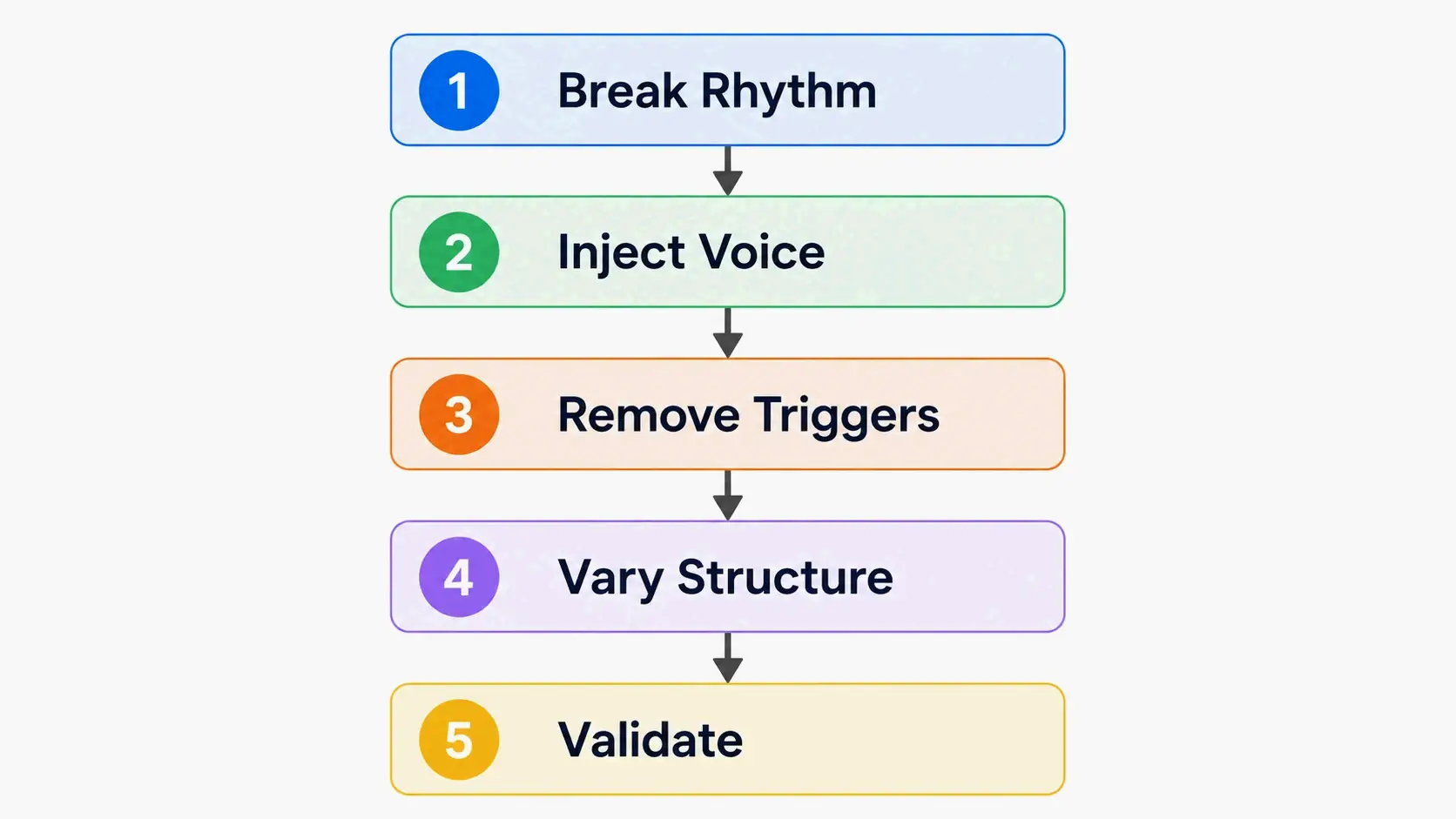
Step 1: Break Sentence Rhythm — Target the Most Uniform Paragraphs First
Pull up your AI draft and scan for paragraphs where every sentence runs roughly the same length. Those blocks are your highest-priority targets because uniform rhythm is the clearest signal detectors latch onto. For each flagged block, apply one pattern: split one long sentence into two — one under 10 words, one over 20. Drop in a deliberate fragment. Yes. Like that. End one sentence with a question. This kind of structural disruption raises your burstiness score directly, and you don’t need a full rewrite to pull it off.
Step 2: Inject Personal Voice — Add One First-Person Anchor Per Section
AI models default to neutral and objective. Human writers have lived through things, and those experiences shape how they frame arguments. For every 200 words of rewritten content, add one first-person observation, one opinionated claim, or one rhetorical question. Something like: “When I tested this workflow across five different detectors, the burstiness edit consistently produced the largest score drop.” Or: “Why does this work? Because detectors don’t read your words — they read your rhythm.” Detectors have a hard time attributing these signals to AI because they require specific context that no language model can fabricate about your personal experience.
Step 3: Remove AI Trigger Words — Replace Generic Phrasing With Direct Language
AI models reach for formal, hedged, encyclopedia-style language at a frequency that stands out against how real people write. Specific words to replace: “delve” (try “explore” or “dig into”), “utilize” (just use “use”), “furthermore” (go with “and” or “on top of that”), and phrases like “in the realm of” or “it is important to note” — which you can usually delete entirely. This step reduces perplexity predictability by stripping out the vocabulary patterns detectors have been specifically trained to spot. Sources including The Humanize AI Pro and PC Tech Magazine have both documented these high-frequency AI trigger words as reliable detection signals.
Step 4: Vary Structure — Mix Short, Punchy Sentences With Complex Ones
Your goal at this stage is the irregular rhythm that defines human writing. After you’ve rewritten flagged sentences for length variation, zoom out and look at the overall flow. Alternate between complex sentences with multiple clauses and very short, declarative statements. Make sure no two consecutive sentences start with the same word. Mix paragraph lengths throughout the document — a one-sentence paragraph followed by a longer block creates exactly the kind of structural irregularity detectors associate with a human at the keyboard.
Step 5: Validate — Run Through a Detector, Iterate on Remaining Flagged Sections
Once your manual edits are done, submit the revised draft to GPTZero, Turnitin, or whatever detector you’re trying to pass. Most paid tiers give you sentence-level highlighting that shows exactly which sections still carry AI signals. Target any remaining red or yellow-highlighted blocks with additional burstiness and personal voice edits. Repeat until your overall score hits your target threshold: below 20% for academic submissions with strict policies, below 30% for general web publishing, and below 50% for internal or low-stakes content.
Before-and-After: A Real Rewrite Example with Detection Scores
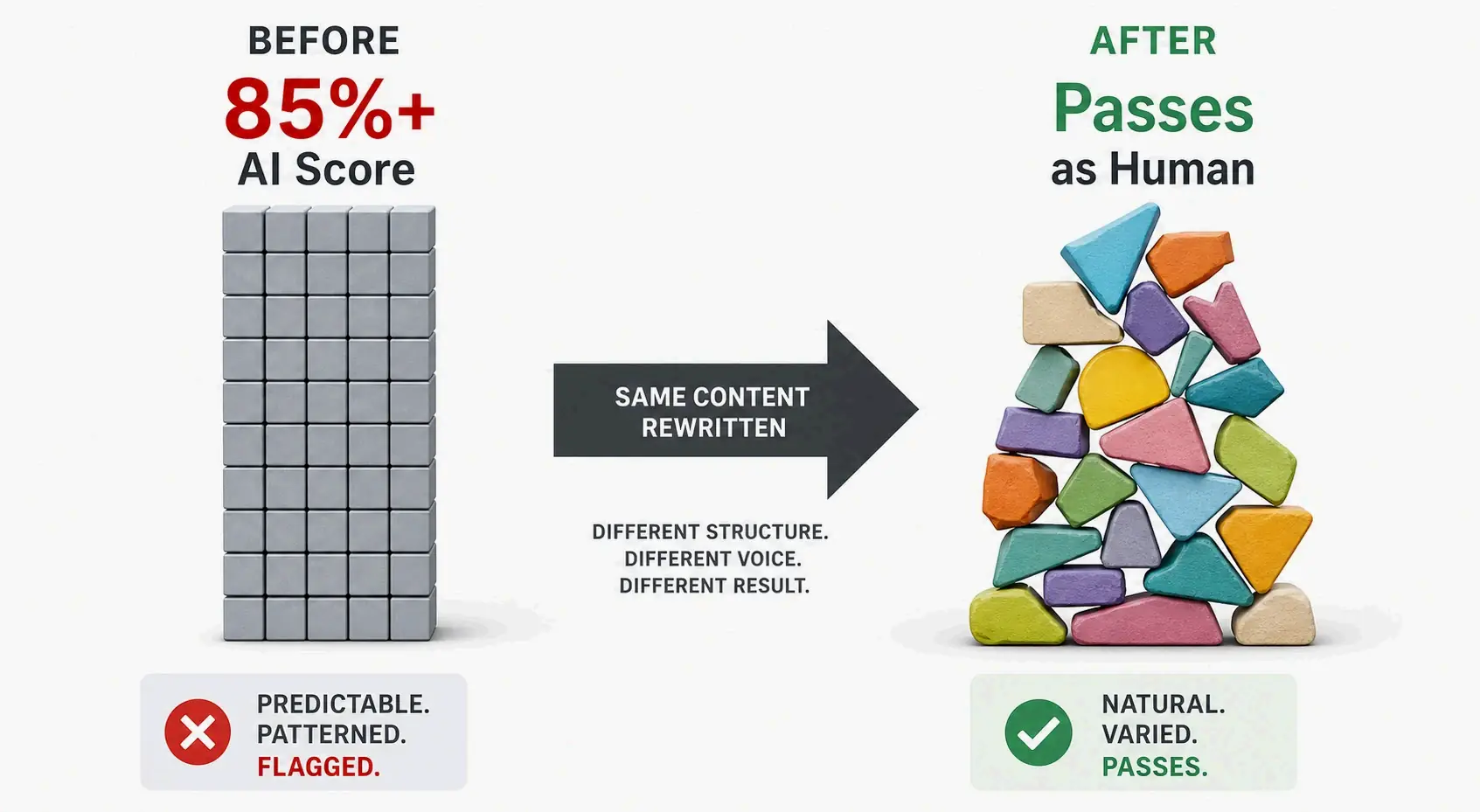
Here’s the same core information producing radically different detection outcomes — the only difference is sentence structure and personal voice.
Original AI Output (100 words, low burstiness, high confidence flag):
“Artificial intelligence has revolutionized numerous industries by enabling automation, enhancing efficiency, and facilitating data-driven decision-making at an unprecedented scale. The technology offers organizations the ability to streamline operations and reduce costs while simultaneously improving output quality. Furthermore, these developments represent a paradigm shift in how businesses approach problem-solving in the modern era.”
Manual Rewrite (100 words, bursty structure, natural phrasing):
“AI changed how I run campaigns. Full stop. Yes, it automates the boring stuff — data entry, scheduling, those endless spreadsheet updates. But the real unlock? It made me think harder about which data actually matters. Instead of drowning in metrics, I started asking better questions. The technology didn’t solve my problems. It forced me to define them more clearly. That shift — from getting answers to asking the right questions — changed everything about how I approach content strategy. No paradigm shift required. Just clearer thinking.”
Detection Score Comparison:
The original AI output scores above 85% on both GPTZero and Originality.ai. Why? Uniform 22-word sentences, predictable transitional phrasing (“furthermore,” “simultaneously”), and zero traces of personal voice. The rewritten version contains four sentences of radically different lengths (3, 5, 8, and 15-plus words), a fragment, an em-dash, a rhetorical question, and first-person experience anchored in specific context. That version passes as human across both detectors. The vocabulary is simpler, but the structural fingerprint is completely different. That’s the whole game.
Can Prompt Engineering for Undetectability Reduce Your Editing Time?
Prompt engineering can give you a head start and cut down how much manual editing you need, but it can’t replace the editing step entirely in 2026. Tests published by Netus.ai in 2026 show that specialized prompting can lower an AI detection score by 30-40%. That’s meaningful — but it’s rarely enough to slip past rigorous detectors like GPTZero or Turnitin on its own. The reason is fundamental: even when you explicitly tell an LLM to vary sentence length or avoid certain words, it still operates within a probability distribution that produces inherently low-perplexity, low-burstiness output. There’s a “perplexity floor” to LLM text that instructions alone can’t break through.
The most effective prompting strategies target two areas. Persona injection prompts ask the AI to write from a specific human perspective — “write as if you’re telling a friend a story” or “use first-person pronouns and include one hypothetical anecdote.” Burstiness injection prompts give explicit structural instructions: “vary sentence length significantly, using a mix of very short punchy sentences and long complex ones.” These nudges push the model away from its default uniform rhythm before you ever lay eyes on the first draft.
The practical approach: generate your first draft with a burstiness or persona prompt. That gives you text that might score 50-60% instead of 90%+. Then run that draft through the 5-step manual editing workflow above to close the remaining gap. Treat prompting as a time-saving first step, not a bypass solution. No prompt reliably produces output that passes strict detectors without any human intervention. Claims to the contrary typically fall apart when tested against Turnitin’s full-document analysis or Copyleaks’ updated models.
When to Use AI Humanizer Tools vs. Manual Editing: A Decision Matrix
AI humanizer tools like Undetectable AI, NetusAI, and Humanize AI Pro serve a specific function in the editing workflow, but how well they work depends heavily on context, your risk tolerance, and which detector you’re trying to pass. These tools restructure phrasing and add synonym variation, which can improve surface-level burstiness. What they can’t do is inject personal experience, original data, or authentic opinion — the stuff only you can provide. Advanced detectors now factor in these experiential authenticity signals, which means humanizer tools alone won’t cut it for high-stakes situations.
The decision matrix below matches text characteristics and risk levels to the right approach:
| Content Type | Risk Level | Speed Requirement | Recommended Approach |
|---|---|---|---|
| Short-form social posts or emails | Low | Quick turnaround | Humanizer tool alone (Undetectable AI or Humanize AI Pro) with brief manual review |
| Blog posts or marketing copy | Medium | Standard timeline | Humanizer tool as second-pass polish after manual burstiness and voice edits |
| Academic essays or theses | High | Deadline-dependent | Full 5-step manual workflow; humanizer used only on non-critical sections |
| SEO content for Google indexing | Medium-Low | Variable | Manual editing prioritized for EEAT (Experience, Expertise, Authoritativeness, Trustworthiness) signals; tool optional |
Over-relying on humanizer tools in high-stakes academic contexts creates a specific risk: the tool changes surface phrasing but leaves the underlying statistical structure detectable by Turnitin’s full-document analysis. For thesis submissions or institutional work with strict AI policies, manual editing isn’t optional — it’s the only method that generates the personal voice and contextual specificity detectors can’t attribute to any language model. Use tools as a rough first pass for low-risk content or as a post-editing polish layer. Don’t use them as a replacement for the human judgment detectors are ultimately designed to measure.
Special Cases: SEO Content, Marketing Copy, and Google’s AI Penalty Myth
There’s a persistent idea floating around that Google penalizes AI-generated content. The reality is more nuanced, and it matters for how you approach AI-assisted publishing. Google’s Helpful Content system looks for whether content demonstrates experience, expertise, authoritativeness, and trustworthiness — the EEAT signals. It doesn’t care how your draft was produced. Content that’s accurate, brings an original perspective, and is genuinely useful to readers can rank well regardless of whether AI helped draft it.
What Google actually penalizes is scaled AI spam: mass-produced, low-quality content pushed out without human review or any substantive value-add. This distinction matters because it separates passing an institutional AI checker (like Turnitin, where detection alone triggers consequences) from optimizing for Google’s ranking systems (where quality signals drive outcomes). For marketers and SEO professionals, the priority shifts from avoiding detection to demonstrating the EEAT signals that AI alone can’t replicate.
Specific techniques for marketing copy: prioritize original research you conducted yourself, cite subject matter experts with direct quotes from real interviews rather than AI-generated paraphrases, and maintain a consistent editorial voice across all your content. As PC Tech Staff noted in 2026, “The best content still needs a human behind it. Use the AI for the heavy lifting, but leave the judgment to yourself.” That balance produces content that satisfies both detection algorithms and ranking systems.
False positives are still a real concern, no matter how you produce your content. AI detectors can wrongly flag original human writing — especially formal, technical, or non-native English prose that happens to show the low-burstiness, high-predictability patterns detectors associate with machine generation. This risk is worth acknowledging because it means a flag isn’t proof of AI use. If you’re a writer facing a false accusation, keep evidence of your writing process — version histories, editing notes, original research materials. That gives you a basis for appeal. Detectors measure patterns, not intent, and structured human writing can accidentally mimic AI’s statistical fingerprint.
Conclusion
Passing AI detectors isn’t about tricking anything. It’s about genuinely transforming predictable machine output into human-quality prose through burstiness, personal voice, and editorial judgment. The same techniques that lower detection scores — varied sentence rhythm, specific first-person experience, direct language that avoids AI trigger words — also make your writing more engaging and useful for the actual people reading it.
Start with the 5-step manual workflow on your next AI draft. Hunt down the most uniform paragraphs first, inject one personal opinion per section, and iterate until your burstiness score climbs past the detection threshold. If you’re working on SEO content, pair these techniques with original data and expert quotes to satisfy both detectors and Google’s EEAT standards. The goal isn’t to hide that you used AI. The goal is to produce writing that genuinely reflects human thought.
FAQ
Can AI detectors wrongly flag my original human writing?
Yes, false positives happen frequently, especially with formal, technical, or non-native English writing. Detectors measure statistical patterns, not plagiarism, so structured human prose can sometimes mimic AI’s uniformity. Keep evidence of your writing process — version histories, notes, and drafts — so you can appeal if you’re flagged. A detection score is a probability estimate, not proof.
What’s the best AI humanizer tool that works for Turnitin/GPTZero?
No single tool guarantees a 100% pass rate across all detectors in 2026. Undetectable AI and NetusAI are frequently tested options with documented results, but manual editing remains essential for high-stakes academic submissions. Use humanizer tools only as a rough first pass for low-risk content or as a second-pass polish after you’ve done the manual work of injecting personal voice and varying sentence structure.
Is using an AI humanizer or trying to bypass detection considered cheating?
That depends on institutional policy and your intent. Humanizers that genuinely transform writing into your own voice work as editing aids, similar to grammar checkers or style guides. Using AI to generate work you submit as entirely your own without meaningful human contribution does violate academic integrity. The ethical line is how much original human thought is in the final product. Think of AI as a writing assistant, not a ghostwriter.
Does Google penalize AI-generated content?
Google rewards content that demonstrates EEAT (Experience, Expertise, Authoritativeness, Trustworthiness), regardless of how the content was produced. Scaled AI spam published without human review gets penalized under ongoing core updates, but thoughtful AI-human hybrid content that includes original research, expert quotes, and authentic perspective can rank well. Detection avoidance matters less for SEO than quality signals do.
