


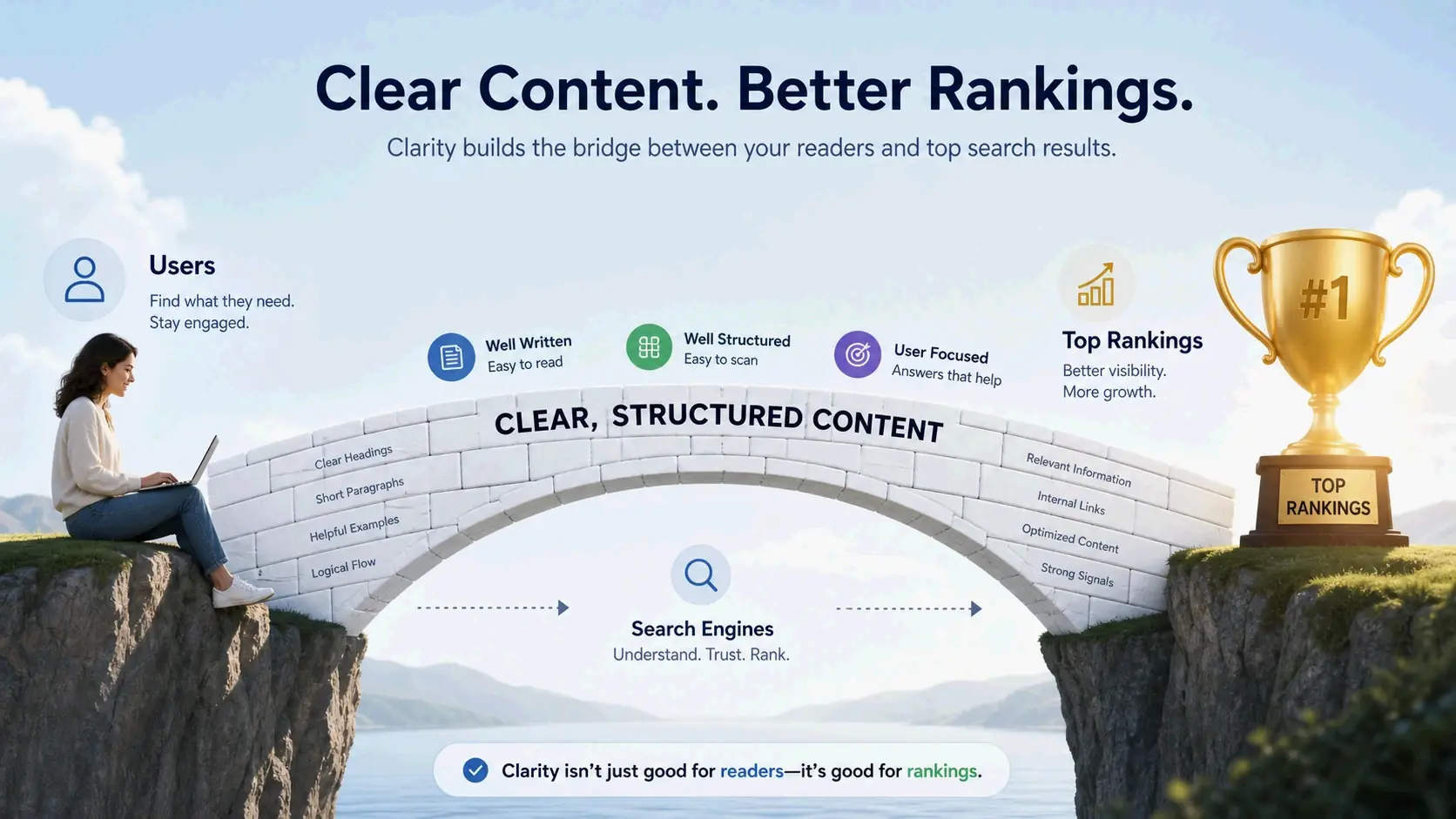
TL;DR: Readability directly impacts SEO by improving user engagement signals like lower bounce rates and longer dwell time. Optimizing for readability means using clear language, scannable structure, and balanced keyword usage to create content that satisfies both readers and search engine algorithms, and increasingly, AI-powered generative engines.
Contents
- Introduction: You’re Losing Readers (and Rankings) Without This
- Is Readability a Google Ranking Factor? The Data-Backed Answer
- Readability vs. Scannability: Why You Need a Layered Content Design
- Write for AI Citability: The New SEO & Readability Frontier
- A Practical, 3-Step SEO Readability Optimization Framework
- Before & After: Readability Optimization in Action
- Conclusion
- FAQ
Introduction: You’re Losing Readers (and Rankings) Without This
Most online visitors do not read your content. According to Nielsen Norman Group, 79% of users always scan a new page, and only 16% read it word-for-word. This has a direct consequence for search engine optimization (SEO): if your content isn’t built for scanners, you’re likely losing both readers and rankings.
The connection between clear writing and strong search performance comes down to user engagement. Readability isn’t a direct ranking factor that Google’s algorithm explicitly measures, but it influences rankings through its impact on how people interact with your page. When content is easy to understand, users stay longer, view more pages, and are less likely to bounce right back to the search results—a behavior known as pogo-sticking.
This dynamic has only grown in importance. As search engines evolve from classic blue-link results to AI-powered overviews and generative engines, clear, structured, and citable content has become a cornerstone of visibility. This guide unpacks the data on how SEO and readability connect, explains how readability differs from scannability, and gives you a practical optimization framework you can apply right away.
Is Readability a Google Ranking Factor? The Data-Backed Answer
Let’s get straight to it: no, readability is not a direct, confirmed Google ranking factor. You won’t find a “readability score” signal in any documentation of how the algorithm works.
The real mechanism is more sophisticated and entirely user-focused. Think of readability as an “engagement signal bridge.” When your content is highly readable, it naturally nudges users toward positive behaviors. They find what they need quickly, grasp the information without struggle, and are more likely to engage with the page. Those behaviors generate quality signals that Google’s algorithms are designed to notice. The chain reaction works like this: high readability leads to lower bounce rates, longer dwell time, and more pages per session. All of them tell Google that your page is a valuable result for the query.
Decoding the Engagement Metrics That Matter for SEO
Two metrics are central to understanding this indirect influence. Bounce rate is the percentage of single-page sessions where someone leaves your site without any interaction. A high bounce rate often signals that a page didn’t meet the user’s needs. Dwell time—how long a user spends on your page before heading back to the search results—is another powerful hint of content quality.
Clear structure directly prevents pogo-sticking, that pattern where someone clicks a search result, quickly finds the content unhelpful, and bounces back to the SERP. When a page uses descriptive headings, short paragraphs, and simple language, users can see the value instantly and stay. That sends a positive signal back to Google.
Flesch Reading Ease: Your Readability Thermometer, Not a Ranking Dial
The most common tool for measuring readability is the Flesch Reading Ease score. Developed by Rudolph Flesch in 1948, it’s a diagnostic metric that calculates text difficulty on a scale from 0 to 100 based on average sentence length (ASL) and average syllables per word (ASW). The formula is 206.835 – (1.015 x ASL) – (84.6 x ASW). A score between 60 and 70 is standard for plain English and easily understandable by 13- to 15-year-old students.
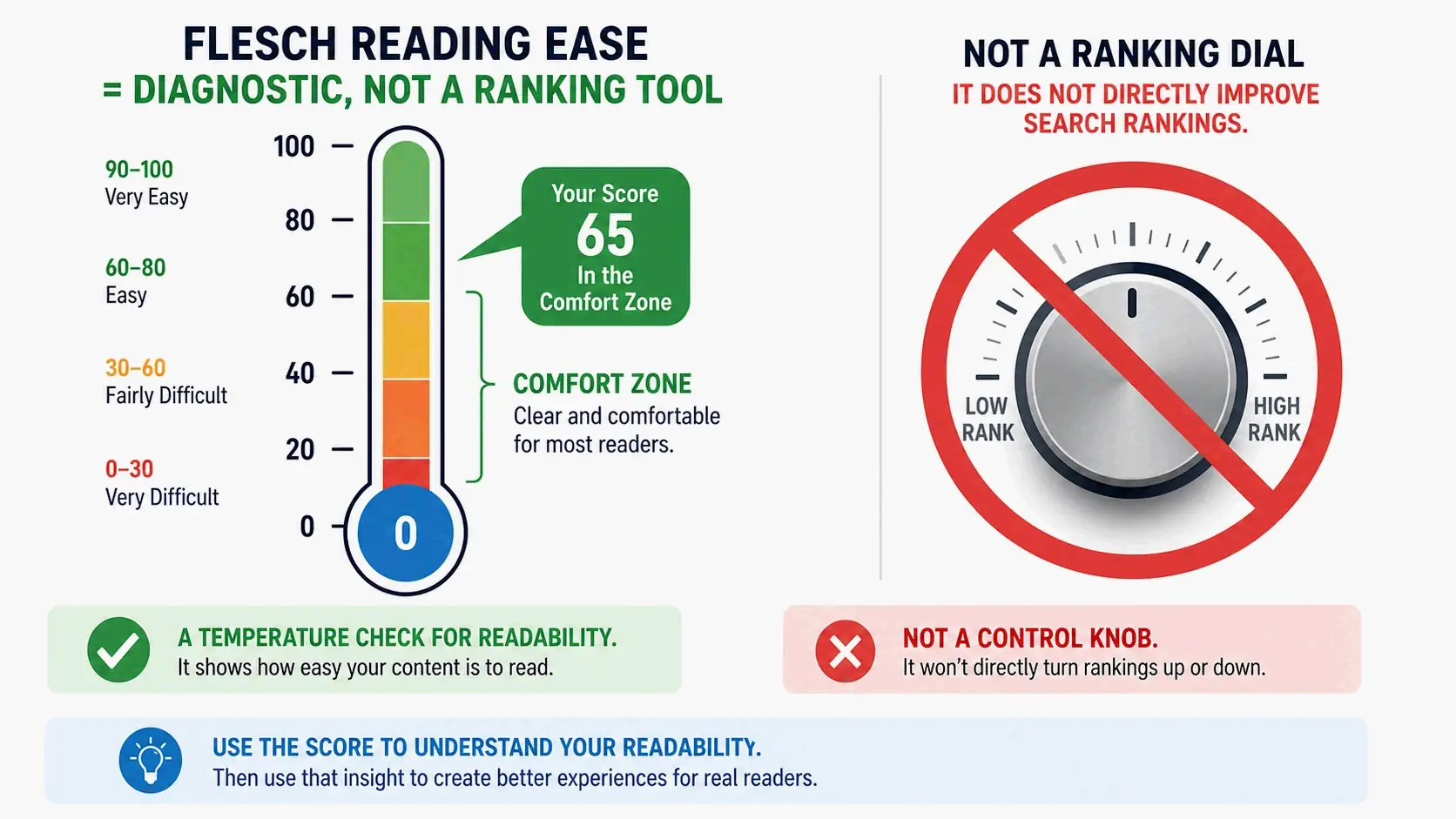
But here’s the thing: treat this score as a thermometer, not a ranking dial. Your content won’t get a boost from Google simply because your Flesch score jumped from 40 to 65. The score is a helpful benchmark that tells you when your text may be too complex for your target audience. If your score is low, it’s a warning that you’re likely creating comprehension barriers that will frustrate users and damage those engagement signals search engines rely on. A related metric, the Flesch-Kincaid Grade Level, translates that ease score into a U.S. school grade level to estimate how many years of education someone would need to understand the text. This focus on clarity also implicitly supports E-E-A-T (Experience, Expertise, Authoritativeness, Trustworthiness), because making a complex expert topic clear and accessible is one of the best ways to demonstrate true mastery and build trust.
Readability vs. Scannability: Why You Need a Layered Content Design
People often use readability and scannability interchangeably, but they’re distinct concepts you need to optimize separately. Readability is about sentence-level comprehension—how easily your brain processes and understands the words and syntax. Scannability is about visual structure—how easily your eyes can quickly find the specific information they want. A text can have perfectly readable sentences, but if it’s presented as an unbroken wall of text, it will still fail to hold the attention of a scanner.
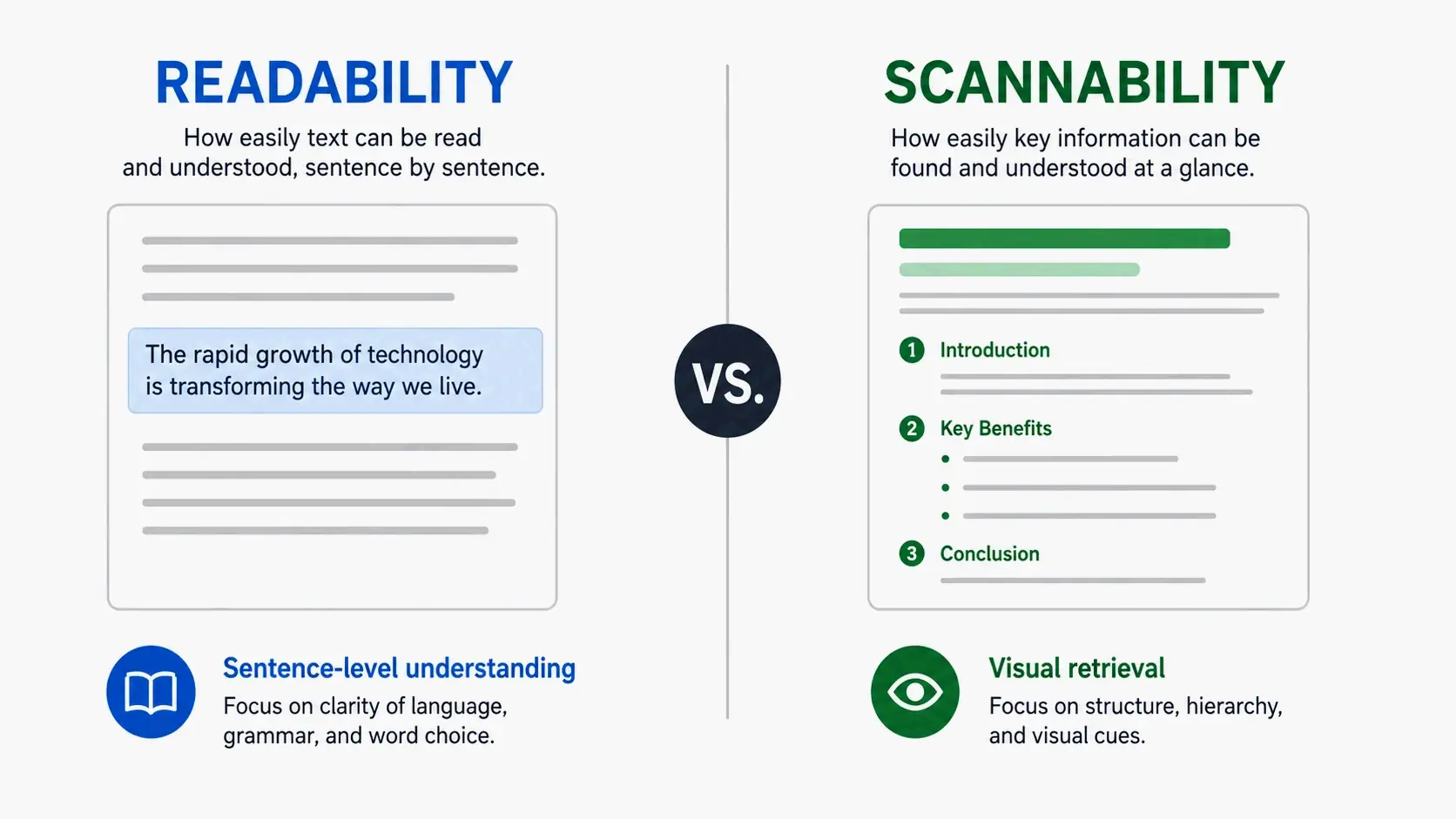
To satisfy both the 79% who scan and the 16% who read deeply, a page needs what I call a “Layered Content Design” model. This approach builds content to work for both groups at the same time, combating the bounce rate from unserved scanners while building authority with deep readers.
A page built this way has two layers. The scannable top layer consists of descriptive header tags (H2, H3), bolded key takeaways, bulleted lists, and summary boxes. Someone scanning can grasp the core argument by reading only these elements. The readable deep layer lives within the paragraphs beneath those headings, providing detailed explanations, case studies, data, and context for the reader who commits. This dual-layer design ensures that no matter how someone reads, their first interaction with your page is a positive one.
How to Build the ‘Scanning’ Layer with Perfect Header Tags
Building the scanning layer starts with a logical information hierarchy using H2 and H3 tags. Think of your H2s as a table of contents for your article; if someone reads only the H2s, they should understand the full narrative arc of the page. H3s then break those main sections into digestible, logical sub-points.
Write descriptive, benefit-driven headings that tell a story, not generic labels. Instead of a vague heading like “Results,” a scannable heading would be “Why a Readability Audit Reduced Our Bounce Rate by 20%.” This turns the heading structure into a compelling visual index. A time-pressed reader can perform a five-second scan and instantly learn the page’s value, structure, and core conclusions.
Write for AI Citability: The New SEO & Readability Frontier
The biggest evolution in the SEO and readability relationship is Generative Engine Optimization (GEO). Here’s the big idea: in the age of AI Overviews and ChatGPT, clear, structured content isn’t just for human users anymore. It’s the primary way Large Language Models (LLMs) source, parse, and cite authoritative answers.
These AI models process content not by appreciating compelling narratives but by parsing structure. They rely on header tags (H2, H3) to understand topic hierarchy and extract answers from clear, direct sentences, lists, and tables. A dense, complex paragraph is a black box to an LLM, making the information inside effectively invisible when AI generates answers.
A concrete example shows the difference. Imagine an LLM handling a query about “the benefits of readability.” If it encounters a lengthy, jargon-heavy paragraph that buries the key advantages in complex sentences, the AI would likely fail to extract a concise, citable set of bullet points about SEO, user experience, and accessibility. But if the same information is presented with a clear H2 heading (“Benefits of Readability for SEO”) followed by a simple bulleted list of those three points, the LLM can instantly pull a perfect, citable answer. That’s the foundation of GEO.
Google’s guidance has long emphasized that content quality, not production method, is what counts. However, the definition of “quality” has now expanded to include “AI interpretability.” To be considered high-quality today, content must not only satisfy a human reader but also be structurally optimized for an AI to understand, extract, and attribute. According to Ahrefs, only 4.6% of top-ranking pages are purely AI-generated. The clear path to visibility is human-led, AI-readable content.
A Practical, 3-Step SEO Readability Optimization Framework
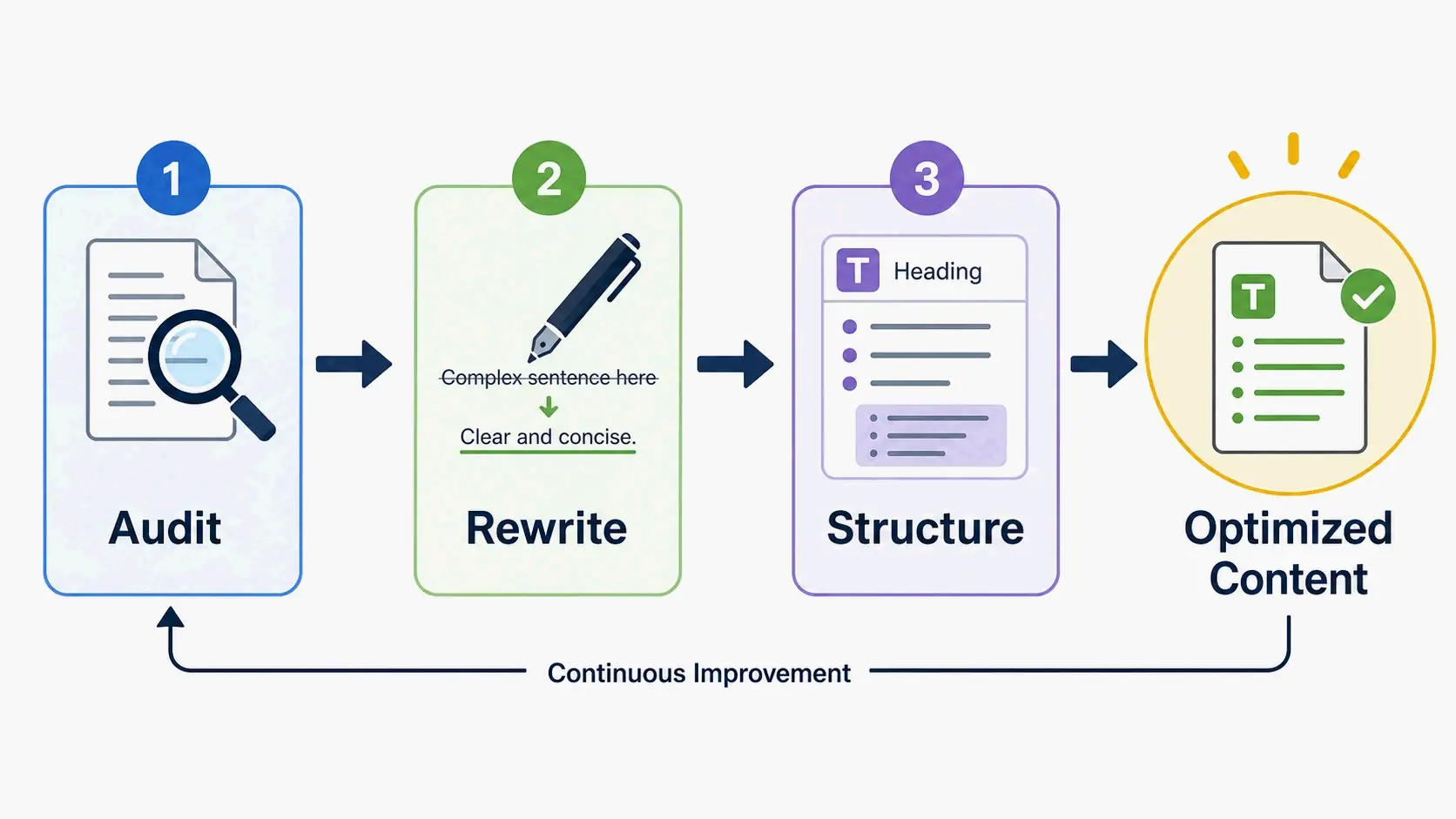
Moving from theory to action takes a repeatable process. This 3-step framework—Audit, Rewrite, Structure—is designed to improve both traditional user engagement metrics and your content’s citability by AI systems.
Step 1: Audit Your Content with a Readability Tool
Optimization begins with an objective audit. For WordPress users, the Yoast SEO plugin provides real-time readability analysis right in the post editor, including a Flesch Reading Ease score and actionable checks for sentence length and passive voice. If you’re not on WordPress, the Hemingway Editor is a web and desktop app that excels at visually flagging complex sentences, adverbs, and passive constructions. Focus your audit on three specific metrics: the Flesch score as a general benchmark, the number of sentences flagged as hard or very hard to read, and how often passive voice shows up.
Step 2: Rewrite for Clarity, Not Just Concision
Once problem areas are identified, the rewrite process centers on clarity. A primary target is to bring average sentence length under 20 words. This doesn’t mean making every sentence short and choppy; it means breaking down multi-clause sentences into their logical parts.
Strategic use of transition words—such as “however,” “therefore,” “for example,” and “specifically”—helps create a logical flow between those shorter sentences and guides the reader through your argument. Another key action is to keep paragraphs to a maximum of 3-4 sentences. This step isn’t about dumbing down your text; it’s about transforming complex, authoritative content into a format that’s frictionless for a human brain to follow and clean enough for an AI to reliably parse.
Step 3: Structure for the Scanners with a ‘Layered’ Approach
The final step is to apply the structural layer. Use the Layered Content Design model by revisiting the page’s architecture. The rewritten paragraphs from Step 2 form the “readable deep layer.” Now, build the “scannable top layer” on top of it. Add a descriptive H2 or H3 above every 200-300 words of text. Place a bolded, one-sentence key takeaway at the beginning of each major section. Where a paragraph lists benefits, steps, or examples, convert that prose into a bulleted list. This layered approach ensures the finished piece doesn’t just read well—it functions effectively for every type of user, human or machine.
Before & After: Readability Optimization in Action
The value of this framework becomes most tangible in a direct comparison. Below is a “before” example of a dense, technical paragraph, followed by its systematically optimized “after” version.
Before:
“As organizations navigate the complexities of the modern digital ecosystem, it becomes increasingly critical to understand the multifaceted and non-linear user interactions that algorithmic systems employ when assessing the intrinsic value and contextual relevance of a given piece of informational content in order to subsequently index it and serve it in response to a highly specific user query within the search engine results page, a process which is fundamentally predicated on a large number of interrelated ranking signals, of which content accessibility is one.”
After:
Search engines use complex algorithms to decide what content to show for a user’s query. These algorithms are built on many interconnected ranking signals. One of these signals is content accessibility. To rank well, your website’s information must be easy for Google to understand and use. This is a core part of modern search engine optimization.
Annotations on the rewrite:
- Shortened a 58-word sentence into an 18-word opener: The original sentence was a single, 58-word labyrinth. The rewrite starts with a clear, 18-word core statement: “Search engines use complex algorithms to decide what content to show for a user’s query.”
- Replaced jargon-heavy phrasing with plain language: “The multifaceted and non-linear user interactions that algorithmic systems employ when assessing the intrinsic value and contextual relevance” was simplified to “Your website’s information must be easy for Google to understand and use.”
- Added clear, direct statements to replace a chain of dependent clauses: The rewrite isolates the key factors (algorithms, ranking signals, accessibility) into their own digestible points, removing confusing conceptual nesting.
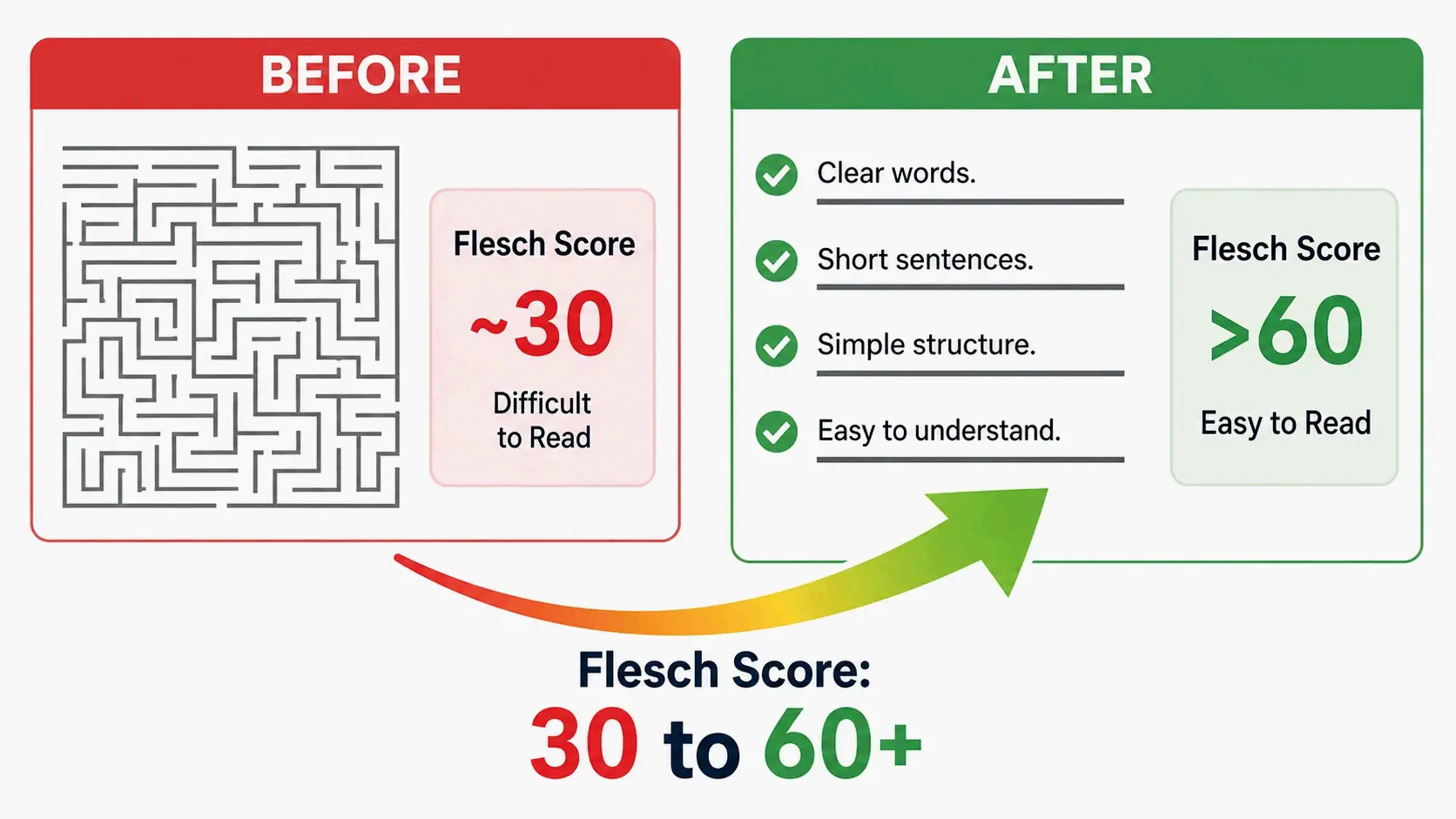
Direct Result: This specific rewrite took a text with an estimated Flesch Reading Ease score of roughly 30 (very difficult, university-graduate level) and brought it to a score above 60 (plain English, accessible to a broad audience).
Conclusion
SEO and readability are no longer separate disciplines—they’re a unified strategy for winning with both human users and the AI algorithms reshaping search. Clear content drives the engagement signals Google uses to judge quality, and its structured format is now the primary language of AI citability. Start with a readability audit of your top three most-trafficked pages using a tool like Yoast SEO or Hemingway Editor. Then, don’t just shorten sentences; redesign the content in structural layers so it simultaneously serves the 79% who scan and the 16% who read deeply, along with the AI that will determine its future visibility.
FAQ
Is readability a direct Google ranking factor?
No, it is not a direct, confirmed ranking factor. Its power is indirect. It impacts user engagement signals like bounce rate and dwell time, which Google uses to assess page quality and relevance, leading to higher rankings.
What is Flesch Reading Ease, and how is it calculated?
It’s a score from 0-100 that predicts text difficulty based on average sentence length and syllables per word. A score of 60-70 is standard for web content. A higher score means easier-to-read text, and tools like Yoast SEO calculate it automatically.
Will improving readability make my content sound unprofessional?
Not if done correctly. The goal is not to “dumb down” your content but to make complex ideas clearer and more accessible. You can maintain authority by using precise terminology while simplifying your sentence structure and improving flow.
Are readability and scannability the same thing?
No. Readability is about how easy your sentences are to understand. Scannability is about how easy your page layout makes it to find key information quickly. You need both for effective, modern SEO content that satisfies all user behaviors.
What are some free tools to check my content’s readability?
Hemingway Editor is excellent for identifying complex sentences with a free web version. Yoast SEO offers real-time Flesch Reading Ease analysis for free on WordPress. Many word processors like Microsoft Word also have built-in readability statistics you can enable.
