


TL;DR: GEOWriter vs Frase: The core difference? GEOWriter is a writing platform with Generative Engine Optimization (GEO) baked into how content gets created. Frase, in contrast, takes its strong research and optimization foundation and adds an AI visibility tracker on top. If you want guided, GEO-first drafting, choose GEOWriter. If your process revolves around heavy research and you’d like to add AI citation monitoring, go with Frase.
Contents
- GEO Is Not SEO: The New Rules Defining This Comparison
- GEOWriter vs Frase: The Fundamental Product Philosophy Divide
- AI Visibility Tracking: A Critical Gap Emerges
- Content Quality & Trustworthiness: The Citation Hallucination Problem
- Feature-by-Feature: SEO Score, Content Briefs, and Core Capabilities
- Pricing, Value, and the Right Team for Each Tool
- Conclusion
- FAQ
GEO Is Not SEO: The New Rules Defining This Comparison
Generative Engine Optimization has split off from traditional SEO. The goal is no longer just ranking on Google—it’s about getting cited by AI engines like ChatGPT, Perplexity, and Gemini. SEO optimizes for blue links. GEO optimizes for showing up inside AI-generated answers. That single shift sets up the entire GEOWriter versus Frase comparison.
A major Sprinklr study from May 2026 put this to the test. The researchers—Vishwakarma, Kumar, and Jamidar—ran 252,000 trials across six large language models to figure out what drives citation preference. They found four “gatekeeper” factors that decide whether a source gets cited: topic match, price absence, recency, and list position. Fail any one of them, and your odds of being cited drop dramatically, no matter how good the rest of your content looks. Once those basics are covered, secondary elements like completeness, trust cues, and competitive positioning can further lift your visibility.
Recency packs an especially strong punch. An SE Ranking 2025 study showed that pages updated within the last 30 days are 3.2 times more likely to get cited by AI engines. Fresh content isn’t just nice to have—it’s a structural requirement for GEO.
This article measures both GEOWriter and Frase against that new framework. Using the Sprinklr gatekeepers as a benchmark, we’ll look at which tool better helps content teams nail topic relevance, include explicit pricing and specs, stay current, and structure content so it lands in the right spot when an AI retrieves sources. The answers will make it clear which platform fits a modern GEO strategy.
The 4 Gatekeepers of AI Citation (Sprinklr 2026)
The 2026 Sprinklr study built a controlled two-document RAG testbed to isolate exactly which content factors make a language model cite a source. After 252,000 trials across six LLMs, four factors stood out as universal gatekeepers with massive effects (odds ratios above 100 in every model tested).
Topic match comes first. If your content mentions unrelated products instead of what the user is actually asking about, citation odds collapse. This sounds obvious, but it often breaks down in subtle ways: missing key query terms, addressing adjacent topics without connecting to the real question, or offering generic information that doesn’t match the specific intent.
Price absence is the second gatekeeper. When product price information is missing, language models consistently prefer sources that include it. Including explicit pricing was so influential that the Sprinklr researchers reported odds ratios too big to pin down exactly—marked as “>>10k.” This isn’t just an e-commerce thing. SaaS pricing pages, service cost breakdowns, or any content where a reader would expect to see numbers will run into this filter.
Recency works through timestamps. Content labeled 2026 won decisively over content labeled 2019 across every model tested. The SE Ranking 2025 study backs this up: pages updated within 30 days get 3.2 times more citations. Timestamps act as freshness signals, helping AI engines filter out stale information.
List position is the fourth gatekeeper, rooted in how LLMs process context. The first piece of content in a retrieved set gets cited far more often than the second. The Sprinklr study found odds ratios over 10,000 when comparing position one to position two. In practice, that means the SEO fundamentals that influence traditional ranking—backlinks, domain authority, technical health—still matter a lot. They determine where your content sits when an AI engine pulls candidate sources.
GEOWriter vs Frase: The Fundamental Product Philosophy Divide
At its core, the GEOWriter versus Frase decision hinges on two very different philosophies. GEOWriter is an integrated writing platform where GEO optimization lives inside the content creation process. Frase is a research-first optimization suite that later added AI visibility tracking to its established SERP analysis workflow.
GEOWriter’s workflow revolves around generating E-E-A-T-aligned, AI-optimized content from scratch inside a single editor. According to SEO Calling, the platform bundles live SERP analysis, structured content generation, E-E-A-T alignment, automated visuals, and one-click publishing into one flow. GEO isn’t treated as an add-on—it’s the foundation. While you draft, the editor serves up GEO scoring and citation optimization guidance in real time, not after the fact.
Frase built its reputation on a different base. As the Daily AI Reviews 2026 test detailed, Frase has always excelled at building deep content briefs from SERP analysis. It analyzes top-ranking pages, surfaces competitor structures, and creates comprehensive briefs that guide human writers. In the 2025–2026 period, Frase rolled out AI visibility tracking across multiple AI engines, added GEO scoring alongside its traditional SEO scores, and expanded its AI Agent to more than 80 skills. Those additions matter, but the underlying architecture is still a research tool with AI tracking attached—not a GEO-native creation platform.
This split leads to different recommendations depending on your team’s style. Teams that start every piece of content with research—digging into competitors, building detailed briefs, then writing—will feel at home with Frase’s strengths. Teams whose main goal is creating AI-citable content with built-in GEO optimization from the first sentence will find GEOWriter’s integrated approach a better fit.
Workflow Showdown: GEO-First Drafting vs. SERP-First Briefing
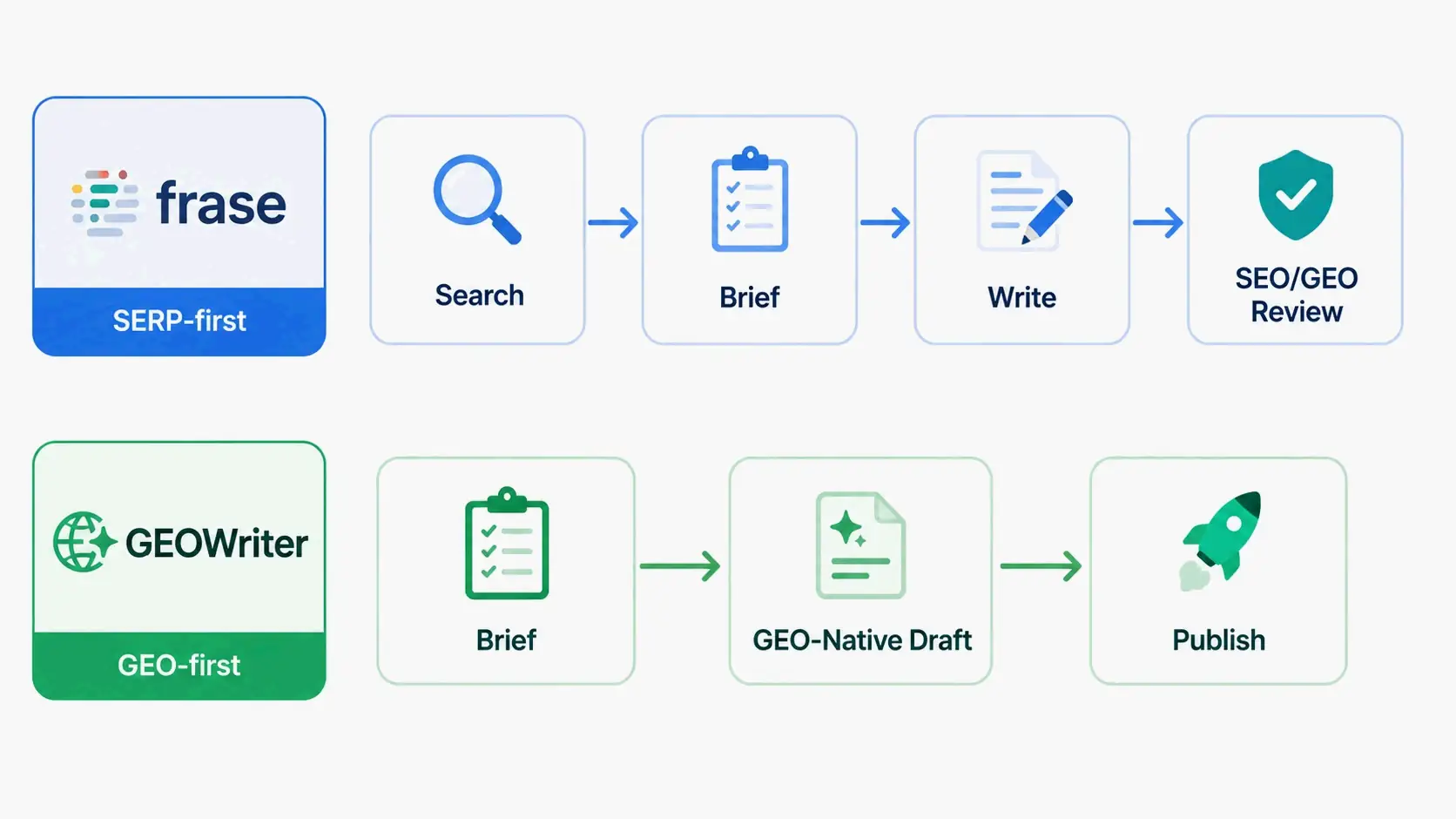
The practical difference snaps into focus when you lay out a typical content sequence. In Frase, you start with a keyword, move into SERP analysis and brief generation, then write with AI assistance or draft manually in the editor. GEO scoring and AI visibility tracking sit in separate layers. They inform your process but don’t drive it. The writer is still the central actor, using Frase’s research and scores to make decisions.
GEOWriter flips the order. SEO Calling’s coverage describes it as an integrated pipeline: live SERP analysis feeds into content generation, E-E-A-T alignment, and publishing. GEO considerations get baked in at the drafting stage. The content generator is built to produce copy that addresses the four Sprinklr gatekeepers—topical relevance, pricing inclusion, recency signals, and clear structure for AI retrieval position—without forcing the writer to manually tick each box after the fact.
If you want a quick test between the two tools, write the same content brief in both and watch where GEO optimization happens. In Frase, optimization is mostly a review step. In GEOWriter, optimization is a generation parameter. Which one makes sense for you comes down to whether your team’s bottleneck is research quality or writing speed with built-in GEO compliance.
AI Visibility Tracking: A Critical Gap Emerges
AI Visibility Tracking means monitoring which AI engines cite your content, how often, and for what queries. This has become essential now that ChatGPT, Perplexity, Gemini, and similar assistants often intercept top-of-funnel questions before Google does. Both GEOWriter and Frase offer AI visibility tracking, but their approaches reveal a meaningful gap in philosophy and execution.
Frase treats AI visibility tracking as a monitoring overlay. It tracks brand mentions across up to eight AI platforms, depending on your plan: ChatGPT, Perplexity, Claude, Gemini, Google AI Overviews, Grok, Copilot, and DeepSeek. The Daily AI Reviews May 2026 test confirmed this genuinely broad coverage. You add prompts you care about, and Frase reports when AI assistants cite your content versus competitors’. The tracking dashboard shows what’s happening, but it operates separately from the content creation workflow. A writer can check AI visibility data, then switch over to the editor to create or optimize content based on those insights.
GEOWriter takes a different path by merging GEO scoring and citation-optimization suggestions directly into the content editor. Instead of making AI visibility a separate monitoring function, it weaves optimization guidance into drafting. As a writer creates content, the editor gives real-time feedback on how well the piece meets the criteria that drive AI citation. Visibility tracking isn’t a report you check after publishing—it’s a parameter that shapes content while you’re making it.
Numbers from established research help underline why this integration matters. The Princeton GEO study by Aggarwal et al., presented at KDD 2024, measured the most effective levers for AI visibility: citing sources lifted visibility by 40%, adding statistics by 37%, and using an authoritative tone by 25%. A platform that bakes these techniques into drafting—prompting writers to include citations, surface statistics, and keep a confident voice—applies those levers systematically, rather than leaving them to the writer’s judgment during later optimization passes.
From Monitoring to Action: How Each Tool’s Scores Work
Frase serves up dual SEO and GEO scoring alongside the content in real time, with an E-E-A-T breakdown for Expertise, Experience, Authoritativeness, and Trustworthiness. The Daily AI Reviews test found that the scoring updates smoothly with each edit. But the score works as a post-hoc grade: it tells you what you’ve written and where you could improve, without actively guiding you toward GEO-friendly choices as you draft.
GEOWriter’s integrated scoring pushes that a step further. According to SEO Calling, the platform’s content generation is built around E-E-A-T alignment from the start, with GEO considerations woven into drafting parameters. Instead of showing a score and leaving you to interpret and adjust, it steers content toward citation readiness as it’s produced. For teams that don’t have deep GEO expertise in-house, this guided approach cuts down the learning curve that Frase’s more self-serve model demands.
Content Quality & Trustworthiness: The Citation Hallucination Problem
A hands-on test by Daily AI Reviews in May 2026 exposed a trust issue with Frase that directly threatens GEO viability. When reviewers tested Frase’s AI-generated article output, they clicked every external link in a sample article. Out of 11 AI-generated external citations, 5 pointed to mismatched or completely unrelated destinations. A citation attributed to an “Ahrefs May 2025 study” linked to ranklytics.ai, a Frase competitor. An attribution to the “Content Marketing Institute” went to the US Chamber of Commerce website. A claim about a “Linearloop retail experiment” with a specific 23.7% conversion lift statistic pointed to airops.com—another competitor—with no mention of that statistic anywhere on the page. Most concerning, a reference to “Daily AI Reviews Internal Testing” led to a third-party YouTube video, attributing research that never existed.
This isn’t just a minor editorial headache. For GEO, factual accuracy and source integrity are foundational to E-E-A-T. They directly influence whether AI engines keep citing your content. The Sprinklr 2026 research highlighted trust cues—claims backed by evidence, consistent information, and avoiding hedging language—as important secondary factors in citation preference. When a tool produces content with made-up or mismatched citations, it tears down every trust signal at once.
Frase positions itself as a “Human + AI partnership” and includes a “Take Over” button to hand control back to the writer for editing. The Daily AI Reviews test confirmed that the Brief stage uses real, verified URLs. The citation problem is confined to the Write stage, where full articles get generated. For teams that lean on Frase mainly for research and briefs, you can sidestep this issue. But if you’re relying on Frase to produce publishable articles without careful verification, the risk is real. The reviewers estimated 10–15 minutes per article just for citation verification—a hidden cost that eats into the time savings AI generation promises.
GEOWriter’s platform is designed to reduce this risk by building E-E-A-T alignment and structured sourcing into its content generator. Independent hands-on testing of GEOWriter’s citation accuracy wasn’t available in the sources reviewed, but the architectural approach is different: the content generator is built around structured, verifiable claims from the start, not as an afterthought requiring cleanup. For content teams in regulated industries—or anyone working under strict editorial standards—that difference carries both legal and reputational weight, well beyond simple workflow efficiency.
Feature-by-Feature: SEO Score, Content Briefs, and Core Capabilities
Beyond GEO-specific tools and citation trust, both products compete on traditional content optimization features. A direct look at core capabilities—content optimization scores, SERP research depth, and AI writing assistant chops—reveals where each tool’s mature strengths actually lie.
Frase’s content optimization scoring has been refined over years on the market. It analyzes top-ranking pages for any query, surfaces structural patterns, and scores drafts against competitive benchmarks, complete with an E-E-A-T breakdown. The Brand Profile feature, tested by Daily AI Reviews in May 2026, crawled a sample domain in about 90 seconds and produced an accurate classification with specific positioning phrases. The internal linking capability generated accurate, topic-relevant links to existing content with zero configuration. For teams whose workflow orbits around research-driven creation, Frase’s ability to go from SERP analysis to a structured brief in just minutes is a genuine time saver.
GEOWriter takes a more streamlined, GEO-focused route. SEO Calling reports that it combines SERP analysis with content generation, E-E-A-T alignment, automated visuals, and publishing in one workflow. Rather than chasing the deepest SERP analysis on the market, GEOWriter prioritizes speed from research to a publish-ready draft with GEO compliance built in. Its content generation is designed to satisfy the Sprinklr gatekeeper factors—topic relevance, pricing inclusion, recency signals, and clear structure—without needing the writer to manually check each criterion.
Surfer SEO often pops up in these conversations as a third-party alternative that some teams pair with either tool. Slate’s June 2026 roundup of AI writing tools for SEO positions Surfer as stronger on NLP-grade content scoring and SERP structural analysis than either GEOWriter or Frase, while noting that Surfer’s AI prompt tracking is locked behind higher pricing tiers. Teams already using Surfer for on-page optimization might find Frase’s research workflow redundant—or find GEOWriter’s GEO-first approach a better complementary layer.
Comparison Table: GEOWriter vs Frase Core Features
| Capability | GEOWriter | Frase (Professional, $129/mo) |
|---|---|---|
| Core Philosophy | GEO-first writing platform | SERP-first research and optimization suite |
| Content Optimization Scoring | Integrated GEO scoring in editor | Dual SEO + GEO scoring with E-E-A-T breakdown |
| SERP Research Depth | Live SERP analysis integrated with generation | Deep SERP analysis, competitor structure surfacing |
| AI Writing Assistant | Built-in content generator with E-E-A-T alignment | AI Agent with 80+ skills; Write step with Brand Profile |
| GEO Features | Embedded citation optimization guidance | AI Visibility tracking across up to 8 platforms (tier-gated) |
| Content Briefs | Generated as part of integrated workflow | Comprehensive briefs from SERP analysis |
| Internal Linking | Automated during content generation | Brand Profile crawl with accurate internal linking |
| Citation Accuracy | Structured sourcing in generator (untested independently) | Known citation hallucination issue in Write step (5/11 links mismatched in May 2026 test) |
| Topic Clusters | Supported through integrated SERP analysis | Supported through research workflow |
| Collaboration | Single-editor focus | 3 seats on Professional; additional seats $29/mo each |
Pricing, Value, and the Right Team for Each Tool
Pricing for GEOWriter and Frase mirrors their different philosophies. Frase’s tiers, confirmed from frase.io/pricing in May 2026, break down like this: Starter at $49/month (10 articles, 1 seat, AI Visibility on 2 platforms), Professional at $129/month (40 articles, 3 seats, 3 platforms), Scale at $299/month (100 articles, 5 seats, 5 platforms), and Enterprise with custom pricing and 8-platform coverage. Annual billing cuts the price by 20%. They also offer a 7-day free trial with full feature access but a 5-article cap—no credit card needed, which gives you a decent evaluation window within that limit.
GEOWriter’s published pricing varies by configuration, though exact figures weren’t independently verified in the sources we reviewed. When weighing value, don’t stop at the pay-as-you-go cost. Factor in the time saved and the risk avoided. A tool that demands 10–15 minutes per article for citation verification—as the Daily AI Reviews test found for Frase’s Write output—brings a hidden labor expense. A tool that integrates GEO optimization into drafting lowers the expertise barrier, effectively compressing the 3–6 month learning curve that self-serve GEO tools impose on new teams.
Value also extends to legal and compliance risks. In finance, healthcare, legal, or any regulated field, publishing content with fabricated citations creates exposure that far outweighs pay-as-you-go price differences. Frase’s citation hallucination issue, where 5 of 11 external links pointed to mismatched destinations in controlled testing, becomes a material risk for teams that can’t verify every external reference before publishing.
Scenario-Based Decision Matrix: “If You…, Then Choose…”
If you’re a solo blogger publishing 4–8 articles a month and your bottleneck is research quality, Frase Starter at $49/month makes sense. The SERP analysis, brief generation, and internal linking compress your workflow noticeably, and the AI Visibility tracking on two platforms gives you a GEO starting point. Just make citation verification a mandatory step in your publishing checklist.
If you’re a small content team of 2–3 people publishing 8–15 articles monthly and GEO compliance is your top concern, GEOWriter likely offers better value through its integrated GEO-first drafting. The reduction in manual GEO optimization time—and the lower citation risk—outweighs any loss in SERP research depth, especially if you already get keyword research from other tools.
If you’re a content marketing agency churning out 20+ articles a month with distributed writers, Frase Professional at $129/month provides the research infrastructure and brief standardization you need to keep quality consistent across contributors. The Brand Profile and internal linking features cut per-article setup time. Still, budget for editorial review to verify external citations before anything goes to a client.
If you’re an enterprise SEO team already deep into Semrush, Ahrefs, or similar platforms, step back and ask whether Frase’s AI Visibility tracking or GEOWriter’s GEO-first drafting plugs the bigger hole. Most enterprise teams already have SERP research covered, so the real call is whether AI citation monitoring (Frase’s strength) or guided GEO content creation (GEOWriter’s strength) addresses your current bottleneck.
For small teams specifically weighing cost-effectiveness, map where your team actually spends its hours. If the research-to-brief pipeline eats up your day, Frase’s entry plan compresses that step meaningfully. If the real struggle is creating content that AI engines will cite—without building GEO expertise from scratch—GEOWriter’s integrated approach likely delivers more value per dollar, even if its base pricing sits higher.
Conclusion
The GEOWriter vs Frase decision comes down to a single fork in the road: do you need a research and monitoring co-pilot (Frase), or a guided content creation engine built for how AI reads and cites (GEOWriter)? Frase shines at SERP analysis, brief generation, and broad AI visibility tracking across multiple platforms. Its established research workflow makes it a strong pick for teams that begin every piece of content with competitive analysis. GEOWriter flips the priority, treating GEO optimization as a first-draft parameter rather than a post-hoc check. For teams that need content structured for the Sprinklr gatekeepers—topic match, price inclusion, recency, and clear structure—from the moment of creation, the integrated approach saves substantial time and lowers citation risk. Take advantage of free trials where they exist. Write the same content brief in both tools, apply the gatekeeper factors from the Sprinklr 2026 study, and measure which workflow concretely improves your speed and content trustworthiness.
See also: GEOWriter vs AI SEO Tools: The Ultimate 2026 Comparison — a comprehensive comparison of GEOWriter against all major AI SEO tools.
Related comparisons: GEOWriter vs SurferSEO · GEOWriter vs MarketMuse
FAQ
What exactly is GEO, and why is it important for content writers right now?
GEO is the practice of optimizing content so it gets cited by AI engines like ChatGPT and Perplexity, not just ranked on Google. It matters because LLMs are becoming the go-to answer source for millions of users, redirecting traffic and brand authority away from traditional blue links toward the sources cited inside AI-generated responses.
Does GEOWriter offer a free trial?
You should check the latest trial offering on the GEOWriter website, as GEOWriter offers a free trial with no credit card required. Frase provides a 7-day free trial with no credit card required and full feature access capped at 5 articles—a good benchmark for what to expect in this product space.
Is Frase’s content likely to be cited by AI search engines?
Frase can produce citable content, especially when you optimize it with its dual SEO and GEO scoring. However, the Daily AI Reviews test from May 2026 highlights a specific risk: AI-generated copy in the Write step included mismatched external citations in 5 out of 11 links tested. That kind of citation hallucination creates a real liability for the trustworthiness that AI engines evaluate when deciding which sources to cite.
How many AI search engines can GEOWriter track visibility in?
GEOWriter integrates AI visibility tracking into its content scoring, providing optimization feedback for major AI engines during drafting. For a precise list of tracked engines and current coverage, check their latest product documentation—AI search engine support is expanding quickly across the whole category.
Which tool is more cost-effective for a small content team, GEOWriter or Frase?
For a small team prioritizing a safe, GEO-first workflow with less manual fact-checking overhead, GEOWriter probably offers more value through its integrated approach. If your team’s bottleneck is in-depth SERP research and brief creation—and you have editorial processes to verify AI-generated citations—Frase’s entry plan at $49/month might be more immediately useful. Don’t forget to factor in the hidden cost of citation verification time and the expertise needed to manually optimize content for GEO when you run the numbers.
