


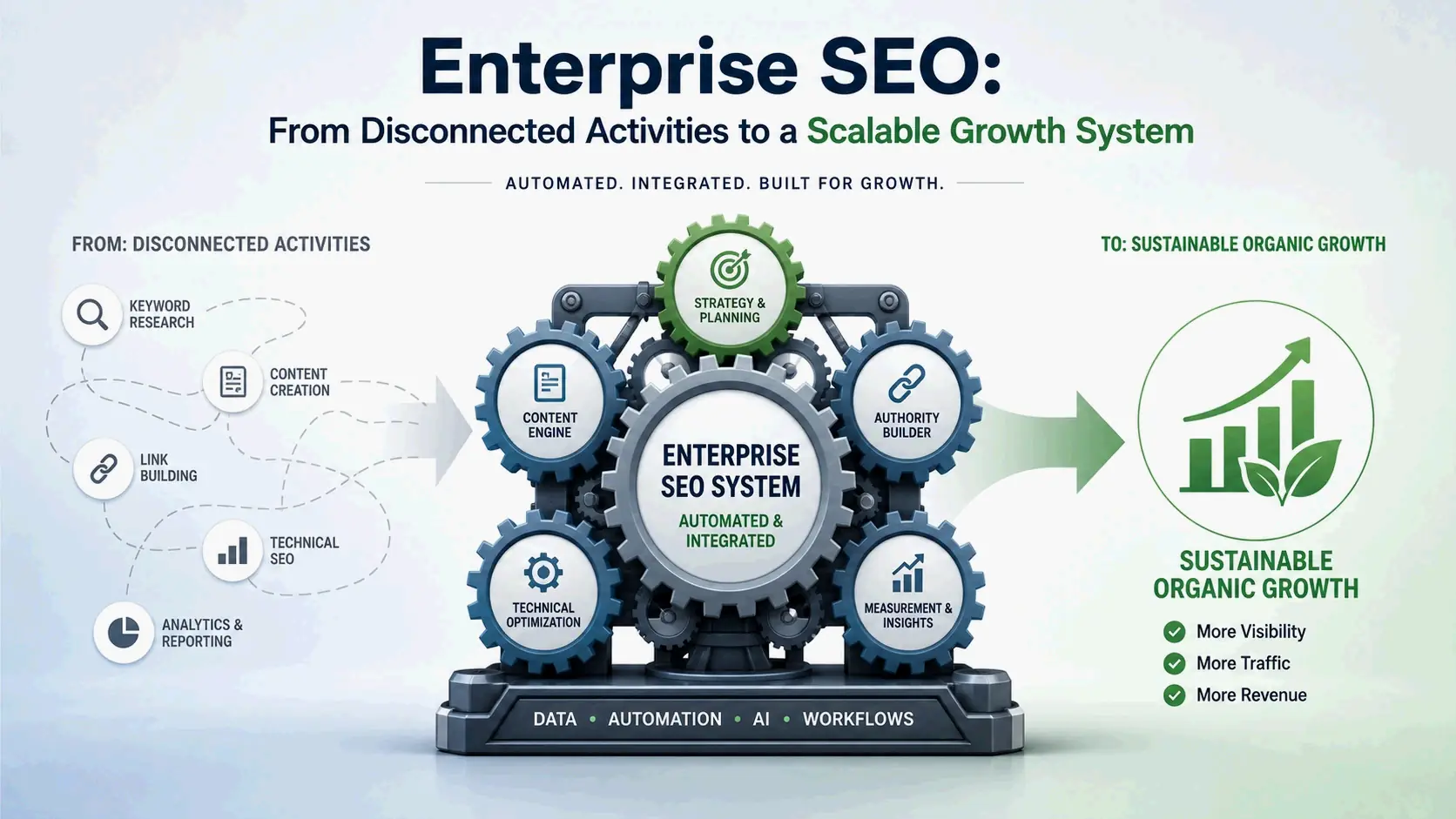
Enterprise SEO strategies are about building scalable, automated systems that keep your organic visibility strong and generate predictable revenue across thousands of URLs. In 2026, the focus isn’t on one-off tactics—it’s on creating a governance model that ties together your technical infrastructure, cross-team coordination, and AI-driven visibility, turning organic search into a core business channel.
Contents
- Why Legacy SEO Fails at Scale: The Enterprise Disconnect
- The 4 Pillars of a Scalable SEO System
- Pillar 1: Automating a Bulletproof Technical Foundation
- Pillar 2: How to Govern Content Quality Across 10,000+ Pages
- Pillar 3: Integrating GEO: A 3-Step AI Visibility Protocol for 2026
- Pillar 4: Scaling SEO with a Cross-Organizational Governance Model
- How to Prove Revenue Impact, Not Just Rankings
- Conclusion
- FAQ
Why Legacy SEO Fails at Scale: The Enterprise Disconnect
Enterprise SEO has fundamentally shifted away from isolated tactical fixes. It’s now about building a reliable, company-wide operating system. Traditional playbooks—think periodic audits, manual page tweaks, and siloed keyword tracking—can’t keep up when you’re managing tens of thousands of URLs, multiple product lines, and teams that publish across different regions. Lumar research backs this up: 60% of digital leaders say their biggest SEO challenge is simply executing improvements and monitoring large sites at scale. The real bottleneck isn’t a lack of knowledge. It’s the organizational friction that stops good ideas from ever being implemented.
The problem gets worse when reporting only shows rankings and traffic. If SEO metrics don’t connect to revenue, pipeline, or market share, you’ll lose buy-in from the top. You need Business Outcome Reporting that goes beyond vanity metrics. Equally important is the Cross-Team Coordination & Governance layer—without it, you end up with a long list of completed audits that never turn into real changes. In complex organizations, SEO can’t live solely in marketing; it has to be baked into product roadmaps, engineering sprints, content workflows, and even legal reviews.
The biggest reason SEO programs stall is that they’re treated like marketing projects instead of an operational discipline. A single technical fix might need sign-off from three different departments. Without cross-functional alignment, momentum simply evaporates. The larger the organization, the more SEO success relies on systems—not heroic one-off efforts.
The 4 Pillars of a Scalable SEO System
To scale, enterprise SEO needs to work like an operating system—a set of interconnected, repeatable processes that guide how the entire organization handles organic visibility. This mindset moves SEO from just another marketing channel to a company-wide operational layer. The system is built on four pillars, each tackling a set of problems that old-school approaches leave unsolved.
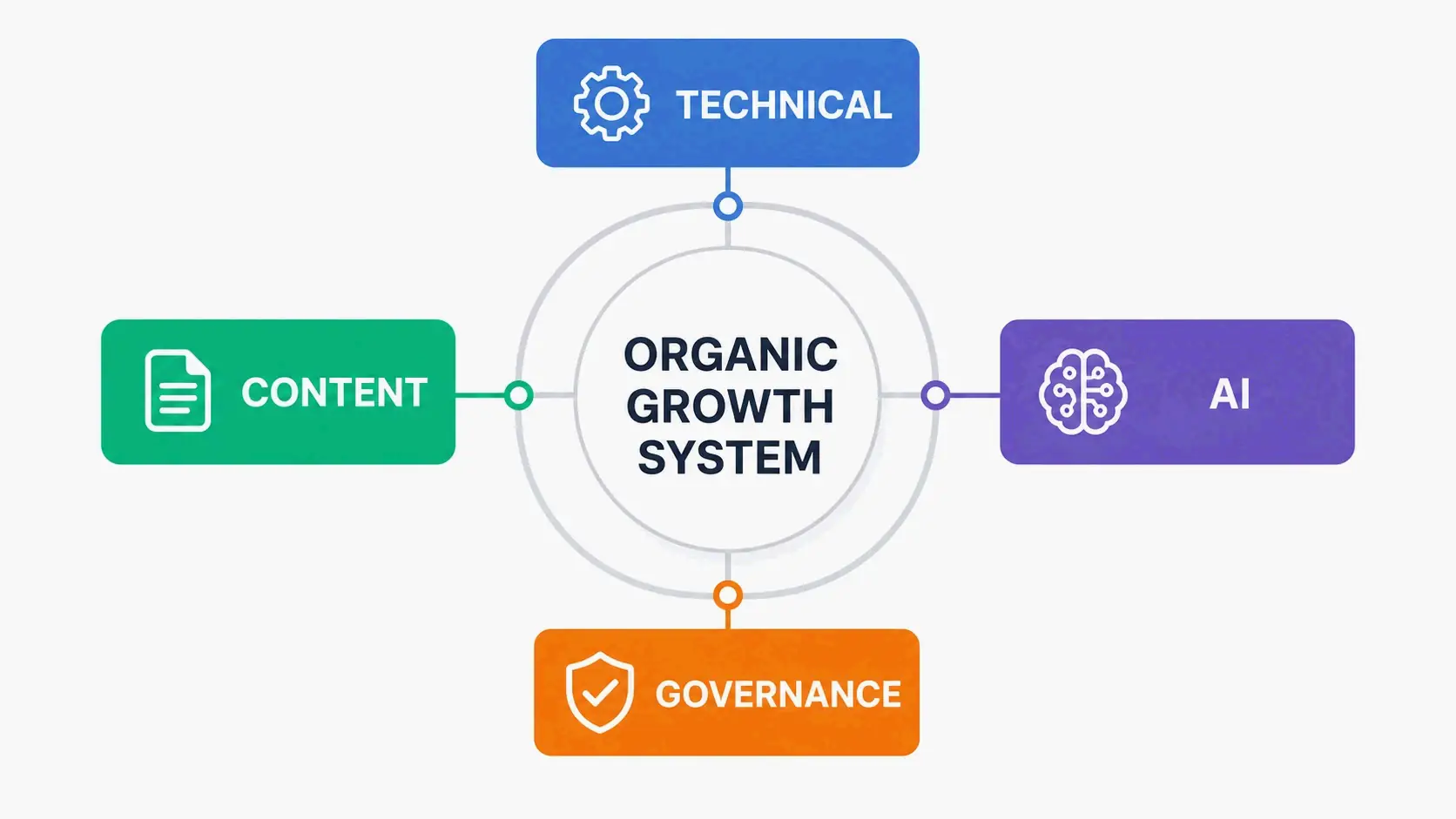
1. Technical Foundation: This is the automated backbone that handles crawlability, indexability, and performance at scale. If the technical layer isn’t solid, every other investment—content, authority, AI visibility—underperforms.
2. Content Engine: A governance-driven approach to content that replaces chaotic creation with topic clusters, lifecycle management, and quality controls that actually scale. This connects content operations directly to business results.
3. AI Visibility Protocol: A structured way to do Generative Engine Optimization (GEO). Since AI-powered search and LLMs are now primary research tools for B2B buyers, getting cited in AI-generated answers is no longer optional—it’s essential.
4. Governance Model: The cross-organizational framework that aligns product, engineering, content, legal, and regional teams around shared organic goals. This pillar also anchors the shift from vanity metrics to Business Outcome Reporting.
Taken together, these four pillars create a resilient organic growth system. The rest of this guide walks through each one in detail, with concrete strategies and templates you can adapt to your own enterprise environment.
Pillar 1: Automating a Bulletproof Technical Foundation
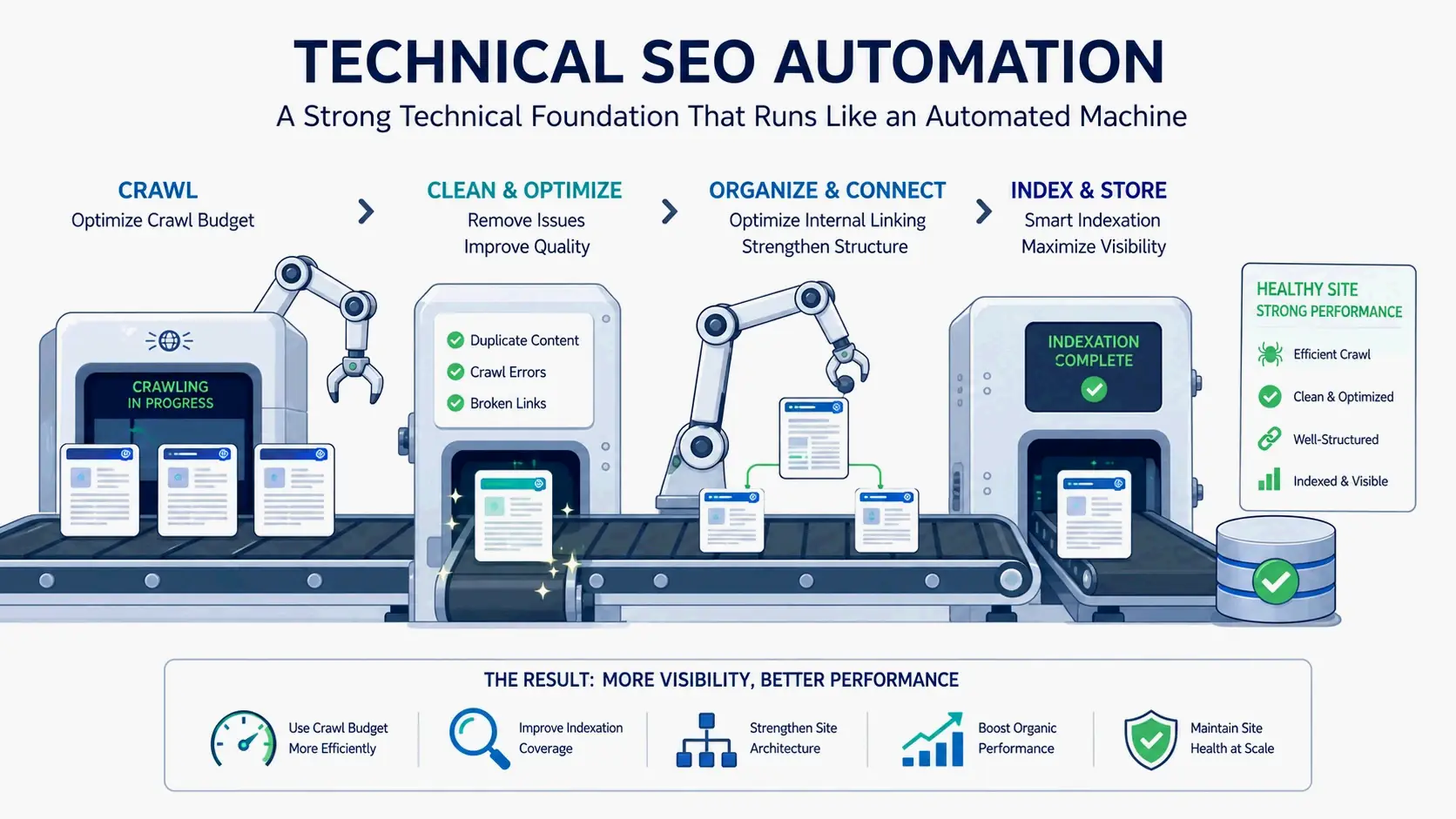
Managing site architecture and indexability at scale demands programmatic solutions—manual spot-checks just don’t cut it. Technical SEO is the foundation everything else sits on. Research cited by Saffron Edge indicates that 53% of mobile users bail on a site that takes more than 3 seconds to load. Before you ramp up content production, you need a digital estate that’s fast, crawlable, and properly indexed.
Crawl Budget Optimization must be treated as a prioritization system, not just another server metric. Big enterprise sites often burn crawl budget on parameter URLs, faceted navigation, duplicate pages, and stale archives. Google’s own guidance says you should help crawlers focus on your most valuable pages through clean architecture and clear rules. Segment your XML sitemaps by content type—each sitemap should stick to the 50,000 URL or 50MB limit—and use robots.txt to block useless paths while applying noindex to pages you don’t want in search results.
Internal Linking Systems are one of the most underutilized levers in enterprise SEO. Instead of dropping links in manually, build out templated or programmatic internal linking frameworks. Think related content modules, topic cluster navigation, or automated contextual recommendations. These systems distribute authority throughout your site, make crawling more efficient, and strengthen topical relevance. Every new page should get internal links from related content and link back to the pillar page it supports. The equity you build compounds over time.
Indexation Management also needs ongoing attention. Not every page belongs in the index. Thin, duplicate, or outdated pages eat up crawl budget and water down the quality signals your site sends. Regularly reviewing indexed vs. non-indexed pages—and pairing that with a “content pruning” routine—cuts down on index bloat and helps search engines zero in on the pages that actually drive pipeline.
Triage Template: How to Write a Technical SEO Ticket for Engineering
A crucial skill in enterprise SEO is turning a technical finding into a ticket that an engineering team can just pick up and run with. A well-structured spec cuts out the back-and-forth and dramatically increases the odds that the fix actually gets shipped. Here’s a template that covers the essential fields:
- Title: [Brief, specific description, e.g., “Add self-referencing canonical to blog post template”]
- URL Pattern: [The template or segment affected, e.g.,
/blog/*] - Expected Behavior: [How the system should behave, e.g., “Each article must output a self-referencing canonical URL pointing to its own live URL.”]
- Current Behavior: [The bug or gap, e.g., “All blog posts output a canonical pointing to
/bloginstead of the individual post URL.”] - Business Impact: [The quantified or qualitative risk, e.g., “This prevents approximately 2,000 articles from ranking independently and causes indexing issues across the blog.”]
- Technical Notes & Resources: [Links to documentation, log file excerpts, or relevant crawl reports, e.g., “See Screaming Frog snapshot from August 1, 2026 attached.”]
- Acceptance Criteria: [What must be true after deployment, e.g., “The
<link rel=canonical>tag on each blog post resolves to the exact live post URL, verified for 10 randomly selected articles.”]
This format moves the conversation from “we found an issue” to “here is the fix, the evidence, and how to verify it.”
Pillar 2: How to Govern Content Quality Across 10,000+ Pages
Scaling a content strategy beyond the generic “just create topic clusters” advice takes a real operating model, or chaos takes over. Solid enterprise content governance spells out who’s Responsible, Accountable, Consulted, and Informed (RACI) for every stage—creation, publication, and retirement. A scalable strategy organizes everything into topic clusters: one central pillar page, supported by satellite articles on integrations, use cases, comparisons, and thought leadership. Automated internal linking between those clusters reinforces the semantic relationships and helps search engines grasp your content hierarchy.
At scale, the real danger isn’t publishing too little—it’s publishing too much without any oversight. When different business units, regions, and product teams all publish on their own, you get canonical conflicts, keyword cannibalization, and a flood of thin content. A Content Pruning and lifecycle management process must be treated as a first-class governance function. Pages that haven’t earned impressions or clicks over a set period, that compete with other internal pages, or that contain outdated product info should be consolidated, redirected, or refreshed. Cutting dead weight often lifts your site’s overall quality signals faster than launching new content.
Successful enterprise programs also keep content production separate from content approval. Pre-approved templates and style guides—vetted by legal, brand, and SEO—speed up reviews. When a reviewer can compare a draft to a proven format, they spend less time interpreting and more time verifying compliance. That shifts the bottleneck from gatekeeping to actually getting content out the door.
Content Governance RACI Matrix: Downloadable Template
A clear RACI model turns content governance from a theoretical idea into something your team can actually run. Map out these dimensions for every type of content asset:
- Responsible (R): The person or team doing the work—like an SME drafting a guide or an agency writer creating the copy.
- Accountable (A): The single owner who approves the final output and signs off on SEO requirements. Typically a content lead, product marketing manager, or editorial director.
- Consulted (C): People who must weigh in before a page goes live: legal (for claims and disclaimers), product (for feature accuracy), SEO (for keyword alignment and structure), and regional leads (for localization).
- Informed (I): Teams that need a heads-up for transparency and distribution—social media, demand gen, or exec leadership.
Assign these four roles to every core content type—product pages, blog posts, integration docs—and you’ll get a repeatable, auditable workflow that stops duplication and governance drift in its tracks.
Pillar 3: Integrating GEO: A 3-Step AI Visibility Protocol for 2026
Generative Engine Optimization (GEO) now runs alongside traditional SEO—it’s not a replacement, but it’s just as important. 6sense data indicates that 94% of B2B buyers already use LLMs somewhere in their buying process. If your brand doesn’t show up in AI-generated answers, you’re invisible to a growing chunk of your most valuable audience.
The following three-step protocol gives you a structured way to build AI search visibility. Each step reinforces classic SEO fundamentals while specifically tuning for how LLMs retrieve and synthesize information.
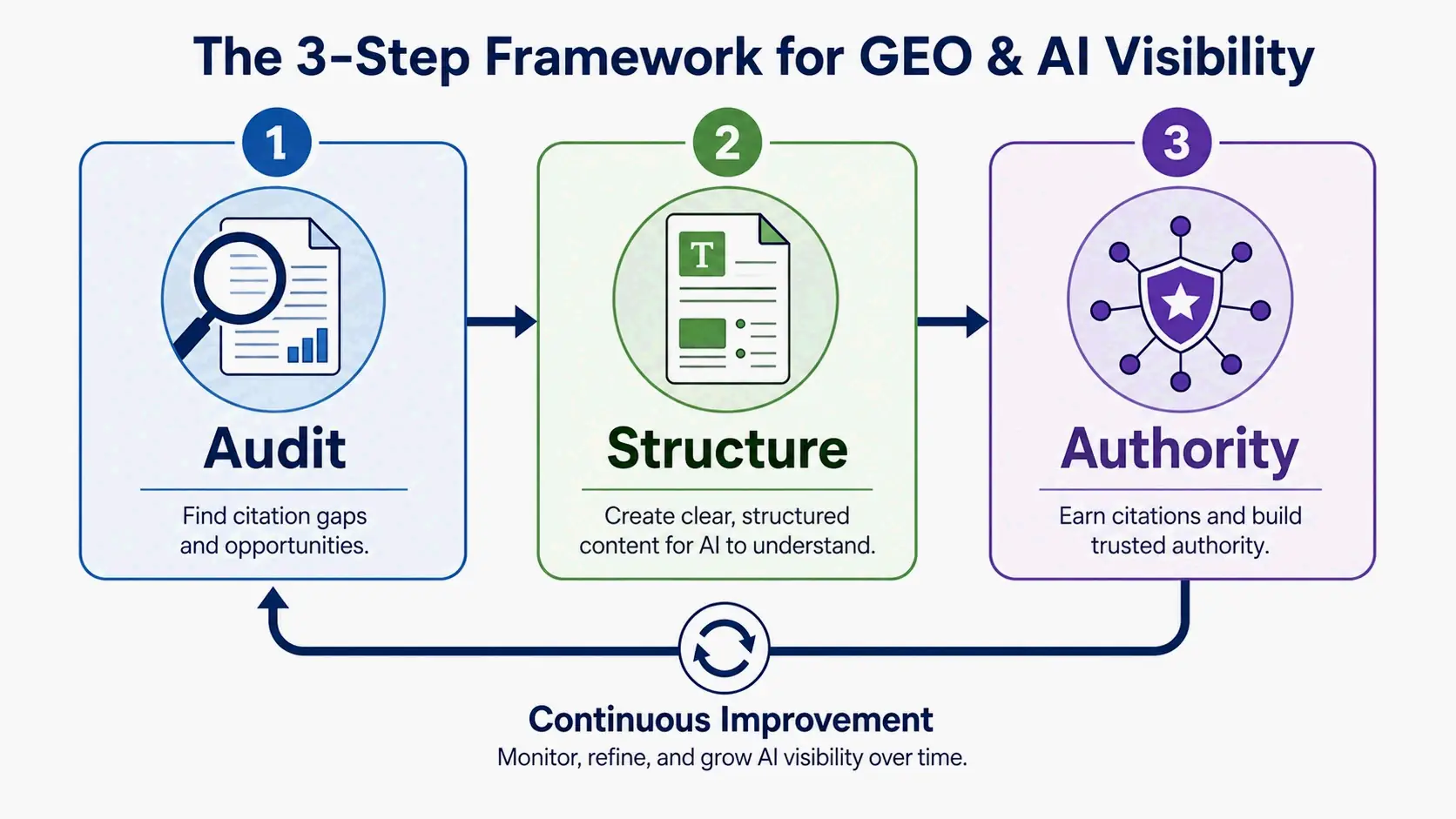
Step 1: AI Citation Audit. Start by checking whether your brand shows up in AI Overviews, ChatGPT, Perplexity, and Gemini for the topics that matter to you. Tools like Semrush and specialized GEO trackers can show where your domain gets cited and where competitors are getting the nod instead. This gives you a baseline and flags whether your existing content is structured well enough for AI extraction. Make sure to cover branded queries, category-level questions, and long-tail informational prompts tied to your product suite.
Step 2: Structured Answers. Next, build content that’s rich in Q&A, fact panels, and dedicated stats sections—designed for machine readability. AI models favor clear, concise, and well-structured answers to common questions. Use heading hierarchies that match question patterns, add schema like FAQ or HowTo where it fits, and place original data points in self-contained paragraphs that are easy to quote. Pages that zero in on a single, well-defined intent tend to perform better in both traditional and AI search.
Step 3: Authority Networks. Getting cited in LLM responses is about more than just on-page formatting. AI systems look at authority signals: being a publicly cited source, co-authoring with trusted institutions, and being the original source for referenced stats. Publishing original research, earning co-citations with recognized industry bodies, and keeping your entity definitions consistent across the web all boost perceived trustworthiness. Third-party validation—like analyst reports, peer-reviewed journals, and citations from credible publishers—sends a strong signal that you’re a reliable source worth including in a synthesized answer.
These three steps create a flywheel: structured content gets cited, those citations boost authority, higher authority earns you more spots in AI answers, and that visibility influences buyers who land on your owned channels with higher intent.
Pillar 4: Scaling SEO with a Cross-Organizational Governance Model
SEO can’t scale if it’s stuck in one department. Product, engineering, content, legal, and regional teams all shape organic performance, but they almost never share the same priorities or timelines. Getting everyone rowing the same way calls for a dedicated operating model, often set up as a Center of Excellence (CoE).
An SEO CoE acts as the central hub for strategy, standards, and shared knowledge. It defines the templates, tools, and workflows that individual business units or regions follow, while still leaving room for localized execution. This model bridges a common gap: the strategic need for consistent quality versus the practical need for speed and autonomy in distributed markets.
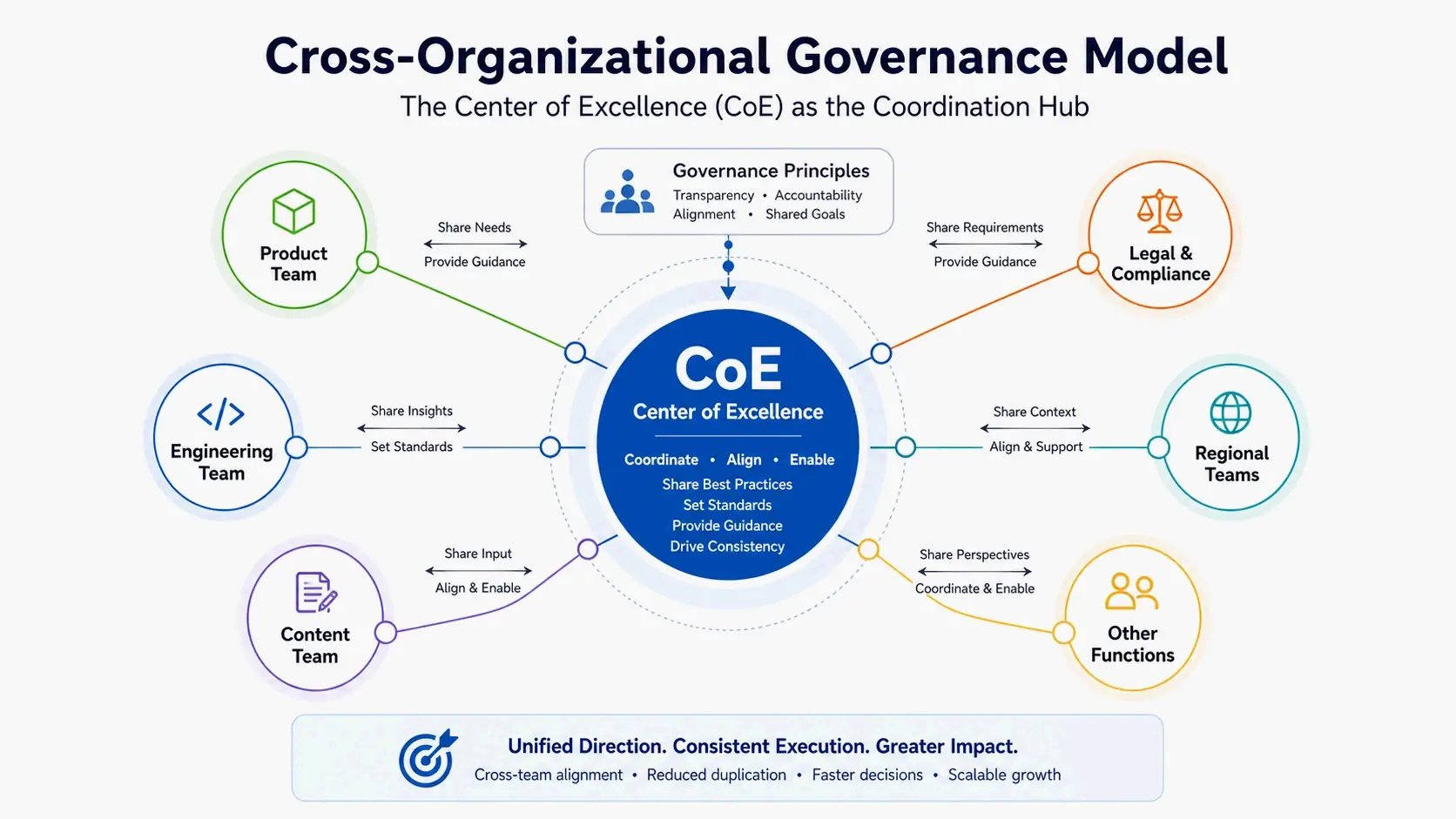
Tailoring the governance pitch to each executive’s priorities is essential for securing cross-organizational commitment. A short value proposition for each key stakeholder includes:
- CFO: An SEO CoE cuts customer acquisition costs by generating owned organic traffic that replaces expensive paid media. You get predictable pipeline contribution instead of the volatility of ad auctions.
- CTO / VP Engineering: Embedding SEO guidelines into the development lifecycle reduces technical debt. Instead of racing to fix indexing errors or Core Web Vitals after the fact, engineering teams can prevent them at the code level, saving sprint capacity and lowering outage risk.
- Legal: Standardized content templates and a centralized review process for claims, pricing, and jurisdictional compliance lower the risk of regulatory trouble. The CoE makes sure every piece of content meets the same legal bar before it goes live, no matter which team created it.
This governance layer also reinforces Business Outcome Reporting. When every team can see how their work impacts qualified pipeline or revenue influenced—not just traffic—the whole organization starts treating organic search as a primary growth channel.
How to Prove Revenue Impact, Not Just Rankings
Business Outcome Reporting swaps out keyword rankings for metrics that tie directly to your sales funnel. Measure SEO performance against qualified pipeline generated, revenue influenced, and share of voice for high-intent commercial terms. A real-world benchmark: Omniscient Digital’s engagement with Smartling generated $3.7 million in qualified pipeline and a 12.8X ROI through a product-led SEO program. That result was tracked by linking organic landing pages to CRM stages—not by reporting a vanity metric like total sessions.
Your monthly executive dashboard needs to cut the noise. Skip the keyword table and instead show the count of MQLs, SQLs, and closed-won deals where organic search was a significant touchpoint. Add a “revenue influenced” number, calculated with a multi-touch attribution model that both finance and marketing agree on. Alongside those outcomes, include leading indicators—new organic landing pages cracking the top 10 for commercial intent, page-level engagement signals, and branded search volume growth—to demonstrate progress even during long sales cycles.
Conclusion
Building a defensible organic moat in 2026 isn’t about chasing every algorithm update. It’s about constructing and running a scalable, cross-functional SEO system that delivers measurable business results. The winners are the organizations that treat SEO as an operational discipline—governed, automated, and directly tied to revenue—instead of a pile of marketing projects. Start by auditing your current operational bottlenecks: is it technology, governance, or AI visibility? Pick the corresponding pillar from this guide and build your first scalable prototype within the next quarter.
FAQ
How long do enterprise SEO strategies take to show significant results?
Major changes usually take 6 to 12 months because of crawl scheduling and complex implementation cycles. But you can see early signal wins—like fixing critical Core Web Vitals issues or resolving indexation problems—within a few weeks. The compound gains that come from building content authority, however, take quarters to materialize. When setting expectations, it helps to separate quick technical fixes from long-term structural investments.
Should we build an in-house enterprise SEO team or hire an agency?
A hybrid model usually works best: let internal strategy leads own the roadmap, stakeholder advocacy, and system management, while specialized agencies or freelancers handle scalable execution. Your internal team’s real job is cross-team coordination and governance. Siege Media reports that 31% of content teams now budget $15,000–$45,000 monthly for content marketing; putting a slice of that into strategic oversight makes sure your execution dollars go toward the highest-impact work.
How are enterprise SEO strategies evolving for AI Overviews and LLMs?
The focus is shifting from pure link-based authority to citation-based authority. Success now means being a first-party source of verified data, building content that’s structured for machine extraction, and earning authority through original research that gets cited publicly. GEO tracking—measuring brand mentions and sentiment in AI answers—needs to be part of your monthly reporting as a leading indicator of future organic demand.
What is the real impact of a common technical error on an enterprise site?
A single rogue noindex tag on a content template can deindex thousands of critical landing pages overnight, causing immediate traffic and revenue loss. Similarly, if a staging site gets crawled and indexed without proper blocking, you can trigger a duplicate content crisis that takes weeks to clean up. Automated, real-time monitoring is the only scalable defense against these templated errors that have a huge blast radius.
