


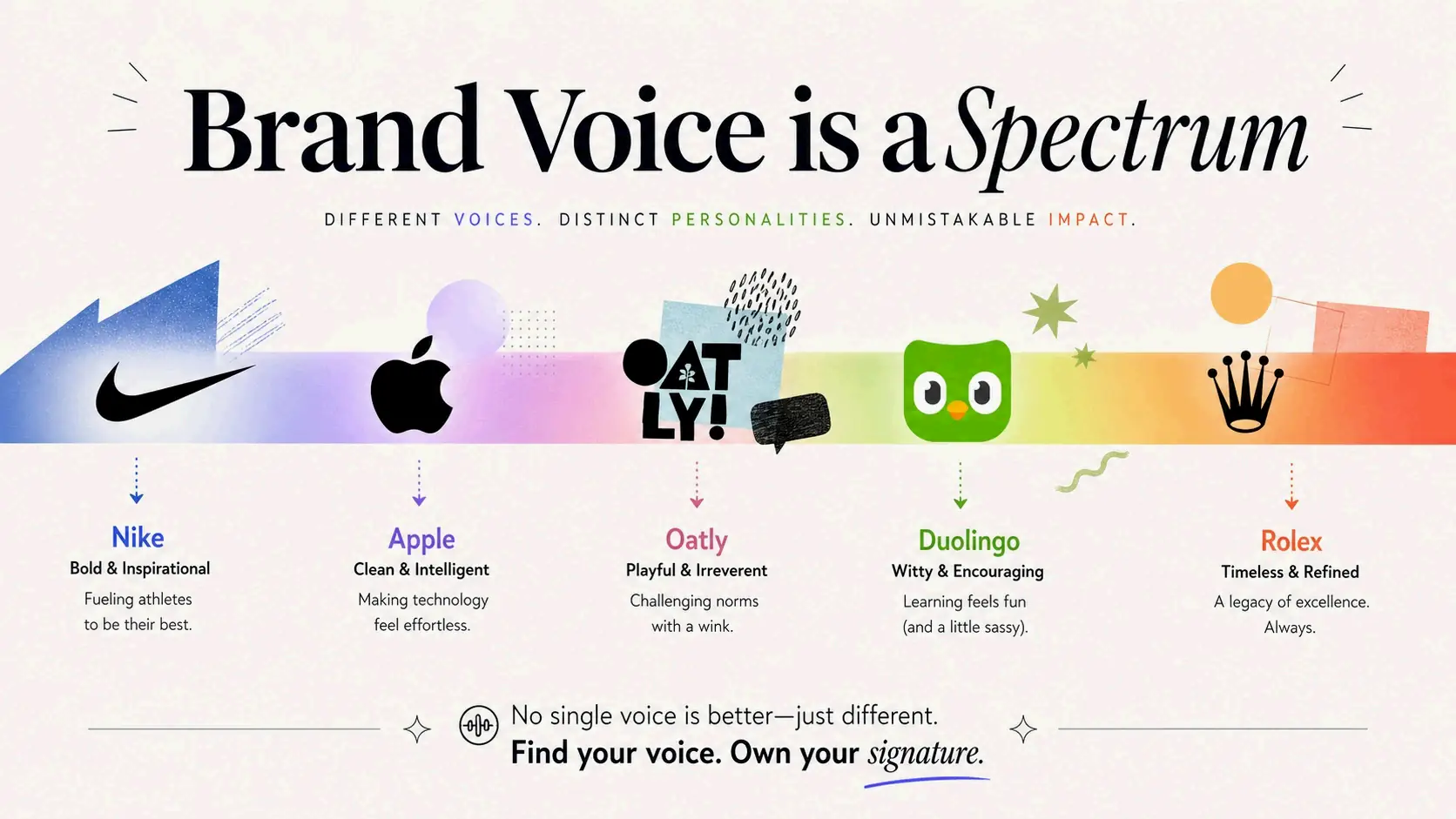
Your brand voice is the personality your company projects through words. The best examples — think Apple’s minimalist confidence or Oatly’s irreverent wit — prove that consistency builds trust. In this article, we go beyond adjectives to analyze 10+ brand voice examples using a data-driven framework, so you can define and measure your own voice with precision.
Contents
- Brand Voice vs. Tone of Voice: What’s the Real Difference?
- A Data-Driven Framework for Analyzing Brand Voice Examples
- 10+ Inspiring Brand Voice Examples (Deconstructed Spec-by-Spec)
- How to Engineer Your Own Brand Voice (A 3-Step Spec System)
- Maintaining a Consistent Voice in the Age of AI Content
- Conclusion
- FAQ
Brand Voice vs. Tone of Voice: What’s the Real Difference?
Before we look at any examples, let’s clear up two terms that people often mix up: brand voice and tone of voice. Think of your brand voice as its consistent personality — the core character that doesn’t change. Tone of voice is how that personality adapts to the situation. Imagine your brand as a person at a party: your voice is who you are (maybe a witty storyteller or a calm listener), while your tone shifts depending on whether you’re making small talk, cracking a joke, or apologizing for spilling a drink. This analogy is widely used in brand strategy, and you’ll find it explained in resources like Elite Asia’s 2026 guide.
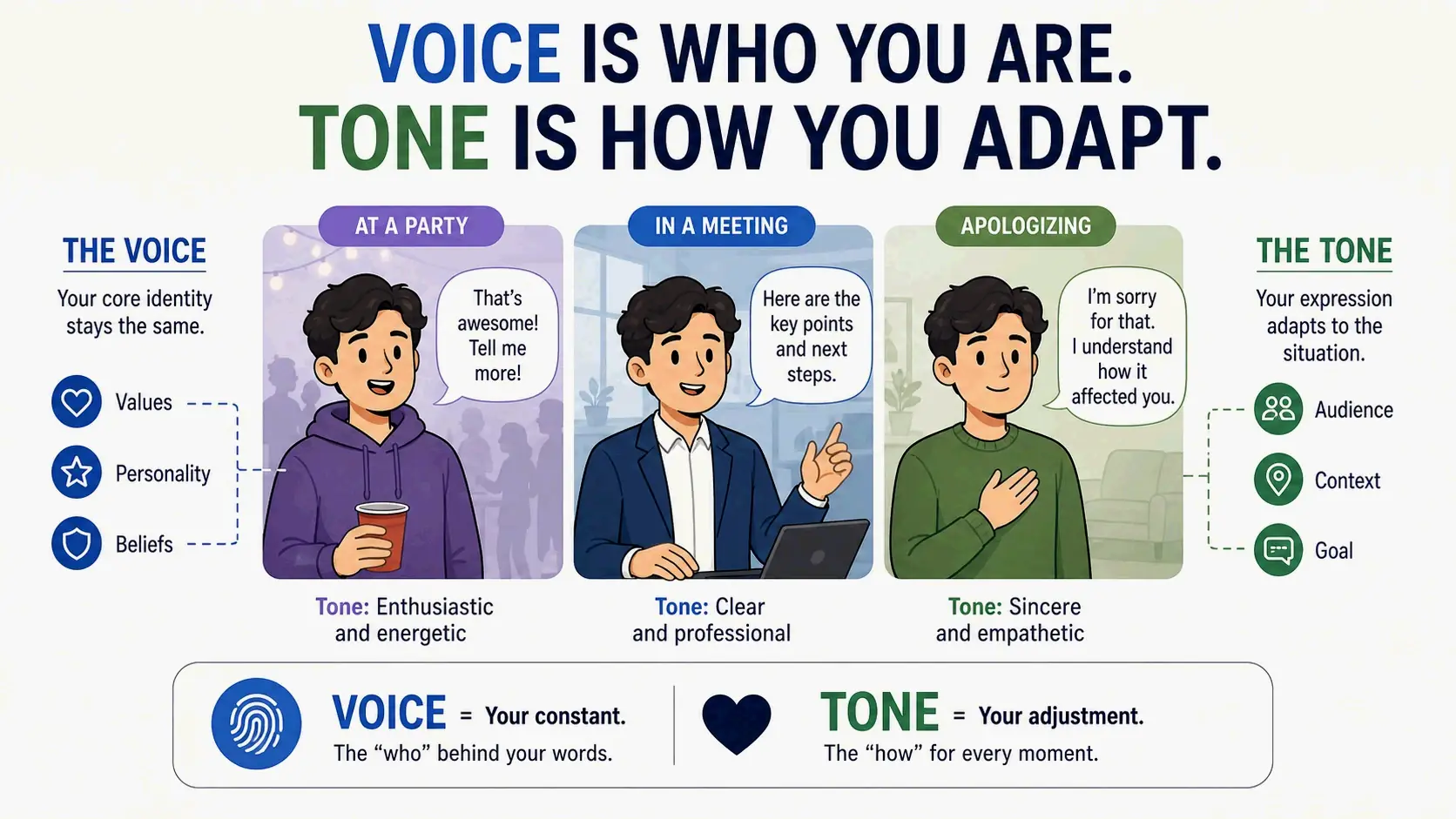
Your voice stays constant. It covers your core values, the rhythm of your language, your vocabulary, and how you explain ideas. Tone, on the other hand, adapts. A confident brand voice might sound direct on a product page, encouraging in an email newsletter, and empathetic in customer support. Same voice, different delivery. As Dansalva’s guide puts it: “Voice is your core personality — who you are at your heart. Tone is your mood — how you adapt your delivery depending on who you’re talking to and where the conversation takes place.”
Why does this matter? When teams don’t understand the difference, they often fall into one of two traps: they lock into a single mode that sounds wrong on some channels, or they let every channel develop its own personality until the brand feels fragmented. StoryChief, a B2B SaaS content platform, puts it bluntly: “Before long, the same company sounds like four different companies.” Understanding that voice is stable and tone is variable is the first step toward consistency. That’s also the foundation for the analytical framework we’ll use to unpack every brand voice example coming up.
A Data-Driven Framework for Analyzing Brand Voice Examples
Most brand voice guides are built on adjectives: “friendly,” “professional,” “innovative.” The problem? Adjectives describe pretty much any brand without actually constraining anything. As The State of Brand noted in July 2026, try the swap test: take your voice guide, put a competitor’s name at the top, and see if anything needs to change. Chances are, it doesn’t. The document that was supposed to define your voice ends up being the same generic template as everyone else’s, just with a different logo.
A better approach is to treat brand voice as something measurable, not just aspirational. That’s where a spec-driven framework comes in. It pulls from two key sources: the Nielsen Norman Group’s Four Dimensions of Tone, and linguistic metrics that turn style into something you can actually pin down.
Nielsen Norman Group (NN/g) scores copy along four scales, each with a neutral middle: funny ↔ serious, formal ↔ casual, respectful ↔ irreverent, and enthusiastic ↔ matter-of-fact. In their research, they surveyed over 100 U.S. adults and found that trustworthiness alone accounted for 52% of the variance in how likely people were to recommend a brand (desirability). Friendliness only added about eight more percentage points on top of that. This finding — reviewed in January 2024 and referenced in Digital Applied’s August 2026 voice extraction guide — shows a direct link between measurable tone and business results.
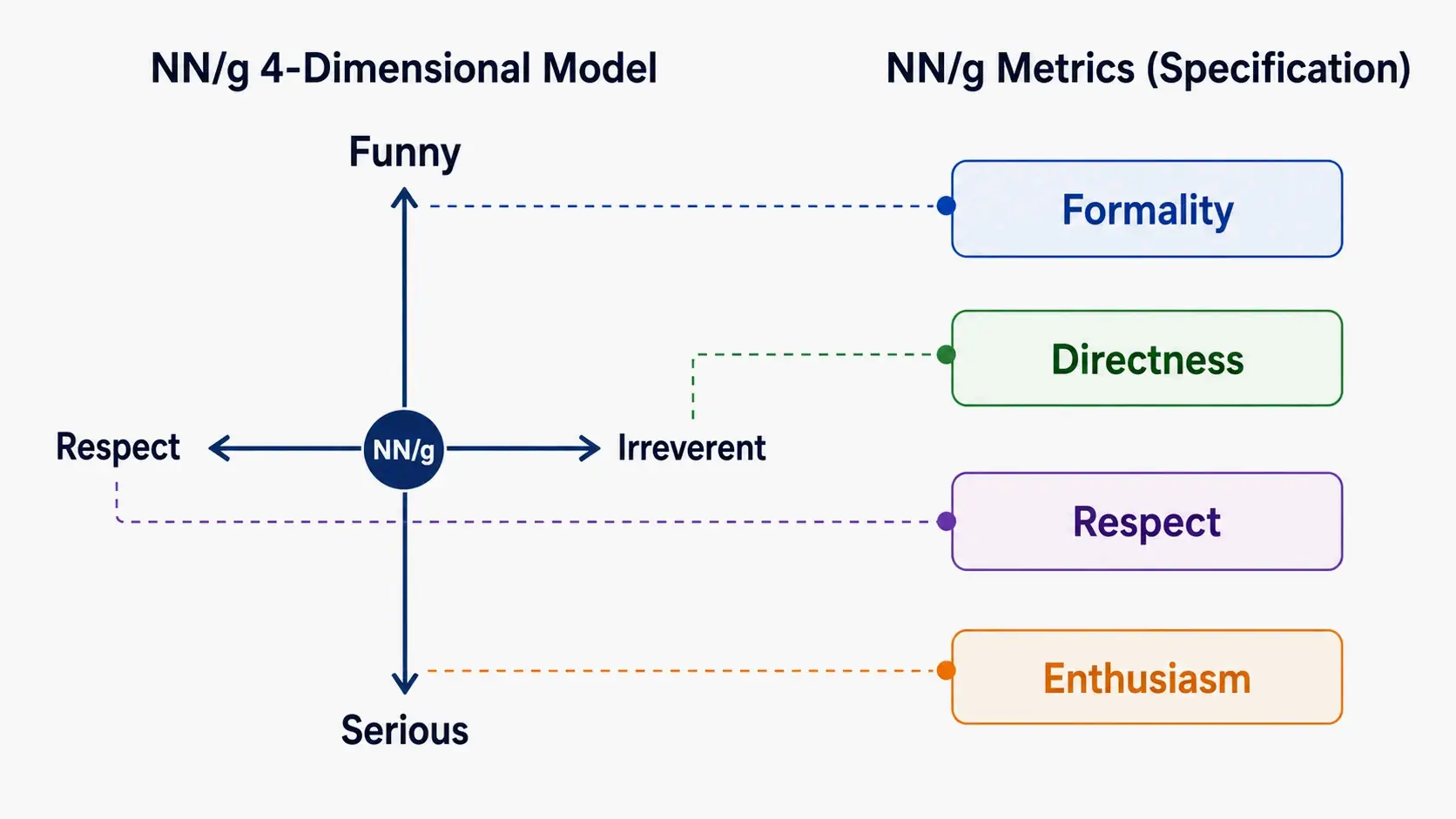
To turn these dimensions into a repeatable specification, you can attach concrete linguistic metrics to each:
- Formality: Grammar choices (contractions, sentence fragments), pronoun usage (first-person versus third-person), and greeting conventions.
- Directness: Average sentence length, frequency of questions, and amount of contextual framing before the main point.
- Lexicon: Word choice and complexity. Specific in-list (words you use) and out-list (words you ban) govern recognition.
- Humor/Enthusiasm: Exclamation frequency, emoji use, and the presence of self-referential or absurd elements.
Combine NN/g’s trust-centered dimensions with these measurable signals, and you shift from “we want to sound confident” to concrete rules like “use declarative sentences under 12 words, avoid hedging, and never begin with a throat-clearing preamble.” That’s the leap from adjectives to specifications — and it’s the lens we’ll use to analyze the brand voice examples below.
10+ Inspiring Brand Voice Examples (Deconstructed Spec-by-Spec)
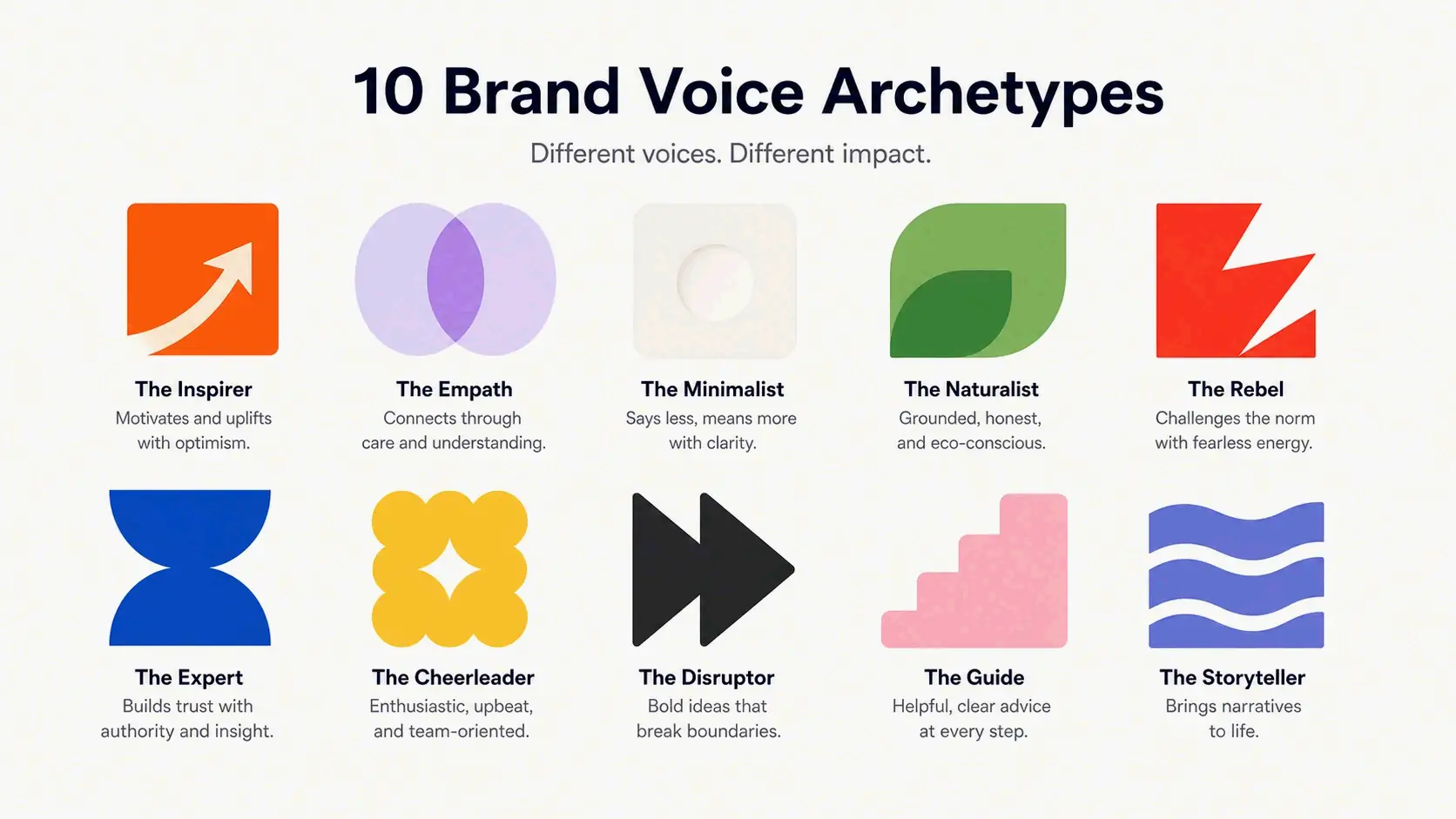
The examples below are grouped by voice archetype and broken down using our data-driven framework. For each one, you’ll see how the four dimensions and linguistic metrics come together to show how a distinct voice is actually built — not just talked about in abstract terms.
The Empowering & Motivational Voice: Nike
Nike’s voice is all about declarative, you-focused, action-oriented language. On NN/g’s scales, it’s highly enthusiastic and matter-of-fact, respectful, and leans serious (its mission carries real weight). The style is casual and direct — no complex grammar, no wasted words. Take the iconic “Just Do It.” In three words, it packs a full emotional punch, using nothing but verbs and an imperative. This pattern runs through all of Nike’s campaigns: short, punchy statements that address every reader as an athlete, which makes the brand feel inclusive and empowering. The vocabulary sticks to strong, active verbs and words around effort, victory, or personal truth. As Elite Asia’s analysis observes, “Nike speaks directly to human emotion.”
The Minimalist & Confident Voice: Apple
Apple’s copy is famous for its simplicity. Linguistically, product descriptions average under 10 words per sentence, free of jargon and technical specs. On NN/g’s dimensions, Apple leans toward formal (on the casual–formal scale), stays respectful and matter-of-fact — the confidence comes from structure, not volume. The spec is clear: don’t explain how it works; describe the experience and the result. The line “The thinnest, most powerful MacBook ever” uses just six words. No adjectives beyond a concrete attribute and a superlative. This intentional minimalism, noted by Elite Asia, builds a premium, aspirational feel that sets Apple apart from competitors who lean on spec sheets.
The Disruptive & Irreverent Voice: Oatly
Oatly’s voice is a deliberate rebellion against pretty much every branding rule. On NN/g’s scales, it’s highly irreverent, humorous, casual, and enthusiastic. The spec is unusually direct: write like a real person talking to another person, break the fourth wall, mock marketing clichés, and never sound polished. As quoted in Elite Asia’s roundup, Oatly’s packaging says: “This carton is made of paperboard. If you don’t like paperboard, you probably shouldn’t be holding this product right now.” The passage runs longer than typical brand copy, feels conversational and self-referential, and avoids any typical food-brand language. It uses informal words like “probably shouldn’t,” and the humor is dry, not in-your-face. This voice is so distinct that it works across every channel — packaging, website, social — without the brand ever having to shout.
The Friendly & Approachable B2B Voice: Mailchimp
Mailchimp’s voice, spelled out in its public style guide, is built on four named values: Plainspoken, Genuine, Translator, and Dry Humor. The spec puts clarity above entertainment every time. On NN/g’s scales, it’s casual, warm-hearted with occasional humor, and respectful. Linguistically, you see contractions everywhere, a direct “you” and “your” address, and questions that lower the intimidation factor — stuff like “Ready to build your first campaign?” As Elite Asia points out, Mailchimp uses “light humour and plain language to make email marketing feel approachable rather than overwhelming.” The voice turns a technically complex product into something that feels human and easy to navigate — a big deal for a B2B SaaS tool targeting small business owners who might feel out of their depth.
The Bold & Humorous Voice: Old Spice
Old Spice is a textbook case of reviving a brand through voice. The brand pivoted from a dated, declining image to an absurdist, high-energy personality. On NN/g’s scales: maximum humor, enthusiastic, irreverent, and casual. The spec leans on exaggerated claims, surreal imagery, and playful self-parody. Elite Asia’s guide captures the energy with the line “The man your man could smell like.” Linguistically, it’s short, emphatic phrases, surprising combinations, and a wink at its own ridiculousness. The turnaround worked because the voice stayed committed — Old Spice didn’t just run one funny ad; it rebuilt its entire communication system around this single, audacious personality.
The Empathetic & Calming Voice: Headspace
Headspace speaks to an audience that’s often anxious, stressed, or new to mindfulness. That means its voice has to be reassuring, non-judgmental, and calm without coming off as preachy. On NN/g’s dimensions, Headspace is respectful, serious (the topic deserves weight), matter-of-fact but warm, and relatively formal in its clear, structured phrasing — but never cold. The vocabulary avoids clinical jargon and opts for gentle, everyday words. As quoted in Dansalva’s archetype breakdown: “Mindfulness doesn’t mean changing who you are. It’s about training in awareness and getting a healthy sense of perspective.” The sentences move at an unhurried pace, with lots of “you” to create a feeling of direct, supportive conversation. Using the Jobs to Be Done (JTBD) lens, SIVO Insights explains that this voice fulfills the emotional job of “help me feel less anxious and more in control.”
More Quick-Fire Brand Voice Examples (Starbucks, Slack, Patagonia, Duolingo)
Here are four more brands, each representing a distinct voice archetype, mapped to core dimensions and linguistic quirks.
-
Starbucks (Warm & Inclusive): Warm, optimistic, and focused on shared moments rather than product details. Elite Asia highlights its emotionally rich, inclusive tone. The spec uses second-person address, sensory language, and short, welcoming phrases. Formality is casual-warm; the vocabulary centers on “you” and words tied to community and comfort.
-
Slack (Conversational & Helpful): Slack’s voice makes a corporate tool feel like a helpful colleague. It’s casual, respectful, matter-of-fact, and almost completely free of buzzwords. You’ll see direct “you” and “we,” short, clear sentences, and a focus on cutting friction. Elite Asia notes that Slack “avoids buzzwords entirely.”
-
Patagonia (Purpose-Driven & Activist): Patagonia’s voice is bold, purposeful, and tied directly to environmental activism. On NN/g scales, it’s serious, respectful, formal enough to carry authority, and matter-of-fact. The SIVO Insights JTBD analysis maps this voice to the social job “help me express my commitment to sustainability.” The vocabulary includes activist terms (“our fight,” “protect,” “planet”) and steers clear of retail soft-sell.
-
Duolingo (Playful & Meme-Savvy): Duolingo is a social-voice pro, using an unhinged, chaotic-good humor especially on TikTok. Dansalva slots it under the “Witty & Irreverent” archetype. The voice is highly humorous, irreverent, and enthusiastic. The spec: turn push notification nagging into a running joke, use meme formats, and never sound corporate. This voice drives engagement by making learning feel fun and shareable — directly fulfilling the emotional job “help me stay motivated and feel like I’m progressing,” as identified by SIVO Insights.
How to Engineer Your Own Brand Voice (A 3-Step Spec System)
Studying these brand voice examples is useful, but the real goal is to turn that insight into a measurable spec for your own brand. The following three-step system is built on the Jobs to Be Done (JTBD) framework and the spec-driven principles we’ve covered.
Step 1: Define Your Voice’s Jobs to Be Done (JTBD)
Start not with how you want to sound, but with what your customers need your voice to do for them. JTBD breaks motivation into three types: functional jobs (the practical problem), emotional jobs (how they want to feel), and social jobs (how they want to be perceived). SIVO Insights explains that a wellness brand whose customers “hire” its product to feel in control should adopt a calm, encouraging, informative tone — never pushy. Go back to the brand voice examples in Section 3, pick the three that feel closest to what you want, study their core jobs, and then define your own voice’s primary emotional and social jobs.
Step 2: Turn Adjectives into Measurable Specifications
Once you know the jobs your voice needs to do, convert your desired adjectives into rules that a writer — or an AI — can be held to. Instead of “confident,” write a spec like: “Sentences should be declarative, max 20 words; avoid hedging phrases like ‘we think’ or ‘perhaps.’” This is the shift from aspirational to operational. Digital Applied’s extraction methodology suggests analyzing your own published content to find natural patterns — sentence-length rhythm, how often you hedge versus boost, vocabulary habits — and turning those into explicit guidelines. Pick two or three core dimensions and define hard rules for each. Now you have a spec sheet, not just a wish list of adjectives.
Step 3: Build Your Brand Voice Guide & ‘This/Not This’ Cheat Sheet
Compile your specifications into a practical guide built around a “This/Not This” table. Dansalva’s template recommends laying out each voice pillar with what it means, what to do, and what not to do. For example: Pillar: Clear & Direct. DO: Use short sentences, active verbs. DON’T: Use jargon, buzzwords, or passive fluff. Dotdigital’s help guide also advises creating explicit Dos and Don’ts, with a reason for each Don’t so AI and new team members get the intent behind the rule. This cheat sheet turns on-brand writing into a measurable action, not a subjective call.
Maintaining a Consistent Voice in the Age of AI Content
In 2025–2026, AI writing tools are standard infrastructure for most content teams. AI is great at scaling volume, but it introduces a real risk: it can flatten your brand voice. Research published in the EMNLP 2025 Findings by Wang, Tripto, Park, Li, and Zhou tested six top-tier LLMs as they imitated over 400 authors across different formats. For structured text like news and formal emails, authorship verification accuracy topped 95%. But for informal, personal blog-style writing, the same models achieved roughly 19% accuracy. The authors concluded: “In-context learning alone proves insufficient for authentic personalized writing.”
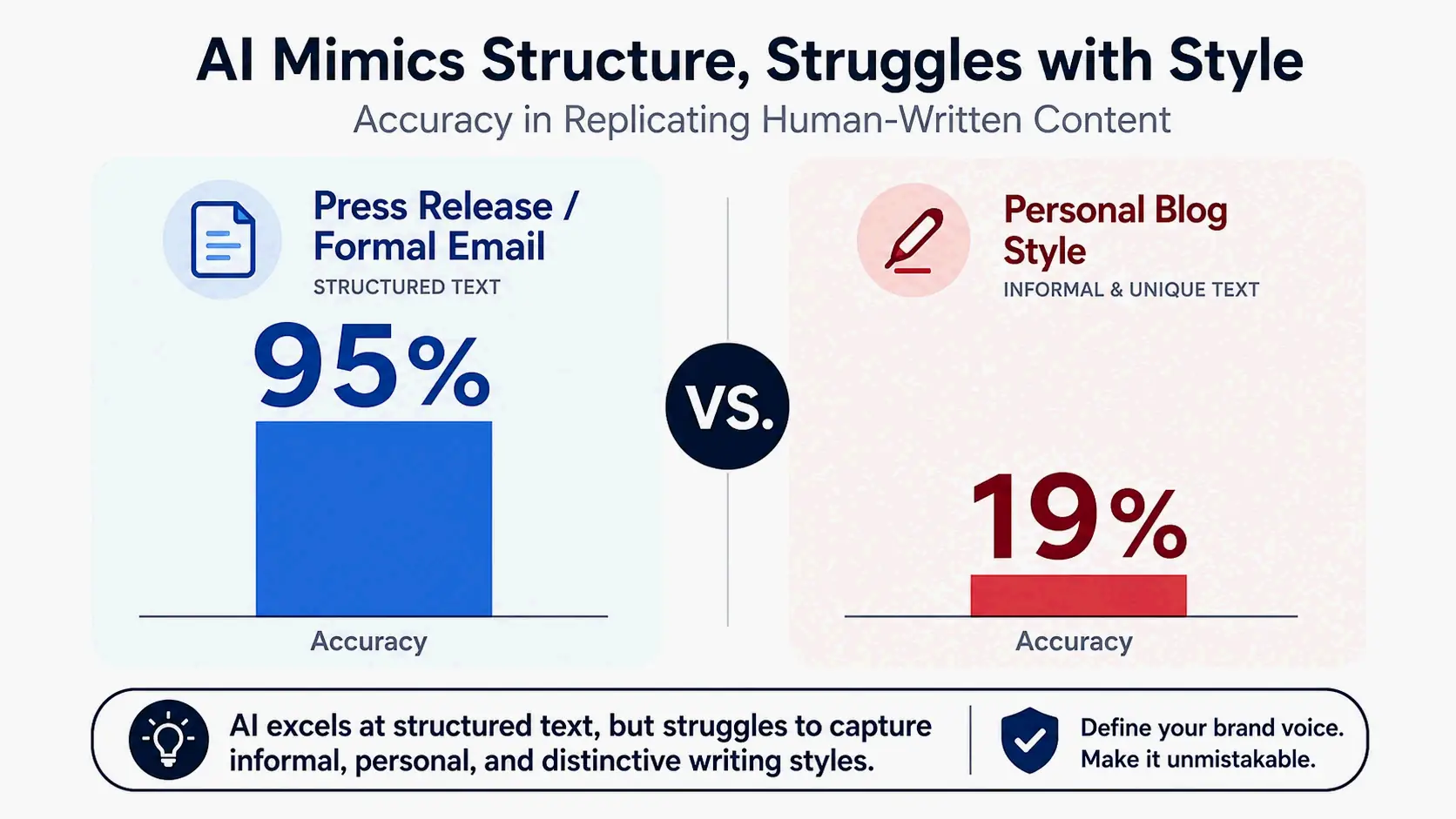
That gap means that if you feed a generic prompt to an LLM — even with a few examples — you get text that sounds fine but loses the subtle, hard-to-pin-down qualities of your voice: the rhythm, the cautious hedging, the specific word choices. As The State of Brand warned in July 2026, many AI-powered content systems default to a generic “helpful but not bossy” tone, which makes brands sound interchangeable.
The fix is to use your voice specs — not a list of adjectives — as a systematic review checklist. Before you publish any AI-generated draft, run it through your spec sheet: Does it stay within the sentence-length range? Does it use the approved vocabulary and avoid banned constructions? Does its hedging posture match your guidelines? A practical “blind test” protocol, adapted from Digital Applied’s work, goes a step further: periodically mix AI-generated pieces into a batch of your real copy and ask team members to sort them. If they can reliably tell which is which, your spec needs refinement. That cycle of blind testing and spec adjustment is the only honest way to know your voice is surviving AI deployment.
Conclusion
Defining a strong brand voice isn’t about inspiration — it’s about specification. The most iconic brand voice examples work because they’re built on measurable, repeatable rules, not because someone wrote down a catchy list of adjectives. So don’t just admire Oatly or Mailchimp. Steal their methodology: take your last 10 pieces of content and run a quantitative audit against your new spec sheet. Your brand’s most underused growth asset isn’t your ad budget — it’s your authentic, scalable voice.
FAQ
What is the difference between brand voice and tone of voice?
Your brand voice is your consistent personality — it’s who you are. Tone of voice is how that personality adapts to the situation. Picture the person-at-a-party analogy: your voice is your character, and your tone shifts depending on whether you’re greeting a friend or giving a serious update. Voice stays fixed; tone flexes.
Can a brand’s tone of voice really impact sales or customer loyalty?
Yes, and the impact is real. Research from the Nielsen Norman Group found that trustworthiness in tone accounts for 52% of the variance in how likely people are to recommend a brand (desirability). Friendliness alone added only about eight percentage points on top of that. A trustworthy voice directly contributes to the trust that drives conversions and long-term loyalty.
How do I maintain a consistent brand voice across a large team and multiple channels?
Move beyond adjectives and create a spec-based Brand Voice Guide. Build a “This/Not This” cheat sheet with concrete rules — for example, “keep sentences under 25 words,” or “avoid passive voice.” This turns on-brand writing into a measurable action that any writer or AI can check, instead of relying on gut feel.
How can I use AI to write in my brand’s voice without sounding generic?
Treat AI as a first-draft engine, not the final writer. Use your voice specifications as a review checklist before you publish. Run blind tests: periodically mix AI-generated copy into your real content and see whether your team can spot the difference. If they can, refine your spec. A measurable voice guide keeps AI output tied to your actual identity, not a generic default.
