


{# Semantically Related Keywords: The Complete Guide for 2026 SEO & AEO
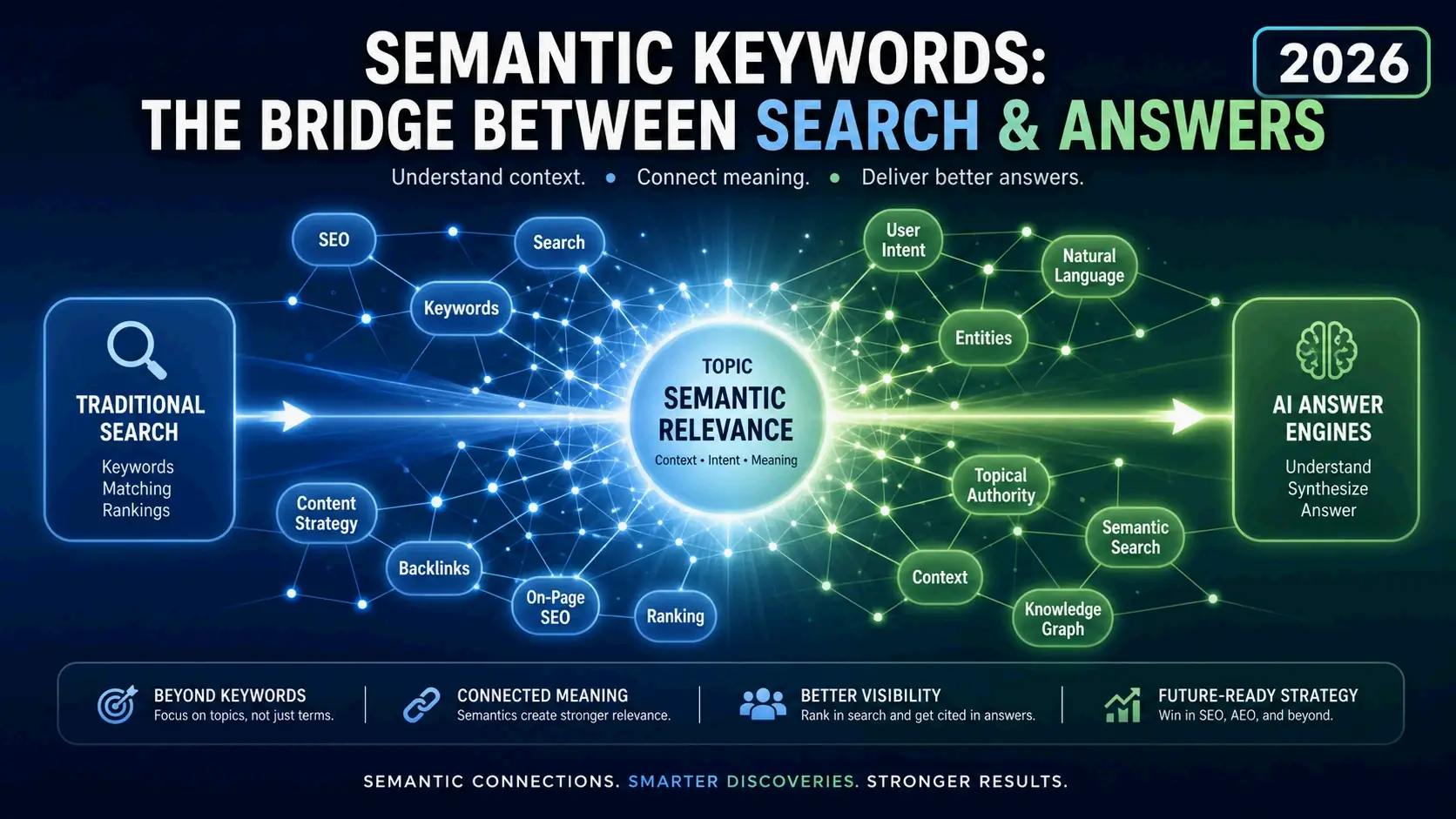
Semantically related keywords aren’t just words that show up near each other. They`re terms and ideas tied together by meaning and context. In 2026, they’re what tells search engines your content has real topical depth. They also give AI answer engines the confidence to pull and cite your work—far more effectively than the old LSI approach ever could.
Contents
What Are Semantically Related Keywords?
Semantically related keywords are terms that share a contextual and conceptual link to a main topic. They move beyond simple word matching to reflect how meaning is constructed in language. This idea comes from linguistics. Semantics is the study of how language creates meaning—how we understand words, phrases, and sentences. Merriam-Webster defines “semantic” simply as “of or relating to meaning in language.” One key idea behind all this is compositionality.
The Linguistic Principle Behind ‘Semantic’ (It’s Not Just Co-occurrence)
When we hear a phrase like “content marketing strategy,” we don’t just see three random words. We understand the meaning by combining the meaning of each part. This is compositionality—the idea that the meaning of a larger expression comes from the meaning of its pieces and how they fit together. It’s why we can make sense of sentences we’ve never encountered before.
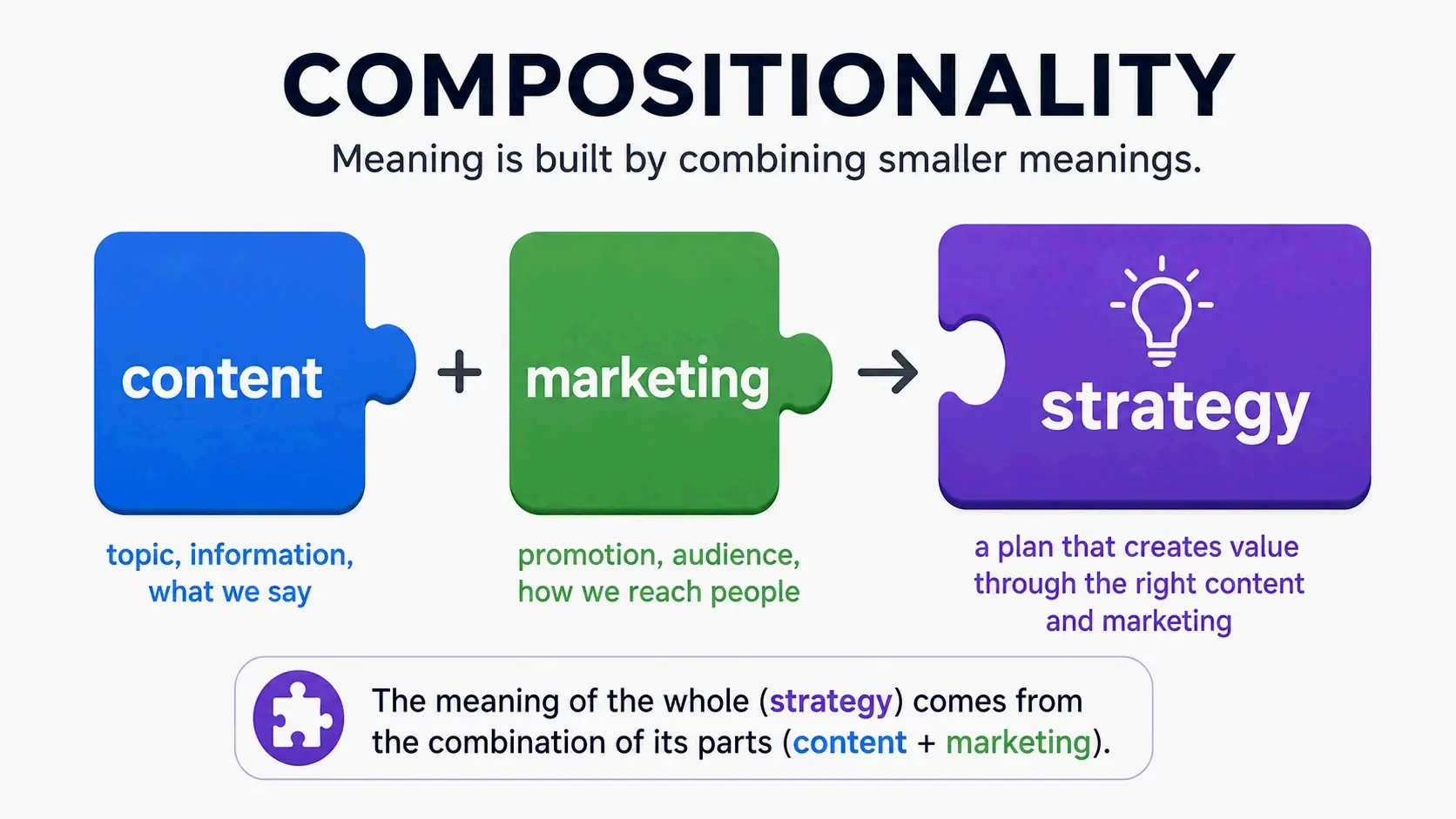
In SEO, this means that semantic relationships aren’t about how often words appear together. They’re about how those words build a coherent idea. Modern search engines use models that work in a similar way, evaluating content as a conceptual whole, not a list of keywords to check off.
Semantic Keywords vs. LSI: Why the Old Model is Dead
You’ll still hear people talk about “LSI keywords,” but here’s the thing: that model is outdated. Latent Semantic Indexing comes from a 1988 research paper and looks at how often words appear together in documents. In 2019, Google’s John Mueller said flat out that Google doesn’t use LSI for rankings. So calling any keyword an “LSI keyword” doesn’t really make sense in modern SEO.
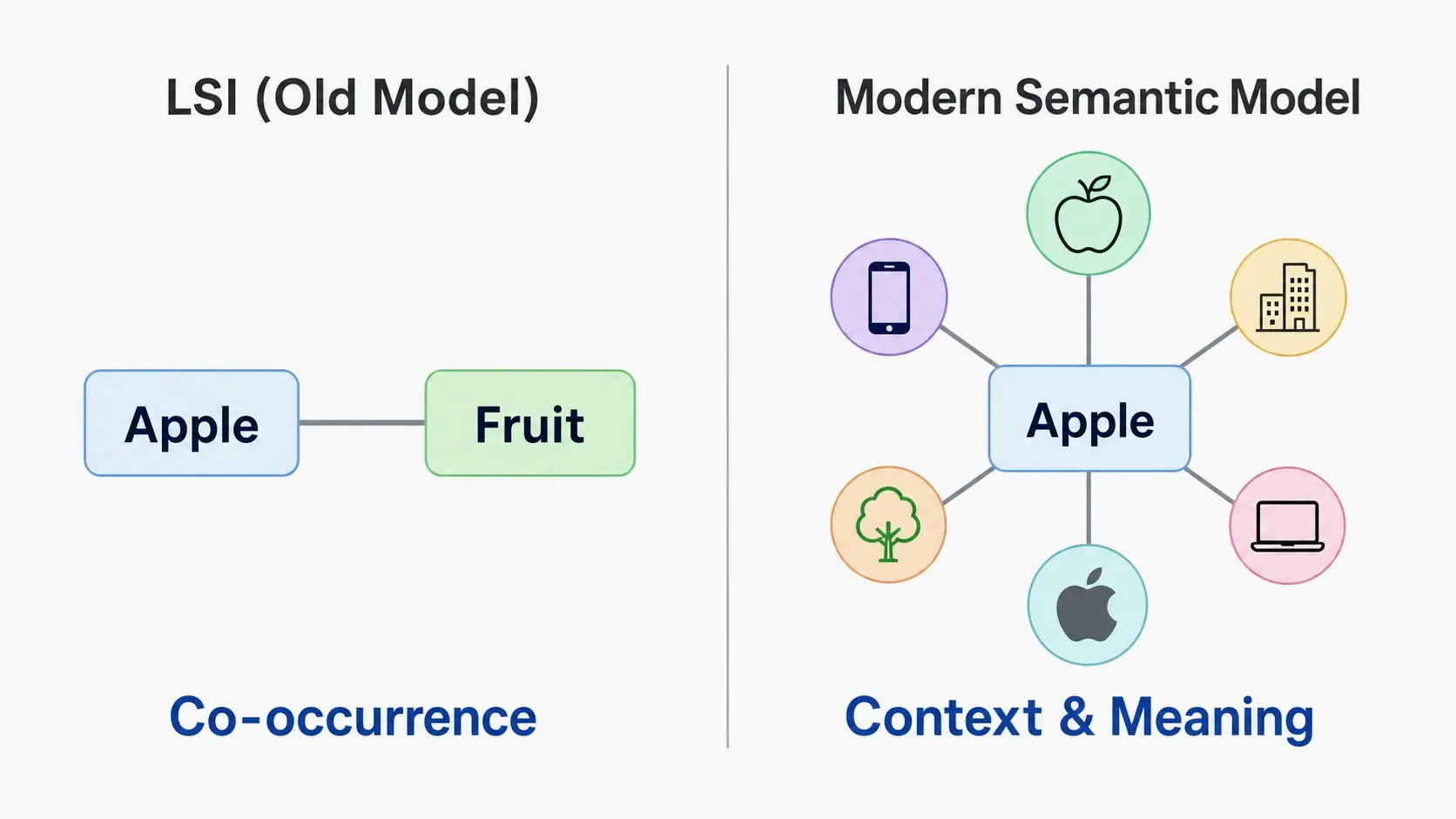
Semantic keywords are different. They come from natural language processing and machine learning, which try to grasp a word’s meaning, context, and how it connects to other concepts and entities—not just the odds of it sitting next to another word.
Why BERT, MUM, and Entities Demand a Semantic Strategy
Google handles over 5 trillion searches a year, according to HubSpot. To make sense of that kind of volume, it has to go way beyond matching keywords like a string. That’s where models like BERT (Bidirectional Encoder Representations from Transformers) and MUM (Multitask Unified Model) come in. These NLP systems look at the context around words—both in the search query and in documents—to understand what someone really wants and whether a piece of content truly fits the topic.
All of this conceptual work is organized around entities. Think of an entity as a distinct, definable thing—a person, place, brand, idea, or object that search engines can identify. These entities are the building blocks of Google’s Knowledge Graph, a huge database that maps out how billions of facts relate to each other. For instance, the Knowledge Graph knows that “Apple Inc.” is a tech company and “apple” the fruit is something else entirely—each one links to its own set of attributes and related concepts. Semantic keywords act like the threads tying a broad topic to the specific entities that define it. They show search engines you’re not just writing about a single word. You’re covering the whole web of connected ideas that give that word its full meaning.
Semantic Keywords’ Dual Role: Traditional SEO vs. AEO in 2026
Semantic keywords play two important roles in search today. On the traditional SEO side, they signal how deeply your page covers a topic. When you use a well-clustered set of related terms, Google’s algorithm feels more confident that your page is a real, trustworthy source—and that can help you rank for a broader range of related queries.
In 2026, there’s a second role that’s become just as important: Answer Engine Optimization (AEO). AI answer engines like ChatGPT, Perplexity, and Google’s AI Overviews need dense, context-packed information they can pull from, piece together, and trust. Kelvin Çobanaj, CEO of ZeroRank, explains it this way: “With AI search, I focus more on covering the full topic and common questions, not just keyword variants. That gives AI enough context to include the brand in its answer.”
Bernard Huang, founder of Clearscope, ties these two goals together: “I see a lot of teams treating AEO and SEO like two totally separate things, and honestly, it’s the biggest resource waste out there right now. Both come down to the same goal: creating content that genuinely covers a topic well. When you do good semantic keyword research and map out the concepts and relationships around a topic, you’re building content that works for traditional search and AI engines at the same time.”
Ultimately, you’re aiming for topical authority—a signal that works for both sides. One well-researched, semantically deep piece can boost traditional rankings and, at the same time, package knowledge in a format that AI systems can directly pull from.
The 2026 Citation Principle: How to Get AI Answer Engines to Quote You
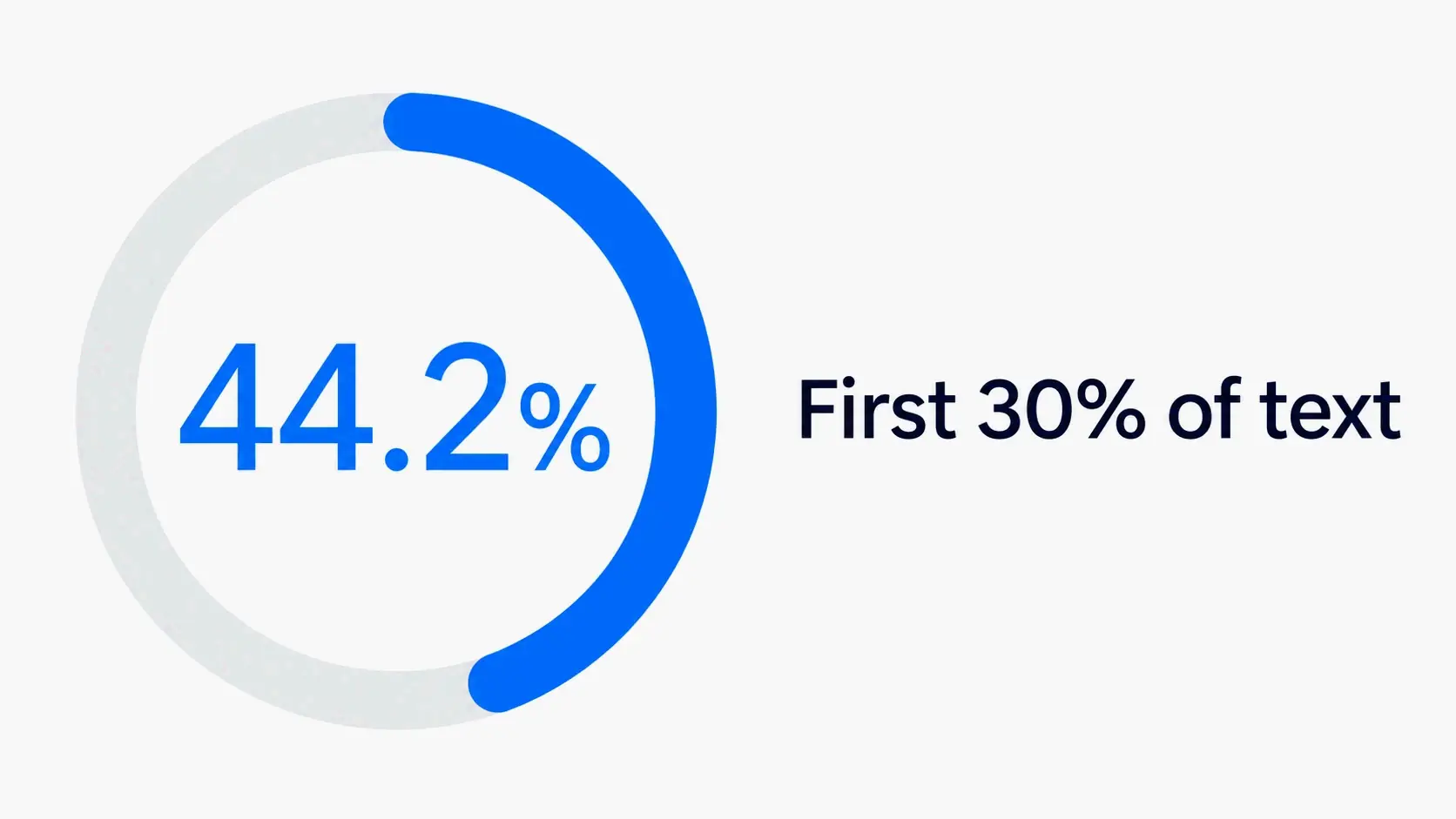
Where you put things matters a lot for AEO. According to research highlighted by Search Engine Land (using HubSpot data), 44.2% of ChatGPT citations come from the first 30% of a text. So your most important semantic keywords, core definitions, and critical subtopics should show up early. When you front-load content with explicit, clearly defined concepts, it’s easier for an AI model to tell what your page is about and grab a direct quote, which greatly improves your odds of being cited.
How to Find and Map Semantically Related Keywords: A 5-Step Workflow
Good semantic keyword research isn’t random—it follows a clear process that takes you from a rough idea to a complete map of the topic. The aim is to uncover the web of concepts, questions, and entities that truly define what you’re writing about.
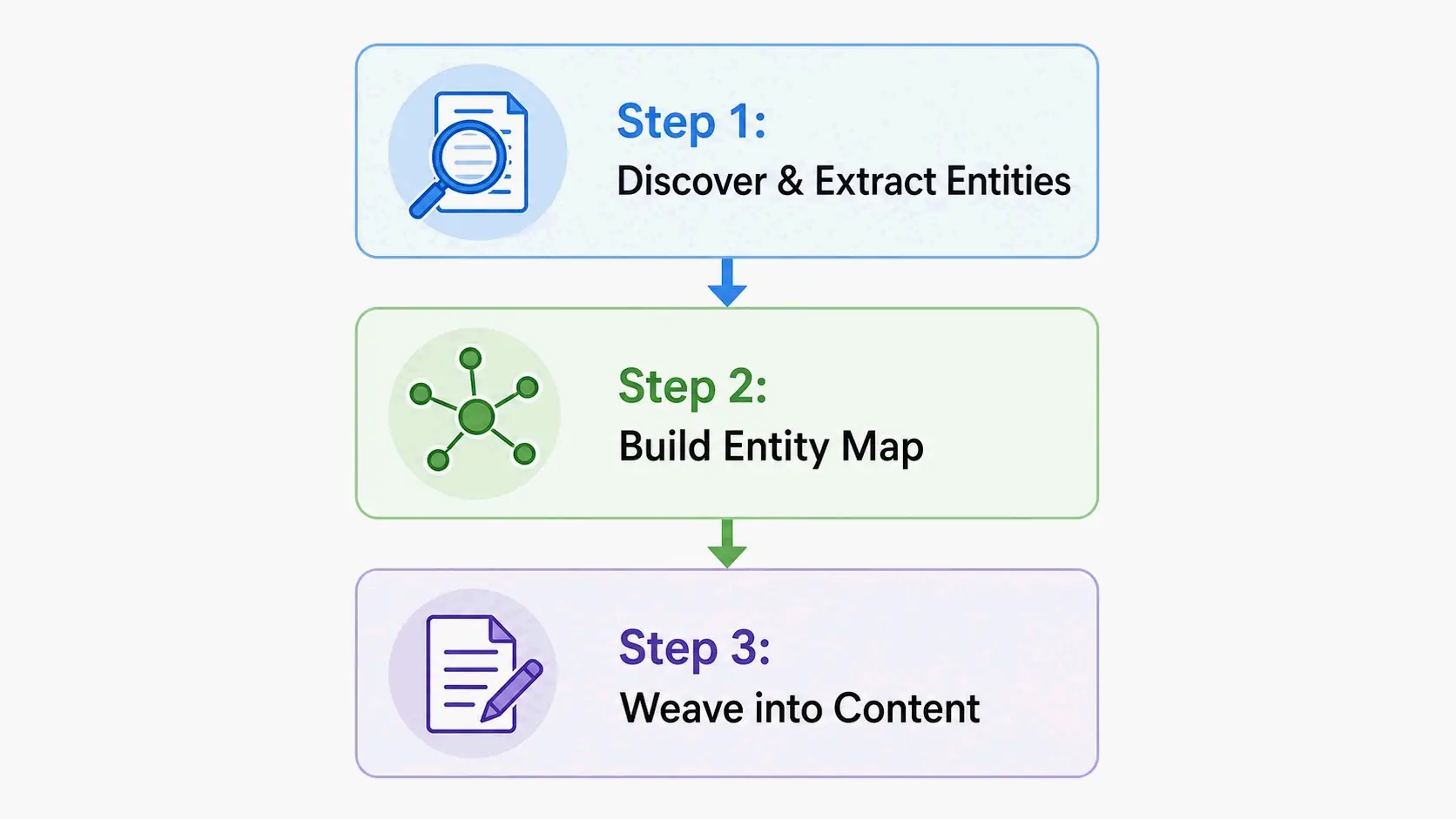
Step 1: Pool discovery. Start by casting a wide net. Pull ideas from multiple places: the SERP for your main keyword, the “People Also Ask” box, related searches, forums, competitor pages, and official documentation. See how the topic actually gets talked about. Daniel Horowitz, Enterprise SEO at Salesforce, walks through his method: “I always want to see how the topic is actually being framed across rankings, AI answers, People Also Ask, forums, documentation, and competitor pages. That’s where you start to see which entities recur, which subquestions matter, where you can add value with an FAQ section, and which phrasing keeps showing up.”
Step 2: Entity extraction. Now, pull out the repeating nouns, subtopics, and questions from all that raw material. These are the core entities and concepts that anchor the topic. If you’re writing about “project management software,” your entities might be specific tools like Asana or Jira, and concepts like “Gantt chart” or “Kanban board.”
Step 3: Research and grouping. Group these terms into an Entity Map. Think of this as a structured picture of how all your terms relate to one another and to your main topic. Sort them into buckets such as core concepts, common questions, related entities, and comparison terms. This map makes content gaps obvious and tells you what sections your article really needs.
Step 4: Tool mapping. At this stage, pair your specific goal with the right tool. Broad discovery can be done with general SEO tool suites. For deep competitive analysis, something like Ahrefs fits better. If you want a direct look at the questions and entities Google connects to a topic, a tool like KeywordsPeopleUse can be especially useful.
Step 5: Content weaving. Use your entity map to assign every semantic cluster to a heading (H2, H3) in your content plan. And here’s a critical move: put your core semantic terms and their definitions in the top 30% of the draft. That placement boosts visibility for traditional ranking signals and helps AI engines find and extract what they need.
Expert Methodology-to-Tool Matrix: Which Tool Fits Your Research Phase?
The tools you reach for depend on where you are in your research. A simple matrix can clarify:
| Research Phase | Primary Goal | Optimal Tool or Method |
|---|---|---|
| Pool Discovery | Collect a broad, unfiltered set of terms, questions, and competitor ideas. | SERP analysis, “People Also Ask,” Reddit, Google Autocomplete, HubSpot SEO Marketing Software. |
| Entity Extraction | Pinpoint the distinct, definable things and concepts that anchor the topic. | Google’s NLP API, KeywordsPeopleUse, manual review of top-ranking pages. |
| Competitive Analysis | Spot content gaps and see which headings and topics your competitors are covering. | Ahrefs Content Gap tool, Semrush Topic Research tool. |
| Content Optimization | Make sure a draft covers a comprehensive set of semantic terms found on top pages. | Surfer SEO, or on-page SEO recommendations within HubSpot. |
Mapping each research goal to a specific tool like this keeps you from getting buried in data. It focuses your workflow so each phase churns out insights you can actually use when you start writing.
From Keyword Map to Topical Authority: A Writing Blueprint
When you take a map of keyword clusters and assign each cluster to a section, you’ve got a real content plan. Let’s say your topic is “solar panel battery storage.” Your map might have clusters like “battery types,” “cost & savings,” “installation,” and “compatibility.” Those become your H2s. Inside the “battery types” cluster, you’d find terms like “lithium-ion,” “lead-acid,” “LiFePO4,” and “cycle life”—and those drive the details in that section.
Covering the entire topic—not just a handful of keyword variations—is what powers both search rankings and AI citations. The idea is simple: a comprehensive guide built around an entity map naturally uses the concepts and language that establish topical authority. A page that explains the difference between lithium-ion and LiFePO4, digs into depth of discharge, and covers AC vs. DC coupling feels far more authoritative than one that just says “solar battery storage” a few times with some synonyms. That kind of depth tells every search system—whether it’s a ranking algorithm or an AI model—that your content is a go-to source.
Building Your Content’s Semantic Layer: A Strategic View for Content Directors
If you’re a content director, think of semantic keyword research as a way to build a strategic asset: a semantic layer. This is a consistent framework that maps your organization’s knowledge and content to the real-world concepts, entities, and relationships your audience actually cares about—something both machines and people can read. Rather than treating each article like its own island, a semantic layer ties your content together into a unified whole. When your site clearly defines, links to, and elaborates on a steady set of entities, you create a brand-level authority signal. Google’s Knowledge Graph and AI models pick up on that signal, which makes your whole domain more likely to be cited.
Conclusion
In a search world built on context and meaning, semantically related keywords are your proof of topical depth. Both Google’s ranking algorithms and AI answer engines like ChatGPT now care less about repeating the same word and more about whether you’ve covered a subject from an entity-based perspective. Drop the old LSI playbook and build your strategy around linguistic meaning and entity maps—you’ll end up with content that serves as a definitive source, no matter what’s doing the searching. The fastest way to get there? Start your next piece with broad entity research. Turn what you find into a topical map, organize your content around those clusters, and make sure the most important semantic concepts land in the first 30% of your article.
FAQ
Are LSI keywords the same as semantic keywords, and does Google use LSI?
No, they aren’t the same. LSI is a math model for analyzing documents that dates back to 1988. Google’s own spokespeople have confirmed that LSI isn’t part of its ranking system. Semantic keywords, on the other hand, come from modern NLP and machine learning. These technologies try to grasp what a word means, the context around it, and how it links to other concepts and entities—not just the odds of it appearing near another word.
How many semantically related keywords should I add to a single page?
There’s no set number you should target. The real goal is to cover the topic and its closely related subtopics and entities thoroughly. A solid entity map will show you the natural clusters. Focus on working those distinct subtopics into your section headings, and weave in related terms where they fit naturally to support the main idea—not because you’re checking off a list.
Where exactly should I place semantic keywords for the best SEO and AEO results?
Put your key semantic keywords and subtopics in the first 30% of your content. That’s where a 2025 study found that 44.2% of ChatGPT citations are pulled from. For traditional SEO, work them into your headings (H2, H3), the opening paragraph, and the alt text of relevant images. This builds a visible layer of topical depth and helps connect your content to the core entities in Google’s Knowledge Graph.}
