


TL;DR: GEOWriter is a skill-based AI SEO agent toolchain running inside Claude Code and other CLI environments—it turns a brief into a publication-ready article in minutes, handling keyword planning, batch generation, brand integration, internal link injection, and SEO diagnosis in one automated workflow. Gemini is a general-purpose AI assistant woven into Google’s apps. The GEOWriter vs Gemini decision boils down to this: do you want a tool that handles the entire content pipeline for you, or a conversational helper you guide step by step?

Contents
- AI Agent vs. AI Assistant: Why the Distinction Matters More Than the Model
- Head-to-Head Workflow: Producing a Blog Post with GEOWriter vs. Gemini
- GEOWriter vs Gemini for SEO: Dissecting Content Quality and GEO Readiness
- Authority and Trust: Can Gemini’s Deep Research Compete with a Specialized Agent?
- Pricing, ROI, and the True Cost of Content Creation
- The Verdict: When to Choose GEOWriter Over Gemini (and Vice Versa)
- Conclusion
- FAQ
AI Agent vs. AI Assistant: Why the Distinction Matters More Than the Model
The biggest difference in the GEOWriter vs Gemini comparison isn’t about which model writes the better sentence. It’s architectural. GEOWriter operates as an AI agent—it’s built to run a multi-step workflow on its own, no hand-holding required. Gemini is an AI assistant. It responds to your prompts, but you have to manage every next action yourself.
An AI agent doesn’t just answer a question and wait. It pulls live data, makes decisions, moves through sequential tasks, and hands you a finished output. As detailed in a Search Engine Insight analysis of AI SEO agents, GEOWriter is a content-focused AI SEO agent. It autonomously runs a complete multi-stage pipeline—keyword planning, live SERP analysis, structured writing, E-E-A-T alignment, brand integration, internal link injection, automated visuals, and WordPress publishing—delivering a ready-to-publish article in roughly five minutes.
An AI assistant like Gemini needs you to feed it at every stage. You prompt for an outline, review it, prompt for each section, fact-check the output, format the copy, and upload it to your CMS yourself. The assistant generates text. The agent ships finished work.
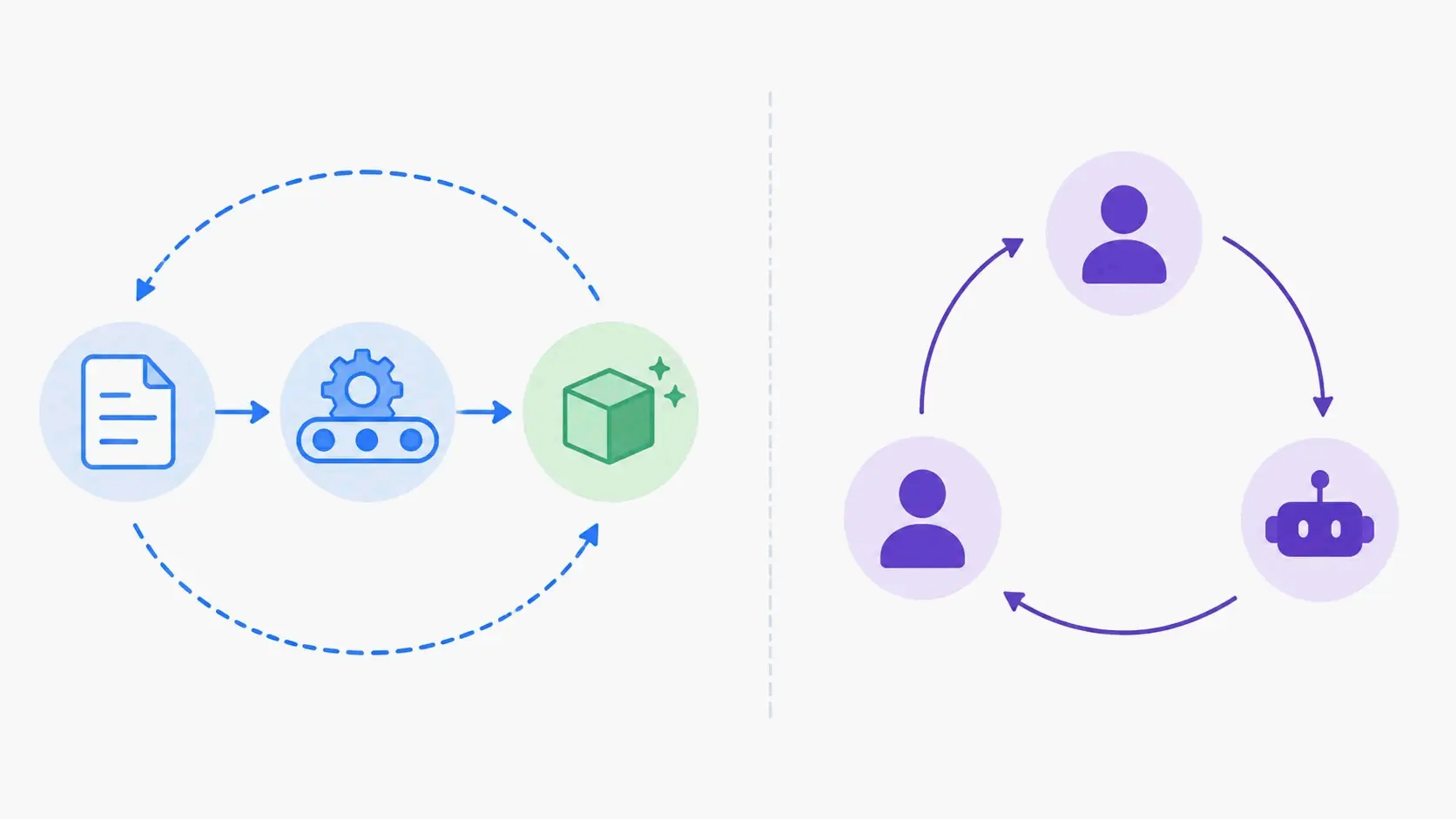
This matters especially for content creation, which is a sequence of dependent steps. Each phase—keyword research, outlining, writing, optimizing, publishing—relies on the one before it. With an assistant, you’re the glue holding those steps together. An agent handles the handoffs for you.
The Sequential Nature of SEO Workflows
SEO content production is a chain of tasks, not a single creative burst. That makes it a natural fit for agent-based automation.
Louise Linehan, quoted in the Search Engine Insight article, puts it plainly: “SEO is a particularly good fit for AI agents because most of the work is sequential. Keyword research informs your content brief. Competitor gaps shape your outline. A technical audit tells you what to fix before you publish.”
Ask Gemini to write a blog post, and it answers that single prompt with a single output. It won’t go analyze what competitors rank for, structure the article around entity gaps, weave in internal links, or publish to WordPress on its own. You have to break the job into pieces and manage each one. An AI SEO agent like GEOWriter, by design, treats content creation as a pipeline—not a series of disconnected requests. It runs the research, applies SEO rules, generates the draft with E-E-A-T baked in, creates visuals, and publishes. All as one flow.
Head-to-Head Workflow: Producing a Blog Post with GEOWriter vs. Gemini
Here’s how each tool handles the task of creating a high-quality, SEO-optimized article for a specific keyword.
The GEOWriter Journey: One Click to a Publication-Ready Draft
GEOWriter treats the entire content pipeline as a single automated run. You provide a topic or keyword brief, and the agent handles the rest.
The process follows a consistent sequence. Live SERP analysis scans the top-ranking pages for your target keyword, pulling out structural patterns, entity coverage, and gaps. A structured outline builds from those competitive insights. The AI then writes a full draft incorporating E-E-A-T—Experience, Expertise, Authoritativeness, and Trust—not as an afterthought but as a built-in constraint of the writing process. Automated visuals are generated and placed inline. When the draft is ready, GEOWriter can publish directly to WordPress or another connected CMS.
Your involvement is concentrated at the start and finish: define the brief, then review the finished article. Everything in between runs autonomously. Total production time? About five minutes.
The Gemini Journey: The Power and Peril of Prompt Engineering
As of mid-2026, Gemini offers no native SEO content pipeline. You have to break the task into individual prompts and manage each stage by hand.
A typical workflow might go like this: prompt Gemini for an article outline based on your keyword, review and tweak that outline, then prompt section by section for the full text. Once the draft is generated, you manually fact-check all claims (Gemini doesn’t cite live sources by default), review header structure and keyword placement, format the content for the target platform, and finally upload it to your CMS. Any visuals have to be prompted and placed separately.
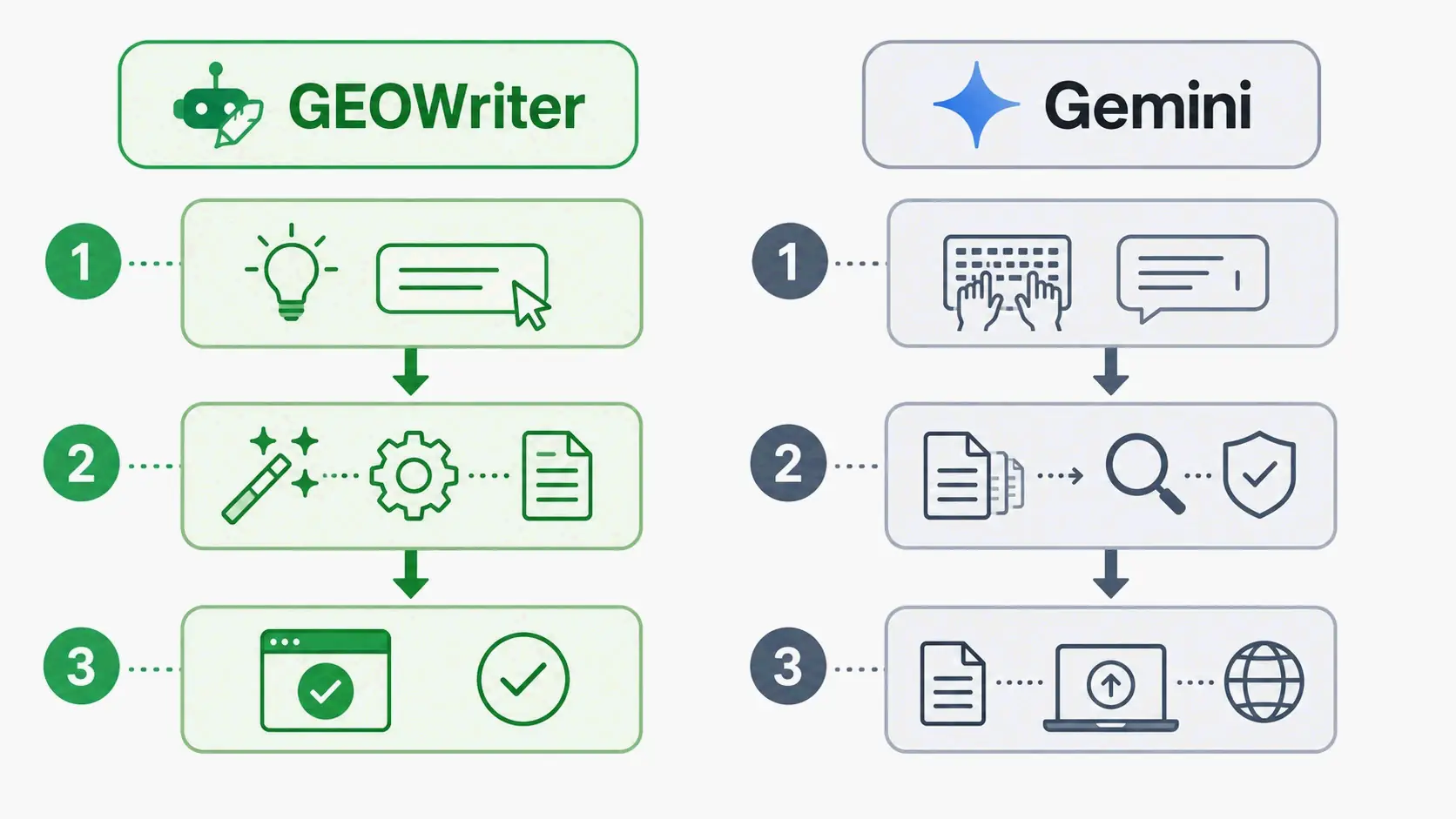
The quality of the final piece depends heavily on your prompt engineering skill. A well-crafted prompt can produce strong content, but each step remains a separate interaction. No automated SERP analysis informs the structure. No E-E-A-T guardrails run in the background. The assistant waits while you do the orchestration work.
The total time investment includes writing time plus the hours you spend prompting, fact-checking, formatting, and publishing. That’s the practical gap between the two tools for content production: an automated pipeline versus a manually managed chat.
GEOWriter vs Gemini for SEO: Dissecting Content Quality and GEO Readiness
To compare output quality, you need to look at two frameworks that decide whether content gets seen in both traditional search results and AI-generated answers: E-E-A-T and Generative Engine Optimization (GEO).
The Search Engine Insight article highlights a statistic worth paying attention to. According to Semrush, LLM visitors convert at a rate 4.4x higher than the average organic visitor. Visibility in AI answer engines like ChatGPT, Perplexity, and Google AI Overviews isn’t a side concern anymore—it hits revenue directly.
Why E-E-A-T Is a Product Feature, Not a Prompt
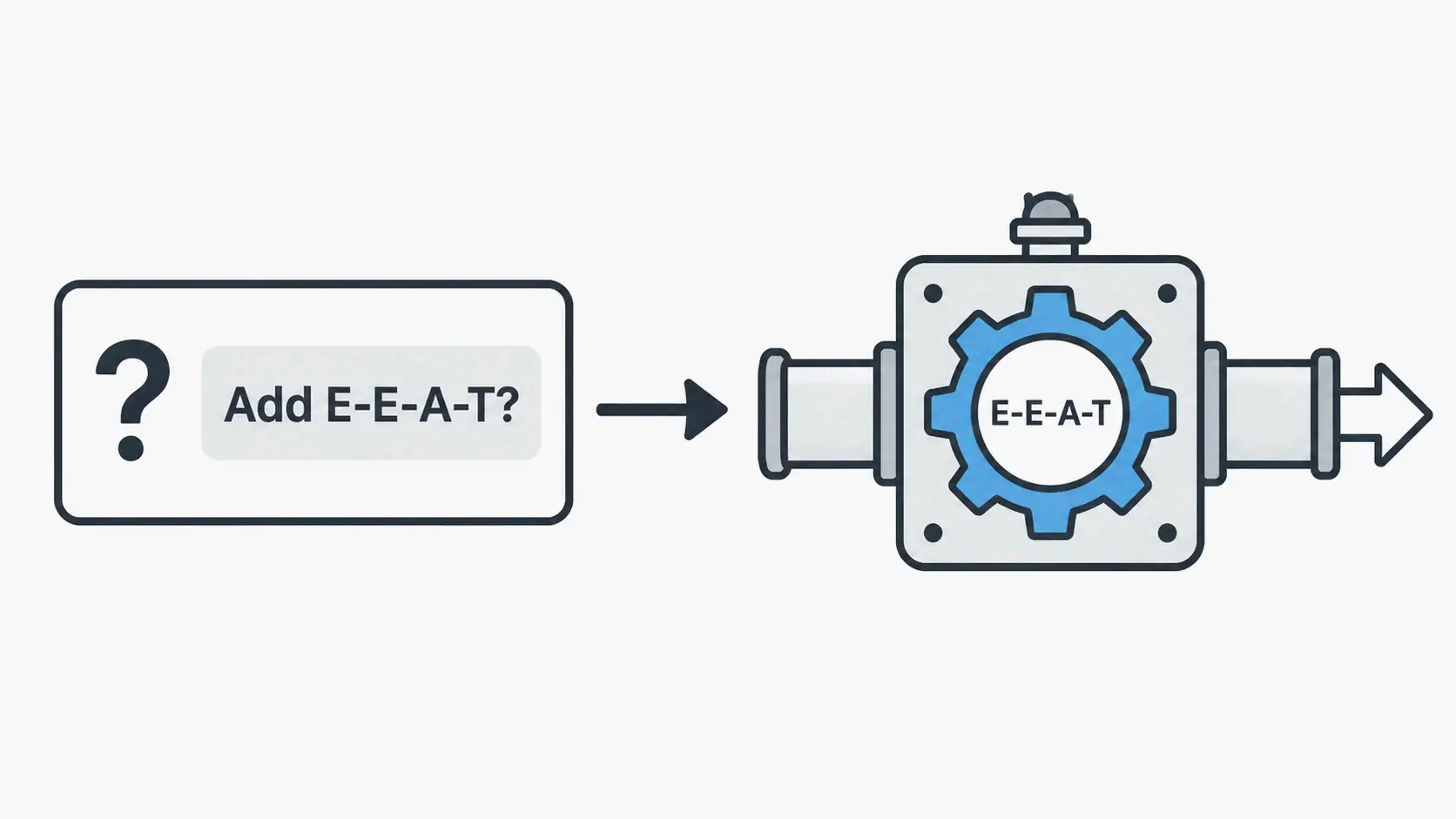
A general-purpose assistant like Gemini can produce content that mentions experience, cites sources, or demonstrates expertise—but only if you explicitly prompt it to do so. The presence and quality of E-E-A-T alignment depends entirely on whether you remembered to include those requirements and knew how to phrase them.
GEOWriter, as an AI SEO agent, builds E-E-A-T into the content generation pipeline itself. The agent’s workflow applies these principles systematically—not because a user remembered to ask, but because the system is designed to produce content that meets Google’s quality standards by default. It’s the difference between asking an assistant to “sound authoritative” and running a pipeline engineered to produce authoritative output.
The GEO Advantage: Are You Writing for Readers or AI Crawlers?
Generative Engine Optimization addresses a question traditional SEO doesn’t fully answer: can AI systems parse, attribute, and cite your content correctly when generating answers? As the Search Engine Insight analysis notes, “Content that AI crawlers can access but cannot parse or attribute will be ignored regardless of quality.”
The same article documents a real-world example of GEO strategy at work. Thrive Internet Marketing Agency applied its own AI SEO strategies internally and grew total traffic from all AI platforms by +4,302% from January to October 2025. That includes +322% traffic from Gemini and +862% from ChatGPT. The agency used advanced optimization, structured data, and AI-focused content creation to drive those numbers.
An AI SEO agent like GEOWriter addresses GEO readiness during content production by structuring output so AI systems can extract it reliably. A general assistant like Gemini generates text that may or may not be formatted for AI answer engines—leaving that optimization entirely up to you.
Authority and Trust: Can Gemini’s Deep Research Compete with a Specialized Agent?
Research capability is where the difference between a generalist model and a purpose-built agent becomes clearest. Gemini’s Deep Research feature can compile multi-source reports that rival what a junior analyst would deliver in hours. But that research sits outside the content production pipeline—you still have to take the findings and build the article yourself.
GEOWriter’s approach is different in kind, not just degree. Its research component runs programmatic SERP analysis: it scans live search results for the target keyword, extracts competitor structures, identifies content gaps, and feeds those insights directly into the content generation step. The research shapes the output structure, not just informs the writer.
The Data Problem: General Knowledge vs. Live SERP Analysis
Gemini draws on its training data and, when Deep Research is activated, on real-time web sources. The output reflects what the model knows or can retrieve. But SEO content needs more than general accuracy. It needs competitive positioning—knowing what currently ranks, why, and what gaps a new article can fill.
GEOWriter’s programmatic SERP analysis answers those questions before a word is written. The agent sees the current search landscape and structures content accordingly. Gemini can describe competitors if you prompt it, but it won’t automatically bake competitive analysis into the article structure.
Writing quality presents a related challenge. Bhavyadeep, reviewing Gemini alternatives for Emergent, notes: “Gemini is not bad. It rarely loses outright on any task. But it rarely wins either, which is exactly the frustration that drives the search for alternatives.” That captures the limitation well: Gemini is a capable generalist that rarely produces the best output for any specialized job.
Gemini’s underlying models are technically strong. According to TeamAI’s 2026 model guide, Gemini 3 Flash scored 90.4% on GPQA Diamond, and Gemini 3.1 Pro reached 77.1% on ARC-AGI-2. The raw intelligence is there. But the gap between model capability and task-specific optimization is exactly where a dedicated agent adds value. GEOWriter doesn’t need a better model than Gemini—it needs a system tuned for one job, where Gemini serves many.
Pricing, ROI, and the True Cost of Content Creation
Subscription prices tell only part of the story. The real cost includes the time you spend prompting, editing, fact-checking, formatting, and publishing—the operational costs that live outside the monthly bill.
Gemini’s consumer pricing as of mid-2026, documented on Google’s subscription page, spans four tiers: Free, AI Plus at $7.99/month, AI Pro at $19.99/month, and AI Ultra starting at $99.99/month. The Pro tier unlocks Deep Research, higher usage limits, and Gemini in Gmail and Docs. The Ultra tier adds first access to advanced features like Deep Think.
GEOWriter, as a specialized AI SEO agent, charges $1 per article on a pay-as-you-go basis with a free trial to get started. The comparison isn’t just Pro versus Agent at the invoice level.
Per-Article Cost vs. Operational Cost: A Simple ROI Model
To gauge true ROI, look at the combined cost of creating content, not just the software subscription.
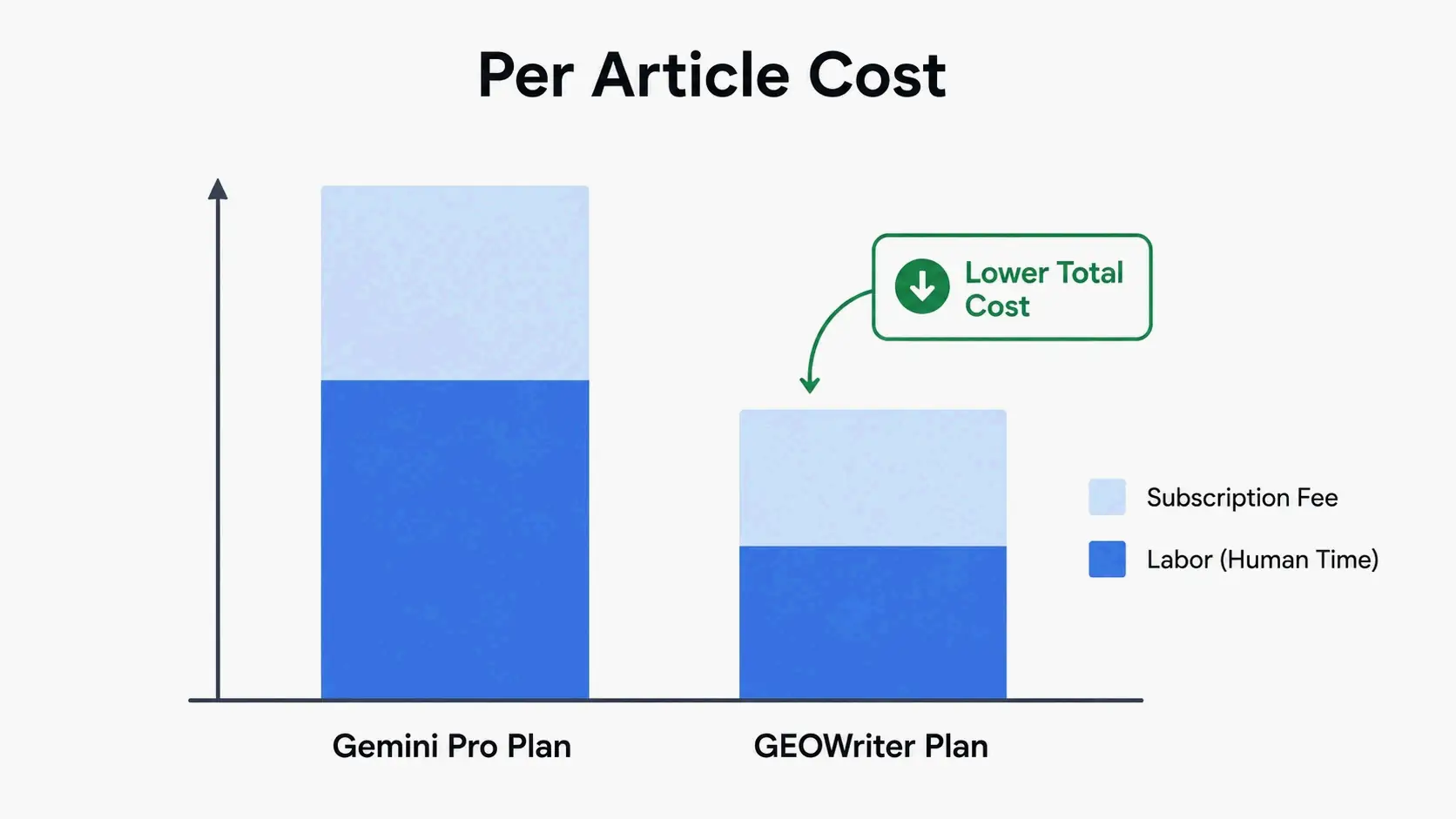
Using Gemini for blog production, you pay $19.99/month for Pro and then invest significant time per article in prompting, editing, fact-checking, and CMS publishing. If a skilled writer spends two hours per article at a given internal rate, the true per-article cost includes that labor multiplied by the number of articles produced each month.
GEOWriter’s $1-per-article model covers the entire pipeline—research, writing, optimization, visuals, and publishing—in a matter of minutes per article. The per-article labor cost drops to near zero. At $1 per published article, the total operational cost is significantly lower than any manual workflow for teams producing content at scale.
Predictability matters too. Gemini’s usage-based limits can create uncertainty—you might hit a rate cap mid-workflow with no clear dashboard tracking what’s left. A fixed-price AI SEO agent removes that variability, which helps when you’re budgeting content production across months or quarters.
The Verdict: When to Choose GEOWriter Over Gemini (and Vice Versa)
The GEOWriter vs Gemini decision comes down to workflow, not intelligence. Both tools are capable. They solve fundamentally different problems.
Choose GEOWriter when your main goal is scalable, SEO-optimized content production with minimal manual effort. The agent is built for teams and solo creators who need publication-ready drafts that weave together live SERP analysis, E-E-A-T alignment, automated visuals, and CMS integration in one automated run. If content creation is your bottleneck, an AI SEO agent removes the bottleneck—rather than just speeding up one step of the process.
Choose Gemini when you need a versatile AI assistant that works across the Google ecosystem—research, data analysis, drafting, and multi-modal tasks inside Gmail, Docs, Sheets, and Search. Gemini’s integration with Google Workspace is genuine, and its Deep Research feature serves as a strong investigative tool. For teams with robust editorial oversight who want AI support within existing workflows rather than end-to-end automation, Gemini is the practical choice.
The deciding factor is whether you need a comprehensive automation agent for content production or a general-purpose assistant for a range of tasks. Both have their place. The only real mistake is picking the wrong one for the job.
Conclusion
The GEOWriter vs Gemini debate isn’t about which AI is smarter. It’s about whether you need a specialized automation agent that produces GEO-optimized, publication-ready content in a single workflow, or a versatile conversational assistant that supports a range of tasks across Google’s ecosystem. For scalable content production with built-in SEO and GEO readiness, GEOWriter’s agent-based approach offers clear efficiency advantages. For research, drafting, and multi-modal tasks inside Google Workspace, Gemini remains a strong choice. If your main aim is to scale high-quality content without burning editorial hours on prompt engineering and manual publishing, start with the tool purpose-built for exactly that job.
See also: GEOWriter vs AI SEO Tools: The Ultimate 2026 Comparison — a comprehensive comparison of GEOWriter against all major AI SEO tools.
Related comparisons: GEOWriter vs ChatGPT · GEOWriter vs Claude
FAQ
Is GEOWriter based on the Gemini model?
GEOWriter is a proprietary AI SEO agent that may use several underlying large language models, including Gemini, as part of its automated workflow. Its core value is not the foundational model but the orchestration layer that conducts research, applies SEO rules, and integrates with platforms like WordPress.
Can Gemini’s Deep Research replace a dedicated AI SEO agent like GEOWriter?
Gemini’s Deep Research is a powerful tool for compiling multi-source reports, but it lacks the SEO-specific output formatting, automated SERP analysis, and CMS integration that GEOWriter provides. It works well as a research assistant, but turning those findings into publication-ready, GEO-optimized articles still takes significant manual effort.
Which tool is better for a solo content creator on a budget?
Gemini’s free or low-cost tiers make it accessible for very budget-conscious projects. However, GEOWriter often delivers a better return for solo creators who value time and direct output, since it effectively acts as a complete writing and SEO team—something that can justify the per-article investment.
