


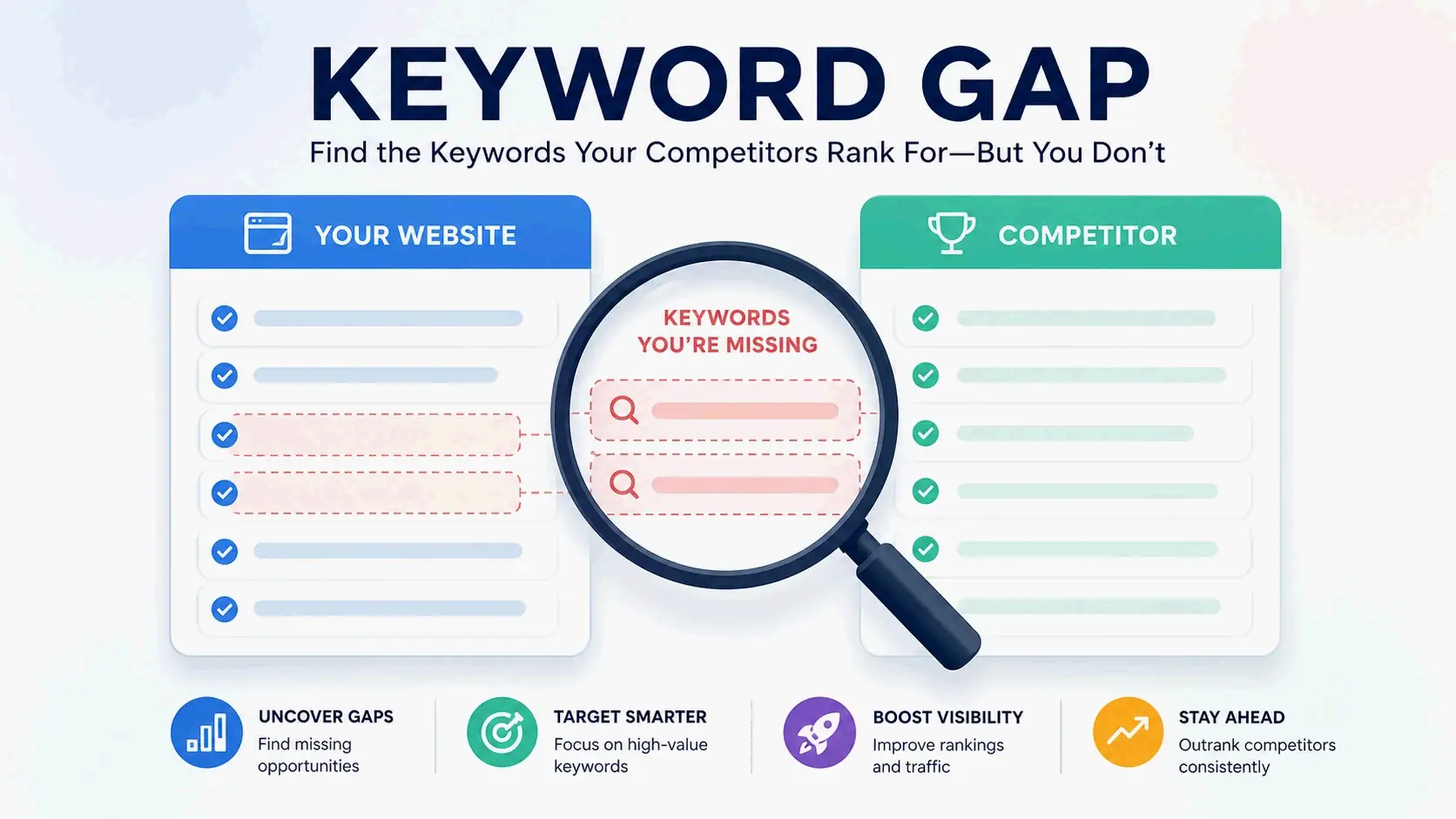
Keyword gap meaning has expanded in 2026. It’s not just the search terms your competitors rank for that you don’t—it now includes AI citation gaps, where competitors get cited by ChatGPT, Google AI Overviews, and similar tools while your brand stays invisible.
Contents
- What Is a Keyword Gap? The Complete Definition for 2026
- Keyword Gap vs. Content Gap: Understanding the Difference
- The Unified Search Visibility Framework: Ranking Gaps + AI Citation Gaps
- How to Perform a Keyword Gap Analysis: A Step-by-Step Guide
- How to Find Keyword Gaps Without Paid Tools (Free Methods)
- Beyond New Traffic: Using Keyword Gap Analysis as a Defensive Strategy
- Measuring Success: How to Track ROI from Keyword Gap Analysis
- Conclusion
- FAQ
What Is a Keyword Gap? The Complete Definition for 2026
Keyword gap analysis is an SEO gap analysis technique that compares your website’s keyword rankings to those of your competitors. It finds the valuable search terms they rank for that you don’t. The process reveals untapped traffic opportunities and gives you a data-driven basis for content strategy decisions.
The core mechanism is straightforward: you feed your domain plus several competitor domains into a keyword gap analysis tool, and it returns the terms where competitors appear in search results but your site is absent. These missing keywords represent demand your competitors are already capturing—traffic that could be flowing to your pages instead.
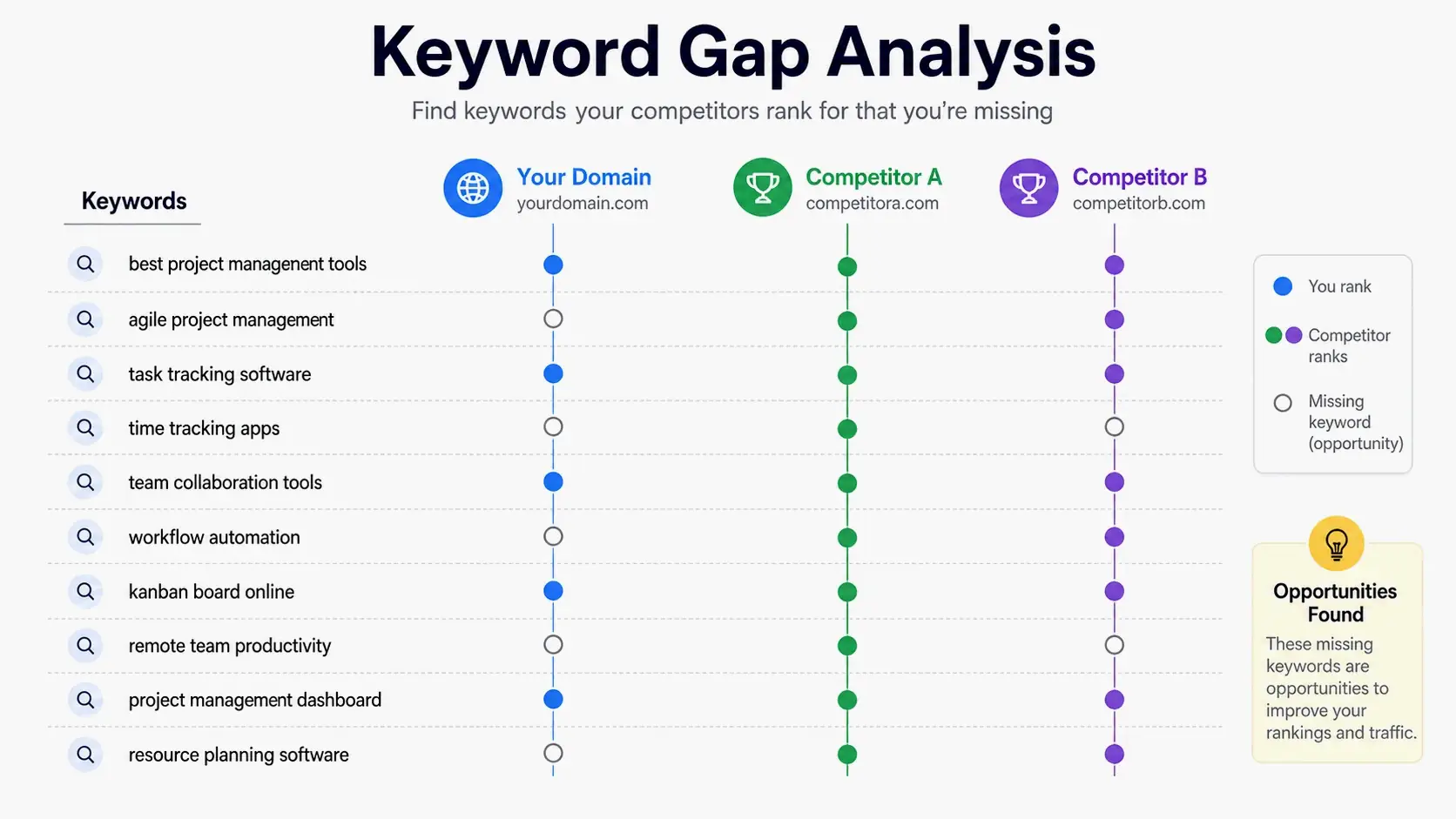
A more expansive definition accounts for how search behavior has shifted. AirOps extends keyword gap analysis into AI search by identifying prompts where competitors earn citations and a brand does not. That means a complete keyword gap analysis in 2026 doesn’t just check Google rankings. It also asks whether AI search engines like ChatGPT, Perplexity, and Gemini cite your content when answering questions about your topic. Closing both gaps is how you capture traffic and build authority across traditional and AI-driven search.
The keyword gap meaning hasn’t fundamentally changed—it still refers to search terms you’re missing relative to competitors. What has changed is the number of surfaces where that gap can exist.
Why Keyword Gaps Happen (And Why They’re Costly)
Keyword gaps form for three primary reasons. The most common is content strategy misalignment: teams build content around internal product language rather than the terms customers actually search for. A second cause is emerging competitor content that targets queries you haven’t addressed yet. The third driver is shifting search intent—as user behavior evolves, yesterday’s high-volume keywords may give way to new phrasings your site hasn’t adopted.
The cost of these gaps is concrete. According to 42signals, 70% of Amazon shoppers never click past page one of search results. If a competitor occupies that first page for a high-volume term and you’re absent, you’re invisible to the majority of the market. The gap directly translates to missed traffic, lost leads, and revenue your competitors claim without resistance.
A Manchester plumbing company experienced this firsthand. They ranked for “boiler repairs Manchester” but had completely missed “emergency plumber Manchester” and “boiler servicing costs”—both higher commercial intent terms. According to NetTrackers, once the company targeted those keyword gaps, the analysis delivered 18 qualified leads within 60 days. The traffic had always existed. The company simply hadn’t built pages to capture it.
Keyword Gap vs. Content Gap: Understanding the Difference
Keyword gap analysis and content gap analysis serve related but distinct purposes. Treating them as the same leads to incomplete strategy decisions.
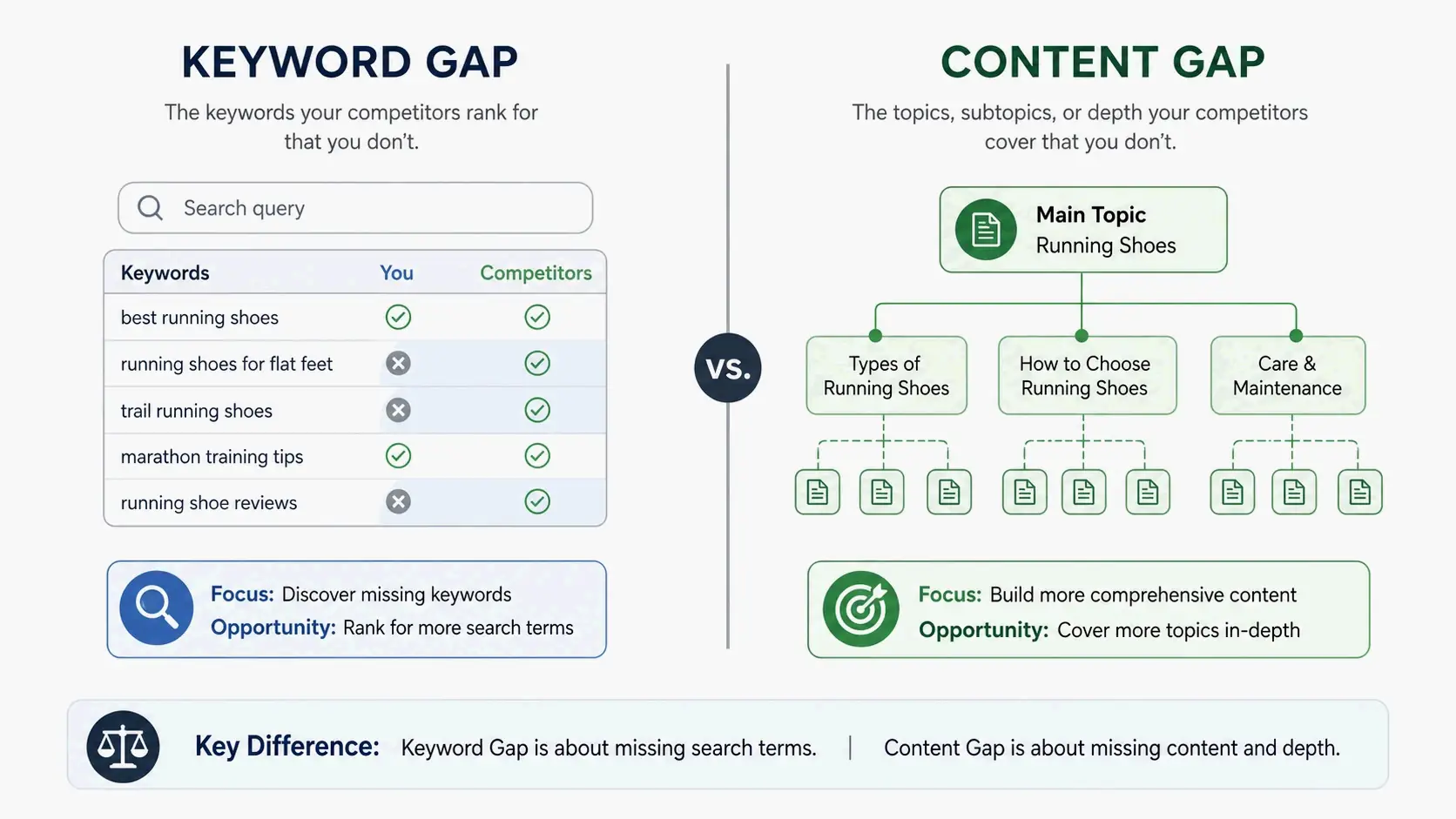
A keyword gap is competitor-relative. It identifies specific search queries your competitors rank for that your site does not target. The output is a quantitative list: terms with search volume, difficulty scores, and current competitor positions. A keyword gap tells you which search queries to target.
A content gap is topic-absolute. It evaluates whether your content covers the topics, intent, formats, and depth your audience needs—regardless of competitor activity. The output is a strategic roadmap: new pieces to create, existing pages to rebuild, and formats to add. A content gap tells you which topics need entirely new pages or more comprehensive coverage.
MQL Magnet captures the distinction practically: a keyword gap tells you that a competitor ranks for “B2B lead scoring software” and you don’t. A content gap tells you that even though you rank for “lead scoring,” your article is a thin overview while competitors offer templates, comparison tables, video walkthroughs, and pricing context. You can win the keyword and still lose the buyer.
A Quick Comparison Table
| Aspect | Keyword Gap Analysis | Content Gap Analysis |
|---|---|---|
| Primary question | Which search terms do competitors rank for that we do not? | Where does our content fail to serve audience needs and intent? |
| Scope | Narrow and quantitative | Broad and strategic |
| Inputs | Ranking data, search volume, keyword difficulty | Topics, formats, funnel stages, intent coverage, depth |
| Typical output | A prioritized list of missing keywords | A content roadmap of new pieces, rebuilds, and format additions |
| Best for | Finding proven demand fast and planning new pages | Fixing stagnant traffic, weak engagement, and thin coverage |
When to Use Each Analysis Type
Keyword gap analysis is the right starting point when you need quick wins, you’re planning new pages, or you’re building a business case with hard demand numbers. It surfaces opportunities with proven demand because a competitor holding a ranking is evidence that Google already matches real searches to that topic.
Content gap analysis becomes essential when traffic is stagnant despite decent rankings, engagement is weak, or conversions lag. It explains why you’re losing even where you rank.
In practice, the two analyses chain together. You extract keyword gaps first because they’re fast and quantitative. Then you evaluate content gaps because they explain why competitors outperform you on those terms. Running both gives you the complete picture—which keywords to target and what it takes to win them.
The Unified Search Visibility Framework: Ranking Gaps + AI Citation Gaps
Traditional keyword gap analysis focuses on Google SERP rankings. AI search engines like ChatGPT, Perplexity, and Gemini work differently. They do not rank pages in a numbered list. They cite sources based on answer quality, directness, and topical authority. That means a page can rank well in Google and still be invisible in AI search results.
A unified search visibility framework maps both traditional keyword gaps and AI citation gaps onto the same prioritization model. The goal is to identify every surface where competitors are visible and your brand is absent—whether that surface is a blue link on page one or a citation in an AI-generated answer.
The framework accounts for how citation visibility behaves differently from ranking visibility. According to AirOps research, 40% of pages that lost AI visibility were able to resurface through citation-focused optimization. This signals that AI citation gaps are often fixable with structural content changes rather than requiring entirely new authority-building campaigns.
Content freshness plays a larger role in AI visibility than in traditional rankings. AirOps research also shows that unrefreshed pages lose up to 3x their AI citation rate over time. A page that earned regular AI citations six months ago may have fallen silent simply because the information aged without updates.
The types of content earning AI citations also differ from what traditional keyword research might prioritize. SEO consultant Steve Toth notes that many pages earning AI citations are not traditional SEO assets. In a recent AirOps webinar, he explained that case studies, help center pages, and product documentation often get cited more frequently than blog posts, revealing content gaps that keyword tools miss entirely.
The Four-Quadrant Priority Matrix (and How to Use It)
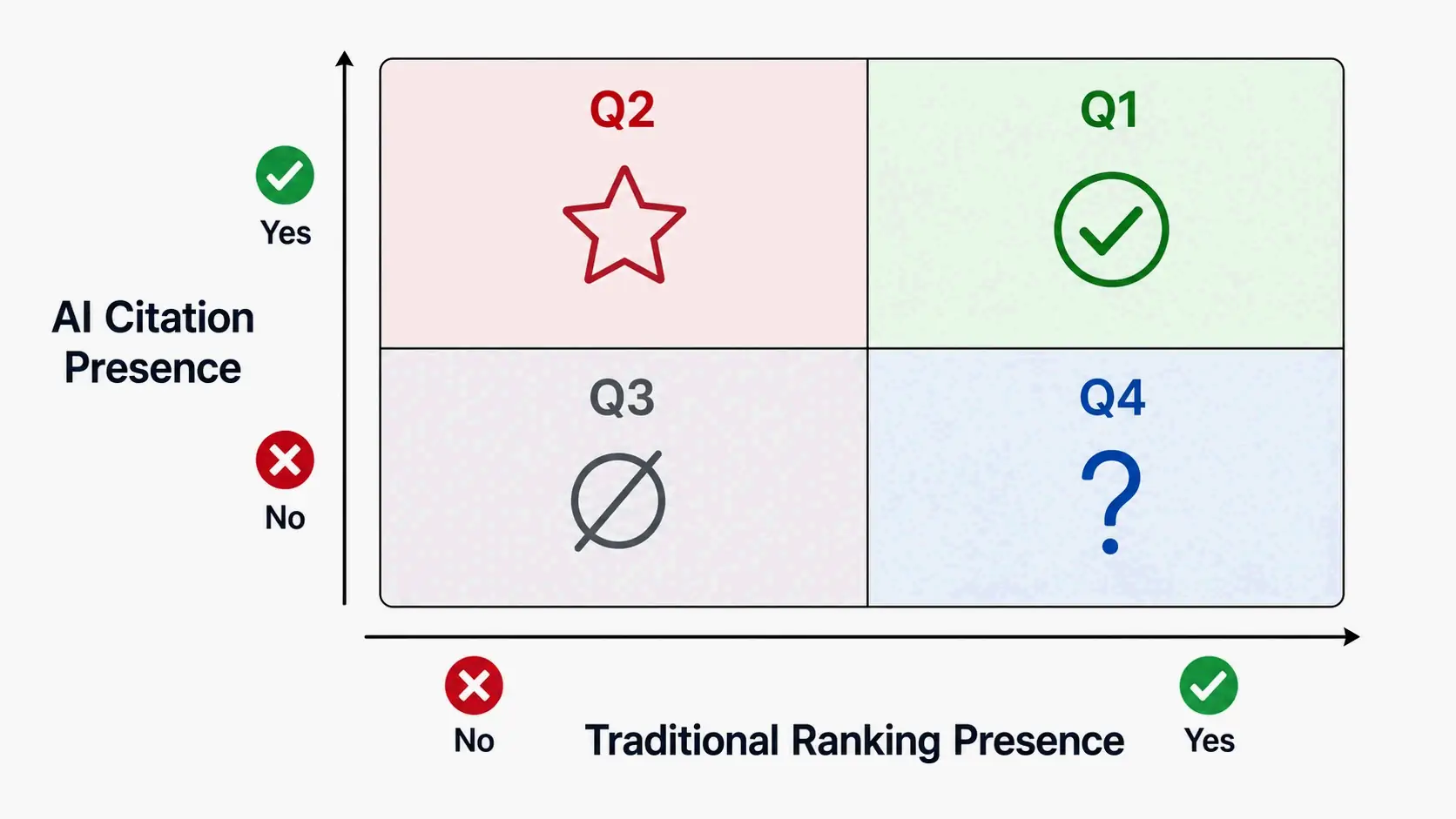
The unified framework organizes every target keyword into one of four quadrants based on two dimensions: traditional ranking presence and AI citation presence.
Quadrant 1: High Rank + No AI Citations. Your content ranks well in Google but never appears in AI-generated answers. The fix is typically structural—improving heading hierarchy, adding direct-answer formatting, and restructuring passages for LLM extractability. Well-structured content sees a significant citation lift in AI search results.
Quadrant 2: No Rank + AI Cited. Competitors earn AI citations on queries where you have no traditional ranking presence. These are high-priority gaps because they signal queries where AI engines already consider the topic answerable. Creating content that mirrors cited pages’ structure and depth is the fastest path to visibility on both surfaces.
Quadrant 3: Both Missing. You don’t rank and AI engines don’t cite you. These gaps represent either low-priority topics or early-stage opportunities where neither traditional SEO nor AI visibility has been claimed yet. Target them if they align with high business value.
Quadrant 4: Both Present. You’re visible everywhere. Monitor these keywords for competitive encroachment and refresh content regularly to prevent citation decay.
The matrix converts a flat list of missing keywords into a strategic action plan. Quadrant 2 and Quadrant 1 gaps typically offer the highest effort-to-impact ratio, because one side of the visibility equation is already working—you just need to close the other.
How to Perform a Keyword Gap Analysis: A Step-by-Step Guide
A systematic keyword gap analysis follows six steps, moving from competitor identification through content assignment. Each step narrows the opportunity set until you’re left with a prioritized, actionable list of keywords worth targeting.
Step 1: Identify Your True SEO Competitors
Your SEO competitors are not necessarily your business competitors. They are the domains that rank for the same search queries you target, regardless of whether they compete with you in the market. Start by searching your top five intended keywords in Google. Document the top 10 results for each. Cross-reference the list against businesses with comparable domain authority but better keyword coverage to find realistic opportunities. Aim to select 2–3 top niche competitors with a strong organic search presence and a similar audience profile.
Step 2: Run a Keyword Gap Analysis in Your SEO Tool
Use a keyword gap analysis tool like Semrush, Ahrefs, or Moz to compare your domain against your selected competitor domains. These platforms visualize keyword overlaps and surface the terms where competitors rank and you are absent. Export the complete keyword list into a spreadsheet for filtering. The raw list will contain hundreds of terms, but only a fraction will be relevant to your business.
Step 3: Export and Filter Competitor Keywords Using KD, Volume, and Intent
Exporting is the mechanical step. Filtering is where the analysis becomes strategic.
Step 3 Deep Dive: Filtering Competitor Keywords That Actually Matter
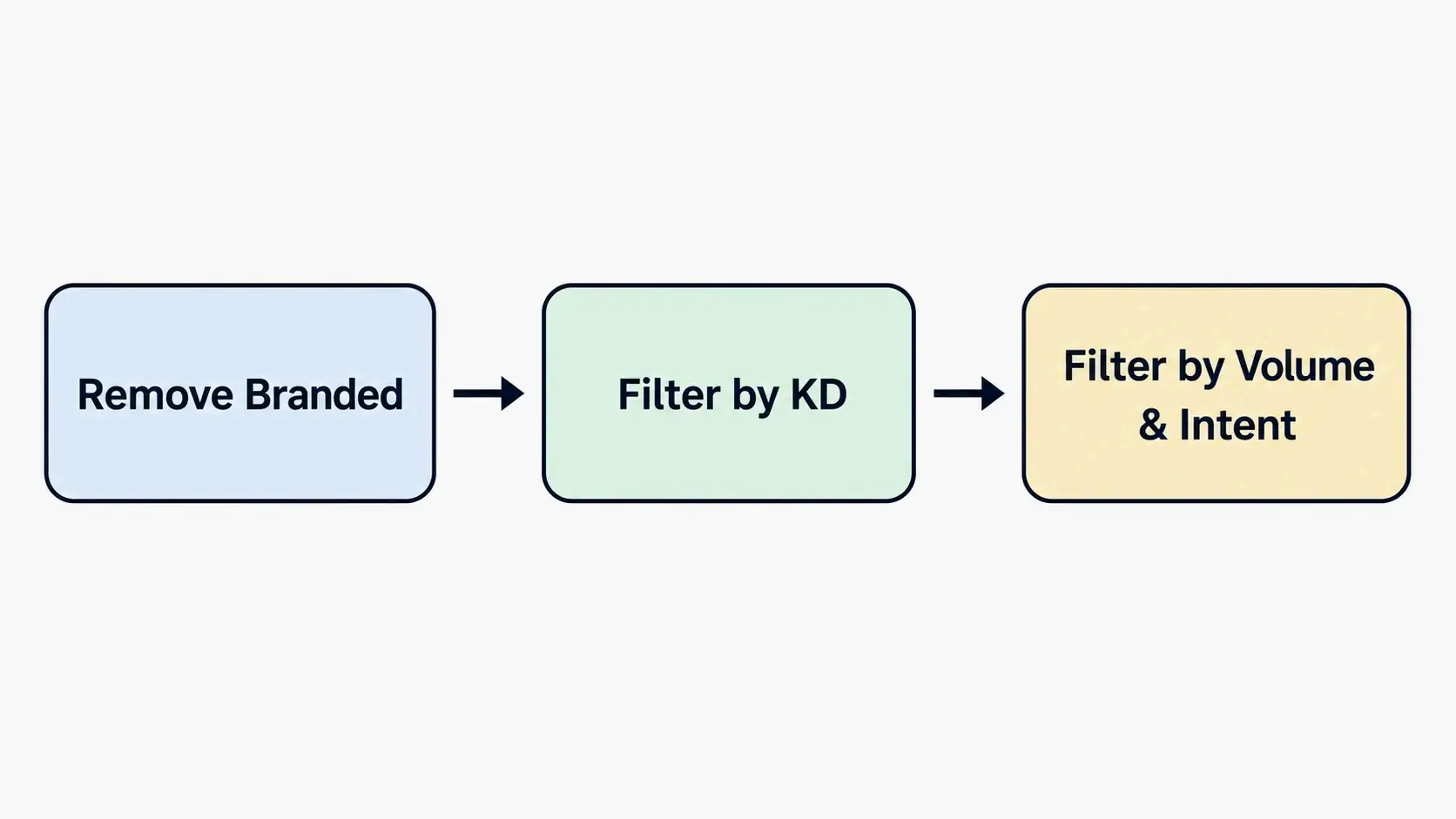
The raw keyword gap export will contain branded terms, out-of-scope categories, and queries with negligible search volume. Apply three filters to surface the opportunities worth pursuing.
First, remove branded terms. Keywords containing competitor brand names are gaps by definition—you shouldn’t rank for them—and chasing them wastes production capacity.
Second, filter by keyword difficulty (KD) relative to your domain authority. A practical framework from NetTrackers suggests matching KD targets to your authority level: sites with domain authority under 20 should target keywords with KD under 25, while sites with authority over 60 can pursue terms with KD above 50. This ensures you’re not picking gaps that are gaps because you can’t compete on them yet.
Third, filter by search volume and commercial intent. Prioritize terms with 50+ monthly searches where you have realistic ranking potential. Consider the buyer journey stage each keyword represents—commercial intent terms indicating purchase readiness often justify targeting even at lower volumes.
Step 4: Apply the 5-Step Intent Evaluation Framework
Not all keyword gaps are worth pursuing. A gap might exist because the keyword isn’t relevant to your business, or because search volume is artificially inflated by a one-time event. The intent evaluation framework filters out mismatches before you invest in content creation.
Step 4: The 5-Step Intent Evaluation Decision Tree
-
Does this keyword genuinely fit my business? Check whether the top 10 search results for the term resemble your website and serve customers like yours. If the results are completely different from your offering, the gap is a mismatch, not a missed opportunity.
-
What type of intent does this keyword represent? Classify each keyword as informational (seeking knowledge), commercial (evaluating options), or transactional (ready to act). Informational keywords are best served by blog posts and guides. Commercial keywords require comparison pages and detailed product information. Transactional keywords need landing pages and product pages.
-
Are the people searching this term likely to become customers? A keyword might drive traffic without driving revenue. Prioritize terms where the search intent aligns with a path to conversion.
-
What stage of the buyer’s journey does this keyword represent? Map each keyword to top-of-funnel (awareness), middle-of-funnel (consideration), or bottom-of-funnel (decision). Many content strategies over-index on top-of-funnel keywords while neglecting the middle-funnel content that drives decisions.
-
Does the intent match a format you can realistically produce? Some keywords require formats you may not have—video, interactive tools, original research. Flag these for future investment rather than pursuing them with a mismatched content type.
Step 5: Prioritize Keywords Based on Opportunity Score, Not Just Volume
Once keywords pass the intent filter, rank them by opportunity score. This combines search volume, keyword difficulty, and business relevance into a single prioritization metric. A gap with difficulty of 20–40 and 50+ monthly searches typically represents a high-priority opportunity. A gap with difficulty above 60 may require 6–12 months to rank for, making it a lower near-term priority regardless of volume.
Step 6: Assign Each Keyword to the Right Content Format
The final step maps each prioritized keyword to a specific content type. Product pages serve transactional intent. Blog posts and guides serve informational intent. Comparison pages and case studies serve commercial intent. Landing pages capture high-intent traffic ready to convert. Assigning keywords to formats before creating content prevents the common mistake of addressing every gap with a blog post, which leaves commercial and transactional intent underserved.
How to Find Keyword Gaps Without Paid Tools (Free Methods)
Paid tools accelerate the process, but a complete keyword gap analysis is possible using free methods. These approaches require more manual effort but surface opportunities that paid tools alone can miss.
Google Search Console’s Performance report provides a starting point. The Queries report shows search terms where your site already appears, including those where you rank in positions 8–20—close enough to the first page that content improvements could move you into visible territory. Filter for queries with high impressions but low click-through rates to identify terms where you have partial visibility that competitors are capturing fully.
Google Autocomplete and “People Also Ask” boxes reveal competitor gap signals at no cost. Search your primary keywords and document the suggested completions and related questions that appear. These represent real search demand. Cross-reference them against your content library to identify which questions competitors are answering that your site doesn’t address.
Manual SERP Audit: What to Look For
A manual SERP audit involves searching your priority keywords and analyzing the pages that appear in the top 10 results. For each result, document the page type (blog post, product page, comparison page, landing page), the content depth (word count, sections covered, data included), and the formats used (tables, video, templates, calculators). Compare these findings against your own pages targeting the same or similar terms.
Look specifically for format gaps. If every top-ranking page for a comparison keyword includes a structured comparison table and your equivalent page doesn’t, that’s a gap worth closing. If competitors include original data or case studies that your content lacks, that’s a depth gap. These qualitative observations complement the quantitative keyword data from Search Console.
Free Chrome extensions can estimate competitor keyword profiles, though they surface less data than paid platforms. Use them to build an initial competitor keyword list, then validate findings through manual SERP checks.
To create a free keyword gap tracker in Google Sheets, set up columns for keyword, search volume (estimated via Google Keyword Planner’s free tier), your current rank, competitor ranks, and gap status. Update the tracker monthly to monitor shifts in the competitive landscape. This manual system won’t scale to hundreds of keywords, but it works well for tracking a prioritized set of 20–30 high-value terms.
Beyond New Traffic: Using Keyword Gap Analysis as a Defensive Strategy
Keyword gap analysis is often framed as an offensive tactic—finding new keywords to target and new traffic to capture. The defensive applications are equally valuable and frequently overlooked.
Identifying keyword cannibalization across your own pages is the first defensive use case. When multiple pages on your site target the same keyword, they compete against each other in search results, diluting authority and confusing search engines about which page should rank. A gap analysis that includes your own domain as one of the inputs reveals these overlaps and provides the data needed to consolidate or differentiate cannibalizing pages.
Competitive early warning is the second defensive application. When you run keyword gap analysis on a quarterly cadence, shifts in a competitor’s keyword footprint reveal where their strategy is heading before their positioning catches up. If a rival suddenly starts ranking for terms adjacent to your core keywords, it signals an expansion strategy you can prepare for before they capture significant share.
Setting up ongoing gap monitoring requires automated alerts for ranking changes on high-priority terms. Most paid SEO platforms offer this functionality. When a competitor moves into the top 10 for a term you own, that’s a defensive priority—strengthen the ranking page with updated information, additional depth, or fresh backlinks before the competitor consolidates their position.
Strengthening content to defend existing rankings follows the same principles as closing offensive gaps. Audit the pages that already rank well, identify where competitor pages have added depth or formats your content lacks, and refresh your pages proactively. Regular refresh cycles prevent the slow ranking erosion that happens when content ages while competitors improve theirs.
Measuring Success: How to Track ROI from Keyword Gap Analysis
Measuring the impact of keyword gap analysis requires tracking both traditional SEO metrics and AI-specific visibility indicators. The combination provides a complete picture of whether your gap-closing efforts are generating returns.
Key traditional metrics include new keyword rankings achieved, incremental organic traffic from gap-closing content, and conversion rate from newly targeted keywords. A Manchester plumbing company’s results illustrate concrete ROI: according to NetTrackers, their keyword gap analysis delivered 18 qualified leads within 60 days of targeting previously missed terms. Tracking conversions rather than just rankings is essential—a keyword that drives traffic without generating leads hasn’t closed a business gap.
Share of Search and Share of Voice serve as long-term indicators of gap-closing progress. Share of Search measures how often your brand appears in search results compared to the total number of searches in your category. As you close keyword gaps, this metric should rise. Monitoring it for both branded and non-branded keywords provides a full picture—branded terms indicate customer loyalty, while non-branded terms show how effectively you’re attracting new buyers.
AI-specific metrics are newer but increasingly critical. Track AI citation count (how often AI search engines reference your content), AI-referred traffic (visitors arriving from AI-generated answers), and brand mention frequency in AI responses. These metrics capture visibility that traditional rank trackers miss.
Timeline expectations should be realistic. For lower-difficulty keywords on sites with moderate authority, expect to see ranking movement within 60–90 days of publishing gap-closing content. Higher-difficulty terms may require 4–12 months. AI citation improvements can appear faster when content is restructured for extractability, but sustained AI visibility requires regular content refresh cycles to prevent citation decay.
Conclusion
Keyword gap analysis is no longer just about finding competitor keywords you don’t rank for—it’s about understanding where your brand is invisible across the entire search ecosystem, from SERPs to AI-generated answers, and systematically closing those gaps to capture traffic and build authority. The 2026 definition of a keyword gap includes both traditional ranking absences and AI citation gaps, because traffic now flows through both channels and missing either one leaves revenue on the table.
Start by running a keyword gap analysis using one paid or free method outlined above. Identify your top 10 missed opportunities, evaluate their intent, create a content assignment plan, and set up a tracking dashboard to measure impact over the next 60–90 days. The systematic approach compounds: each quarterly analysis reveals new gaps while previous gap-closing content builds the authority to target progressively harder keywords.
FAQ
How often should I conduct a keyword gap analysis?
A full keyword gap analysis should be conducted quarterly for most websites to capture market shifts and competitor strategy changes. For fast-moving industries like ecommerce or SaaS, monthly analysis is recommended to catch emerging competitors before they consolidate positions. Set up automated weekly competitor keyword tracking in Semrush or Ahrefs for high-priority terms to receive alerts when rivals move into key positions.
What is the difference between a keyword gap and a content gap?
A keyword gap means competitors rank for specific search queries you don’t target—it’s competitor-relative and quantitative. A content gap means you haven’t covered entire topics your audience needs, regardless of competitor activity—it’s topic-absolute and strategic. In practice, keyword gap analysis reveals which terms to target; content gap analysis reveals what it takes to win them.
Can I perform a keyword gap analysis for a brand new website?
Yes, but your approach should differ from established sites. Start by identifying your top 3–5 competitors and using free tools like Google Autocomplete and People Also Ask to surface demand signals. Focus on long-tail keywords with low competition, and use competitor blogs and product pages as reverse-engineering sources for your initial content strategy. Paid tools become more valuable as your keyword footprint grows.
What should I do after I identify a keyword gap?
First, evaluate each keyword by search intent to determine the right content type—informational keywords need blog posts, commercial keywords need comparison pages, transactional keywords need landing pages. Prioritize keywords with manageable difficulty and clear commercial or informational value. Create content that serves the intent better than competitor pages, then optimize existing related pages before building everything new. Track rankings and traffic within 30–90 days.
Is keyword gap analysis only for Google, or does it apply to AI search engines like ChatGPT too?
In 2026, keyword gap analysis has expanded beyond Google to include AI citation gaps. Tools like AirOps now track which brands get cited by ChatGPT and Google AI Overviews for specific queries. A complete search visibility strategy must address both traditional ranking gaps and AI citation gaps, since both drive traffic and a page can rank well in Google while remaining invisible in AI-generated answers.
