


GEOWriter vs Koala isn’t a side-by-side comparison of identical tools. It’s really a choice between an autonomous AI SEO agent that runs the whole content pipeline on its own, and a specialized, user-guided drafting tool built for high-volume affiliate and SEO blog posts. Your decision comes down to whether you need workflow autonomy or niche-specific drafting speed.
Today, search visibility depends on two things: traditional Google rankings and Generative Engine Optimization (GEO) for AI-powered search like ChatGPT and Google AI Overviews. Data from Semrush shows that visitors from large language models convert 4.4x more than average organic visitors. That makes GEO a business priority, not just some future trend. In this comparison, we’ll look at GEOWriter and Koala through the lenses that matter in 2026: E-E-A-T (Experience, Expertise, Authoritativeness, Trustworthiness), GEO readiness, and real-world content production workflow.
Contents
- GEOWriter vs Koala: What’s the Core Difference?
- GEOWriter: The AI SEO Agent for E-E-A-T and GEO
- Koala AI: The Specialized Powerhouse for Affiliates and Niche Bloggers
- Head-to-Head Feature Comparison: Where They Shine and Fall Short
- Practical Workflow Showdown: Writing the Same Blog Post in GEOWriter and Koala
- Pricing and Target Audience: Making the Final Call
- Conclusion
- FAQ
GEOWriter vs Koala: What’s the Core Difference?
Think of GEOWriter as an autonomous AI SEO agent. It plans, executes, and adapts multi-step SEO workflows on its own, handling everything from real-time SERP analysis to publishing. Koala AI, with its KoalaWriter product, is more of a specialized writing assistant. You feed it prompts, and it’s optimized for generating first drafts—especially strong at Amazon affiliate content.
The big difference is a shift from an assistive tool to an agentic workflow. With a standard AI writing tool, you have to manually feed data, approve each piece, and move on to the next step. An AI SEO agent works on its own—it can analyze search results, map intent, create content that aligns with E-E-A-T standards, and publish it all without you having to step in at every stage. This gap changes how content teams can scale.
The modern search landscape demands more than just keyword optimization. As Onely’s AI agency guide puts it, “Using AI to do SEO and optimizing for AI search are two completely different disciplines.” GEOWriter tackles both within one workflow, while Koala focuses on traditional SEO with a deep specialization in affiliate content. The criteria we’re using here—E-E-A-T alignment and GEO visibility—are what search engines and AI answer engines now care about most.
The Philosophy: AI Agent vs. AI Writing Assistant
The difference between an AI SEO agent and a writing assistant is like the gap between a self-driving car and cruise control. KoalaWriter is the cruise control—it speeds up content creation once you’ve set the direction, but you still have to drive when it comes to research, optimization, and publishing. In a 90-day test by Automate to Profit, Koala scored 7.4 out of 10 as a budget AI writer, excelling at what it was built to do: fast, SEO-informed first drafts.

GEOWriter is the self-driving car—it handles the whole route. It runs real-time SERP analysis, figures out search intent, creates content with built-in E-E-A-T elements, generates visuals automatically, takes care of internal linking, and publishes straight to WordPress. This split reflects a bigger industry shift. Ahrefs documented a case where an agent spotted a broken image issue, opened a GitHub pull request with a fix, and confirmed it was resolved—all with just a human approval. That level of autonomy puts it in a completely different category of software.
GEOWriter: The AI SEO Agent for E-E-A-T and GEO
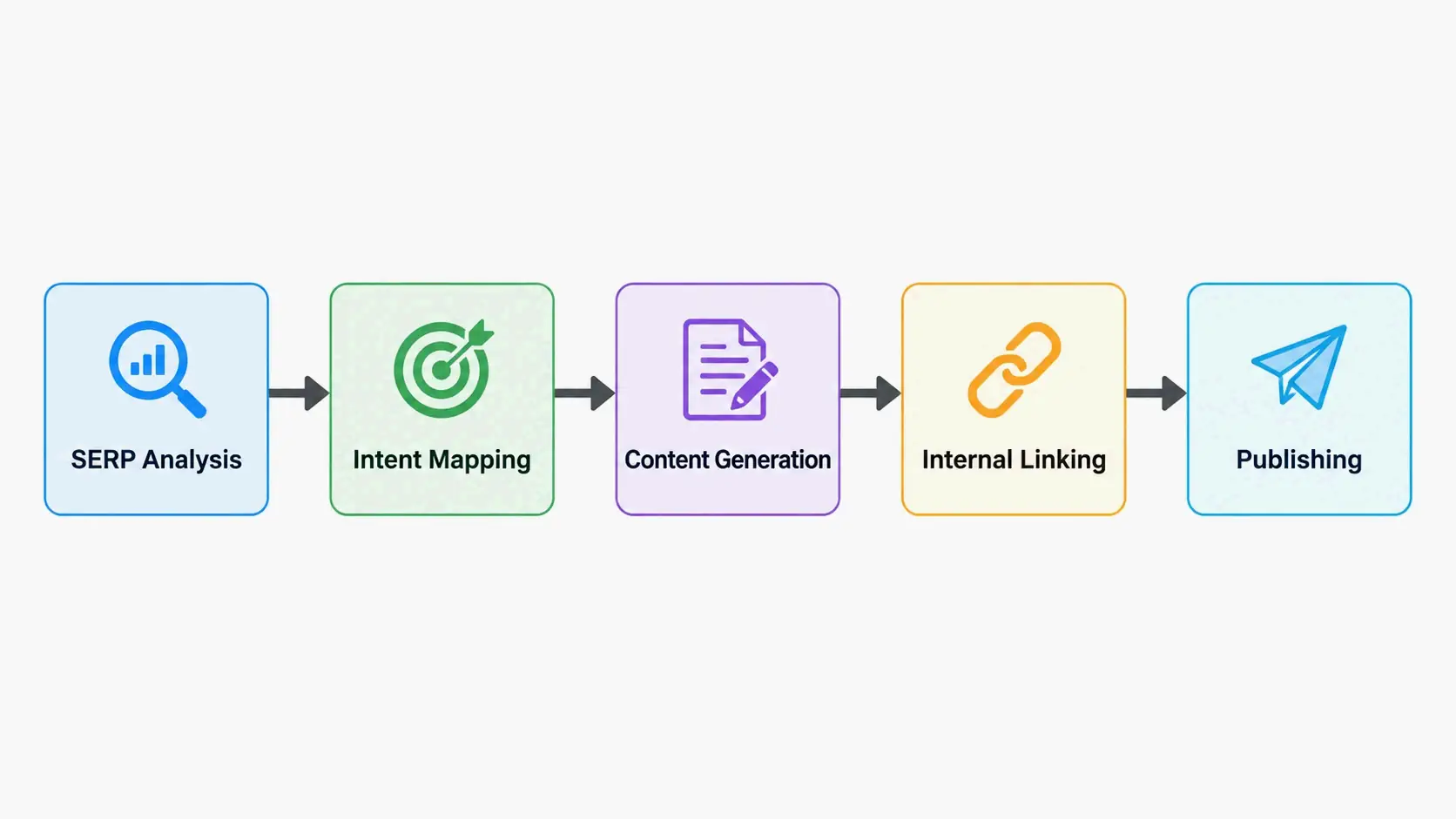
GEOWriter’s core workflow is a repeatable pipeline: real-time SERP analysis → search intent mapping → E-E-A-T-audited content generation → internal linking → publishing. Each stage runs automatically within a single platform, turning out publication-ready articles without the need to jump between separate tools for research, writing, optimization, and publishing.
You really see the architectural difference when you look at GEO optimization. Traditional AI writers structure content for Google’s organic results pages. GEOWriter is built to optimize for AI Overviews, ChatGPT, and other LLM-powered search experiences. That means creating content with clear entity signals, question-based headings that AI systems can pull as direct answers, and structured information (tables, bullet points) that both humans and AI retrieval systems can process easily.
Real-world examples back up the agent approach. Chowly, an AI platform for restaurants, deployed an SEO Agent that constantly monitors four data sources—Google SERP, Map Pack, AI Overviews, and ChatGPT—then synthesizes findings and ships work without waiting for anyone’s input. Suburban Atlanta’s Two Eggs! restaurant saw a 53% jump in first-party sales and saved $64,351 in commissions over four months after putting the agent to work. Ahrefs also documented a case where someone used “Fix with Agent A” to solve a technical SEO issue: the agent accessed the site’s GitHub repo, opened a pull request with a code fix, and ran a fresh crawl to confirm everything was fixed after the merge. That shows agentic task execution going well beyond content writing into technical SEO.
GEOWriter is aimed at content teams and agencies who need a scalable, autonomous solution. Instead of juggling multiple tools and manual handoffs between research, writing, and publishing, teams can run the whole pipeline in about five minutes per article. That removes the usual trade-off between quality and speed.
How GEOWriter Operationalizes E-E-A-T for You
E-E-A-T is the framework Google uses to judge content quality. GEOWriter bakes each pillar into its generation pipeline instead of leaving them for manual editing after the fact. For Experience, it creates author bios and marks first-hand experience signals in the content. For Expertise, it cites sources and structures information to show subject-matter depth. For Authoritativeness, it handles internal linking to existing authoritative pages and makes sure external references are properly attributed. For Trustworthiness, it includes factual citations, auto-generated visuals that reinforce claims, and consistent formatting that helps build credibility.
That’s a big difference from general-purpose AI writers that spit out raw text and expect you to add all the E-E-A-T signals yourself. By building them in from the start, GEOWriter shortens the distance between an AI first draft and publishable content. It works as a content-focused AI SEO agent that addresses both traditional ranking factors and AI answer engine visibility in one pass.
Koala AI: The Specialized Powerhouse for Affiliates and Niche Bloggers
Koala AI, with its KoalaWriter product, has built a loyal following among affiliate marketers by focusing on exactly what they need: long-form product reviews, comparison posts, and roundups that rank in traditional search results. In a 90-day test by Automate to Profit, Koala scored 7.4 out of 10 as a budget AI writer at $9/month, versus Jasper’s 8.2 at five times the cost—a price-to-quality ratio that matters a lot for bloggers keeping an eye on margins.
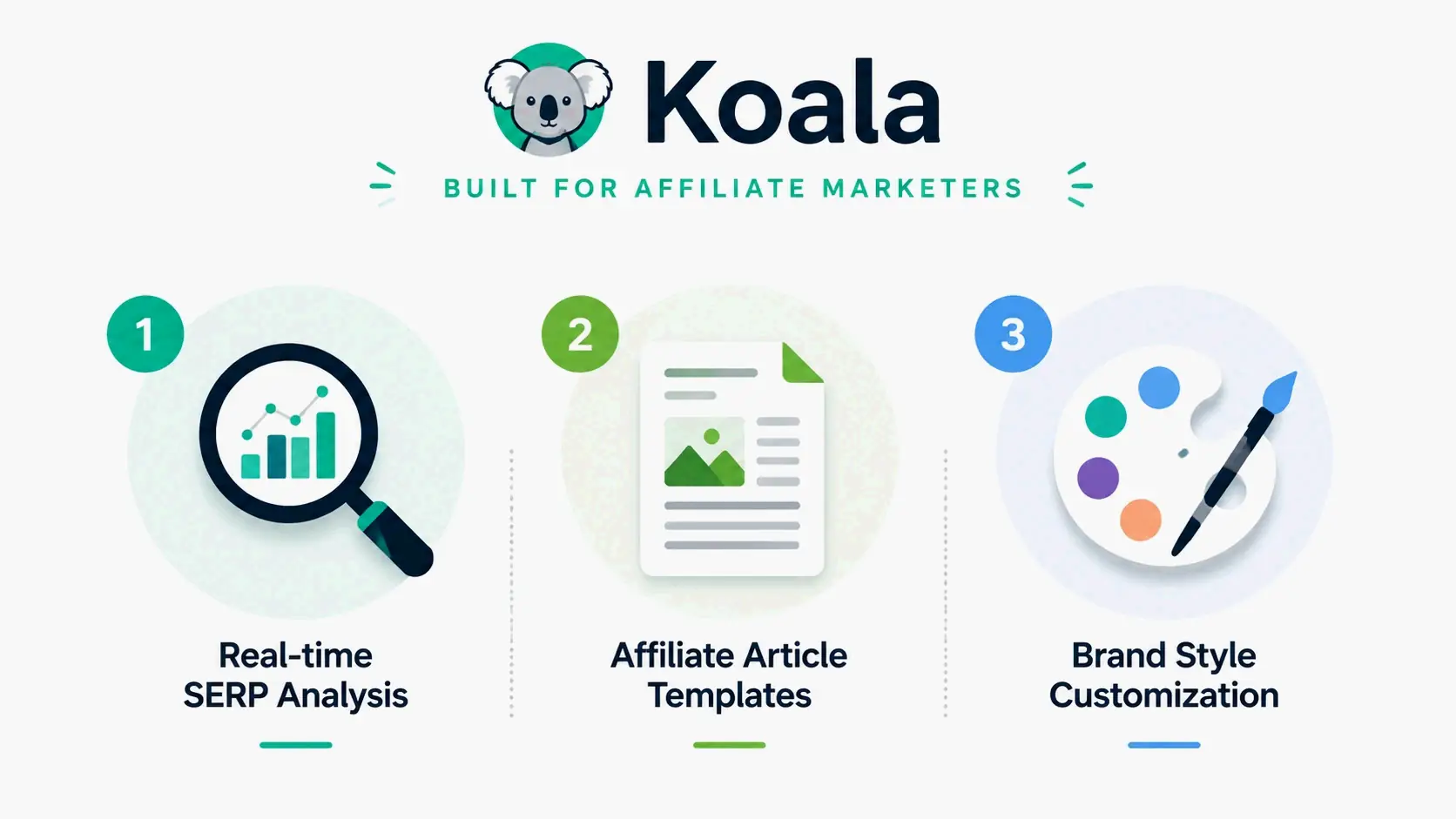
Koala’s main strengths fall into three areas. First, it does real-time SERP analysis for outlining: KoalaWriter reads live Google results before generating content, pulling in current data, stats, and pricing instead of relying on a static training cutoff. That keeps affiliate content accurate, which builds reader trust and helps conversions. Second, it has specialized article type templates built for affiliate use cases. Roundups, “best X for Y” posts, comparison articles, and single product reviews are all first-class templates—not afterthoughts. Third, brand voice customization through Writing Style settings. After a 2026 update, choosing a different style now has a much bigger impact on the final output, as Koala’s beta update blog details.
Solo affiliate marketers really benefit from Koala’s speed-to-draft ratio. You can get a full 2,500-word affiliate review draft in under two minutes, complete with live product details pulled in through real-time web research. For a blogger putting out three or four posts a week, that flips the content economics on its head—hours of manual research and writing get replaced by a fast first draft that just needs human editing and some personalization before going live.
One-Click Amazon Roundups: A Koala Exclusive
Koala’s built-in Amazon product integration is its clearest differentiator for affiliates. The tool pulls live product details, prices, and ratings straight into review posts, automating one of the most tedious parts of creating product roundups. Even pricier tools like Jasper don’t offer this natively. For Amazon affiliates, that means Koala cuts out hours of manual research per post—checking current prices, verifying feature lists, and grabbing accurate ratings—because it pulls all that data through its integration while generating content.
This specialization makes Koala a cost-effective alternative to broader AI writing platforms. Bright SEO Tools, in their alternatives comparison, points to tools like SEOwriting.ai as the closest direct replacement for KoalaWriter’s workflow at a lower price. But Koala’s mix of Amazon integration, real-time web research, and affiliate-specific templates at under $25/month gives it an edge for solo affiliate marketers focused on Amazon revenue.
Head-to-Head Feature Comparison: Where They Shine and Fall Short
A side-by-side feature comparison makes the fundamentally different philosophies pretty clear. The table below maps their approaches across the dimensions that matter for content production in 2026.
| Feature | GEOWriter | Koala AI / KoalaWriter |
|---|---|---|
| Core Philosophy | Autonomous AI SEO agent managing end-to-end pipeline | User-guided writing assistant for first drafts |
| Target User | Content teams, agencies, B2B content operations | Solo affiliate bloggers, niche site builders |
| GEO Optimization | Built-in—structures content for AI Overviews and LLM citation | Not designed for GEO; focuses on traditional Google rankings |
| E-E-A-T Handling | Embedded in generation: author bios, source citations, experience markers | Left to human editor; output is raw draft requiring E-E-A-T layering |
| Workflow Autonomy | Full pipeline: SERP analysis → generation → linking → publishing | User-led: input keyword → receive draft → edit → publish separately |
| Amazon Integration | Not a core focus; can write affiliate content with high E-E-A-T | One-click Amazon product roundups with live product data |
| Real-Time Research | Live SERP analysis during generation | Live web research pulling current data and pricing |
| WordPress Publishing | Direct publishing within agent workflow | Direct publishing on higher plans |
| Starting Price | $1/article pay-as-you-go with free trial | ~$9/month for Essentials plan |
The contrast goes beyond a feature checklist; it’s about how each tool views content’s role in search. GEOWriter sees content as part of a broader GEO strategy—pages need to work for both human readers and AI extraction systems. Koala treats content as the ranking mechanism itself, optimizing for what performs in Google’s organic results today. Both approaches have their place, but the investment implications are quite different.
Yahoo! Finance, reporting via SEO Calling, notes that organic search still drives roughly 53% of all website traffic, which validates the importance of Koala’s traditional focus. But as AI-powered search grows, visibility in ChatGPT, Perplexity, and Google AI Overviews becomes an extra channel—and that’s exactly what GEOWriter targets. So the question is: does your content strategy need to solve for today’s rankings, or do you need to build for a search landscape that’s increasingly shaped by AI answer engines?
E-E-A-T Scorecard: How Each Tool Delivers on Experience, Expertise, Authority, and Trust
E-E-A-T isn’t a direct ranking factor, but it’s a framework Google uses—with human raters and algorithmic signals—to judge content quality. How each tool handles these pillars reveals their different philosophies about making content.
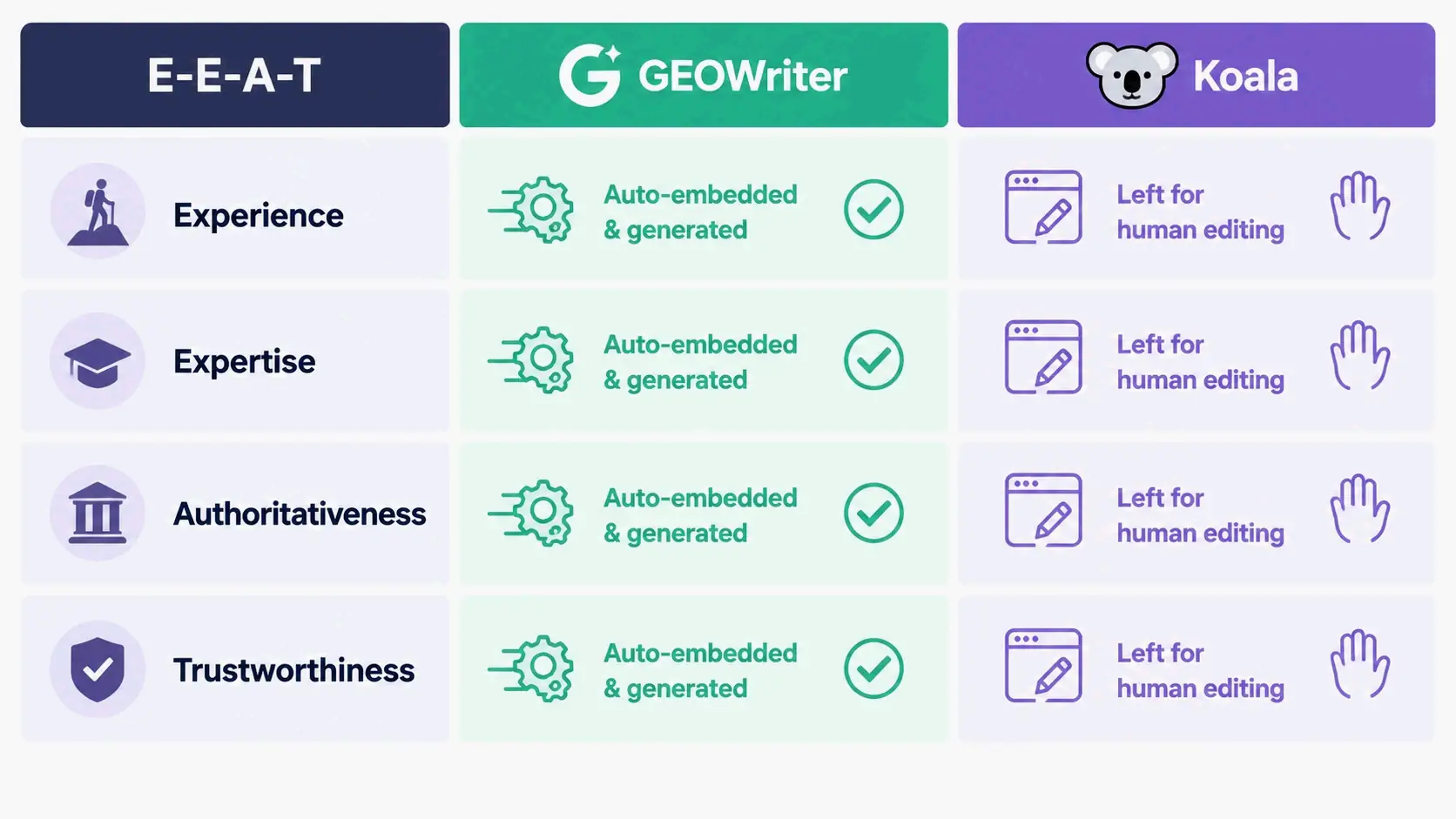
Experience: GEOWriter generates author bios and marks first-hand experience signals right in the content. KoalaWriter gives you raw text, and you have to manually layer on experience—adding personal anecdotes, testing notes, or practical insights that show you really know the topic.
Expertise: GEOWriter cites sources as it generates and structures info to show subject-matter depth, pulling in credible references. KoalaWriter’s real-time web research helps with factual accuracy, but it doesn’t automatically organize information to showcase expertise; you, the human editor, have to do that structuring.
Authoritativeness: GEOWriter handles internal linking to your existing authoritative pages and makes sure external references are properly attributed—all as part of its autonomous workflow. KoalaWriter does automatic internal linking on Professional plans and higher, but you still need to check that those links point to genuinely authoritative sources, not just AI-suggested ones.
Trustworthiness: GEOWriter includes factual citations, auto-generated visuals that back up claims, and consistent formatting that supports credibility. KoalaWriter’s output needs to be verified before you publish. As Automate to Profit’s review put it, “factual claims—especially about pricing and features—should always be verified before publishing.”
The practical difference: GEOWriter builds E-E-A-T into the generation process, so you spend less time editing before hitting publish. KoalaWriter gives you a fast draft and you have to manually add E-E-A-T signals. That workflow works fine for experienced affiliate marketers who know their niches inside out, but it can add a lot of editing time for teams producing content at scale across multiple topics.
Practical Workflow Showdown: Writing the Same Blog Post in GEOWriter and Koala
To make the differences real, let’s walk through the end-to-end process for a single keyword: “best ergonomic chair for tall people 2026.” We’ll compare how each tool handles SERP analysis, drafting, and the path to getting the post live.
Step 1: SERP Analysis and Briefing
With KoalaWriter, you start by entering the target keyword and picking an article type—here, a product roundup template. KoalaWriter reads the live Google results for that keyword, analyzes what the top-ranking pages cover, and builds an outline from that SERP data. You review the suggested outline, maybe tweak some section headings or add specific products, and confirm the brief before generation kicks off. Koala’s real-time web research pulls current pricing and product details into the draft automatically, so you skip most of the manual research for product features and costs.
With GEOWriter, the same keyword kicks off an autonomous SERP analysis. It identifies the dominant search intent, maps out the entities that current ranking pages cover, and builds a structured brief that aligns with E-E-A-T requirements. The system decides on the content format—probably a product comparison with detailed specs relevant to tall users—and preps author bio components and citation frameworks before generating content. There’s no manual brief approval step; the agent handles the whole briefing on its own and goes straight to generation.
Step 2: First Draft Generation and E-E-A-T Audit
KoalaWriter churns out a 2,500-word draft in under two minutes, complete with product descriptions, live pricing, and a structured comparison format. It comes formatted with headings, body sections, and a conclusion. But the draft doesn’t have much in the way of E-E-A-T signals beyond the basic facts. There’s no author bio, no first-hand experience markers, and no cited sources besides the product data. You’ll need to add personal testing notes, cite ergonomic research, explain how you evaluated the chairs, and create or find original images that show real-world use.
GEOWriter generates a draft that already has these elements baked in. You get author bio sections, source citations for any ergonomic claims, internal links to related content (like office ergonomics or back health), and structured info that AI systems can pull as direct answers. You’ll still need to edit for brand voice and do a final accuracy check, but the E-E-A-T foundation is already there in the first version.
Step 3: Final Polish, Optimization, and Publishing
With KoalaWriter, you need to run through a full editing checklist: verify product pricing, add original images, weave in personal experience, build internal links to related posts, and maybe format for featured snippets if you want. After editing, you either copy the content into WordPress manually, or on higher plans use Koala’s direct publishing feature, which sends the content as a draft for final review before going live.
GEOWriter handles internal linking, final formatting, and WordPress publishing all within the same workflow. The agent can publish directly to your connected WordPress site. As the user, your main editing tasks are verifying factual accuracy and polishing brand voice—the structural SEO and E-E-A-T elements were already put in place during generation. That shifts your role from builder to editor, which scales a lot better for teams managing content across multiple sites or topics.
Pricing and Target Audience: Making the Final Call
Koala AI uses a credit-based pricing model with a low entry point. The Essentials plan starts around $9/month for 15,000 words; the Starter plan is $25/month for 45,000 words; and the Professional plan costs $49/month for unlimited words and includes real-time web research and internal linking. For a solo affiliate blogger publishing three or four posts a week, the Starter plan usually covers your volume. GEOWriter has agency-focused pricing with premium tiers, aimed at teams that need the full autonomous pipeline rather than just a drafting tool.
The audience split is pretty clear. Solo affiliate bloggers and niche site builders should go with Koala for its Amazon integration and affiliate-specific templates. The low entry price and specialized feature set make it practical if you need high-quality first drafts at scale and you’re comfortable manually layering in E-E-A-T during editing.
Content teams, agencies, and B2B content operations should lean toward GEOWriter. The autonomous pipeline removes the overhead of switching between research, writing, and publishing tools. For organizations that need to scale content across multiple topics with consistent E-E-A-T standards, the agent approach cuts down on editing per article. And if you’re an SEO user who cares about AI-era visibility—getting your content to show up in ChatGPT, Perplexity, and Google AI Overviews—you should test GEOWriter for its built-in GEO optimization, which Koala doesn’t address.
Conclusion
GEOWriter vs Koala isn’t about one tool being universally better. It’s about which one fits your fight: scaling content authority for the age of AI search, or pumping out high-volume, niche-specific drafts for today’s Google rankings. These tools solve fundamentally different problems. Pick the wrong one and you’re either overpaying for automation you don’t need or underinvesting in capabilities your content strategy actually requires. Solo affiliates: test Koala’s Amazon features first. The one-click roundup generation and sub-$25/month entry point line up with affiliate content economics. Agency leads and content teams who care about E-E-A-T compliance and generative discoverability should run a GEOWriter pilot, tracking both traditional ranking impact and visibility gains across AI-powered search platforms.
See also: GEOWriter vs AI SEO Tools: The Ultimate 2026 Comparison — a comprehensive comparison of GEOWriter against all major AI SEO tools.
Related comparisons: GEOWriter vs WriteSonic · GEOWriter vs Jasper
FAQ
Is GEOWriter a direct alternative to KoalaWriter?
No, GEOWriter isn’t a direct feature-by-feature alternative. It’s an autonomous AI agent built for the full GEO and E-E-A-T pipeline, while KoalaWriter is a specialized, user-guided tool for drafting SEO and affiliate content. They solve different problems, even if the types of content they produce can sometimes overlap.
Which tool is better for Amazon affiliate marketing?
Koala AI is the clear winner for Amazon affiliate marketing. Its one-click Amazon product roundup generation and deep integration pull live product details, prices, and ratings right into your posts. GEOWriter can certainly write affiliate content that meets high E-E-A-T standards, but it doesn’t have Koala’s instant, Amazon-specific workflow.
Which tool is better for ensuring content ranks in AI-powered search engines like ChatGPT?
GEOWriter is purpose-built for that. It structures content so it’s easy for AI Overviews and LLMs to cite—using clear entities, question-based headings, and formatting that AI can extract. Koala optimizes for traditional Google rankings, which still drive plenty of traffic, but it doesn’t directly target GEO visibility.
Does GEOWriter offer a free trial or a free plan?
Trial availability varies, so you should check the official GEOWriter website for the latest offers—they can change. Its agency-focused pricing usually means premium tiers, which is a contrast to Koala’s more accessible budget plans that start at about $9/month and often come with a free trial.
