


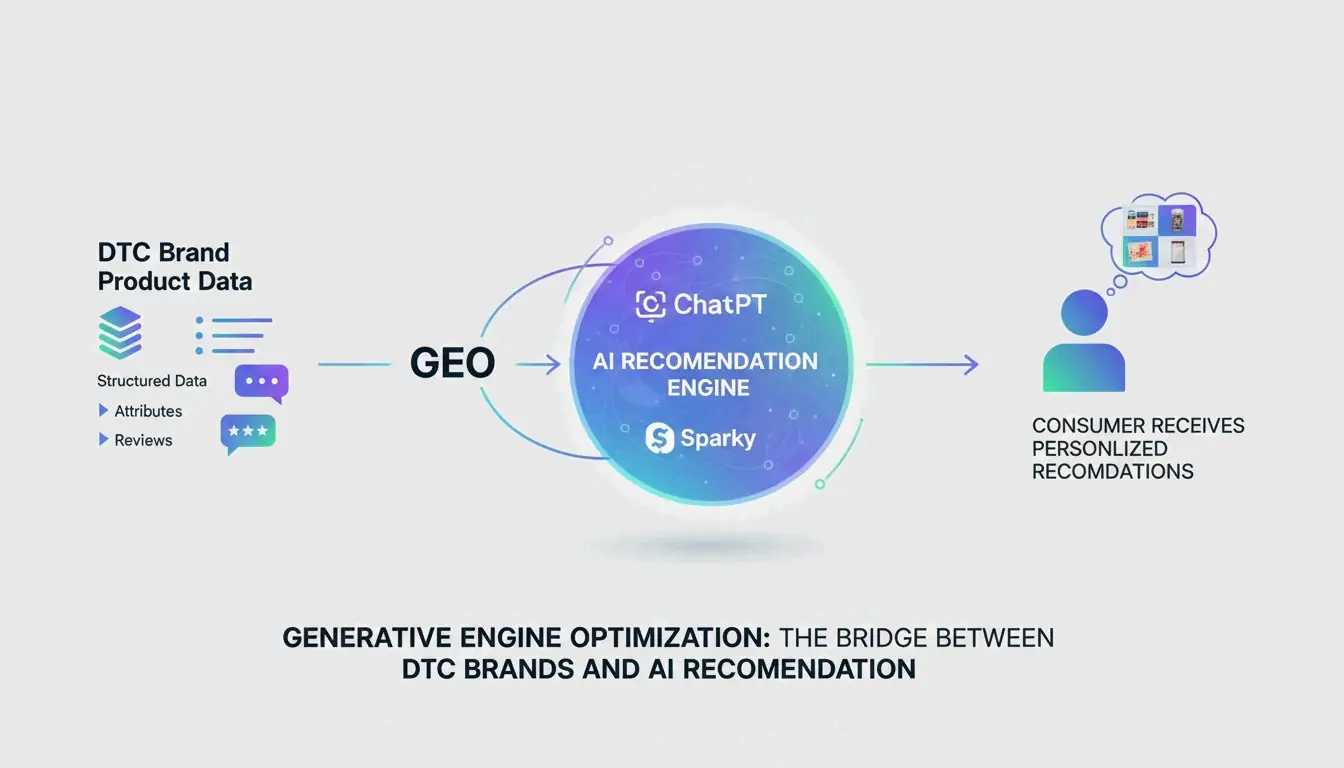
As of May 2026, GEO (Generative Engine Optimization) is how you optimize product data and brand content for AI engines like ChatGPT, Amazon Rufus, and Walmart Sparky. Unlike SEO, it focuses on structured data, entity clarity, and conversational match to earn direct product recommendations.
Contents
- What Is GEO for DTC Brands—And Why It’s Different From SEO?
- Why DTC Brands Can’t Afford to Ignore GEO Right Now
- GEO Platform Breakdown: Amazon Rufus vs. Walmart Sparky vs. ChatGPT vs. Google AI Overviews
- The 6-Dimension GEO Framework: A Step-by-Step Implementation Guide
- A 30-Day GEO Quick-Start Plan for DTC Brands ($500K–$5M Revenue)
- How to Measure GEO Success: Beyond Traditional Rankings
- GEO vs. Paid Ads: Should You Replace Your Ad Spend?
- The Future: Agentic Engine Optimization (AEO) and Universal Commerce
- Conclusion
- FAQ
What Is GEO for DTC Brands—And Why It’s Different From SEO?
Generative Engine Optimization (GEO) is the discipline of structuring your product data, listings, and brand presence so that AI engines like Amazon Rufus, Walmart Sparky, ChatGPT, Claude, Gemini, and Perplexity recommend your products when buyers ask. Robert Hu, e-commerce strategist, puts it plainly: “It is not a renamed version of SEO. The reading engine changed, the buyer’s prompt changed, and the optimization changed with it.”
Most GEO content out there is written for content publishers and B2B SaaS companies. For DTC brands, it’s fundamentally different because you’re optimizing product listings, structured attributes, review sentiment, and product pages—not blog posts or white papers. The success metric: does your product show up when a shopper asks “what should I buy,” not whether your domain gets cited in an informational answer. For the foundational GEO framework, see our GEO for SaaS: Complete Playbook.
Why Traditional SEO Alone Isn’t Enough in 2026
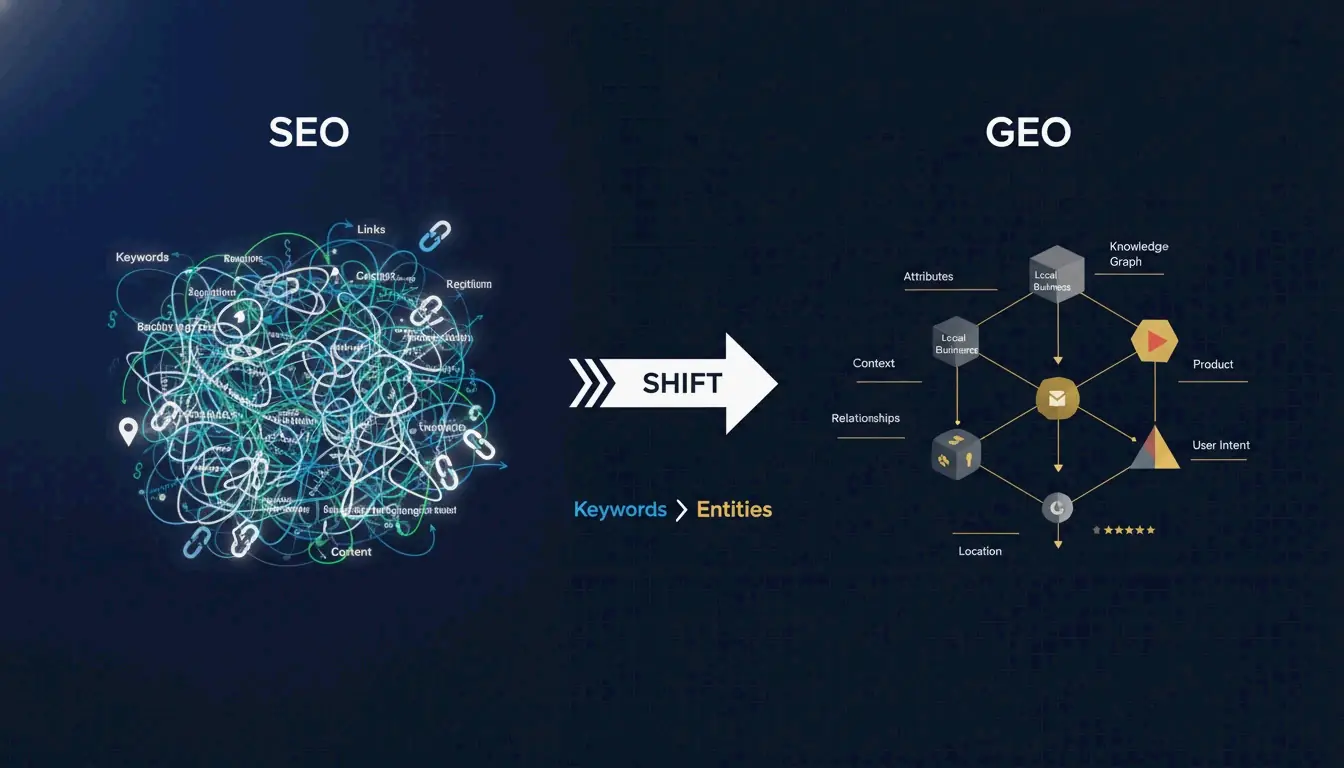
According to Search Engine Land, 37% of consumers now start their searches with AI tools instead of traditional search engines. SEO optimizes for crawler-based search engines that rank pages against keyword relevance and backlink authority. GEO optimizes for generative engines that synthesize answers from structured data, reviews, and entity graphs. The output of SEO is a ranked list of links; the output of GEO is a curated short list with reasoning. Both surfaces still drive revenue, but ignoring the AI-influenced share of buying means leaving a fast-growing channel to competitors with better-structured data.
The Core Shift: From Keywords to Entities
Traditional SEO rewards keyword density and backlink profiles. GEO rewards context, attributes, and entity clarity. The reading engines—ChatGPT, Rufus, Sparky, Perplexity—evaluate whether your product matches a buyer’s stated need based on WHO the product is for, WHEN and WHERE it gets used, WHY someone buys it, and WHAT it is made of, all wrapped in machine-readable data. As Robert Hu notes: “Vague WHO data forces the AI to guess. AI engines do not guess. They skip.”
Why DTC Brands Can’t Afford to Ignore GEO Right Now
The data supporting GEO adoption is no longer theoretical. Amazon Rufus now handles 13% or more of Amazon searches and is still growing, according to RecoScope tracking data. Walmart reported that ChatGPT alone drives roughly 21% of its referral traffic. The conversion case is equally compelling: according to Nudge and AlmCorp data, ChatGPT-referred visits convert at 11.4% versus 5.3% for traditional organic search—more than double the conversion rate. With 37% of consumers starting their search on AI tools, brands invisible to AI surfaces are losing revenue to competitors that appear.
The Data That Makes the Case
Beyond traffic share, the cost dynamics are shifting. AI traffic typically arrives with higher purchase intent because the recommendation engine has already pre-qualified the product against the buyer’s stated need. So every AI citation earned represents a product consideration that cost nothing in ad spend. For DTC brands spending $200,000 or more per month on paid acquisition, AI citation capture is becoming one of the highest-leverage new channels available.
How Small Brands Win in AI Recommendations (Data from RecoScope)
RecoScope tracks 10 categories across ChatGPT, Claude, Gemini, and Perplexity, with separate trackers for Amazon Rufus and Walmart Sparky. The data reveals a crucial pattern: AI recommendation categories are highly volatile. In Skincare, 16 different brands rotate through the top 5 ChatGPT recommendations, and the leader holds only 4 placements. In Running Shoes, eight different brands appear in at least one of three recent weekly runs. This volatility creates openings for smaller brands with cleaner data to break in while larger brands are inconsistent. The brands that move from outside the top 5 to inside it are the ones with the cleanest listing data and most consistent cross-platform signals.
GEO Platform Breakdown: Amazon Rufus vs. Walmart Sparky vs. ChatGPT vs. Google AI Overviews
Each AI engine reads different signals, ignores different content types, and shows different category coverage. Optimizing for one without understanding the others leaves visibility on the table.
Amazon Rufus handles 13% or more of Amazon searches. It reads product listings, customer reviews, Q&A sections, and A+ content. It cross-references this against the COSMO knowledge graph, Amazon’s proprietary commonsense reasoning engine for shopping. Rufus ignores image-locked text and vague marketing copy. RecoScope’s Rufus tracker shows category coverage that often differs from organic Amazon search rankings, especially in categories with strong review sentiment patterns.
Walmart Sparky drives 35% higher average order values than non-Sparky shoppers on Walmart.com. It reads Walmart’s structured catalog data including backend attributes, specifications, and product descriptions. Sparky weights structured attribute completeness more heavily than Rufus does and ignores listings with empty backend attribute fields. According to RecoScope’s Sparky tracker, the brands winning organic Sparky recommendations are not always the ones spending the most on Walmart Connect ads.
ChatGPT and Perplexity are off-platform recommendation engines that pull from indexed web content, third-party reviews, retailer product pages, and structured product data exposed through schema markup. They ignore content locked behind login walls. RecoScope tracks both engines weekly and shows that ChatGPT and Perplexity often surface different brands than Amazon or Walmart organic top performers, which means visibility on these platforms requires a separate optimization track.
Google AI Overviews are top-of-funnel discovery for product research queries. They pull from indexed web content, schema markup on retailer and brand sites, and YouTube video transcripts. AI Overviews are less mature than dedicated shopping AI surfaces but cover a wider range of informational shopping queries.
Quick-Reference: Platform-Specific Optimization Checklist
| Platform | Primary Signals | Ignored Content | Update Cadence |
|---|---|---|---|
| Amazon Rufus | Listing copy, review sentiment, A+ content, COSMO graph | Image-locked text, vague marketing copy | 3-6 weeks |
| Walmart Sparky | Backend attributes, structured catalog data, reviews | Empty attribute fields | 1-3 weeks |
| ChatGPT/Perplexity | Indexed web content, schema, third-party reviews | Unstructured pages, login-walled content | 1-3 months |
| Google AI Overviews | Schema markup, indexed content, video transcripts | Content lacking structured data | 2-4 months |
The 6-Dimension GEO Framework: A Step-by-Step Implementation Guide
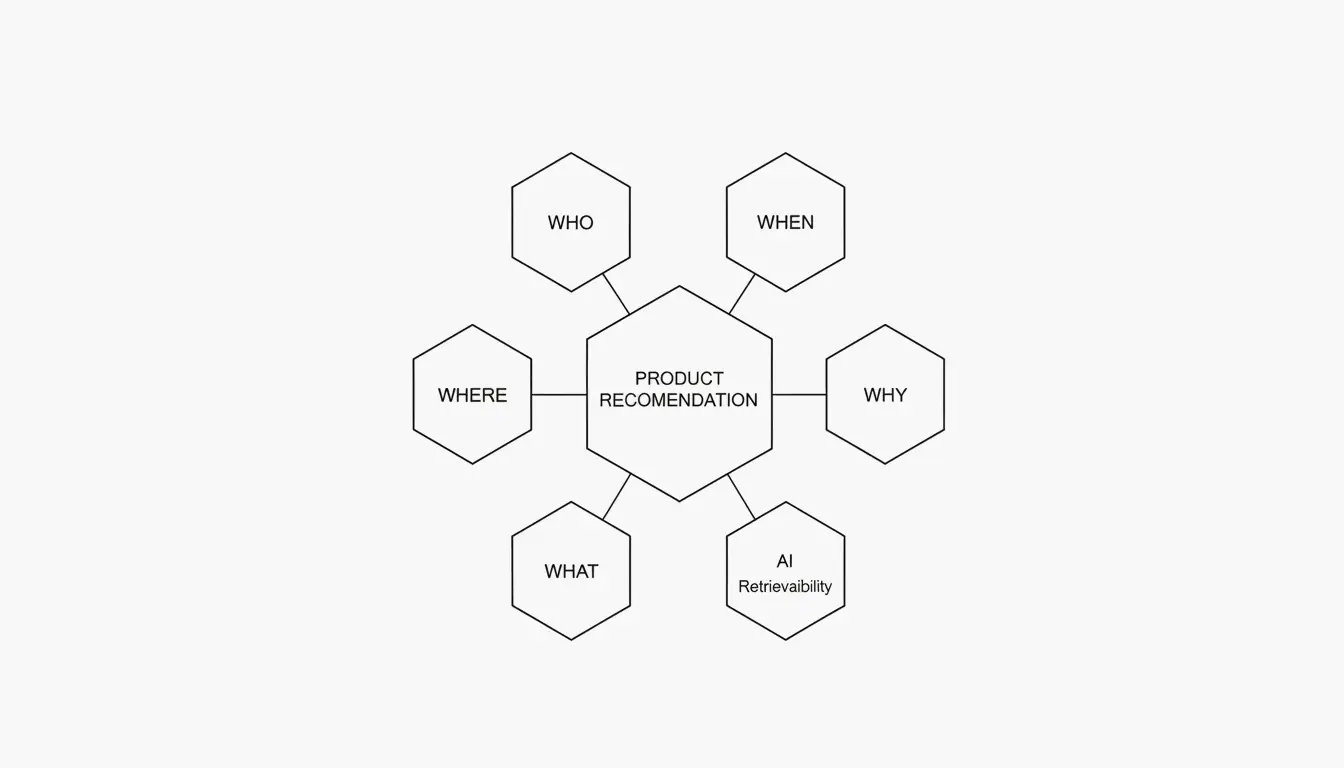
Most listing audits score against generic best practices: keyword density, image count, bullet length. The 6-dimension GEO framework scores against the verified Ideal Customer Profile (ICP). Every dimension answers a question the AI engine is silently asking when it evaluates whether to recommend your product.
According to Nudge, properly structured content shows 73% higher AI selection rates, yet 89% of ecommerce sites implement SKU schema incorrectly. This means most brands are bleeding AI visibility on a structural level before content quality even factors in.
WHO: Define Your Ideal Customer Profile (ICP) from Review Language
Pull 200+ recent reviews per competitor SKU, sort by helpful-vote count, and extract the language patterns shoppers use to describe their actual problem and outcome. Build a language fingerprint of the actual buyer: how they describe themselves, the problem they are solving, and the objections they raise before purchasing. A weak WHO statement reads “yoga mat for everyone.” A strong one reads “extra-thick yoga mat designed for beginners and joint-sensitive practitioners over 40.” As Robert Hu notes: “Vague WHO data forces the AI to guess. AI engines do not guess. They skip.”
WHEN & WHERE: Pinpoint Purchase Contexts and Platforms
Weak WHEN data says “great for any time.” Strong WHEN data says “designed for post-workout recovery within the first hour after exercise.” Similarly, weak WHERE data says “versatile and durable,” while strong WHERE data says “compact enough for studio apartments with no permanent mounting required.” AI engines use WHEN to filter recommendations against situational queries that traditional keyword search never captured.
WHY & WHAT: Understand Purchase Motivations and Product Attributes
WHY is the outcome your product delivers, not the feature it contains. “I want to sleep better” is the prompt; “memory foam mattress” is the feature. The outcome bridges the two. Weak WHY data says “12-inch memory foam mattress.” Strong WHY data says “12-inch memory foam mattress designed to relieve hip and shoulder pressure for side sleepers.” WHAT is the physical product specification: materials, size, weight, certifications, compatibility. Every empty backend attribute is a missed match.
AI Retrievability: The Missing Link in Most DTC GEO Efforts
AI Retrievability is how cleanly your product data is structured for AI parsing. Schema markup on DTC pages, structured backend attributes on Amazon and Walmart, consistent data across channels, and machine-readable specifications form this layer. A weak Retrievability scenario: a product page with key specs trapped in image files, no schema markup, and different attribute values on Amazon vs your DTC site. A strong scenario: every spec in machine-readable text, valid Product schema, and identical data across Amazon, Walmart, and DTC. The cleanest WHO/WHEN/WHERE/WHY/WHAT story still loses if the AI cannot read it.
A 30-Day GEO Quick-Start Plan for DTC Brands ($500K–$5M Revenue)
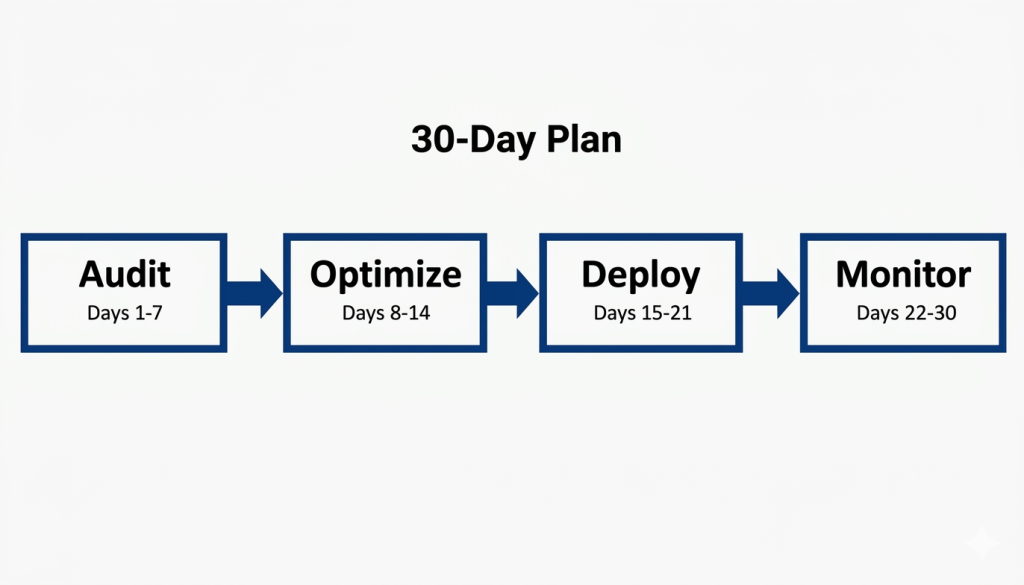
Implementing GEO doesn’t require a full agency engagement. This 30-day plan gives your team the highest-impact actions to execute immediately, drawn from frameworks by Robert Hu and Nudge.
Days 1-7: Audit Current Product Data
Start with a full schema audit across your product catalog. With 89% of ecommerce sites implementing SKU schema incorrectly, this single fix can unlock a 73% lift in AI selection rates. Score each top SKU against the 6-dimension framework (WHO, WHEN, WHERE, WHY, WHAT, AI Retrievability) using a 0 to 5 scale. For most brands, AI Retrievability and WHO are the bottom two dimensions, meaning structured data and persona clarity are the highest-leverage fixes.
Days 8-14: Optimize Core Product Listings
Rewrite titles and bullets in ICP language. Replace keyword strings with sentence-style language that mirrors how the ICP describes their need. Titles should answer who and what. Bullets should answer when, where, why, and what. Replace generic adjectives like “premium” or “professional” with specific, machine-readable attributes—waterproof, USB-C, sulfate-free, 10,000 mAh. Stop optimizing for Amazon’s old keyword density model and start optimizing for natural-language matching against shopper queries.
Days 15-21: Deploy Structured Data
On your owned site, add Product schema, FAQPage schema for product Q&A, and Review schema for aggregated ratings. Schema is the explicit signal AI engines use to extract structured data without inferring from prose. Expand backend keywords from comma-separated lists to descriptive phrases: “designed for runners with knee pain who train on hard surfaces,” not “running shoes knee pain hard surface.” Rufus and Sparky now read backend attributes as natural-language context.
Days 22-30: Launch Cross-Platform Monitoring
Set up category tracking using a tool like RecoScope, GEOly, Nudge, or Passionfruit. Watch weekly runs for movement in and out of the top 5 recommendations. Iterate based on what changed: citation drops signal which products lost AI visibility and need rework. The brands that compound visibility are the ones treating GEO as ongoing data quality discipline, not a one-time project.
Tooling Recommendations for Different Budget Levels
For brands with $500K–$2M revenue, start with Primer SEO at $1,500–$4,000/month for a diagnostic-first approach with a proprietary toolkit. For $2M–$5M revenue, QCK at $3,000–$8,000/month offers Shopify-specialized GEO with Clutch-verified results including 374% page-one keyword increases. For enterprise brands, Nudge provides full enterprise-grade AI visibility with SOC 2 certification and SKU-level schema automation.
How to Measure GEO Success: Beyond Traditional Rankings
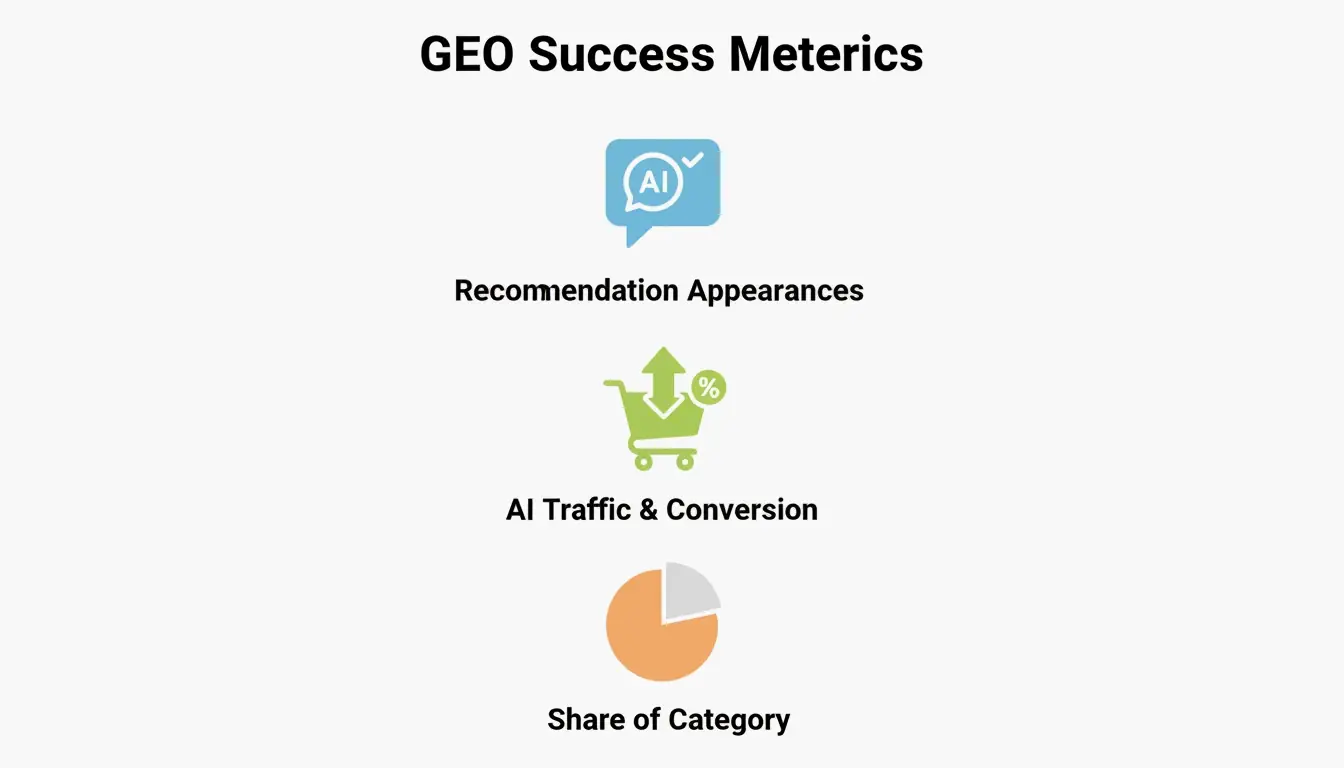
Traditional rank tracking misses AI citation behavior entirely. Measuring GEO success requires three layers.
First, recommendation appearances: how often your brand surfaces in AI answers across ChatGPT, Claude, Gemini, Perplexity, Rufus, and Sparky. Tools like RecoScope automate this tracking weekly across 10 categories and show which brands rotate through recommendations.
Second, AI-influenced traffic and conversion: traffic from AI referrers and the conversion rate of that traffic relative to other channels. Data from Nudge shows that AI-referred visits convert at 11.4% versus 5.3% for organic search.
Third, share of category: the percentage of relevant prompts in your category where your brand shows up. According to RecoScope’s rotation data, AI categories show high volatility—an average of 12 brands rotate through the top 5 ChatGPT recommendations across tracked categories. This volatility is itself a metric: if your category shows high rotation, there is room for smaller brands with cleaner data to break in.
GEO vs. Paid Ads: Should You Replace Your Ad Spend?
No. GEO and paid advertising serve different functions and should operate as complementary channels. Paid ads buy visibility in keyword and category placements, controlling premium positioning and retargeting. GEO buys visibility in AI-generated recommendations, which are growing faster than keyword search. The brands that get the best return on paid ads are the ones with strong organic GEO foundations because the AI surfaces and the ad surfaces share the same underlying product data. Weak data hurts both channels.
A Coexistence Framework for 2026
The optimal strategy uses GEO for baseline visibility and paid ads for acceleration. As Robert Hu notes: “Paid ads buy visibility in keyword and category placements. GEO buys visibility in AI-generated recommendations, which are growing faster than keyword search.” Budget allocation should reflect this: maintain paid spend for immediate control and competitive positioning, while investing GEO dollars in structured data cleanup and content architecture that pays compounding returns over time. The brands that get the best return on paid ads are those with strong organic GEO foundations.
The Future: Agentic Engine Optimization (AEO) and Universal Commerce
Agentic Engine Optimization (AEO) is the next layer above GEO. As Robert Hu explains: “GEO gets you mentioned inside an AI answer. AEO gets you purchased by an AI agent.” The mechanics differ: GEO optimizes for whether ChatGPT, Perplexity, or Sparky names your brand when a buyer asks for a recommendation. AEO optimizes for whether an AI shopping agent—OpenAI Operator, Perplexity Comet, Google’s agentic surfaces—actually completes a purchase from your brand on the buyer’s behalf.
AEO requires deeper structural work: machine-readable pricing, real-time inventory exposure, structured return policies, and agent-friendly checkout flows. Amazon, Meta, Microsoft, and Stripe just joined the Universal Commerce Protocol governance body. The infrastructure is being built in public.
For most DTC brands at $500K to $5M, the right priority order is GEO first, then AEO. Without GEO foundations—clean structured data, persona-specific language, complete attributes—AEO has nothing to work with. The brands that nail GEO are positioned to add AEO incrementally as agent volume scales.
Conclusion
GEO for DTC brands is not a futuristic trend—it’s a competitive necessity in 2026. With 37% of consumers starting their search in AI tools and conversion rates doubling, brands that optimize for AI recommendation engines will capture the fastest-growing channel in e-commerce. Start with a 30-day quick-start plan: audit your product data, deploy structured schema, define your ICP from review language, and begin monitoring your brand’s appearance in ChatGPT, Rufus, and Sparky using tools like RecoScope. The brands that act now are building a compounding advantage that latecomers will find increasingly difficult to close.
Related reading: GEO for Ecommerce: Complete Playbook
FAQ
Does GEO require changing product listings, or just website content?
Both. Platform-level GEO (Amazon Rufus, Walmart Sparky) involves listing optimization including natural-language descriptions, backend attributes, and review sentiment. Brand-level GEO (ChatGPT, Perplexity) involves website content, structured data, and third-party reviews.
Amazon sellers already optimize their listings—why do they need GEO?
Traditional listing optimization focuses on keywords for organic search. GEO optimizes for how AI engines like Rufus interpret context, entities, and conversational signals—a fundamentally different reading engine.
What’s the typical GEO budget for a DTC brand with $500K–$5M revenue?
$2K–$8K per month for basic tooling and in-house effort covering structured data and backend attributes. $15K–$30K per month for full-service agency engagement including monitoring and optimization.
How long before GEO results show?
Listing-level changes show results in 2–4 weeks for Rufus and Sparky. Brand-entity reinforcement takes 1–3 months for ChatGPT and Perplexity references to compound.
Can small brands compete with big brands in AI recommendations?
Yes. RecoScope data shows high volatility in AI categories with an average of 12 brands rotating through top recommendations. Small brands win by focusing on niche contexts, review quality, and structured data completeness.
Is GEO a replacement for Amazon Connect or Walmart Connect paid ads?
No. GEO optimizes organic discovery within AI engines. Paid ads still control premium placement and retargeting. The best strategy uses GEO for baseline visibility and paid ads for acceleration.

1 Comment
Pingback: GEO for Ecommerce: The Complete Playbook for 2026 – GEOWriter