


This complete playbook gives you a 90‑day system to get your local business cited in AI answers. It covers NAP audits, question‑led content, third‑party citations, and weekly citation velocity tracking. Stick with this structured approach, and you should see measurable improvements in AI recommendation visibility within a quarter. For the broader GEO methodology that applies across industries, see our GEO for SaaS: Complete Playbook.
Contents
- Why GEO Matters Now (And What It Actually Means)
- The 90‑Day GEO Playbook: An Overview
- Phase 1: Audit & Foundation (Days 1–14)
- Phase 2: Question‑Led Content & Structured Data (Days 15–35)
- Phase 3: Third‑Party Citations & Authority Building (Days 36–65)
- Phase 4: Monitor, Refresh & Scale (Days 66–90)
- GEO vs SEO: How They Work Together
- Budget‑Friendly GEO: Free Tools & Minimal Spending
- GEO for Service‑Area Businesses (No Physical Storefront)
- Multi‑Location Content Tiers: Hub to Location
- How to Measure GEO Success: Key Metrics & Templates
- Conclusion
- FAQ
Why GEO Matters Now (And What It Actually Means)
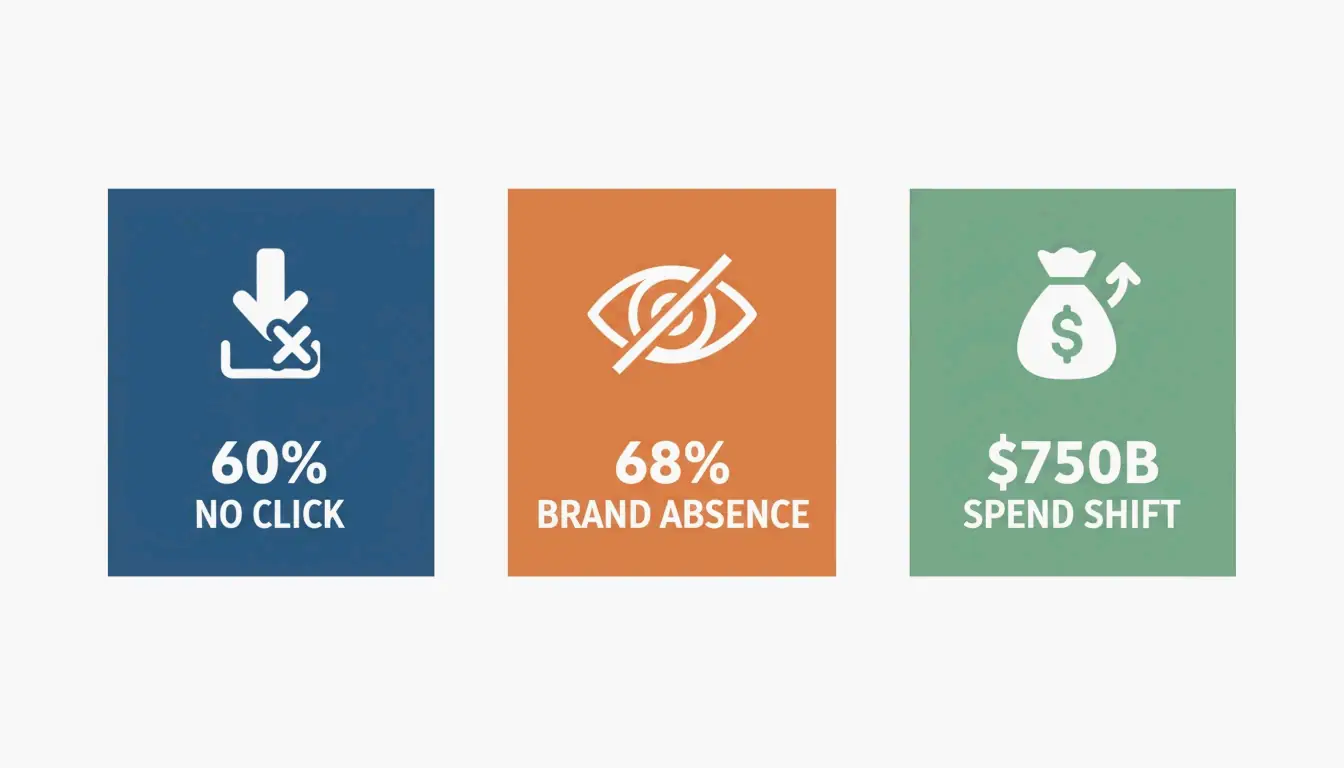
The way local consumers find businesses has changed. Hard. According to recent Uberall research on AI search behavior, roughly 60% of all searches now end without a single click to a website. AI‑generated answers replace the need to visit a site, and an estimated $750 billion in consumer spend is already shifting toward AI‑powered search.
More critical: 68% of brands are missing entirely from the recommendations AI engines generate in their category, according to the same Uberall study. That means most local businesses are invisible in the fastest‑growing discovery channel. Meanwhile, a Press Ganey Forsta 2025 Consumer Survey reports that 84% of consumers search for local businesses daily. That gives you a sense of the opportunity for anyone who acts.
Generative Engine Optimization (GEO) is the practice of making your brand’s content clear, structured, and authoritative enough for AI systems to cite in their responses. As Luma Abu Ghazaleh, Technical Expert for AI Search at Uberall, puts it: “GEO is about making sure your content is so clear, so structured, and authoritative that AI, the librarian, summarizes you accurately and favorably to the end user.”
GEO rests on three pillars:
– Factual sources: Consistent, accurate business information across every platform a model might read.
– Context engineering: Content that answers the questions customers actually ask, in the language they use.
– Orchestration: Measuring citations, refreshing content, and compounding visibility over time.
These pillars replace the old SEO mindset of ranking for keywords. The new goal is to be cited, summarized, and trusted when an AI model answers on your customer’s behalf.
The 90‑Day GEO Playbook: An Overview
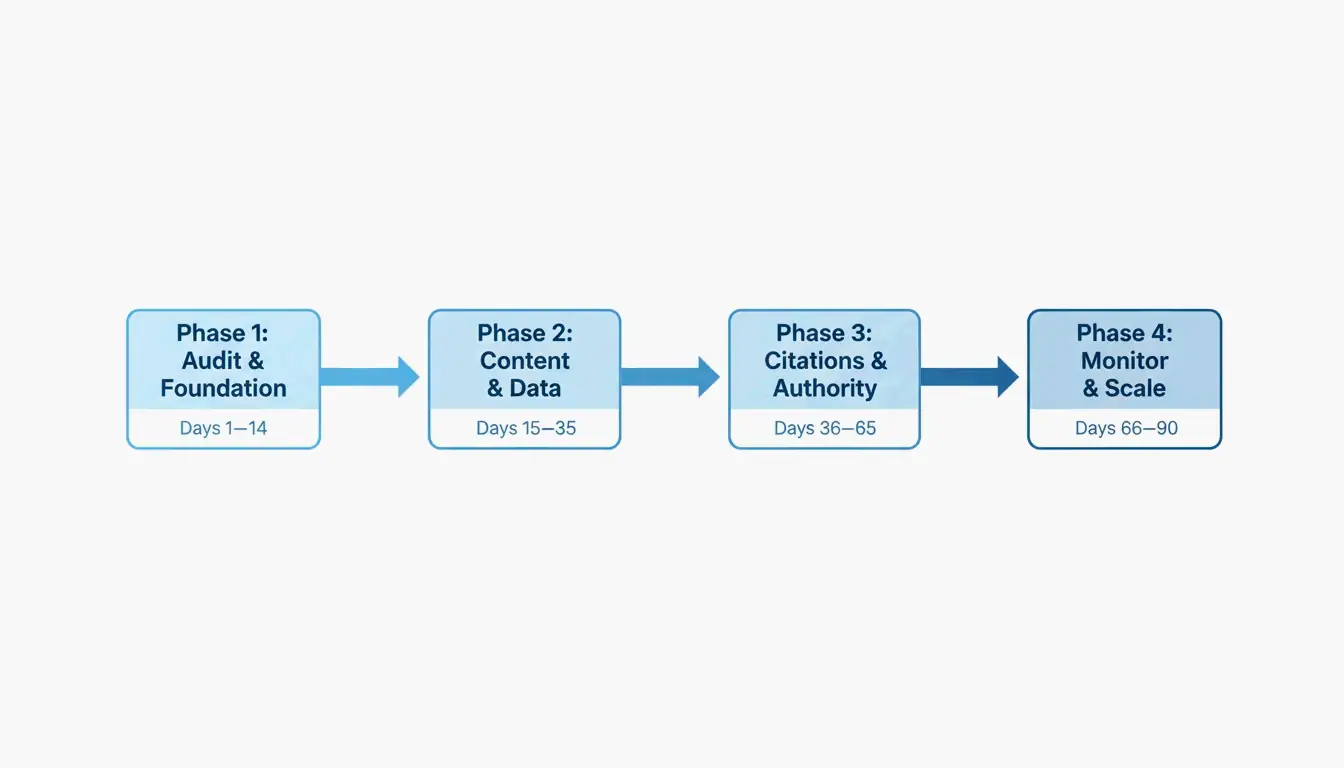
The work splits into four phases, each lasting 2‑4 weeks. The cadence builds on itself — each phase depends on the foundation laid by the previous one.
In a recent Search Engine Journal webinar featuring Uberall and AthenaHQ, GEO‑savvy brands saw 2x as many AI citations and 3‑9x higher conversion rates within 90 days compared to brands still optimizing purely for classic search.
| Phase | Duration | Focus Area |
|---|---|---|
| Phase 1 | Days 1–14 | Audit & Foundation (NAP, GBP, Schema) |
| Phase 2 | Days 15–35 | Question‑Led Content & Structured Data |
| Phase 3 | Days 36–65 | Third‑Party Citations & Authority Building |
| Phase 4 | Days 66–90 | Monitor, Refresh & Scale |
Each phase embeds the three pillars of GEO: factual sources (Phase 1), context engineering (Phase 2), and orchestration (Phases 3 & 4).
Why a 90‑Day Window?
The 90‑day timeframe isn’t pulled out of thin air. Roughly 50% of AI citations come from content less than 13 weeks old, per industry analysis from multiple sources, including rank‑and‑convert.ghost.io. That means content freshness directly drives citation visibility. A 90‑day cycle keeps your content inside that window while giving you enough time to build the infrastructure needed for sustained performance.
What You’ll Need (Free & Paid Tools)
Core requirements are minimal. Every business can get by with:
| Category | Tool | Cost |
|---|---|---|
| Analytics/SEO Foundation | Google Search Console | Free |
| AI Visibility Audit | HubSpot AEO Grader | Free |
| Question Research | AnswerThePublic | Free tier |
| Schema Generation | Google Structured Data Markup Helper | Free |
| Citation Management | Moz Local | ~$14/month (single location) |
| Advanced Monitoring | GEO Studio / Uberall | Freemium / Paid |
Many single‑location businesses can execute the full 90‑day plan for under $500 total. Most of the work uses free tools, plus one or two affordable paid subscriptions.
Phase 1: Audit & Foundation (Days 1–14)
You can’t optimize what AI models can’t parse. Phase 1 is a data‑hygiene sprint — fix the basics before you add any new content or citation work.
Week 1: NAP Audit & Cleanup (Days 1–7)
Step 1: NAP consistency audit. Name, address, and phone must match character‑for‑character across every platform where your business appears. That includes Google Business Profile, Apple Maps, Yelp, Bing Places, Facebook, and major data aggregators.
Common inconsistencies to look for:
– “Street” vs. “St.” vs. “Street.”
– Suite number included on one listing but omitted on another.
– Old phone number format after a change.
– Business name with a tagline on one profile but not another.
Action: Use a free tool like Moz Local’s listing scan, or manually search your business name in quotes across Google, Yelp, Apple Maps, and Bing. Document every discrepancy in a simple spreadsheet. Fix each platform individually. Expect it to take 2–3 hours for a single location.
Week 2: GBP Optimization & Schema Implementation (Days 8–14)
Step 2: Optimize Google Business Profile. Your GBP is one of the most heavily weighted inputs AI systems use when composing local answers. In 2026, it functions less as a destination page and more as a machine‑readable data feed.
Key optimization points:
– Completeness: Fill every section — hours, services, attributes, business description, categories, photos.
– Categories: Select primary and secondary categories that precisely describe your business. Don’t be generic.
– Attributes: Turn on all relevant attributes (e.g., “wheelchair accessible,” “free Wi-Fi,” “appointments recommended”).
– Posts: Publish weekly. Fresh posts signal active management, which AI systems reward.
– Reviews: Respond to every review within 24–48 hours. Detailed owner replies are read by AI models.
– Photos: Upload real photos regularly (not stock imagery). Industry reporting now suggests GBP profiles that haven’t been updated with fresh photos in over 30 days can see dramatic drops in impressions.
Step 3: Implement Tier‑1 schema markup. Schema markup reduces ambiguity about what your business is and does. Pages with complete Tier‑1 schema see up to 40% more AI Overview appearances, according to analysis from stackmatix.com in 2026.
At minimum, every location needs:
– LocalBusiness schema: Name, address, phone, hours, service area, categories, ratings.
– FAQPage schema: On service pages and key content pages.
– Service schema: For each offering, with pricing ranges and service area coverage.
Use Google’s Rich Results Test to validate implementation.
Step 4: Verify grounding pages for each location. A grounding page is a structured, factual landing page that gives AI systems a single, citable source of truth for each business location. It should include unique information about that location — years in operation, neighborhood context, local testimonials, and specific service details. This is especially important for multi‑location brands.
Deliverable: By day 14, you should have a complete foundation checklist done and a Google Sheets tracker that shows NAP status across all platforms, GBP strength score, schema validation pass rate, and grounding page status.
Free Tools for Foundation Work
| Tool | Purpose |
|---|---|
| Google Search Console | Technical SEO health, AI Overview appearance tracking |
| Google Structured Data Markup Helper | Schema generation |
| Rich Results Test | Schema validation |
| Google Business Profile Manager | GBP optimization |
Phase 2: Question‑Led Content & Structured Data (Days 15–35)
Phase 2 shifts from fixing foundations to building the content AI systems actually cite. The core shift is from keyword‑focused content to question‑led content — write to answer the real questions customers ask, not to rank for a search term.
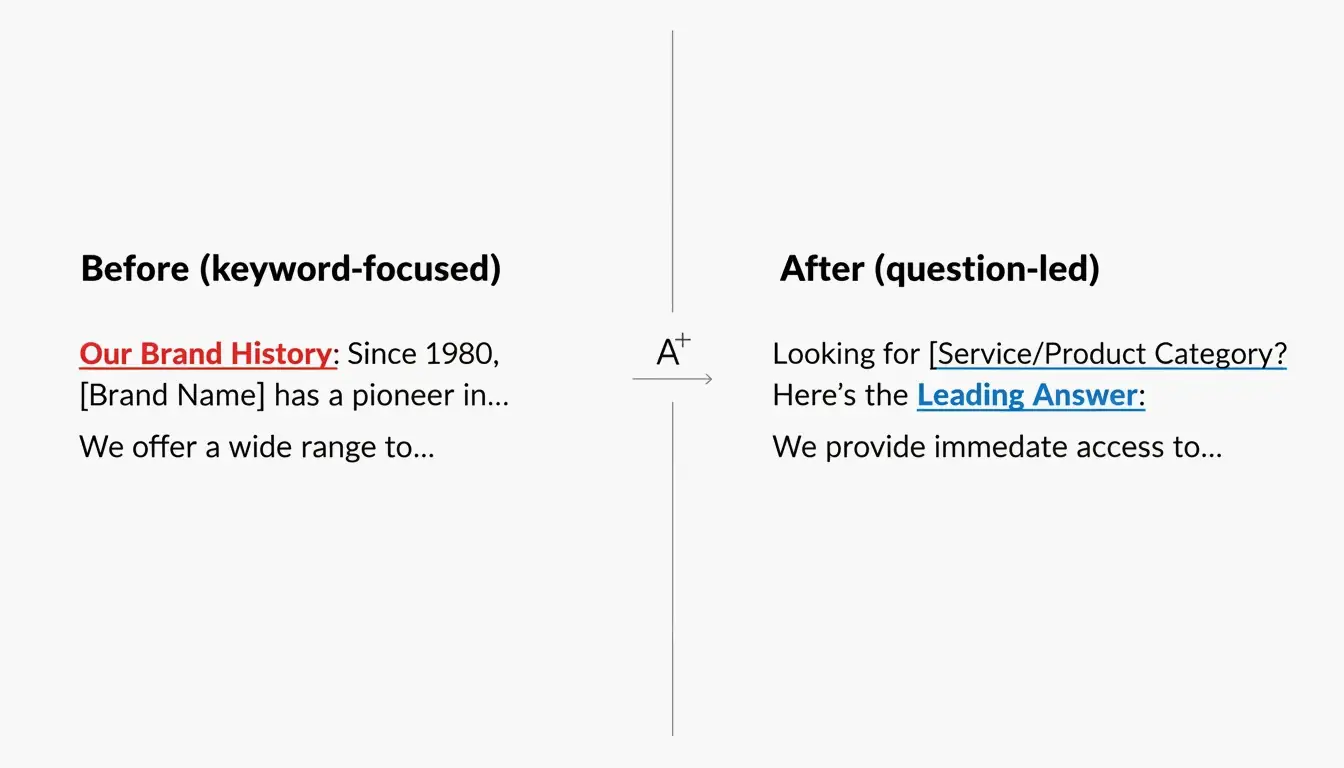
Before & After: Rewriting Your Service Page for AI
The single biggest structural change needed for GEO is leading with the answer, not with the introduction.
Before (keyword‑focused):
“Welcome to our family‑owned plumbing business, serving the Austin community since 1985. We pride ourselves on quality workmanship and customer satisfaction. Our team of licensed plumbers is ready to help with all your plumbing needs.”
After (question‑led):
“Need a family dentist in Austin with Saturday hours? Our clinic, Austin Family Dental, offers sedation dentistry, cleanings, and emergency care every Saturday from 8 AM to 2 PM. We’ve served the Barton Hills and Zilker neighborhoods for over 12 years.”
AI citations pull from the first 200–300 words of a page most frequently. If your service page opens with brand history before answering the customer’s core question, you’re training every AI system to skip past you.
Where to Find Local Questions (Free)
| Tool | What It Provides | Best For |
|---|---|---|
| AnswerThePublic | Question‑based keyword clusters by topic | Discovering phrasing gaps |
| Google “People Also Ask” | Related questions on SERPs | Validating real‑world query patterns |
| Google Search Console | High‑impression, low‑position queries | Identifying existing content gaps |
| Customer service transcripts | Actual customer questions | Authentic language patterns |
Structuring Content for Both Humans and AI
Content that performs well in GEO shares a few structural traits:
- One prompt, one page. If “best family dentist in Austin with Saturday hours” is a gap, build or optimize a page that answers exactly that query directly.
- Lead with the answer. State the answer to the target question in the first paragraph. Include business name, service, and location.
- Use descriptive H2 and H3 headings. These should include the actual question phrasing.
- Add FAQ sections with schema. Each question becomes a potential citation block.
- Include specific data points. “47% of our clients report reduced wait times” outperforms “most clients report satisfaction.”
- Cite yourself credibly. Include dates, named authors, original data, and explicit comparisons.
A 2026 GenOptima benchmark report found that listicle and structured‑format pages were cited roughly 5x the rate of standard blog posts. Format matters as much as topic.
Maintain the 13‑week refresh window. Roughly 50% of AI citations come from content published less than 13 weeks ago, and 76.4% of ChatGPT’s most‑cited pages were updated within the last 30 days. Refresh cadence matters more than raw publishing volume.
Phase 3: Third‑Party Citations & Authority Building (Days 36–65)
AI systems trust third‑party sources far more than self‑published content. Data from AirOps suggests that roughly 85% of brand mentions in AI search are pulled from third‑party sources, not the brand’s own website. Phase 3 focuses on earning those external citations.
Building a Citation Pipeline
Step 1: Identify 10–20 high‑authority citation sources per location. For each location, compile a list of industry directories, local news outlets, chamber of commerce pages, review platforms, and community sites where your business should appear.
High‑priority sources for most local businesses:
– Google Business Profile
– Yelp
– Apple Maps
– Bing Places
– Nextdoor Business Page
– Chamber of Commerce directory
– Industry‑specific directories (Angi, HomeAdvisor, Thumbtack for home services; ZocDoc for healthcare; etc.)
– HERE City Network hyperlocal news sites
Step 2: Earn brand mentions through local press and community sponsorships. In the GEO era, mentions carry weight even without a link. Pitch yourself to local journalists as an expert source on relevant topics. Sponsor Little League teams, community festivals, or charity runs for local coverage.
Step 3: Monitor citation velocity. Citation velocity measures how often your brand is cited in AI‑generated answers per week. Target at least 2–3 new citations per week per location. The compounding effect is meaningful: brands that treat GEO as an ongoing loop see substantially higher citation rates.
Case example: Audika France, a multi‑location hearing‑care brand and Uberall customer, ran this orchestration loop as an early adopter. They used GEO tracking to identify how AI engines described their clinics, spot the attributes models were missing, and close the gap between visible and recommended. Their results demonstrate how a multi‑location brand went from an AI blind spot to a consistent recommendation across 300+ clinics.
Working with Local Media on a Budget
Local news outlets are high‑value targets for GEO because AI systems rate hyperlocal news domains highly — they’re independent, locally focused, and persistently updated. To earn coverage without a PR budget:
| Tactic | Approach |
|---|---|
| Expert commentary | Pitch a local angle on a national story. Journalists need local experts for quotes. |
| Data contributions | Offer a unique local statistic from your business data. |
| Community event sponsorship | Sponsor a local event in exchange for coverage or mention. |
| Business roundups | Participate in “best of” lists and local business spotlights. |
| Guest content | Offer to write a bylined article for the local business section. |
The key is value: offer something useful to their audience, not a press release about your services.
Phase 4: Monitor, Refresh & Scale (Days 66–90)
By day 60, new content should be live, citations should be appearing on publisher sites, and there should be enough signal to measure. Phase 4 is where GEO stops being a project and starts being a system.
Tracking Template: Citation Velocity & Share of Voice
Three metrics worth tracking weekly:
| Metric | Definition | How to Track |
|---|---|---|
| Citation velocity | Number of times your brand is cited in AI‑generated answers per week per location | Manual prompt testing (ChatGPT, Perplexity, Gemini, AI Overviews) or automated tools like GEO Studio |
| Share of Voice (SoV) | Your citation rate relative to competitors across the same prompt set | Compare your citations vs. competitors for 5–10 key prompts per location |
| Content decay | % change in citation count over a 4‑week rolling window | Track which cited pages lose citations and need refreshing |
Trigger for refresh: If SoV drops more than 20% in a market week over week, that location’s content moves to the front of the refresh queue.
A simple Google Sheets template with columns for Location, Citation Count, Competitor Comparison, SoV %, and Content Decay % is sufficient for single‑location or small multi‑location operations.
When and How to Refresh Content
Content that performs well in GEO needs regular freshness updates. The 13‑week window is the upper limit — content older than 13 weeks rapidly loses citation share.
| Content Type | Refresh Cadence | What to Update |
|---|---|---|
| Hub (national) | Full rewrite every 90 days; monthly freshness update | Date stamp, new statistics, new examples |
| Region | Full update every 60–90 days | Regional incentives, market trends, competitor changes |
| City | Update every 45–60 days | Local events, neighborhood changes, new competitors |
| Location | Touch every 30 days | Hours, inventory, reviews, events |
Format refreshes matter too. When a page hits its 13‑week mark, reformat it — add a comparison table, expand the FAQ, add a structured how‑to block. Listicle and table formats lift citation rates significantly.
Scaling to Multi‑Location with Content Tiers
Multi‑location brands need a tier‑aware content architecture to avoid duplication and cannibalization. A proven structure runs four tiers:
- Hub (national): Pillar pages, category‑defining guides, brand methodology. Built for topical authority that flows down. Refresh every 90 days.
- Region (multi‑state or multi‑metro): Regional trend reports, comparison content, incentive coverage. Update every 60–90 days.
- City (city‑specific): Neighborhood authority, city‑tagged comparisons, market‑specific service explainers. Update every 45–60 days.
- Location (single rooftop): Hours, reviews, location Q&A, unique inventory or service availability. Touch every 30 days.
Each tier has unique schema requirements:
– Hub: Article, FAQPage, HowTo, Organization schema with sameAs links.
– Region: Article, FAQPage, optional ItemList for ranking content.
– City: Article, FAQPage, LocalBusiness referencing locations served.
– Location: LocalBusiness (required), FAQPage, Review, Event, Service schema.
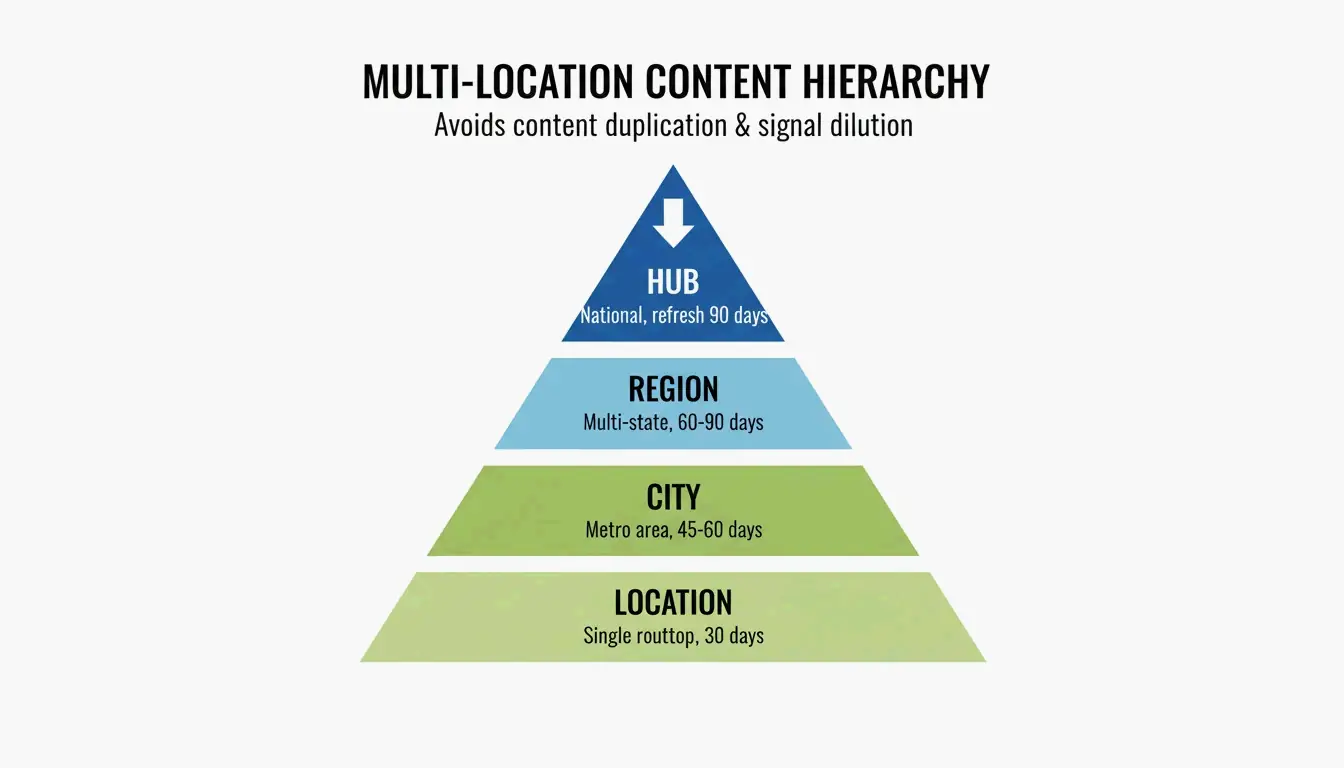
The organic click‑through rate on AI‑Overview queries fell from 1.76% to 0.61% between mid‑2024 and late 2025, according to Seer Interactive’s analysis of more than 25 million organic impressions. As zero‑click behavior grows, the citation inside the AI answer becomes the conversion surface. Multi‑location brands that adopt this tier structure will maintain distinct citation footprints per location without duplication penalties.
As agentic AI — where AI assistants don’t just recommend a business but book appointments, check availability, and complete transactions on the user’s behalf — becomes reality, whoever the AI picks wins the booking, not just the recommendation. Building citation infrastructure now creates a structural advantage that is hard to unwind.
GEO vs SEO: How They Work Together
GEO and SEO are not competing philosophies. They’re different layers of the same visibility problem — one optimized for search engines, one optimized for AI‑generated answers.
| Dimension | SEO | GEO |
|---|---|---|
| Primary goal | Rank in a list of blue links | Be cited in an AI‑generated answer |
| Success metric | Rankings, organic traffic, CTR | AI mention frequency, sentiment, SoV |
| Authority source | Backlinks, technical optimization, keyword relevance | Cross‑platform brand mentions, structured data, NAP consistency, conversational content |
| Content target | Keyword intent | Conversational intent |
| Measurement | Rank trackers | Manual prompt testing or AI visibility tools |
Can You Do GEO Without SEO?
No. A business with a clean Google Business Profile, consistent citations, and decent on‑site content is already most of the way to GEO‑ready. SEO foundations make GEO easier. Zero website, zero reviews, zero directory presence means zero AI citations. Fix the foundation first, then invest in GEO.
You can start both simultaneously if resources allow, but the sequence matters: Phase 1 of this playbook (audit, GBP, schema) is largely traditional SEO work. Phase 2 and beyond layer GEO optimization on top.
Budget‑Friendly GEO: Free Tools & Minimal Spending
Most of the work that drives GEO results requires no paid software. The core actions — content strategy, citation infrastructure, structured data, and audience‑question alignment — are analytical and editorial work, not tool‑dependent.
Zero‑Cost Weekly GEO Checklist
| Week | Task | Tools |
|---|---|---|
| 1 | Audit NAP across 5 major platforms | Google Business Profile, Yelp, Bing Places |
| 2 | Optimize GBP (complete all fields, add posts) | Google Business Profile Manager |
| 3 | Implement LocalBusiness + FAQ schema on key pages | Google Structured Data Markup Helper + Rich Results Test |
| 4 | Run manual prompt tests for 5–10 queries | ChatGPT, Perplexity, Google |
| 5 | Research local questions via People Also Ask | Google Search |
| 6 | Write or rewrite 2 service pages as question‑led content | Google Docs or CMS |
| 7 | Add FAQ section with schema to 1 key page | Schema Markup Generator |
| 8 | Claim or optimize Nextdoor Business Page | Nextdoor |
| 9 | Submit to 3 industry directories | Free directories relevant to your vertical |
| 10 | Pitch local news outlet for expert quote | Local journalism contacts |
| 11 | Set up citation velocity tracking spreadsheet | Google Sheets |
| 12 | Run mid‑quarter citation baseline audit | ChatGPT, Perplexity, Gemini |
| 13 | Refresh oldest content piece | CMS |
Free & Low‑Cost Tool Stack
| Tool | Cost | Purpose |
|---|---|---|
| Google Search Console | Free | Technical SEO health, AI Overview tracking |
| HubSpot AEO Grader | Free | AI visibility audit |
| AnswerThePublic | Free tier | Question‑based keyword research |
| Google Business Profile | Free | Primary local listing |
| Google Structured Data Markup Helper | Free | Schema generation |
| Moz Local | ~$14/month | Citation management, single location |
| GEO Studio / Uberall | Freemium | Advanced AI visibility monitoring |
Single‑location businesses can start with less than $500 total for the first 90 days. Larger budgets accelerate citation building and monitoring, but are not required.
GEO for Service‑Area Businesses (No Physical Storefront)
Service‑area businesses — electricians, plumbers, lawn care, pet sitters, cleaners — face different GEO challenges than brick‑and‑mortar locations. They don’t have a single physical address that appears on maps, but they serve distinct geographic areas that AI models need to understand.
Service‑Area Specific Steps
1. Use ServiceArea schema instead of LocalBusiness where applicable. ServiceArea schema explicitly communicates which ZIP codes, cities, or neighborhoods a business serves. AI models read this to determine relevance for location‑based queries.
2. Optimize for service area radius in GBP. Google Business Profile allows you to set a service area in miles. Be precise. A plumber who serves Austin and Round Rock should set the radius accordingly, not “all of Texas.”
3. Include city names naturally in GBP and content. Your GBP business description and service listing should include the cities you serve. Each service page should reference specific neighborhoods and communities.
4. Earn citations from industry directories and local community sites. For service‑area businesses, Nextdoor is particularly valuable. It functions as a digital referral circle where neighbors recommend nearby professionals. Claim your Nextdoor Business Page, optimize it, and earn recommendations from customers in your service area.
Other high‑value citation sources:
– Angi (formerly Angie’s List)
– HomeAdvisor
– Thumbtack
– Yelp
– Facebook Groups for local neighborhoods
– Local Chamber of Commerce directories
5. Content strategy: “We serve [city] and surrounding areas” + question‑led pages per service. For each service you offer, create a dedicated page that mentions multiple cities you serve. Example: “Emergency Electrical Repair in Austin, Round Rock, and Cedar Park — 24/7 Service” followed by a question‑led answer about common electrical emergencies in the area.
Common Pitfalls for Service‑Area GEO
| Pitfall | Solution |
|---|---|
| Using generic service descriptions without location context | Include specific city/neighborhood names in every service page heading and opening paragraph |
| Not optimizing GBP service area radius | Set an accurate radius that matches actual service coverage |
| Ignoring Nextdoor as a citation source | Claim, optimize, and actively engage on Nextdoor |
| Creating templated city pages that swap only the city name | Enforce unique local data points per page — a fact, a testimonial, or a statistic unique to each area |
| Not using ServiceArea schema | Replace LocalBusiness with ServiceArea where appropriate |
Multi‑Location Content Tiers: Hub to Location
Multi‑location brands face a structural problem that single‑location businesses don’t: duplication. AI models detect templated content that varies only by city name and devalue it as doorway pages. The solution is a multi‑tier content architecture.
The Four‑Tier Architecture
| Tier | Scope | Purpose | Refresh Cadence |
|---|---|---|---|
| Hub | National | Topical authority, category‑defining guides | 90 days |
| Region | Multi‑state or multi‑metro | Regional trends, incentives, market comparisons | 60–90 days |
| City | Single metro area | Neighborhood authority, city‑specific comparisons | 45–60 days |
| Location | Single rooftop | Hours, reviews, unique inventory, Q&A | 30 days |
Each tier has distinct content types:
– Hub: “2026 EV Buying Guide,” “Complete Guide to Hearing Care”
– Region: “Northeast EV Adoption Trends,” “Midwest Roofing Season Guide”
– City: “Best Family Dentist in Lincoln Park,” “Top HVAC Companies in Austin”
– Location: “Our Downtown Clinic Hours and Services,” “Chicago West Loop Team”
The Audika France case study demonstrates this working at scale. As a multi‑location hearing‑care brand, they used GEO orchestration to ensure consistent AI recommendation across 300+ clinics. Their results show how a systematic approach to entity signals, structured content, and citation building turns a multi‑location footprint into a competitive advantage rather than a duplication risk.
Avoiding Cannibalization with Schema
Schema markup is the primary tool for preventing content cannibalization across location pages. Each tier needs specific schema:
| Tier | Required Schema |
|---|---|
| Hub | Article, FAQPage, HowTo, Organization |
| Region | Article, FAQPage, optional ItemList |
| City | Article, FAQPage, LocalBusiness referencing locations served |
| Location | LocalBusiness (required), FAQPage, Review, Event, Service |
A 2026 stackmatix.com analysis confirms that pages with complete Tier‑1 schema see up to 40% more AI Overview appearances. Schema is not optional — it’s the signal that tells AI models each location page is a distinct entity with unique content.
How to Measure GEO Success: Key Metrics & Templates
Measuring GEO requires different metrics than traditional SEO. Ranking position is secondary; citation visibility is primary.
Core Metrics
| Metric | Definition | How to Measure | Target |
|---|---|---|---|
| Citation velocity | Number of AI citations per week per location | Manual prompt testing or GEO Studio | 2–3 new citations per week per location |
| Share of Voice (SoV) | Your citations vs. total citations in your category + location | Compare citations for 5–10 key prompts | Increase over baseline |
| Content decay | % change in citation count over a 4‑week rolling window | Track which cited pages lose citations | Refresh if >20% decay |
| Conversion tracking | Leads/sales attributed to GEO | UTM parameters + CRM integration | Attribute 3–9x higher conversion rate (SEJ 2026) |
Setting Up a Simple GEO Dashboard (Free)
A manual tracking approach works for single‑location or small multi‑location operations:
- Create a Google Sheet with columns: Location, Date, Prompt Tested, AI Platform (ChatGPT/Perplexity/Gemini/AI Overviews), Cited? (Yes/No), Competitors Cited, Citation Source (URL if available).
- Test 5–10 key prompts weekly. These should be the questions your best customers would ask before hiring you.
- Log results. Note whether you appear, who appears instead, and what content is cited.
- Calculate SoV: Your citations ÷ Total citations in category × 100.
- Note content decay: Check which pages are losing citations week over week.
For automated tracking, HubSpot AEO tracks brand visibility across ChatGPT, Perplexity, and Gemini, with prioritized recommendations. GEO Studio from Uberall maps brand presence across major generative engines with a prompt center and action center for closing gaps.
Conclusion
GEO is the new battleground for local businesses. The shift from keyword‑based ranking to AI‑based citation is not hypothetical — 60% of searches now end without a click, and 68% of brands are invisible to AI engines in their own categories. The 90‑day playbook — NAP audits, question‑led content, third‑party citations, and weekly velocity tracking — ensures your brand appears in AI answers before your competitors do.
Start with a 5‑minute NAP audit today. Check your business name, address, and phone number across Google Business Profile, Yelp, and Apple Maps. Use the free checklist and tracking template included in this guide. Bookmark this playbook and begin Phase 1 tomorrow.
The window is open. Roughly 8% of local businesses have any documented GEO strategy in place. The brands that start now build a structural advantage that is hard to unwind once the category catches up.
Related reading: For industry-specific GEO strategies, see GEO for Agencies: How to Sell GEO as a Service.
FAQ
How long does it take to see results from GEO for a local business?
Most businesses see initial citations within 4–6 weeks, with measurable Share of Voice improvements by week 8–10. The 90‑day plan typically yields 2x citations and 3–9x higher conversion rates, per a 2026 SEJ webinar featuring Uberall and AthenaHQ.
Do I need to have a strong SEO foundation before starting GEO?
Yes — clean NAP, optimized Google Business Profile, and proper schema markup are prerequisites. GEO builds on SEO fundamentals. You can start both simultaneously if resources allow, but fix the foundation first.
What is the minimum budget needed to start GEO for a single‑location business?
Less than $500 for the first 90 days using free tools (Google Search Console, HubSpot AEO Grader, AnswerThePublic) and minimal paid tools like Moz Local (~$14/month). Larger budgets accelerate citation building and monitoring.
Can GEO work for service‑area businesses (electricians, plumbers) without a physical storefront?
Absolutely. Use ServiceArea schema instead of LocalBusiness, optimize GBP for service radius, and earn citations from industry directories (Angi, HomeAdvisor, Thumbtack) and local community sites like Nextdoor.
How often should I update content for AI search citations?
Refresh content every 8–13 weeks to stay within the citation window. Roughly 50% of AI citations come from content less than 13 weeks old. Hub content needs full rewrites every 90 days; location content should be touched every 30 days.
What tools are essential for GEO monitoring without breaking the bank?
HubSpot AEO Grader (free), Google Search Console (free), Moz Local (paid but low cost at ~$14/month), and a manual Google Sheets tracker for citation velocity. Most single‑location businesses can manage with this stack alone.
