


Generative Engine Optimization (GEO) for B2B services is the practice of structuring your content and online presence so that AI-powered search engines cite your brand as a trusted source in their synthesized answers. This GEO for B2B Services: Complete Playbook delivers a step-by-step action plan for getting your B2B service brand cited by ChatGPT, Perplexity, and Google AI Overviews within 30 days. For the foundational GEO framework that underpins these strategies, see our GEO for SaaS: Complete Playbook.
Contents
- This Is the GEO for B2B Services: Complete Playbook – Why Your Brand Must Act Now
- Days 1–30: Your Step-by-Step GEO Implementation Plan
- GEO vs. AEO vs. SEO: Drawing the Lines for B2B Services
- Building Brand Narrative Architecture for GEO Success
- How to Measure GEO Success: Metrics, Tools, and Attribution
- GEO for B2B Professional Services: A Specialized Approach
- Advanced Tactics: Winning on Perplexity and ChatGPT Search
- Conclusion
- FAQ
This Is the GEO for B2B Services: Complete Playbook – Why Your Brand Must Act Now
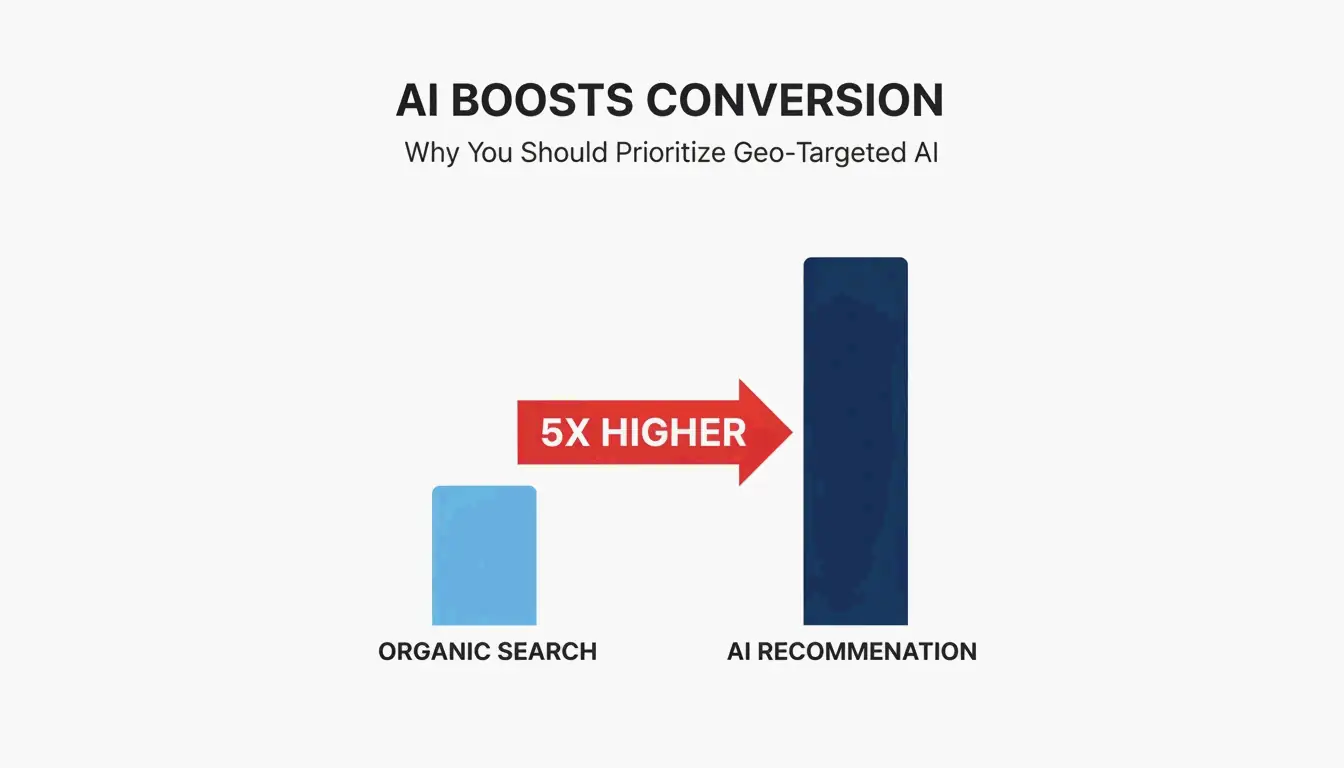
The numbers are hard to ignore. Forrester research found that 89% of B2B buyers now use generative AI as a primary research source for software solutions, making it the dominant starting point for vendor evaluation. And Hengarth data shows AI-referred visitors convert at roughly five times the rate of organic search traffic.
This playbook is built around a tactical 30-day plan—not just theory. It draws on production-tested results and real case studies to give B2B service providers a repeatable framework for earning AI citations.
What GEO Actually Means for B2B Service Providers
Generative Engine Optimization (GEO) is the practice of optimizing your content and online presence so that AI-driven answer engines—ChatGPT, Perplexity, Google AI Overviews, Microsoft Copilot—retrieve, cite, and accurately represent your brand when they generate responses to user queries.
Traditional SEO asks: “How do I rank on page one?” GEO asks: “How do I become part of the answer?” That shift is significant for B2B service providers because buyers increasingly receive synthesized answers before ever clicking a link—a trend some call zero-click search. If your brand isn’t in that synthesized answer, you miss the consideration window entirely.
Days 1–30: Your Step-by-Step GEO Implementation Plan
This 30-day plan is designed for B2B service providers who already have some SEO foundation. Research from Princeton and IIT Delhi (published at KDD 2024) found that optimized content can increase visibility in generative engine responses by up to 40%. The Fountain City case study demonstrated a 60% relative improvement in AI citation rate over five weeks—from 20% to 32% of monitored keywords.
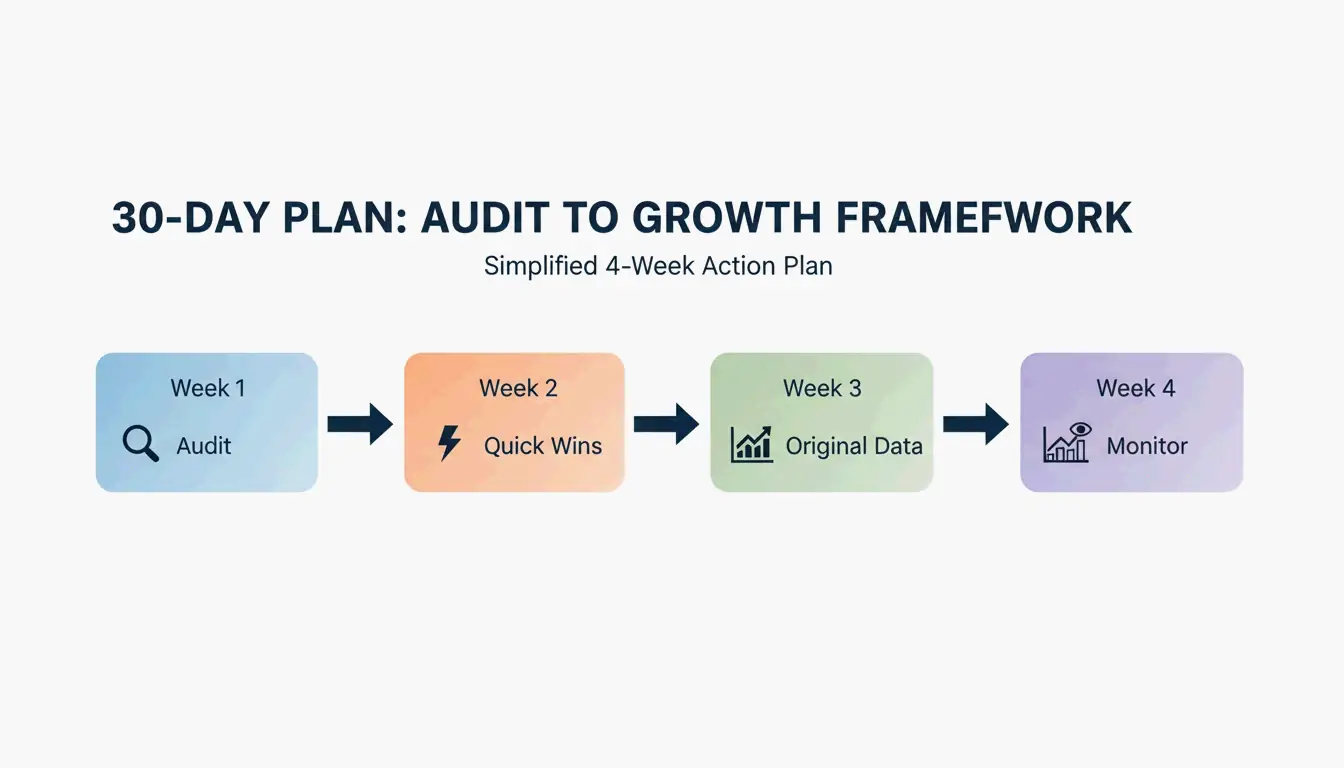
Week 1: Audit Your AI Footprint
Take your top 10 business queries—the ones prospects actually type when looking for what you sell—and run them through ChatGPT, Perplexity, and Google AI Overviews. For each query, note three things: whether you are cited, which competitors are cited, and whether any queries return no citations at all.
Queries with no current citations represent your highest-opportunity targets. This manual audit establishes your baseline and reveals citation gaps that content and structural improvements can address.
Week 2: Quick Wins – Schema, Bio Optimization, and Passage Formatting
Apply structural improvements to your top 5 pages by traffic. Add a direct-answer opening paragraph to each major section. Answer first, then elaborate. Implement FAQPage, Article, and Organization Schema Markup using JSON-LD format—FAQPage schema helps AI engines directly extract Q&A pairs, while Organization schema defines your brand entity for consistent recognition.
Optimize author bios with credentials, expertise signals, and links to published work. As the Valasys Media guide emphasizes, author expertise signals increase citation confidence for LLMs. Check entity consistency across your website, Google Business Profile, LinkedIn, and directories. AI models triangulate information—inconsistent naming across platforms erodes authority.
Week 3: Build Quotable Assets with Original Data
Original data is the single highest-leverage content type for GEO. The Princeton/Georgia Tech research found that adding original statistics improves AI visibility by 40%. Take an operational metric, client result, or proprietary framework your firm has and publish it as a structured article with the data as the centerpiece.
Each section should start with a direct-answer opening paragraph. As Mayank Agarwal, founder of Zadoosh, notes: “AI models reward cross-platform proof rather than single-channel strength.” Original data published on your owned domain provides that proof in a format AI engines can cite with confidence.
Week 4: Baseline, Monitor, and Iterate
Set up tracking and establish your baseline. Manual spot-checks—running target keywords through AI engines and recording the results in a spreadsheet—work for a 25-keyword list. For automated monitoring, tools like GrackerAI, Otterly AI, and Profound track citations across multiple AI engines.
Record your citation rate, which engines cite you, and which competitors appear alongside you. This becomes your baseline for measuring improvement. As the Fountain City case study showed, measurable improvement can appear within five weeks when tracking is consistent and actions are targeted.
GEO vs. AEO vs. SEO: Drawing the Lines for B2B Services
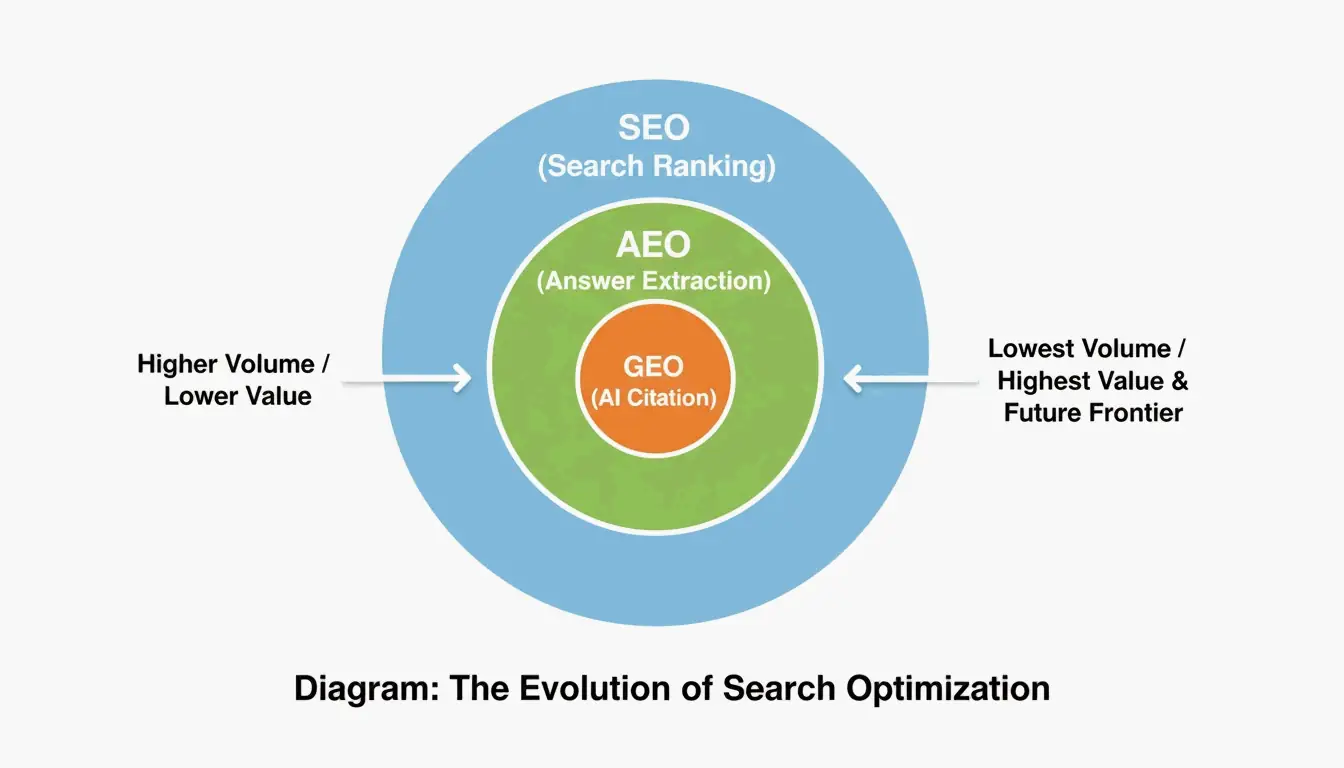
SEO drives organic clicks by ranking pages in search results. AEO (Answer Engine Optimization) targets direct answers in voice search, featured snippets, and AI overviews by optimizing for concise, extracted responses. GEO ensures your brand is cited by generative engines as a trusted source in synthesized answers.
For B2B services, GEO is the highest-value frontier because AI citations drive zero-click, high-intent brand exposure. A buyer who sees your brand cited in a ChatGPT response about your category has already received a trust signal before visiting your website.
Why GEO Is Your New Competitive Advantage in B2B
Traditional SEO focuses on page-level ranking signals—backlinks, keyword density, page speed. GEO focuses on passage-level extractability: content that is modular, self-contained, and readable out of context. For B2B service firms competing against large consultancies with established domain authority, GEO offers a faster path to visibility by prioritizing specificity and quotability over historical backlink accumulation.
Building Brand Narrative Architecture for GEO Success
Most GEO guides focus on technical signals like Schema Markup and content structure. Few address how cross-platform brand consistency affects AI trust. This is a critical gap.
Define your brand entity: who you are, what problem you solve, and whom you serve. Enforce this narrative consistently across your website, product content, LinkedIn, PR, and customer forums. AI models triangulate information from multiple sources. If your LinkedIn profile describes your offering one way, your website another, and a third-party review a third way, the AI may not connect those signals to your brand.
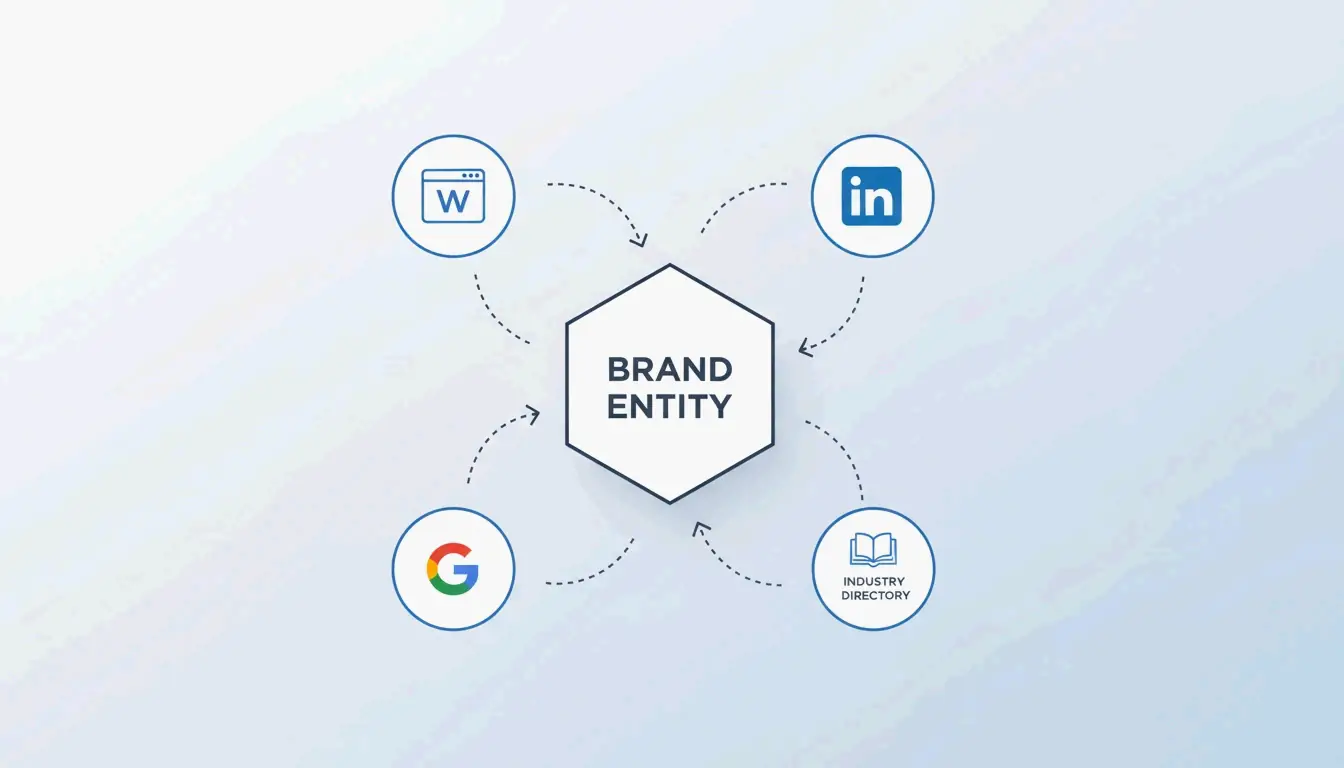
How to Enforce Consistent Brand Messaging Across All Channels
The Valasys Media guide highlights Salesforce’s transformation as a case study. Salesforce shifted from product-centric feature lists to a buyer-question-first approach, restructuring knowledge base content around intent-driven queries rather than technical specifications. This shift led to a measurable surge in organic answer placements because AI models prioritize direct, conversational mapping.
For your B2B service firm, this means auditing every surface where your brand appears—website copy, LinkedIn company page, executive bios, guest posts, analyst listings, review profiles—and ensuring they use the same category language, descriptor format, and value proposition.
The Role of Thought Leadership on LinkedIn in Building Proof Density
LinkedIn Articles are the second most cited domain by LLMs for thought leadership, appearing in 11% of AI-generated responses according to Semrush research. Long-form articles between 1,500 and 2,000 words account for 50-66% of all cited LinkedIn content, and 95% of cited content is original. Reshares almost never get cited by AI tools.
This means publishing original, keyword-aligned LinkedIn articles on a consistent cadence directly contributes to proof density—the volume and diversity of independent third-party sources mentioning your brand.
How to Measure GEO Success: Metrics, Tools, and Attribution
Traditional SEO metrics like keyword rankings and organic traffic only tell part of the story in an AI-centric landscape. GEO requires a different measurement framework.
The AI Visibility Metric Stack
Track these primary metrics:
- AI Citation Rate: How often your domain is a cited source across major AI engines. Tracked by tools like Profound, Otterly AI, and GrackerAI.
- Brand Mention Frequency: Brand presence in AI answers across ChatGPT, Perplexity, Google AI Overviews, and Copilot.
- Share of AI Answer: Your presence relative to competitors for core category queries.
- Zero-Click Search Share: Impressions without a click—brand exposure that influences buyers later in the journey.
A Practical Attribution Framework for GEO
Attribution is harder than tracking but possible with a structured approach. Set unique UTM parameters on AI-accessible content pages. Connect AI overview impressions to subsequent brand searches via Google Search Console and GA4. Use CRM first-touch modeling to validate whether AI-referred visitors from known AI IP ranges (ChatGPT, Perplexity, etc.) convert at higher rates than organic traffic.
The Fountain City case study showed that tracking per-engine divergence matters. Aggregate citation rates hide per-engine differences—the same keyword produced completely different citation leaders on different platforms. Track each engine separately to identify where specific content changes will have the most impact.
GEO for B2B Professional Services: A Specialized Approach
Unlike B2B SaaS, professional service firms—consulting, legal, HR, advisory—rely heavily on case studies, methodologies, and thought leadership for trust. AI engines that cite these firms need data-rich, quotable narratives, not feature lists.
Turning Case Studies into AI-Ready Assets
Optimize case studies as data-rich, quotable narratives. Each case study should start with a direct answer paragraph that states the problem, solution, and result in specific numbers. Structure it with clear H2 headings: The Challenge, The Approach, The Results. Include verifiable metrics—”Reduced client onboarding time by 40%” beats “improved efficiency significantly.”
Apply FAQ schema to any case study that includes common buyer questions. The methodology behind the result is often as important as the result itself for AI citation.
Why Personal Brand Authority Matters for Service Providers
AI engines cite expert profiles as trust signals. LinkedIn Articles are the second-highest cited domain by LLMs for thought leadership, according to Semrush research. For professional service providers, personal authority is a major trust signal.
Each executive should have an optimized LinkedIn profile with clear category language, published long-form articles on priority keywords, and a consistent posting cadence. The Obility thought leadership playbook notes that 75% of cited LinkedIn authors post five or more times per month. Occasional posters are rarely picked up.
Advanced Tactics: Winning on Perplexity and ChatGPT Search
Different AI engines have different retrieval mechanics and source preferences. Optimizing for “AI search” generically misses this per-engine divergence.
Optimizing for Perplexity
Perplexity favors direct, encyclopedic, well-cited content. Its citation behavior shows preferences for domain authority, content freshness, topical specificity, and clear citable claims. Use summaries, tables, and bullet-proof sources. Perplexity shows a strong freshness bias toward content published within the last 90 days.
Publish content that directly answers buyer questions at the consideration and decision stage. Keep technical SEO clean—fast load times, proper canonical tags, accessible HTML. Get your brand mentioned in technology review sites, analyst reports, and industry publications.
Optimizing for ChatGPT Search
ChatGPT Search focuses on natural language responses that match user query intent. Structure content in Q&A or FAQ formats. Write in direct, declarative sentences. LLMs prefer content that says “73% of enterprise software evaluations take more than 6 months” over content that hedges with “most evaluations take a long time.”
Cite data with named-source attribution. AI models treat linked, attributed statistics as higher-trust signals than anonymous claims. Use FAQ schema, definition blocks, and numbered steps to map to how generative models decompose queries.
Optimizing for Google AI Overviews
Google AI Overviews respond strongly to E-E-A-T signals (Experience, Expertise, Authoritativeness, Trustworthiness). Prioritize experience and original research. Content that already ranks well in traditional search is significantly more likely to be cited by AI Overviews, which draws directly from Google’s search index.
Ensure your robots.txt does not block Google’s AI crawlers. Update existing content regularly—freshness signals matter for time-sensitive queries. Implement Article, Organization, and Breadcrumb schema to help AI systems parse and contextualize your content.
Conclusion
Generative Engine Optimization is no longer optional for B2B services. Your brand’s presence in AI-generated answers directly influences buyer trust, research behavior, and conversion. The 30-day playbook in this guide provides a practical, repeatable framework: audit your current AI footprint, apply quick structural wins, publish original data assets, and set up per-engine tracking. Start today by running your top ten business queries through ChatGPT, Perplexity, and Google AI Overviews. The gap you find will reveal exactly where to begin.
Related reading: For industry-specific GEO strategies, see GEO for Agencies: How to Sell GEO as a Service.
FAQ
What is ‘Proof Density’ in GEO?
Proof Density refers to the concept that AI models reward brands with a high volume of mentions across multiple, independent online sources—blog posts, customer reviews, LinkedIn articles, and press releases. Single-channel strength is not enough; you must appear widely to be consistently recommended across AI engines.
How long does GEO typically take to show results?
In 5 weeks, the Fountain City case study saw a 60% relative improvement in citation rate from 20% to 32% of monitored keywords. Generally, initial changes appear in 4–8 weeks with consistent execution, but full brand proof density may take 3–6 months depending on starting authority and competitive landscape.
Should I optimize existing content first, or create new content specifically for AI?
Start with a quick audit of your 20 highest-traffic blog posts: add direct answers, formatted passages, and original data to make them quotable. Then create 2–3 dedicated pillar pieces per quarter built specifically for AI citation with structured data and expert quotes.
What if my buyers still use traditional Google search? Do I need to care about Perplexity?
Yes. B2B buyers increasingly use AI engines as a launchpad for initial research, which then influences their Google search keywords and brand recall. Overlooking Perplexity and ChatGPT Search means missing the top-of-funnel discovery channel that shapes consideration before Google is even opened.
Can I implement GEO myself, or do I need to hire an agency?
The 30-day plan in this playbook is designed for DIY execution using tools like GrackerAI or Otterly AI. For deep technical work—Schema Markup, data modeling, or large-scale content creation—an agency may accelerate results, but initial experiments with audits and structural improvements can be done in-house.

1 Comment
Pingback: GEO for SaaS: Complete Playbook – GEOWriter