


Generative Engine Optimization (GEO) is the strategic process of structuring digital content to improve brand visibility and citation frequency within AI-generated responses. Unlike traditional SEO, what is GEO focuses on making content authoritative and extractable so platforms like ChatGPT, Perplexity, and Google AI Overviews cite your brand as a primary source.
Contents
- 1 Why Generative Engine Optimization (GEO) is the New Search Frontier
- 2 GEO vs. Traditional SEO: Key Differences and Synergies
- 3 How to Optimize for AI Citations: The Content Extractability Framework
- 4 GEO Content Template: Before vs. After for AI Extraction
- 5 Measuring Success: Citation Frequency and Share of Voice
- 6 FAQ
- 7 Conclusion
Why Generative Engine Optimization (GEO) is the New Search Frontier
The search landscape has shifted from a “library of links” to an “engine of answers.” Users rarely want to browse ten blue links anymore; they want a synthesized response that solves their problem immediately. This evolution makes Generative Engine Optimization (GEO) a mandatory framework for any modern digital marketing strategy.
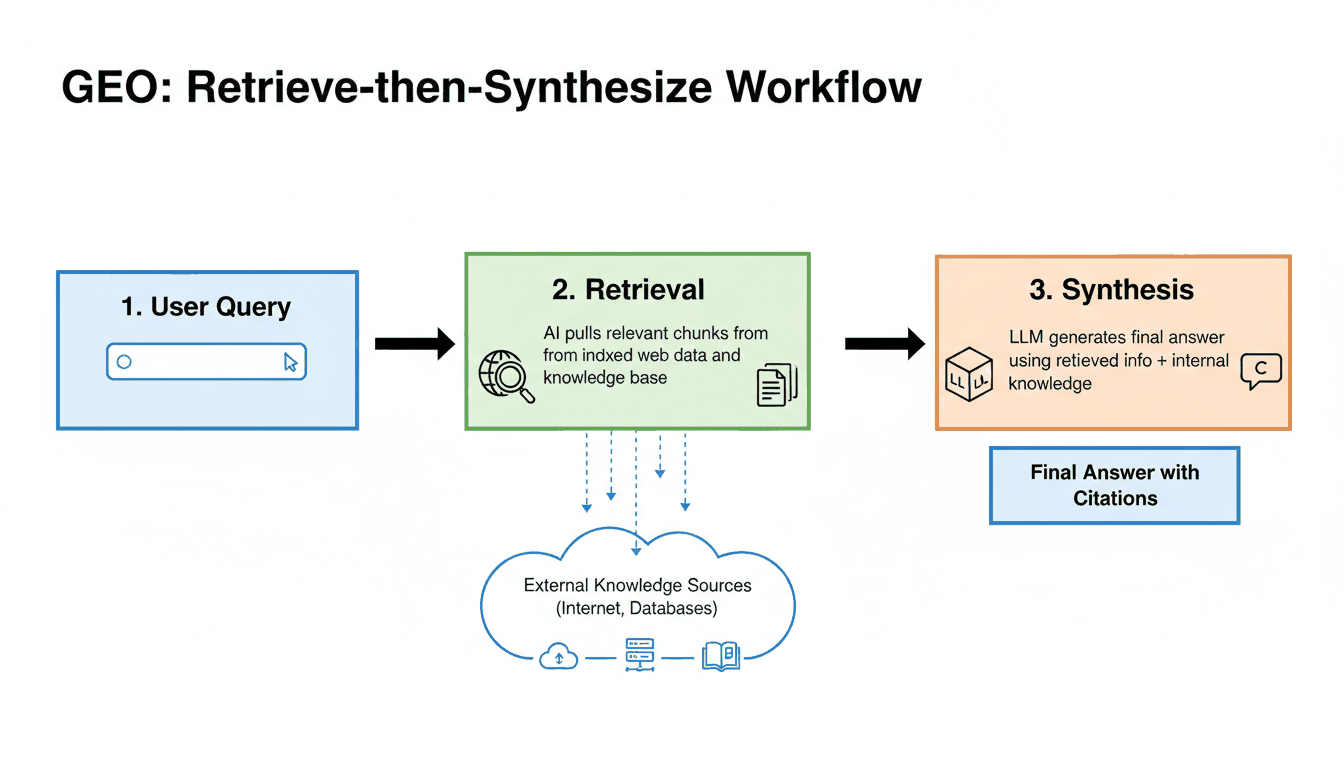
AI engines operate on a “Retrieve-then-Synthesize” workflow. They pull relevant documents from the web and then use Large Language Models (LLMs) to blend that information into a single, cohesive answer. If your content isn’t structured to be easily “retrieved” or “synthesized,” your brand effectively disappears from the conversation.
Data from Semrush shows that AI Overviews (AIO) now appear in 16% to 40% of all searches. In high-intent commercial queries, that number is even higher. This shift is re-engineering how people use the web, moving the goalpost from “ranking #1” to “being the cited authority.”
The Rise of Zero-Click Search and AI Citations
Zero-click searches are hitting record highs because AI engines provide the full answer directly on the result page. To survive, brands have to win AI Citations. Getting cited by a tool like Perplexity or ChatGPT acts as a “stamp of approval” that traditional backlinks just can’t match.
While total clicks to your website might drop, the quality of traffic coming from AI referrals is usually much higher. Early data suggests that users who click through from an AI citation are further down the funnel and ready to take action, leading to better conversion rates than standard organic search.
GEO vs. Traditional SEO: Key Differences and Synergies
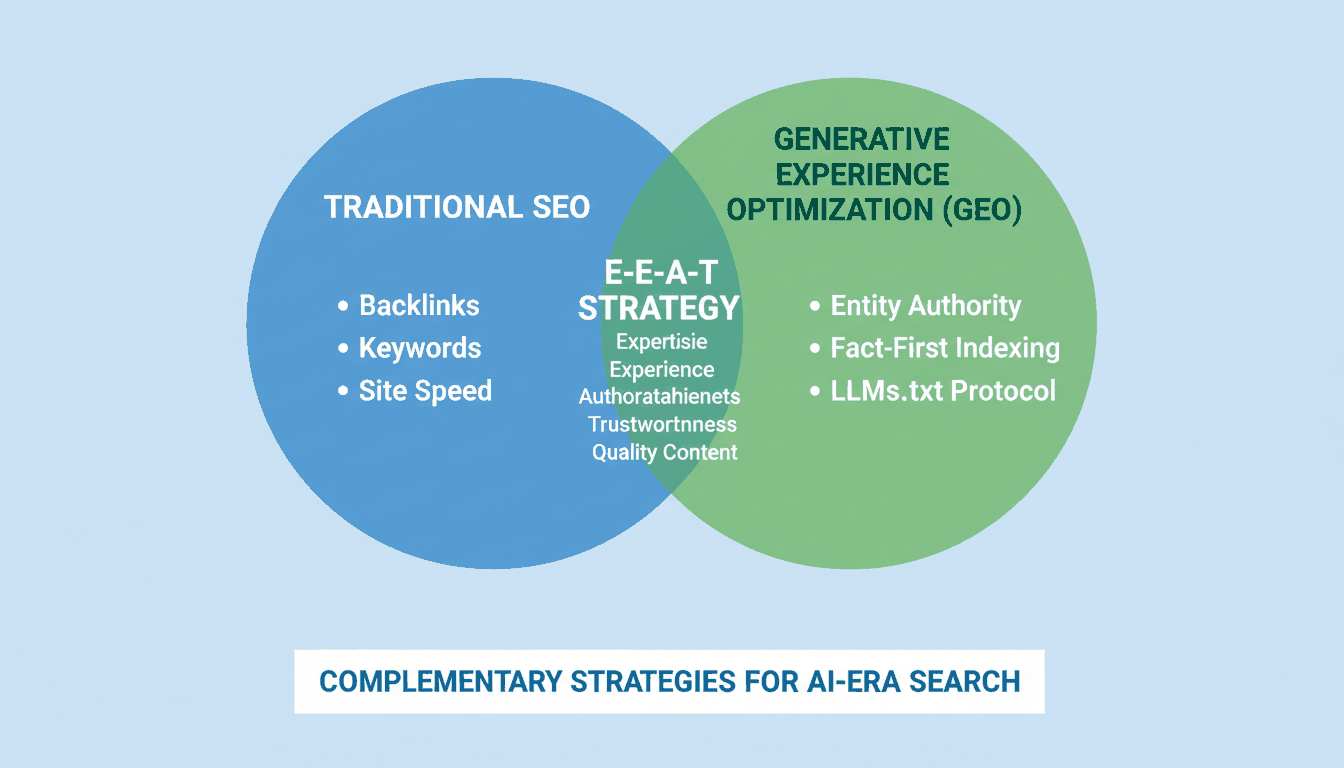
While traditional SEO relies on keywords and site architecture to rank in search results, GEO prioritizes Entity Clarity & Authority. In the AI era, search engines are trying to understand “entities”—people, places, brands, and things—and how they relate to one another.
The foundation for both remains E-E-A-T (Experience, Expertise, Authoritativeness, and Trustworthiness). AI engines are incredibly sensitive to these signals. If an LLM can’t verify your expertise through third-party mentions or clear internal signals, it will likely skip your content for a more “trusted” entity.
As John Mueller, Head of Google Search Spam, noted at Google Search Live in January 2026: “AI systems rely on search. There is no such thing as GEO or AEO without doing SEO fundamentals.”
From Keywords to Entities: Why Authority Matters
In the past, you could rank for “best coffee beans” just by optimizing for that specific string of text. Today, AI engines use Retrieval-Augmented Generation (RAG) to find the most authoritative entities in the coffee space. They cross-reference your site with Reddit discussions, YouTube reviews, and industry news.
To build Entity Clarity & Authority, your brand needs a consistent narrative across the web. Your “About Us” page, LinkedIn profile, and press mentions should all align to define exactly what your entity is and where your expertise lies.
How to Optimize for AI Citations: The Content Extractability Framework
To win in GEO, your content must be “extractable.” AI models break long-form content into smaller “chunks” or vectors. If your paragraphs are too long or rely on context from three pages back, the AI will struggle to use them.
Content Extractability comes down to creating modular, self-contained blocks of information. Each section should answer a specific question so clearly that it could stand alone as a snippet. A Princeton study found that adding statistics and citations led to a 115% increase in visibility for mid-tier websites.
Technical Implementation: JSON-LD and LLMs.txt
Technical GEO goes beyond site speed. You should use Schema Markup (JSON-LD) to explicitly define the relationships between your content and known entities. For example, FAQPage schema helps AI engines identify direct answers, while Organization schema reinforces your brand’s identity.
A newer standard is the LLMs.txt file. Much like robots.txt, this file provides a machine-readable directory for AI crawlers, helping them find your “source of truth” pages quickly without getting lost in low-value archives.
GEO Content Template: Before vs. After for AI Extraction
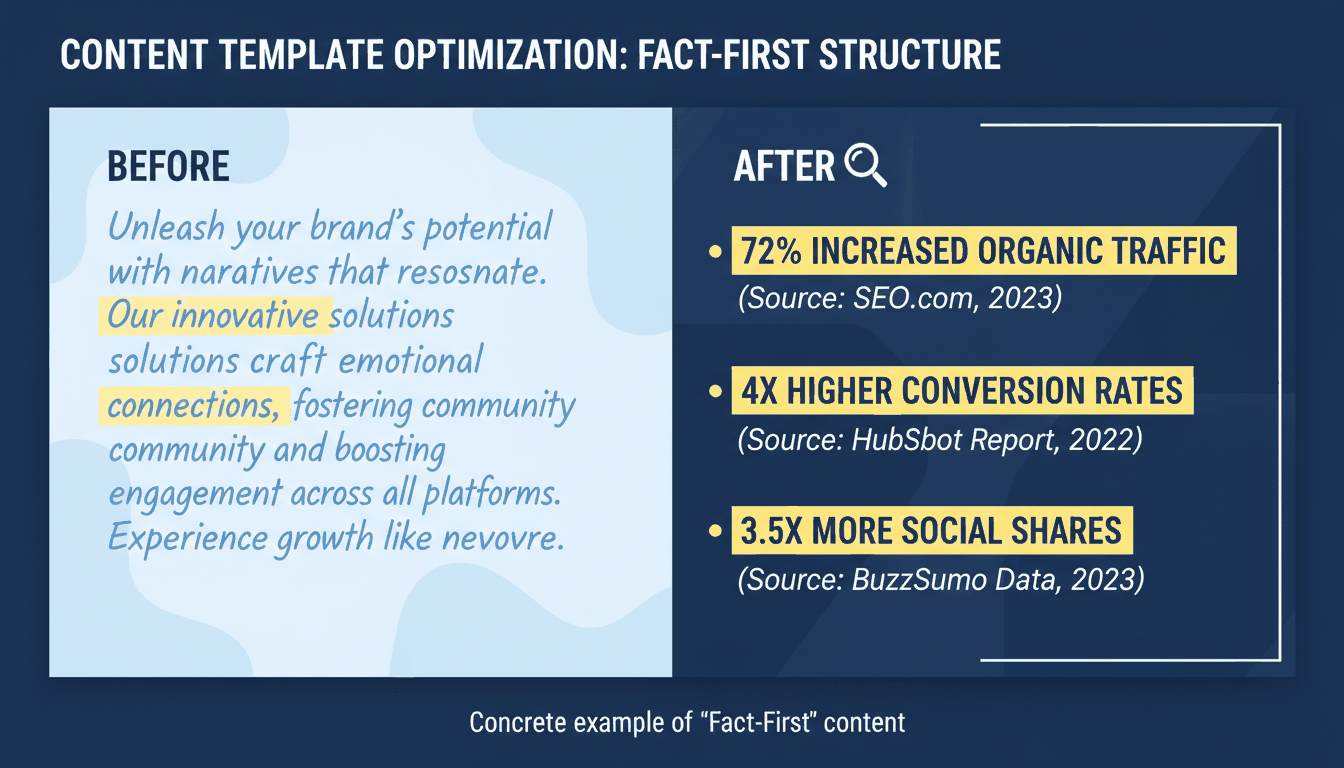
Content in 2026 needs a “Fact-First” structure. AI engines prioritize verifiable facts and direct answers over marketing fluff or long narrative build-ups.
According to Seer Interactive, 80% of AI-driven traffic goes to pages less than two years old. This makes content recency vital. If your data is stale, the generative engine will simply find a fresher source to cite.
The ‘Extractable Paragraph’ Checklist
To make your content AI-ready, check that every key paragraph hits these points:
- Direct Answer: Start with the main point or answer.
- Hard Data: Include a statistic or specific number to build credibility.
- Source Attribution: Reference a study or expert to anchor the claim.
- Self-Contained: Ensure the paragraph makes sense even without the heading.
Example Rewrite:
- Before (SEO Focus): “In this article, we’re going to look at why coffee is good for you and how it impacts your morning.”
- After (GEO Focus): “Coffee consumption reduces the risk of type 2 diabetes by 11% per cup, according to a recent Harvard study. This metabolic benefit is primarily driven by the high concentration of polyphenols and antioxidants found in Arabica beans.”
In the GEO era, we’re moving past “rankings” to track Citation Frequency and Share of Voice. These metrics show how often AI engines choose your brand as the preferred answer over your competitors.
Tally Forms is a great example of this. By focusing on clear documentation and a strong community presence, ChatGPT became their #1 referral source. It proves that smaller brands can dominate the AI landscape by being the most “useful” entity in their niche.
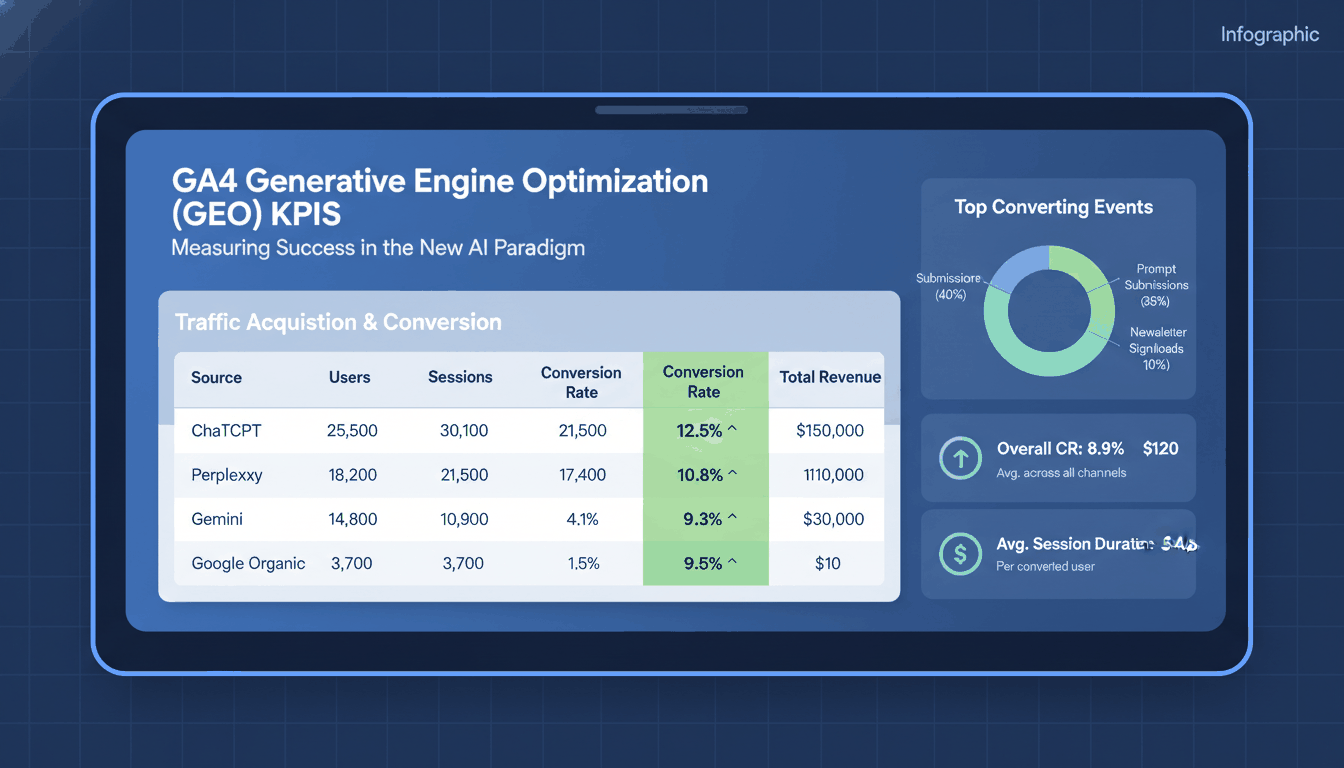
Setting up GA4 for AI Referral Tracking
To see your GEO impact in Google Analytics 4 (GA4), create a custom “AI Traffic” channel group. Keep an eye on referrals from:
chatgpt.com/ai.chatgpt.comperplexity.aigemini.google.comclaude.ai
FAQ
Is GEO replacing traditional SEO in 2026?
No, GEO is an evolution of SEO, not a replacement. Traditional SEO handles the foundational work of indexing and technical health, while GEO focuses on how that content is synthesized and cited within AI-generated responses. You cannot have effective AI visibility without a strong SEO base.
Which AI platforms are most important for GEO?
The “Big Three” remain the priority: ChatGPT (OpenAI), Perplexity AI, and Google AI Overviews (powered by Gemini). While ChatGPT has the largest user base, Perplexity is the leader in citation-heavy research, and Google AIO is the most integrated into daily web browsing.
Does adding statistics and citations really improve AI visibility?
Yes. Academic research, including the Princeton GEO study, confirms that AI engines prioritize verifiable facts. Adding unique statistics, citing reputable external sources, and including direct expert quotations can increase your content’s visibility in AI responses by up to 40%。
Can smaller brands compete with industry giants in AI search results?
Absolutely. GEO levels the playing field. Because AI engines look for the “best” answer rather than just the “biggest” site, smaller brands with high topical authority and niche expertise can often out-cite larger competitors. Tactics like semantic clustering can increase visibility for mid-tier sites by over 115%.
Conclusion
Generative Engine Optimization (GEO) is the pivot brands must make to stay visible in an AI-first world. By focusing on extractable content, entity authority, and citation-worthy data, you stop just “ranking” and start becoming the “source of truth” that AI engines rely on.
Your Next Steps:
- Audit for Extractability: Review your top 10 pages and rewrite key sections to be self-contained and fact-dense.
- Implement Advanced Schema: Make sure
FAQandOrganizationmarkup are live and accurate. - Track AI Referrals: Set up custom segments in GA4 to monitor traffic from ChatGPT and Perplexity today.
