


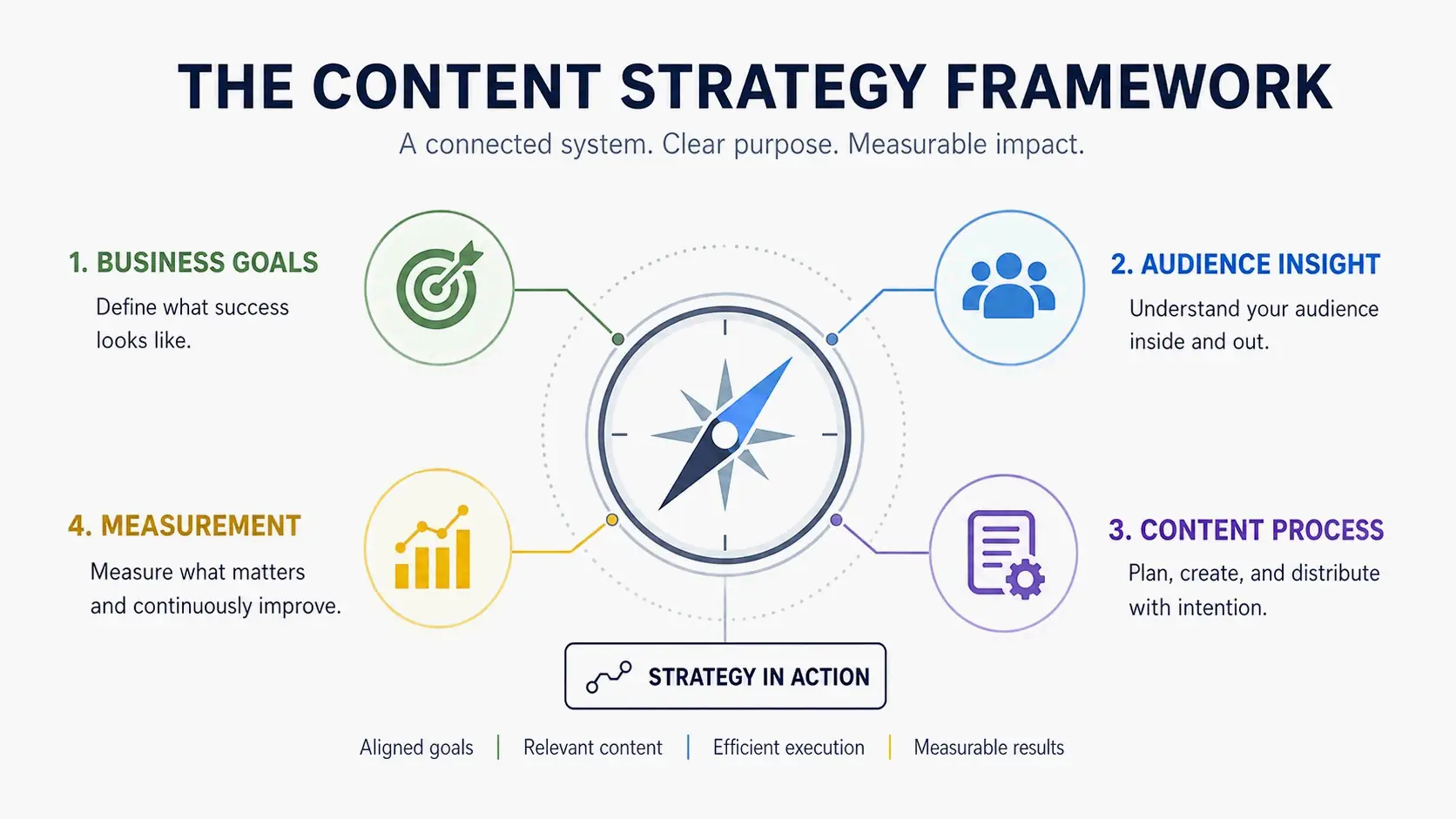
A content strategy framework is a documented system that connects business goals, audience needs, topic pillars, channels, and governance rules into a repeatable plan — so every piece of content earns its place and builds momentum, instead of being published on a whim.
Contents
- What a Content Strategy Framework Is (And What It Isn’t)
- Step 1: Anchor Everything to Business Goals and Audience Reality
- Step 2: Build Your Pillar-Cluster Model and Know What You Already Have
- Step 3: Design a Content Operations System That Ships, Not Stalls
- Step 4: Bake SEO, GEO, and AI-Search Rules into the Creation Brief
- Step 5: Set Governance Rules That Prevent Content from Decaying
- How to Measure If Your Content Strategy Framework Is Actually Working
- Adapting Your Framework for Your Team Size (Solo, Mid-Market, Enterprise)
- Conclusion
- FAQ
What a Content Strategy Framework Is (And What It Isn’t)
A content strategy framework is your ongoing decision-making system. It answers what to create, why you’re creating it, who it’s for, and how you’ll know it worked. It’s not a one-and-done document you file away. It’s an operating manual that weaves business goals, audience needs, content production, and lifecycle management into a repeatable process.
According to Max Benz, Founder and CEO of ContentForce AI, the framework usually covers four things: the business goals your content supports, the audience it’s for, the process you use to plan and produce it, and how you measure and maintain it over time. Nail those four, and the tactical questions — which blog post to write, which format, which channel — start answering themselves.
The real economic case for a framework is compounding. A search-ranking blog post or a shareable video keeps pulling in traffic long after a paid campaign stops. Without a framework, teams produce random content with no feedback loop tying published pieces to pipeline data. With one, you can trace every asset back to a business goal — not a gut feeling about what “seems useful.”
Having a documented framework matters — in numbers. The Content Marketing Institute found that marketers with a documented strategy are 3.5 times more likely to report success than those without. A written plan forces decisions instead of leaving them to whoever’s free that week and under deadline pressure.
Framework vs. Plan vs. Calendar: Where the Lines Blur
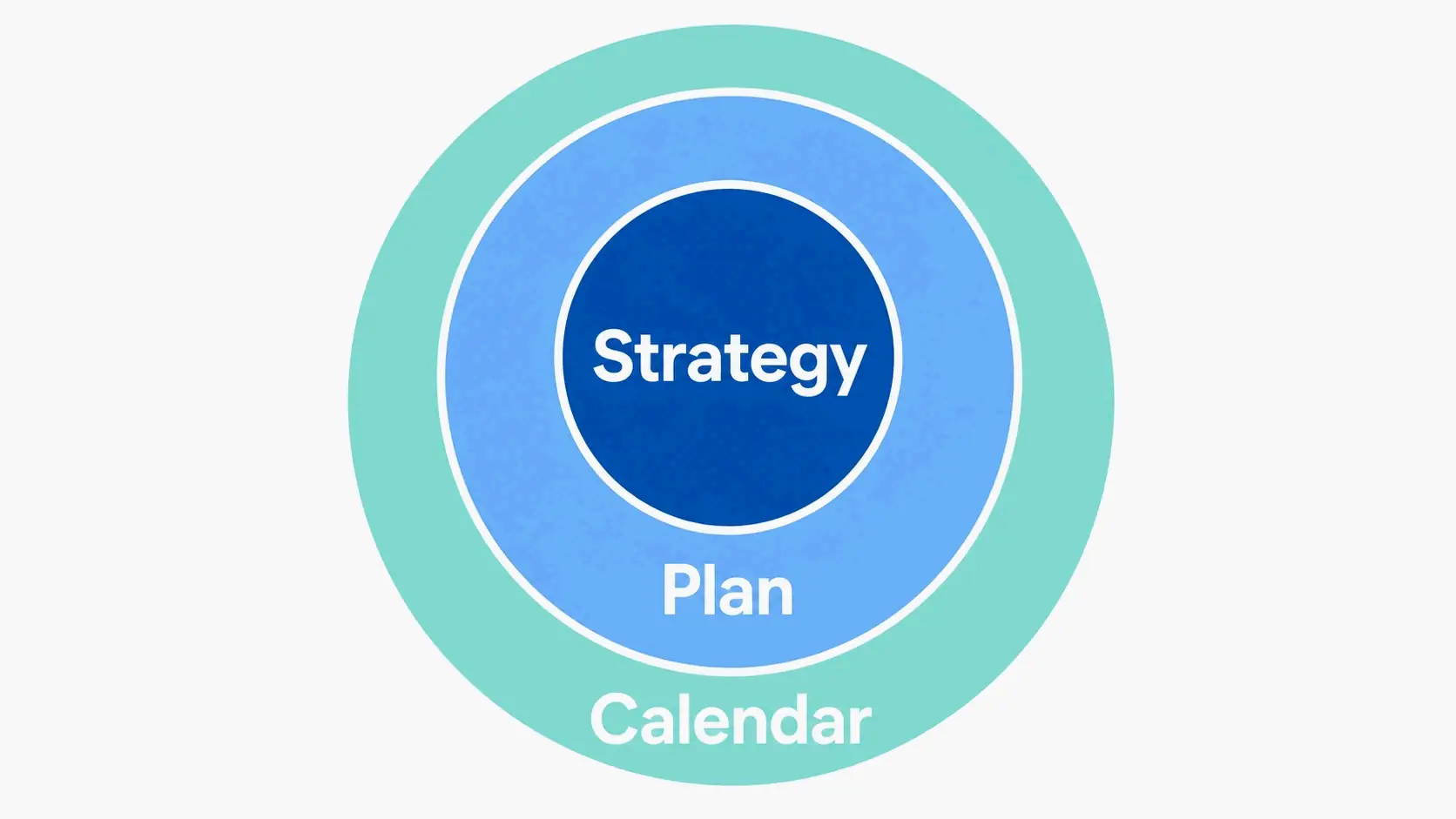
People often swap these three terms around, and that’s why many “content strategies” end up as little more than a list of blog topics. Your content strategy is the big-picture why and what. A content marketing plan is the mid-term how: the channels, formats, and campaigns you’ll use. An editorial calendar is the short-term when: the actual publishing schedule.
A standalone calendar is just a publishing schedule — no strategy behind it. A standalone plan is probably channel tactics with no tie to business goals. A real content strategy anchors both and should stay steady for a year or more. The plan and calendar, though, should shift as you learn what works.
Step 1: Anchor Everything to Business Goals and Audience Reality
Begin by linking content directly to a business outcome, not a vanity metric. Common goals: boost organic traffic to a specific product category, hit a target number of qualified leads per quarter, or cut support tickets on a recurring issue. Attach a measurable KPI to each goal — like organic sessions, conversion rate, or ticket volume — and capture your baseline before you start. That way, you’ll know if you’re moving the needle.
Now, the listening half: audience personas and buyer journey mapping. Create a working profile of who you’re writing for — their role, the problems they face, and the actual search queries they use when those problems hit. Source this from real data: sales call notes, support tickets, customer interviews. No guessing.
Map each content type to a funnel stage so it nudges audiences toward a decision, not just a pageview. Top-of-funnel (TOFU) content educates people who don’t yet know they have a problem. Middle-of-funnel (MOFU) — comparisons, how-to guides — helps those evaluating options. Bottom-of-funnel (BOFU) content — case studies, product comparisons — serves near-ready buyers. This mapping prevents the classic trap: plenty of TOFU blog posts but nothing that helps a buyer commit.
Use JTBD to Escape the Vanity Metrics Trap
The Jobs-to-be-Done (JTBD) framework is a practical way to focus content on real workflows and decisions, not just demographics. Instead of “who is our audience?”, ask “what job were they trying to get done when they started looking for a tool like ours?” The answers become your highest-priority topics.
HelloSign does this well with dedicated pages for “electronic signatures for real estate” and “e-signatures for HR onboarding.” Each page mirrors a specific ICP’s workflow, using their language and addressing their compliance requirements. The lesson: use-case content works because buyers see themselves in the product before a trial. Interview your best customers, pull answers from sales transcripts, and turn those pain points into content that converts.
Template: The Goal-Persona-Funnel Alignment Canvas
Create a simple three-column canvas. Column one: your primary business goal and its measurable KPI. Column two: your primary persona and their core JTBD. Column three: three content topics mapped to TOFU, MOFU, and BOFU that serve that persona’s job. This one-page tool keeps every piece of content you plan tied to a real business objective and a real buyer need.
Step 2: Build Your Pillar-Cluster Model and Know What You Already Have
Topic clusters are the SEO backbone. The idea is simple: one comprehensive pillar page covering a broad topic links out to a set of narrower cluster pages, each answering a specific related question in depth. This mirrors how readers research and how search engines judge whether a site has real depth — not just a single thin page.
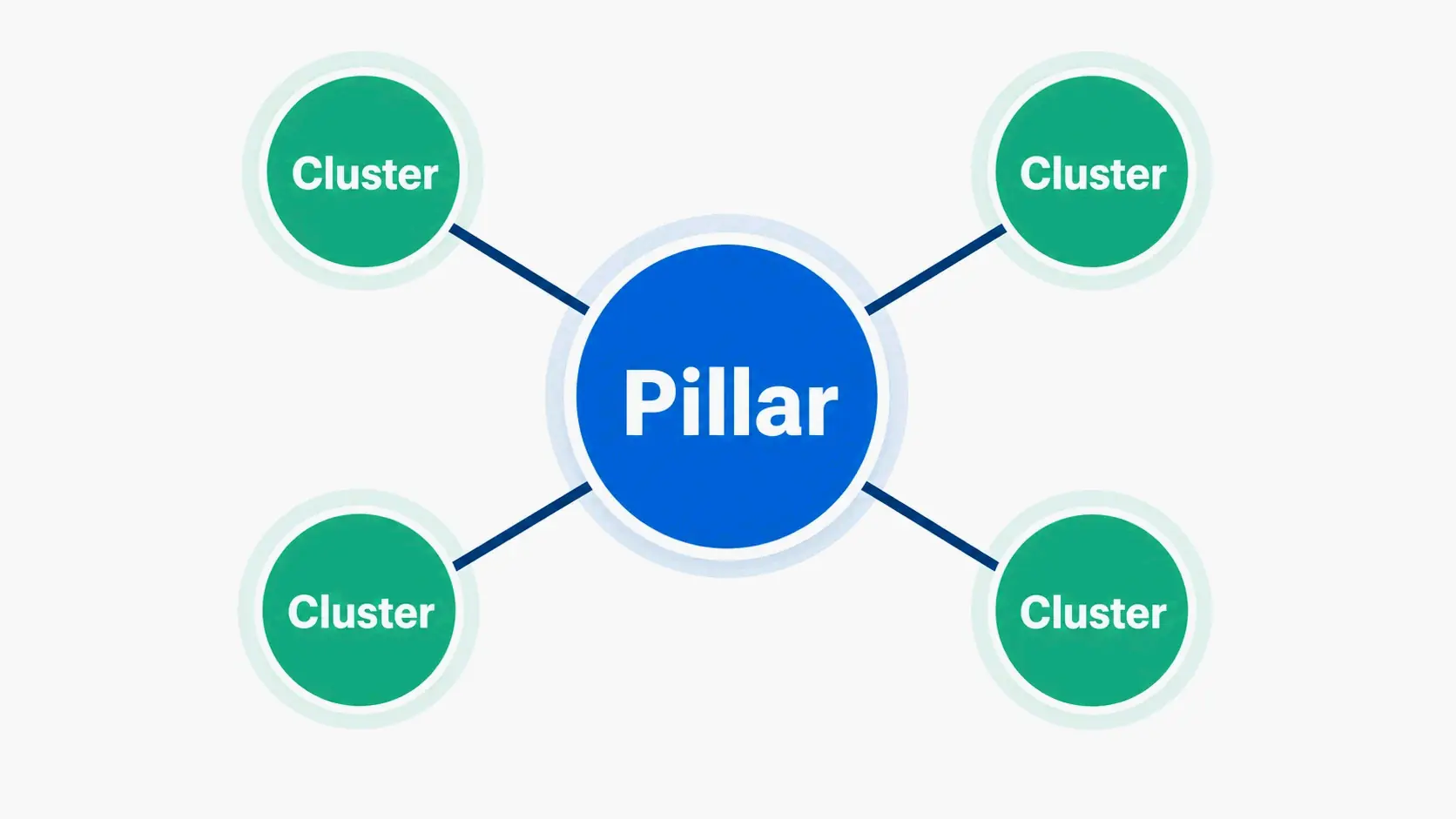
Align your cluster and pillar pages with the buyer journey, and your content can rank for a wide set of related searches — instead of fighting itself for the same keyword. Give each cluster a specific funnel stage: awareness, consideration, or decision, so your site delivers the right answer at the right time.
Before making anything new, do a content audit. Inventory every asset: blog posts, landing pages, help docs, case studies. Track the URL, content type, owner, last updated date, target keyword, current status, and performance data. This reveals gaps, outdated info, and repurposing chances — often more ROI than net-new content. Hidden winners often just need a refresh to rank again, and spotting them stops you from competing with your own pages for the same keyword.
A 30-Minute Content Audit That Reveals Quick Wins
Pull all URLs from your CMS and export 90-day performance data from Google Search Console. In a sheet, flag pages with declining clicks or no update in 12 months. Sort by pages still ranking on page one or two but slipping. Those are your quick wins. Pushing a page from position 8 to 3 gives way higher ROI than starting fresh. Focus on updating stats, adding new examples, and improving internal linking. In 30 minutes, you’ll often find the highest-impact work your team can do this month.
Step 3: Design a Content Operations System That Ships, Not Stalls
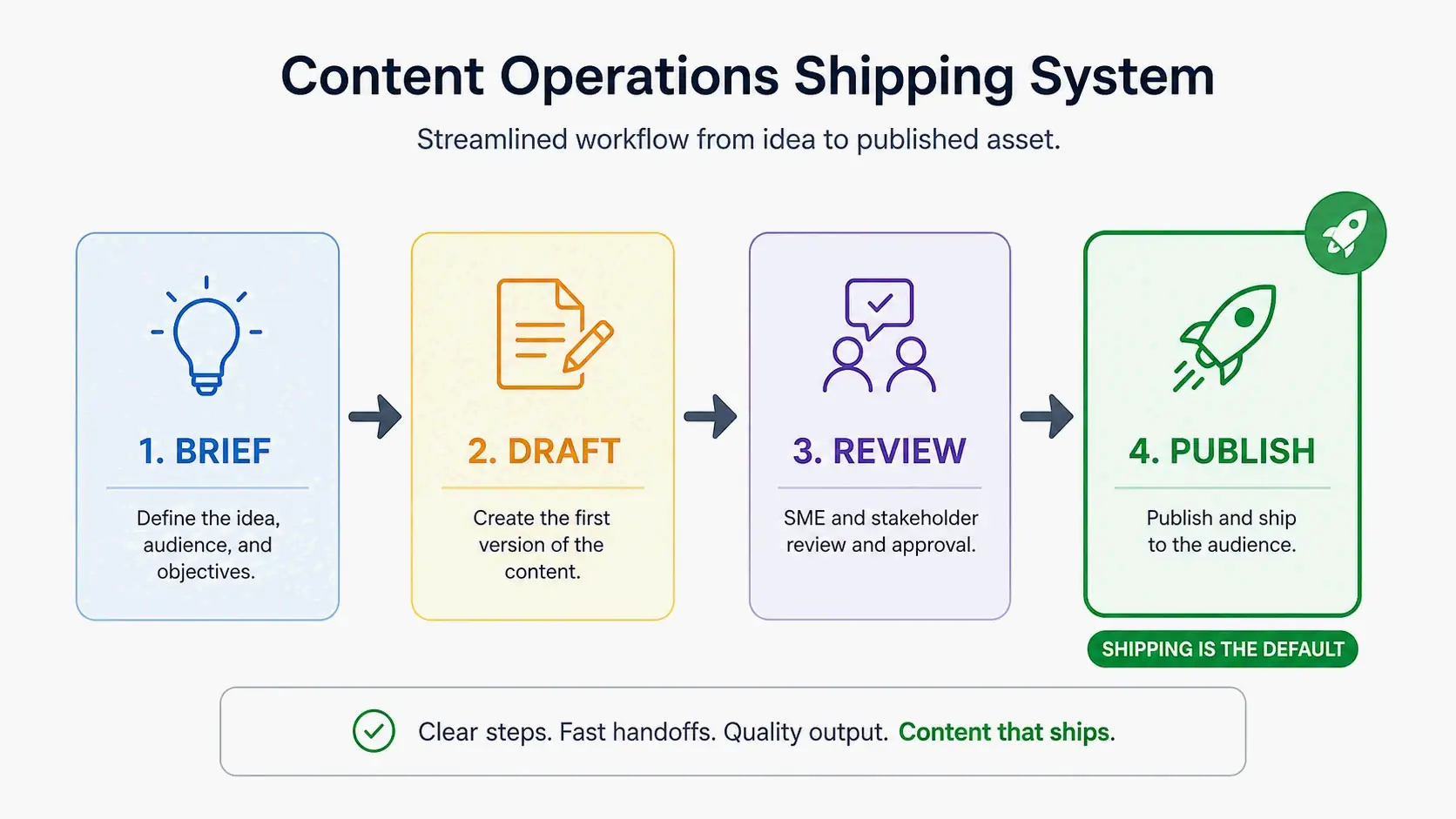
Content operations is the production engine: workflow, roles, tools, and a shipping cadence. Max Benz, Founder and CEO of getspike.ai, puts it plainly: “A SaaS content strategy is not a spreadsheet of topics mapped to funnel stages. It’s a shipping system with a prioritization engine.” The winning teams don’t have fancier strategy docs; they have better systems for moving content from idea to live asset on a steady rhythm.
The components are concrete. An editorial calendar assigns owners and publish dates before work begins. Briefing templates make sure every writer starts with the target keyword, persona, and the core question to answer. Review stages — editorial, SME, legal — have named owners and timelines. A distribution checklist triggers email, social, communities, and any paid promo before the content goes live.
Compare that to the “spreadsheet of ideas” method: in January, 40 topics are mapped to funnel stages. By March, four are published and 36 are stuck — waiting on SME input, blocked by design, or bumped for a product launch. A shipping system closes that execution gap by making “published” the default state, not “planned.”
Why E-E-A-T is an Ops Problem, Not a Writing Problem
People talk about E-E-A-T — Experience, Expertise, Authoritativeness, Trustworthiness — as a content quality issue, but it’s really an ops problem. Author bios, fact-checking processes, and original data aren’t optional writing extras; they’re operational requirements that must live in your production workflow. That means assigning a subject-matter reviewer for high-stakes pieces, having a documented fact-check before publishing, and building a system to generate and cite your own data — not just third-party stats. If your workflow doesn’t enforce these steps, they won’t happen consistently, and AI-driven search systems will push your content down.
Template: From Brief to Publish — A Shipping-Optimized Workflow
Lay out the exact path: Ideation → Approval → Creation → Editorial Review → SME Review → Publication → Monitoring → Maintenance. Ideation: author submits brief with keyword target. Approval: content lead checks against calendar. Creation: writer drafts following style guide. Editorial Review: editor checks voice, accuracy, SEO, links. SME Review if needed. Publication: publisher verifies formatting. Monitoring: SEO lead checks performance at 30, 60, 90 days. Maintenance: author updates quarterly. Every stage has a named owner and a defined action — nothing stalls waiting on an unclear handoff.
Step 4: Bake SEO, GEO, and AI-Search Rules into the Creation Brief
Traditional SEO is necessary but not enough anymore. In 2026, content competes in three places at once: classic search, social feeds, and AI answer engines like Google’s AI Overviews, ChatGPT, and Gemini. Your framework needs to be GEO-native — optimized for the generative engines that summarize and cite content above traditional results.
The practical adjustments are specific. Put a concise definition early in each section, before any background or caveats. Structure data for extraction: a specific, sourced number in a short sentence gets pulled into AI summaries more easily than the same stat buried in dense text. Use question-based H2s and H3s that mirror what people actually type. Give each section a fact-first TL;DR — a clean, self-contained answer an AI can lift and cite. And cite high-authority sources clearly; don’t hide attribution.
This ties directly to the buying journey. 6sense’s 2023 B2B Buyer Experience Report found that 84% of buyers said the first vendor they contacted won the business. Most actual decision-making happens during research, long before sales gets a call. Being that “first contacted vendor” increasingly means being the most useful, visible, and citable source in AI-generated research summaries. The content cited in an AI Overview wins the research phase.
Before/After: Re-engineering a Blog Brief for AI Overviews
Before (traditional brief): Target keyword: “content strategy framework.” Write a comprehensive guide covering definitions, steps, and best practices. Include the keyword in the H1, first paragraph, and one H2.
After (GEO-native brief): Target keyword: “content strategy framework.” Lead with a one-sentence definition an AI can lift whole. Use question-based H2s: “What does a content strategy framework include?”, “How do you build a content strategy framework?”, “How do you measure if a content strategy framework is working?” Place a specific statistic with a named source in the second sentence of each major section. Add an FAQ section with question-and-answer pairs matching real user queries. Add schema markup for FAQ and HowTo where applicable. The goal: rank, yes — but more importantly, be the source an AI Overview cites when it answers the question.
Step 5: Set Governance Rules That Prevent Content from Decaying
Content governance is the maintenance agreement for your framework: ownership, review cycles, freshness scoring, and retirement rules. It’s the policies, processes, roles, and standards that control how content is created, published, maintained, and retired across the organization. Without governance, operations depend on tribal knowledge — one person knows the brand voice, another the approval process — and when someone leaves, the system breaks.
Content decay quietly kills SEO. Old stats, broken links, outdated advice. Stacc reports that organizations with formal content governance see a 90% reduction in errors on published pages. That accuracy directly feeds the E-E-A-T signals Google uses to judge quality.
Content sunset — deliberately retiring or merging weak pages — matters just as much. Not every page deserves an update; some should go. A page with outdated stats, broken links, and bad advice actively hurts your site’s quality score. Your framework needs clear retirement rules: if a cluster page hasn’t driven a single conversion in two straight quarters, merge it into a stronger page or redirect it. Site quality isn’t just about creating good content; it’s about removing bad content.
Bad governance creates the attribution problem. Stacc found that 63% of marketers struggle to tie ROI to content. Ungoverned content skews the data: pages fight for the same keywords, stale assets cloud performance reports, and nobody can trace a closed deal back to the content that influenced it. Attribution trouble is often governance trouble in disguise.
A simple governance playbook has four parts: 1) Quarterly audits that check high-traffic, high-stakes pages for accuracy. 2) Ownership-by-persona: assign each persona’s content to a specific person accountable for accuracy and performance. 3) A RACI matrix for content decisions — who is Responsible, Accountable, Consulted, Informed for creation, review, publication, and retirement. 4) A standing rule: flag any content not updated in 12 months for review. These four rules stop the drift that turns a content library into a liability.
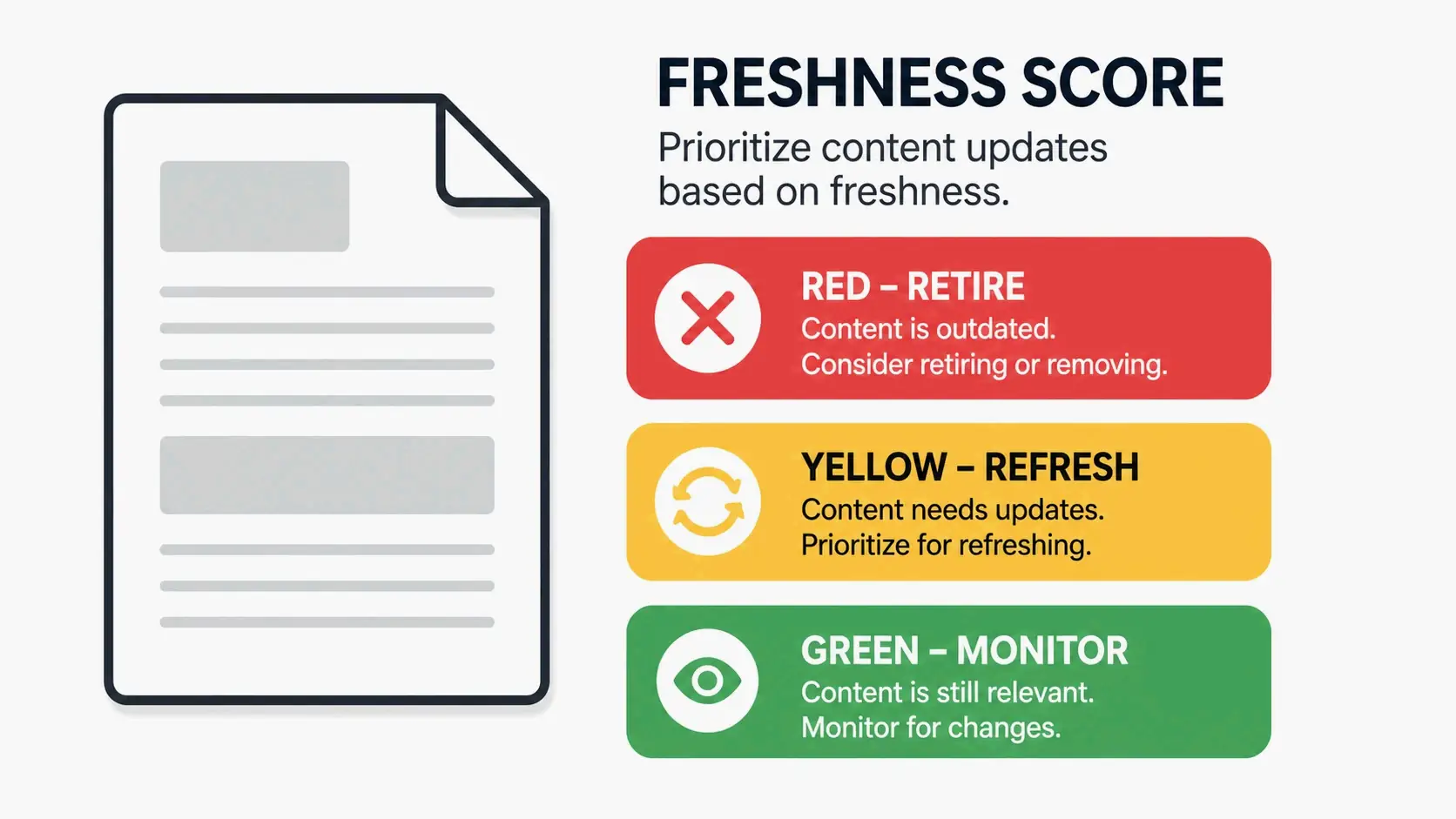
The Content Freshness Score: A Simple Method to Prioritize Updates
Score each page on three factors: traffic trend (declining, stable, growing), conversion rate (none, low, high), and time since last update (over 12 months, 6-12 months, under 6 months). Pages with declining traffic, zero conversions, and no update in over a year are retirement candidates. Pages with growing traffic, high conversions, and recent updates need only routine monitoring. Pages with stable-but-slipping traffic and moderate conversions are your priority refresh targets — a quick update can bring performance back fast.
How to Measure If Your Content Strategy Framework Is Actually Working
Move the measurement conversation from vanity metrics to funnel-stage KPIs and business-impact metrics. Tracking nothing but organic traffic mixes up awareness and revenue impact. A BOFU comparison page converting at 3–5% is worth far more than a TOFU blog post converting at 0.1%, even if the post gets ten times the traffic. The biggest leverage shift a content team can make is going from traffic metrics to pipeline metrics.
Define KPIs per stage: Awareness — branded search volume, organic impressions, new users. Consideration — engaged sessions, time on page, newsletter signups, return visits. Decision — demo requests, conversion rate, trial signups, pipeline influenced. Tie each KPI to the goal from Step 1.
The measurement loop turns your framework into a closed system for continuous improvement. Goals from Step 1 shape the content planned in Steps 2–4, which is governed in Step 5. Measurement data feeds back to the goals, showing what worked and what didn’t. The next planning cycle adjusts. Without this loop, you’re guessing. With it, you have defined KPIs to check on a set schedule.
Push for a content contribution model that reports alongside sales, not just last-click attribution. Last-click always undervalues content because a blog post is rarely the final touch before a demo request. A prospect reads three articles, gets a tip in a Slack community, Googles your brand, and books a demo. Last-click credits “branded search,” ignoring everything that did the real work. Influence-weighted models, or even a simple “How did you first hear about us?” field on demo forms, reveal content’s true impact far better than a broken attribution model ever could.
Adapting Your Framework for Your Team Size (Solo, Mid-Market, Enterprise)
Not every team can run a full-blown framework. The core principles — goal alignment, audience focus, shipping cadence, governance — apply at any size, but the execution has to match your headcount and maturity. What most framework guides miss: a three-person team can’t run the same playbook as a 30-person org.
Solo or small team (1–3 people): Go ruthlessly lean. Focus on one hero-pillar cluster instead of trying to cover the whole funnel. Use a 60/40 creation-to-distribution split: 60% effort on making content, 40% on getting it seen — this prevents “publish and pray.” Ruthless prioritization is a must. Use a simple business-value-vs-difficulty matrix to pick the four pieces you’ll ship each month from a backlog of 50. The question isn’t “what would be nice to create?” It’s “what will drive the most pipeline with the resources we have?”
Mid-market SaaS (10–50 people): Introduce formal but lightweight governance. Form a product marketing + content operations duo: product marketing owns audience and positioning, content operations owns the shipping system. Focus on use-case and integration content that catches buyers during active evaluation. One high-impact move: a comparison page like Ahrefs’ “Ahrefs vs Semrush.” It ranks for a high-intent keyword and drives trials because it honestly acknowledges competitor strengths before pivoting to where Ahrefs excels. That honest positioning builds trust and conversions better than a one-sided pitch.
Enterprise: You need full-scale governance councils, mature lifecycle management, and E-E-A-T enforcement across a large author network. A governance board with reps from content, SEO, legal, and brand maintains standards as volume scales to hundreds or thousands of pieces. Integration with demand-gen KPIs is critical — content is measured not just on its own performance but on its contribution to pipeline and revenue, alongside paid and sales. Key docs at this stage: a RACI matrix for content decisions, an AI-usage policy that mandates SME review on AI drafts, and formal retirement policies to prevent site quality erosion.
Documented frameworks matter at every size. The CMI stat — 3.5x more likely to succeed — counts for a solo marketer with a two-pager or an enterprise with a 40-page governance manual. A written plan forces decisions instead of leaving them to chance.
The Framework Adaptation Matrix: A One-Page Decision Tool
Map your team on two axes: headcount (1–3, 4–10, 10–50, 50+) and content maturity (just starting, consistent publishing, scaling, optimizing). A solo just starting needs one pillar cluster, a weekly shipping cadence, and a Google Sheet for governance. A mid-market team publishing consistently adds formal briefs, a documented review process, and quarterly audits. An enterprise optimizing for scale adds a governance board, multi-channel distribution playbooks, and AI-usage policies. Pick your starting point based on where you are, not where you wish you were. A framework you can run today beats a perfect one you’ll launch next quarter.
Conclusion
A content strategy framework turns content from a cost center into the backbone of your buyer’s research journey — but only if it’s a documented, governed system, not a pile of random acts. Start with the smallest version that builds momentum: a 30-minute audit for quick wins, and a single-page goal-to-persona-to-pillar canvas from Steps 1 and 2. Don’t wait for the perfect framework. Ship an 80% version, measure what happens, and iterate within your governance rules starting next week. The framework compounds when you use it — not when you finish designing it.
FAQ
How does a content strategy framework differ from an editorial calendar?
An editorial calendar is just a publishing schedule: what goes out and when. A framework is the whole operating system. It defines the why through business goals, the for whom through personas, the what through topic clusters, the how through operations and governance, and the was-it-worth-it through measurement. The calendar is one output of the framework, not the framework itself.
Can a small team run a full content strategy framework without extra headcount?
Yes, but only if you stay ruthlessly lean. Take the core principles — goal alignment, customer research, shipping cadence — but apply them to a much smaller content footprint. Prioritize one hero-pillar cluster and a tight distribution loop instead of trying to cover the whole funnel. Three pieces a month, shipped on time, beats six formats that never launch.
Should AI-generated content be governed inside a content strategy framework?
Absolutely. An AI-usage policy is a must-have governance layer. Your framework should define where AI drafts get reviewed by SMEs, how you’ll validate E-E-A-T signals, and where AI must never replace original human experience or proprietary data. Rule of thumb: if an AI-generated draft could apply to any company in your space, it’s not ready to publish.
How do I measure whether my content strategy framework is actually working?
Stop judging content performance with one number. Tie your KPIs back to the goals from Step 1. If your goal is pipeline, track demo requests and opportunity influence, not just traffic. A working framework shows a repeatable link between content activity and business outcomes over 6–9 months. If you can’t trace a closed deal back to the content that influenced it, your measurement loop is broken.
